AI agents for equipment aftermarket requests: prepare compatible parts proposals
From a customer photo and asset label, the Genie prepares a review packet with the resolved serial, supported replacement, stock context and the questions still open.
- Author
- Ignacio Malpartida · GTM Engineer
- Published
- Read time
- 4 min read
The operating decision
An equipment aftermarket Genie should gather the machine identity, installed configuration, approved part references and available commercial context before preparing a parts proposal. It can reduce the searching and copying between service, CRM and ERP records. Keep compatibility, warranty eligibility and pricing approval explicit. A proposed part should carry evidence, and uncertain serials or supersession chains should go to service engineering rather than becoming a confident but unsupported replacement recommendation.
Explore the complete industrial equipment and machinery integration and automation hub for the systems and processes around this guide.
What this looks like in industrial equipment and machinery
An equipment manufacturer receives a customer email with a photograph of a worn component and a local asset number. The service desk must identify the machine, check whether it was retrofitted, locate an approved replacement and ask order management about availability. A Genie can gather those records and prepare a review packet. The customer-facing response should state only what the evidence supports: a confirmed compatible part when approved, or a precise request for missing identification when the machine cannot yet be resolved.
Records, ownership, and update rules
| Record | Owner | Operating rule |
|---|---|---|
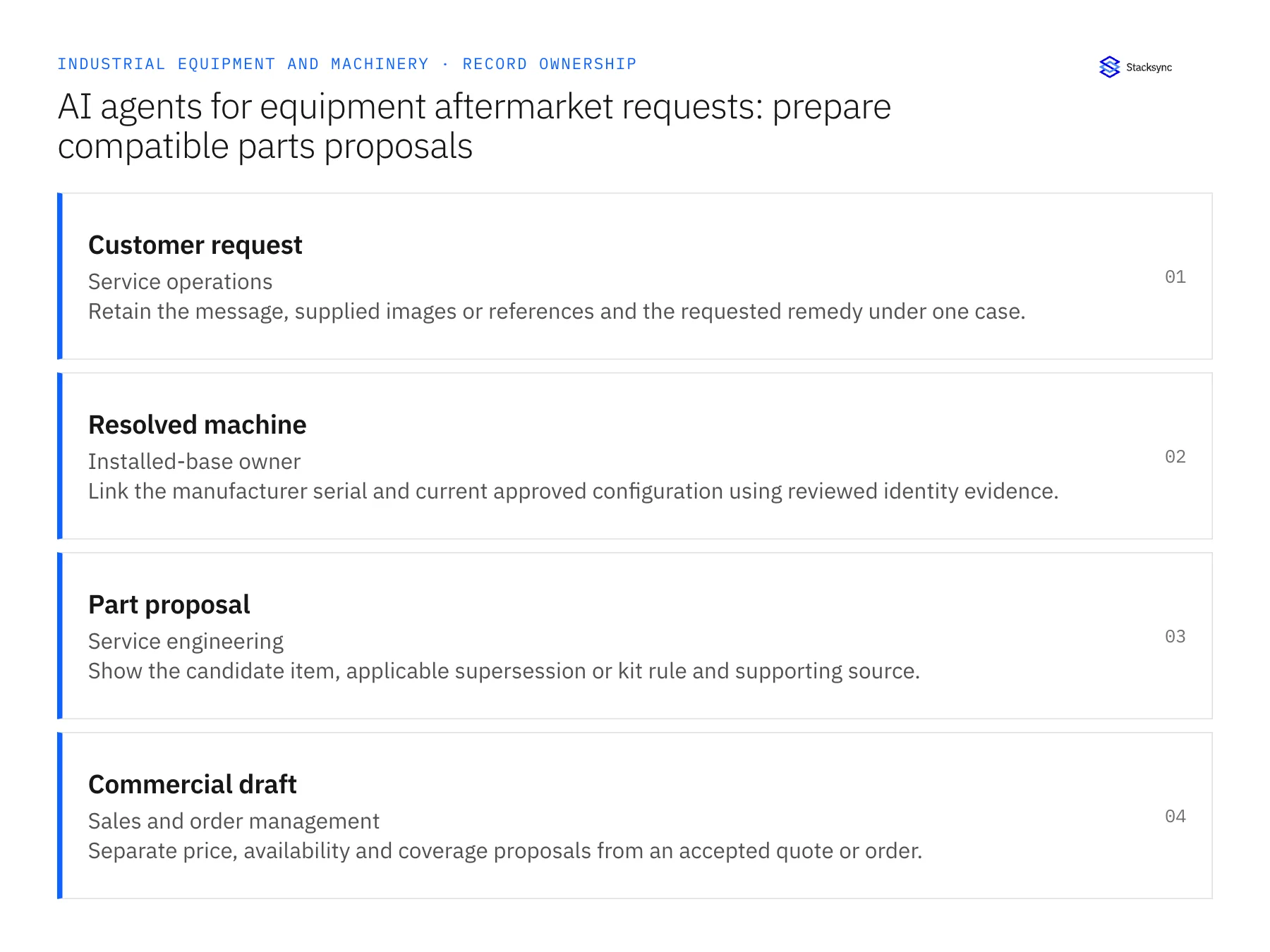
| Customer request | Service operations | Retain the message, supplied images or references and the requested remedy under one case. |
| Resolved machine | Installed-base owner | Link the manufacturer serial and current approved configuration using reviewed identity evidence. |
| Part proposal | Service engineering | Show the candidate item, applicable supersession or kit rule and supporting source. |
| Commercial draft | Sales and order management | Separate price, availability and coverage proposals from an accepted quote or order. |
Work through the process
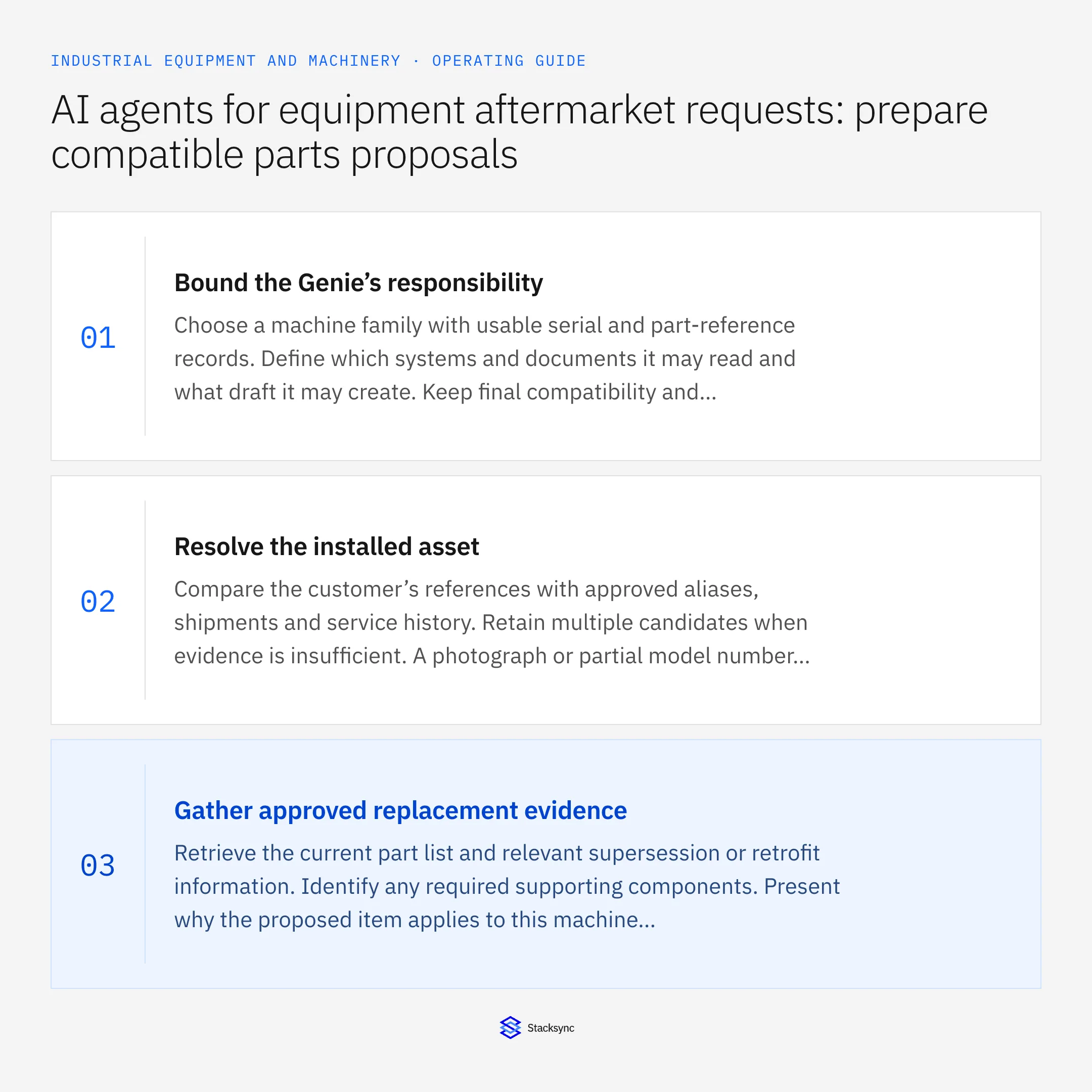
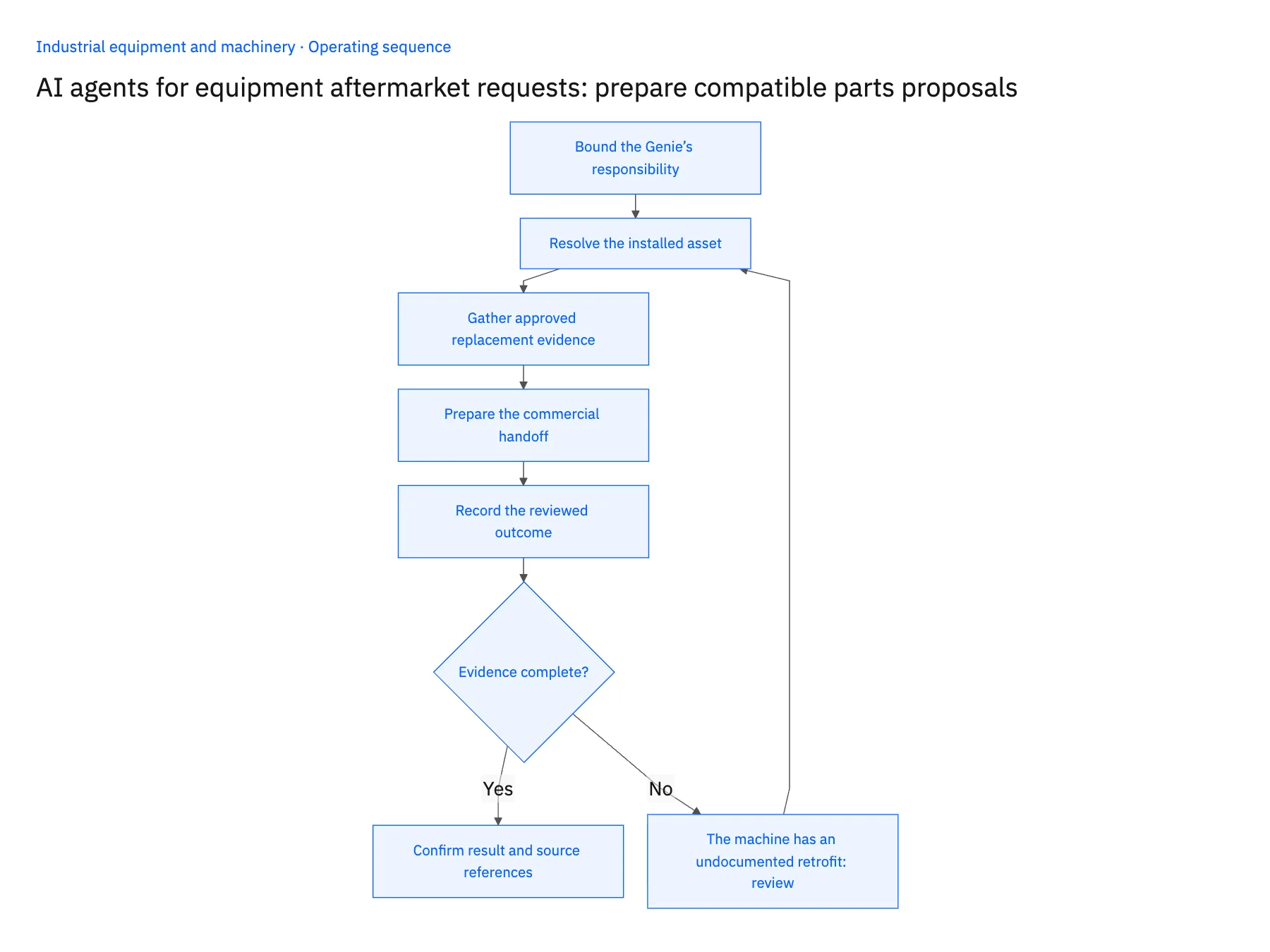
- 01Bound the Genie’s responsibilityChoose a machine family with usable serial and part-reference records. Define which systems and documents it may read and what draft it may create. Keep final compatibility and commercial approval assigned to the people who own those decisions.
- 02Resolve the installed assetCompare the customer’s references with approved aliases, shipments and service history. Retain multiple candidates when evidence is insufficient. A photograph or partial model number can help investigation, but it should not silently select a serial-specific configuration.
- 03Gather approved replacement evidenceRetrieve the current part list and relevant supersession or retrofit information. Identify any required supporting components. Present why the proposed item applies to this machine and show gaps when the history does not establish that conclusion.
- 04Prepare the commercial handoffCheck existing requests, open quotes and replacement orders before starting another draft. Show available stock and requested delivery as sourced context, subject to operational acceptance. Route warranty questions and nonstandard terms to the responsible owner.
- 05Record the reviewed outcomeSave the approved proposal version and resulting quote or order reference where a verified operation supports it. If the case needs clarification, keep the specific question and owner visible. The Genie’s completed search is not the same as a completed customer order.
Handle the exceptions explicitly
The machine has an undocumented retrofit
Ask service engineering to establish the current configuration before finalizing compatibility.
The requested item has a successor
Present the approved supersession conditions and any required kit components. Do not assume every successor is a drop-in replacement.
An existing quote covers the same request
Link the new message to that quote and route any changes for review instead of preparing another independent transaction.
What to verify before expanding
- The proposal identifies the machine evidence supporting its part selection.
- Approved supersession conditions remain visible in the review packet.
- A repeated request links to the existing commercial case.
- Unknown configuration or coverage remains an explicit unresolved condition.

Connect this process to the rest of your operation
Explore Stacksync AI agents (Genies) and scope the records and actions against your actual systems. Book a demo with a real customer request example and the exception your team handles most often, for example the machine has an undocumented retrofit.
- AI agents for equipment aftermarket parts requests
- Equipment parts AI exceptions: serial ambiguity, supersession and incomplete kits
- Equipment EDI orders: preserve distributor kits, service lines and partial shipments
- Equipment manufacturers: connect Salesforce configurations to NetSuite orders
- Human-in-the-Loop Automation: When to Escalate a Workflow to a Person
- Bi-Directional Sync for Salesforce and Beyond: Ensuring Operational Efficiency
The shared architecture guide covers record matching, ownership, and recovery across systems.
Technical references
FAQ
Frequently asked questions










Explore these integrations and topics
Related articles