







Resolve the installed context
Gather serial, shipment and approved modification evidence while preserving uncertain identity matches.
 Salesforce
  HubSpot
  NetSuite
  Zendesk
  Microsoft Dynamics 365 Sales
  Dynamics 365 F&O
  Attio
Attio  Pipedrive
  Zoho CRM
  Campfire
  Rillet
  Front
Front  Shopify
  Amazon Seller Central
  SendGrid
 Industrial equipment and machinery
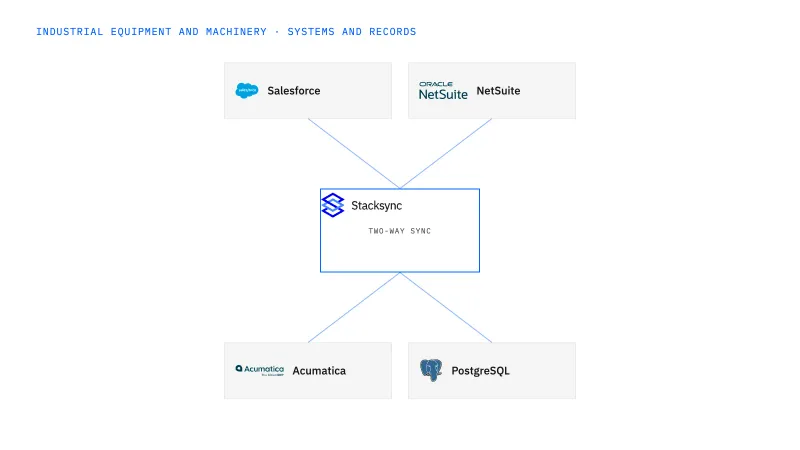
Use a Genie to assemble the machine history, approved part references and commercial context behind an aftermarket request. Stacksync fits equipment builders whose service teams spend time searching several systems before they can prepare a compatible parts proposal. The Genie prepares evidence; service engineering and commercial owners approve the consequential decisions.
A customer sends a photo or asset label, and the team must reconstruct the installed configuration before it can responsibly recommend a replacement.
Explore your process in a demo, or get our shared two-way sync architecture guide.
When this fits
COOs, service directors and IT leaders at US equipment builders with 100–1,000 employees and a mix of manufacturing, distribution and service.
Gather serial, shipment and approved modification evidence while preserving uncertain identity matches.
Show the applicable replacement or kit rule and required companion components.
Warranty, pricing and delivery acceptance remain separately owned; unresolved questions do not disappear inside a generated answer.
The process, end to end
an aftermarket leader wants a reviewer to receive one packet containing the resolved serial, retrofit history, supported replacement and open questions. Evaluate a transferred machine and a conditional supersession rather than only a simple catalog lookup.
Scope your implementation
Review current platform pricing alongside the records, volume, and actions in your process. Use your own operating baseline to evaluate the economics.
Explore your process in a demo, or get our shared two-way sync architecture guide.
From foundation to action
Keep shared customer, order, and operational records aligned, with clear field ownership.
Explore two-way sync 02Move approved work between systems, assign exceptions, and confirm the result.
Explore workflows 03Investigate cross-system questions, assemble the evidence, and prepare the next action.
Explore ai agents (genies) 04Connect trading-partner documents to operational records and exception handling.
Explore ediGo deeper
From a customer photo and asset label, the Genie prepares a review packet with the resolved serial, supported replacement, stock context and the questions still open.
A plausible active SKU is not a compatible part; these exceptions show which serial, retrofit or kit fact is missing before service engineering can sign off.
Explore all industrial equipment and machinery integration and automation guides ↗
Images can assist investigation, but the accepted proposal should follow the manufacturer’s identification and compatibility process.
It keeps the candidates open instead of picking one. When a photo or local asset label matches more than one serial, or the retrofit history is incomplete, the packet lists each candidate, the evidence that separates them and the specific nameplate or shipment reference that would settle it. The service reviewer decides whether to ask the customer or accept a match. No replacement is proposed as compatible until the installed configuration is established.
Measure reviewer search and clarification effort, proposal corrections and completed accepted handoffs, including the cost of reviewing Genie output.
Two-way sync goes in first, so Salesforce, NetSuite and Postgres agree on the serial and installed configuration behind the resolved machine, part proposal and commercial draft. Workflows come next when a warranty replacement handoff needs coverage and compatibility matched with named owners. Then the Genie reads those records, assembles the evidence into a review packet and prepares the next action, while service engineering approves the part and commercial owners approve price and coverage. EDI is a separate transport for distributor purchase orders with kits and partial shipments.


