Amazon–NetSuite Sync for Household Consumables: Reconcile Marketplace Order Quantities
Four three-packs sold on Amazon land in NetSuite as four marketplace units and twelve pouches, with the conversion on record for the return or fee adjustment that comes later.
- Author
- Ruben Burdin · Founder & CEO
- Published
- Read time
- 5 min read

The operating decision
Preserve both Amazon order quantity and the number of physical household units in the seller’s offer. A marketplace unit may represent a multipack, case, or refill bundle. Match the seller-scoped offer to an approved ERP pack definition before calculating physical quantities or reconciling later returns.
Explore the complete household consumables integration and automation hub for the systems and processes around this guide.
What this looks like in household consumables
A household brand sells a three-pack of refills on Amazon while its ERP stocks individual pouches. An order quantity of four represents twelve pouches. A finance import that records four individual pouches can still carry the correct gross amount, hiding the physical mismatch until fulfillment or return reconciliation.
Records, ownership, and update rules
| Record | Owner | Operating rule |
|---|---|---|
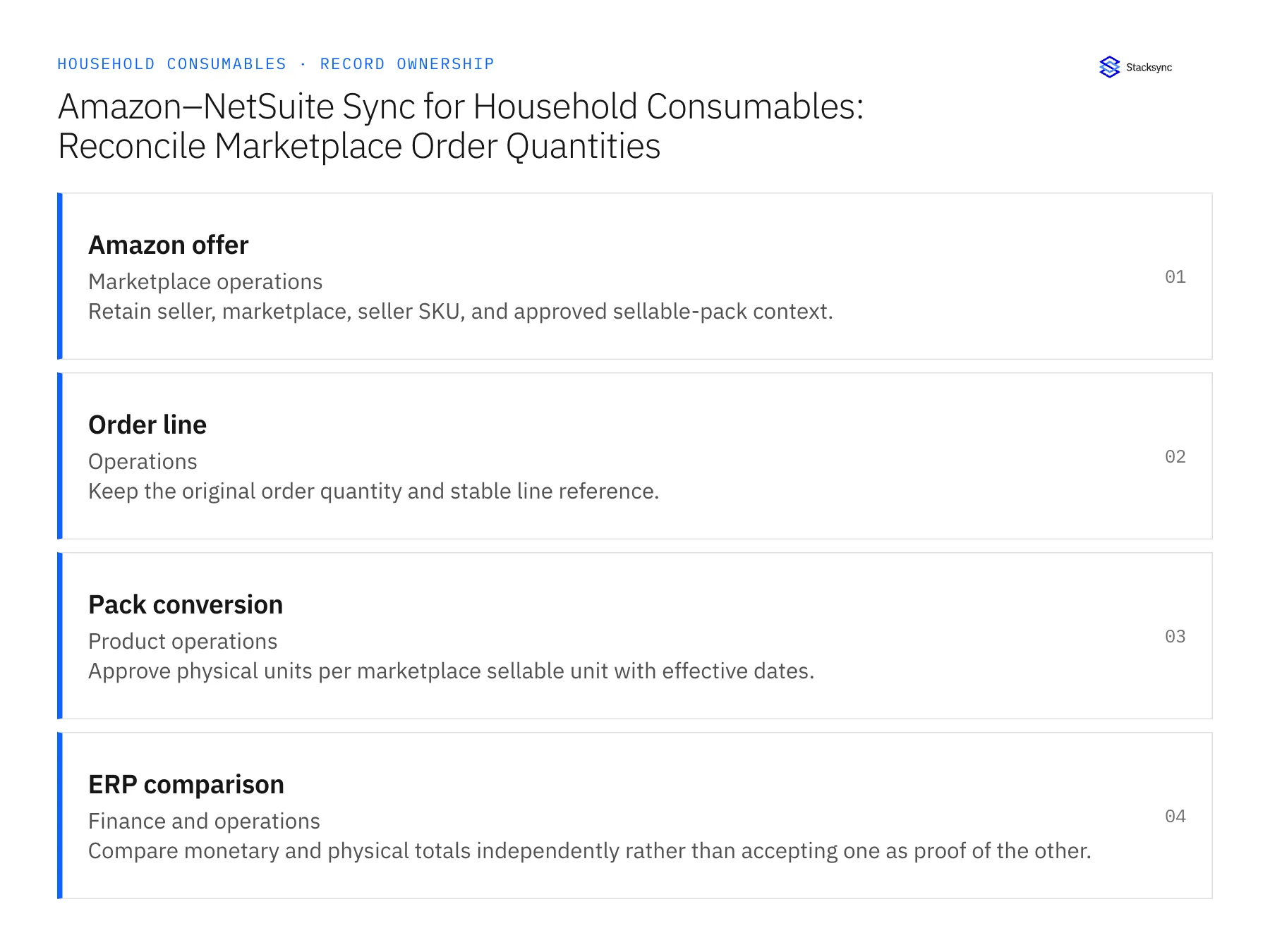
| Amazon offer | Marketplace operations | Retain seller, marketplace, seller SKU, and approved sellable-pack context. |
| Order line | Operations | Keep the original order quantity and stable line reference. |
| Pack conversion | Product operations | Approve physical units per marketplace sellable unit with effective dates. |
| ERP comparison | Finance and operations | Compare monetary and physical totals independently rather than accepting one as proof of the other. |
Work through the process
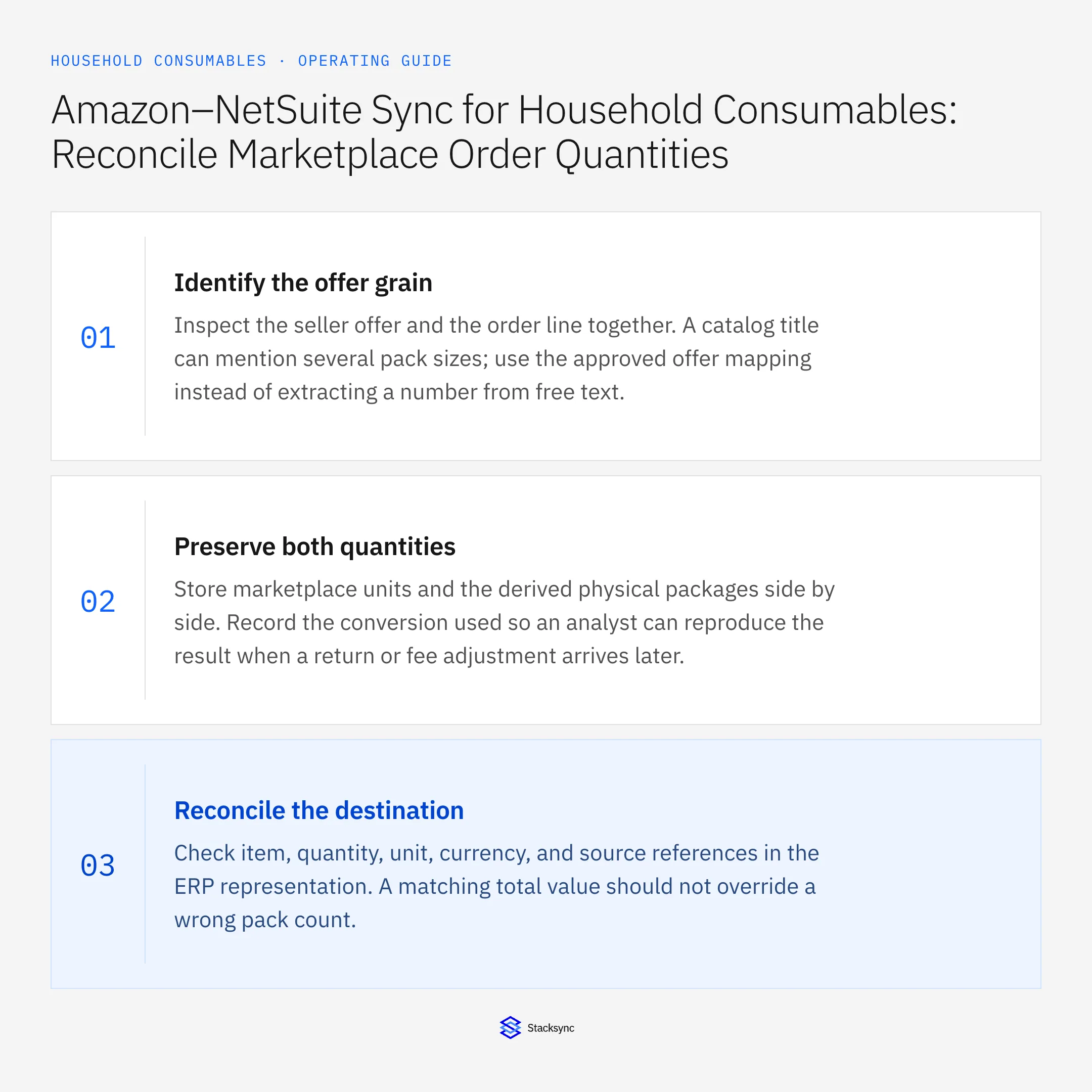
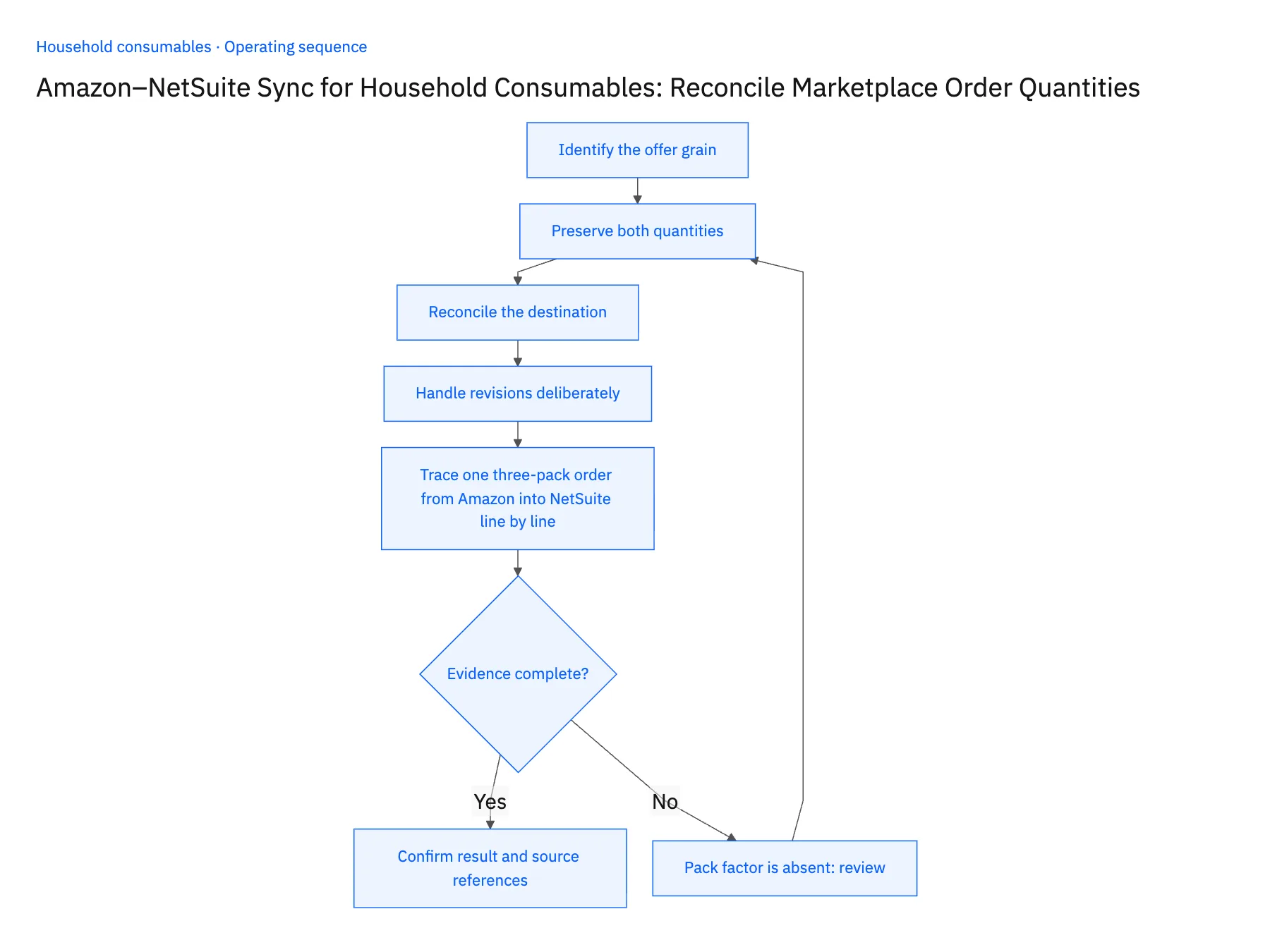
- 01Identify the offer grainInspect the seller offer and the order line together. A catalog title can mention several pack sizes; use the approved offer mapping instead of extracting a number from free text.
- 02Preserve both quantitiesStore marketplace units and the derived physical packages side by side. Record the conversion used so an analyst can reproduce the result when a return or fee adjustment arrives later.
- 03Reconcile the destinationCheck item, quantity, unit, currency, and source references in the ERP representation. A matching total value should not override a wrong pack count.
- 04Handle revisions deliberatelyVersion pack changes and keep historical mappings available. A seller SKU reused for a new multipack must not reinterpret orders placed under the old configuration.
- 05Trace one three-pack order from Amazon into NetSuite line by linePick an Amazon order for four units of the three-pack refill offer and follow it into NetSuite. The imported line should carry a quantity of four marketplace units, a derived physical count of twelve pouches, and the conversion record that produced twelve, including its effective date. Then pick a second order for a seller SKU whose pack factor is unapproved. That line should show an unreconciled physical quantity with a request open to product operations, even when the order total matches the ERP amount to the cent. A twelve that appears with no conversion reference, or a physical count filled in for the unmapped SKU, stops the rollout.
Handle the exceptions explicitly
Pack factor is absent
Hold physical reconciliation and request the approved offer definition.
Return quantity uses another unit
Preserve the source unit and normalize only with a confirmed relationship.
Overlapping import repeats the order
Resolve to the original order and line identities without creating a second accepted transaction.
What to verify before expanding
- Four three-packs remain four marketplace units and twelve physical packages.
- Each derived quantity records its approved conversion.
- A missing pack factor leaves physical quantities unreconciled even when marketplace and ERP monetary totals agree.
- A return expressed in another unit remains in its original unit until the approved offer-specific conversion is confirmed.

Connect this process to the rest of your operation
Explore Stacksync two-way sync and scope the records and actions against your actual systems. Book a demo with a real amazon offer example and the exception your team handles most often, for example pack factor is absent.
- Shopify–NetSuite Integration for Household Consumable Brands
- Amazon–NetSuite Integration for Household Marketplace Quantities
- Salesforce–NetSuite Sync for Household Brands Serving Janitorial Distributors
- Household Product Replenishment Workflows: Prevent Duplicate Wholesale Orders
- Household Product Return Workflows: Route Damaged and Unsellable Goods for Review
- How to Sync Zendesk with Salesforce: A Two-Way Integration Guide
- Beat Shopify API Rate Limits with Stacksync Real‑Time Sync
The shared architecture guide covers record matching, ownership, and recovery across systems.
Technical references
FAQ
Frequently asked questions










Related articles