







Preserve both quantities
Keep the marketplace order count and approved physical-unit calculation visible together.
 Salesforce
  HubSpot
  NetSuite
  Zendesk
  Microsoft Dynamics 365 Sales
  Dynamics 365 F&O
  Attio
Attio  Pipedrive
  Zoho CRM
  Campfire
  Rillet
  Front
Front  Shopify
  Amazon Seller Central
  SendGrid
 Household consumables
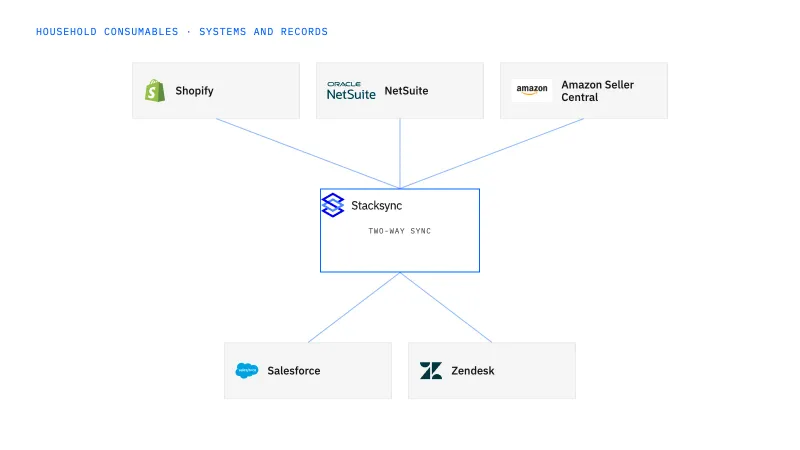
Connect household marketplace evidence to the right ERP pack and physical quantity. This fits brands selling multipacks or cases where an Amazon order unit represents several internal units. Keep seller, marketplace, offer, and order-line identity intact while importing data through Amazon’s read-only sync access.
Finance totals look correct while order units and physical packages disagree across marketplace and ERP records.
Explore your process in a demo, or get our shared two-way sync architecture guide.
When this fits
Cleaning, paper, refill, and household-consumable brands combining manufacturing, marketplaces, DTC, and wholesale distribution.
Keep the marketplace order count and approved physical-unit calculation visible together.
Use seller-scoped SKU and effective pack definitions rather than extracting a number from a product title.
Stacksync reads Amazon Seller Central; nothing is written back. Order lines and seller-scoped offer context flow into NetSuite for reconciliation, but a listing correction, order cancellation, or marketplace refund stays a separate action taken in Amazon by someone with that authorization. Product operations keeps ownership of the pack conversion, and NetSuite writes are limited to the objects you scope.
The process, end to end
A brand sells three-packs of refill pouches through Amazon and stocks individual pouches in the ERP. A demo should show that four marketplace units represent twelve physical pouches, with the conversion and original order line retained for later returns and reconciliation.
Scope your implementation
Review current platform pricing alongside the records, volume, and actions in your process. Use your own operating baseline to evaluate the economics.
Explore your process in a demo, or get our shared two-way sync architecture guide.
From foundation to action
Keep shared customer, order, and operational records aligned, with clear field ownership.
Explore two-way sync 02Move approved work between systems, assign exceptions, and confirm the result.
Explore workflows 03Investigate cross-system questions, assemble the evidence, and prepare the next action.
Explore ai agents (genies) 04Connect trading-partner documents to operational records and exception handling.
Explore ediGo deeper
Two refills ordered on Shopify stay two concentrate packages in NetSuite, and a starter kit keeps its approved bottle and refill components through fulfillment and returns.
Four three-packs sold on Amazon land in NetSuite as four marketplace units and twelve pouches, with the conversion on record for the return or fee adjustment that comes later.
Janitorial distributors stay the paying customer in NetSuite while Salesforce tracks the schools and offices they serve, so no facility turns into an accidental billing account.
Explore all household consumables integration and automation guides ↗
No. Monetary totals and physical quantities can agree independently. Validate the product, unit, and pack relationship as well.
The return keeps its original unit until the offer-specific conversion is confirmed. If the Amazon order was four three-packs and the return is reported in pouches, the pouch count stays a pouch count beside the four marketplace units instead of being collapsed into either one. Product operations supplies the effective factor with its date; finance and operations then compare monetary and physical totals as two separate checks. Amazon access is read-only, so any marketplace refund is handled in Seller Central by an authorized person.
Yes. Start with two-way sync so Amazon Seller Central order lines and seller-scoped offers land in NetSuite with both the marketplace unit and the approved physical count, while writes stay on the NetSuite side. Workflows come next when a replenishment or damaged-return decision needs a case, an approver, and a read-back of the ERP result. Genies follow when a claimed shortage on multipacks or cases needs ordered, shipped, and claimed quantities compared with the effective pack factor. EDI belongs to distributor purchase orders, not marketplace data.


