







Keep physical identity clear
Map stable variants to approved ERP items and separate usage claims from stock and order quantities.
 Salesforce
  HubSpot
  NetSuite
  Zendesk
  Microsoft Dynamics 365 Sales
  Dynamics 365 F&O
  Attio
Attio  Pipedrive
  Zoho CRM
  Campfire
  Rillet
  Front
Front  Shopify
  Amazon Seller Central
  SendGrid
 Household consumables
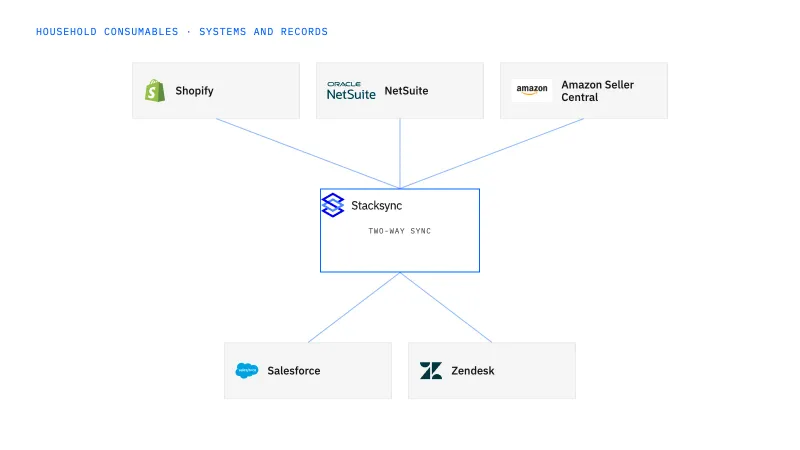
Connect household ecommerce purchases to the actual refill, concentrate, multipack, or kit represented in NetSuite. This fits brands combining DTC and wholesale when teams repeatedly translate marketing-oriented product descriptions into physical operational quantities. Preserve the sold package and approved components before adding downstream automation.
Refill yield, package count, and case quantity become interchangeable in order and return records.
Explore your process in a demo, or get our shared two-way sync architecture guide.
When this fits
Cleaning, paper, refill, and household-consumable brands combining manufacturing, marketplaces, DTC, and wholesale distribution.
Map stable variants to approved ERP items and separate usage claims from stock and order quantities.
Retain the purchased recipe and effective package definitions for fulfillment and return reconciliation.
Ecommerce owns the Shopify variant a customer purchased; product operations owns the ERP item it maps to. Two-way sync covers Shopify product variants, orders, and customers, with writes scoped to the objects and fields you select. Inventory levels and fulfillment are separate actions to confirm. A revised container size or concentrate strength changes the mapping after product-owner review, not through a storefront edit.
The process, end to end
A cleaning brand sells ready-to-use bottles, concentrate refills, and starter kits online. The ERP stocks the physical items, while the storefront emphasizes usage benefits. A focused demo should show that two refills remain two actual packages and that a kit retains its bottle and refill components.
Scope your implementation
Review current platform pricing alongside the records, volume, and actions in your process. Use your own operating baseline to evaluate the economics.
Explore your process in a demo, or get our shared two-way sync architecture guide.
From foundation to action
Keep shared customer, order, and operational records aligned, with clear field ownership.
Explore two-way sync 02Move approved work between systems, assign exceptions, and confirm the result.
Explore workflows 03Investigate cross-system questions, assemble the evidence, and prepare the next action.
Explore ai agents (genies) 04Connect trading-partner documents to operational records and exception handling.
Explore ediGo deeper
Two refills ordered on Shopify stay two concentrate packages in NetSuite, and a starter kit keeps its approved bottle and refill components through fulfillment and returns.
Four three-packs sold on Amazon land in NetSuite as four marketplace units and twelve pouches, with the conversion on record for the return or fee adjustment that comes later.
Janitorial distributors stay the paying customer in NetSuite while Salesforce tracks the schools and offices they serve, so no facility turns into an accidental billing account.
Explore all household consumables integration and automation guides ↗
No. Operations needs the actual purchased product and package. Similar yield does not establish equivalent physical goods.
The customer buys one kit line in Shopify, and that purchased line is what reaches NetSuite. Your product team's versioned kit recipe defines the bottle and refill inside it, so the breakdown counts each component once and never doubles a bottle ordered on its own. If a component is swapped, the original purchase keeps its recipe and the substitution is recorded as a separate approved fulfillment decision. A demo order with a kit, a lone refill, and a bottle together shows whether that holds.
Begin with two-way sync between Shopify and NetSuite so the purchased variant, the approved ERP item, and the kit recipe agree on what was sold. Add workflows once wholesale replenishment requests or damaged-return reviews need a stable case and an approver before NetSuite is touched. Genies come next, when a distributor disputes refill or case quantities and a reviewer wants ordered, shipped, and claimed figures assembled with the effective conversion. EDI is last, for distributor purchase orders and case-level shipment documents.


