Equipment warranty RMAs: coordinate replacement, return and credit decisions
Shipping a replacement should not close the return or decide the credit; each RMA obligation stays open until the owner who holds it confirms the outcome.
- Author
- Ignacio Malpartida · GTM Engineer
- Published
- Read time
- 4 min read
The operating decision
An equipment warranty RMA workflow should connect the reported failure, installed asset, approved remedy, replacement shipment and required return. Keep technical diagnosis, coverage and credit authorization separate. Automation can assemble the evidence and follow up on obligations, but creating an RMA does not prove that a returned part is eligible for credit or that a replacement fixed the machine. Close each obligation only when the responsible owner confirms its outcome.
Explore the complete industrial equipment and machinery integration and automation hub for the systems and processes around this guide.
What this looks like in industrial equipment and machinery
An equipment builder sends an approved replacement drive to restore a customer’s machine before receiving the failed unit. The service case is marked resolved when the replacement ships, leaving the return untracked. Months later, finance cannot tell whether a charge or credit is due. A connected handoff preserves the installed asset, warranty decision, replacement order and expected return as related but distinct records. Service can resolve the operating problem while the returns team and finance continue the outstanding commercial obligations.
Records, ownership, and update rules
| Record | Owner | Operating rule |
|---|---|---|
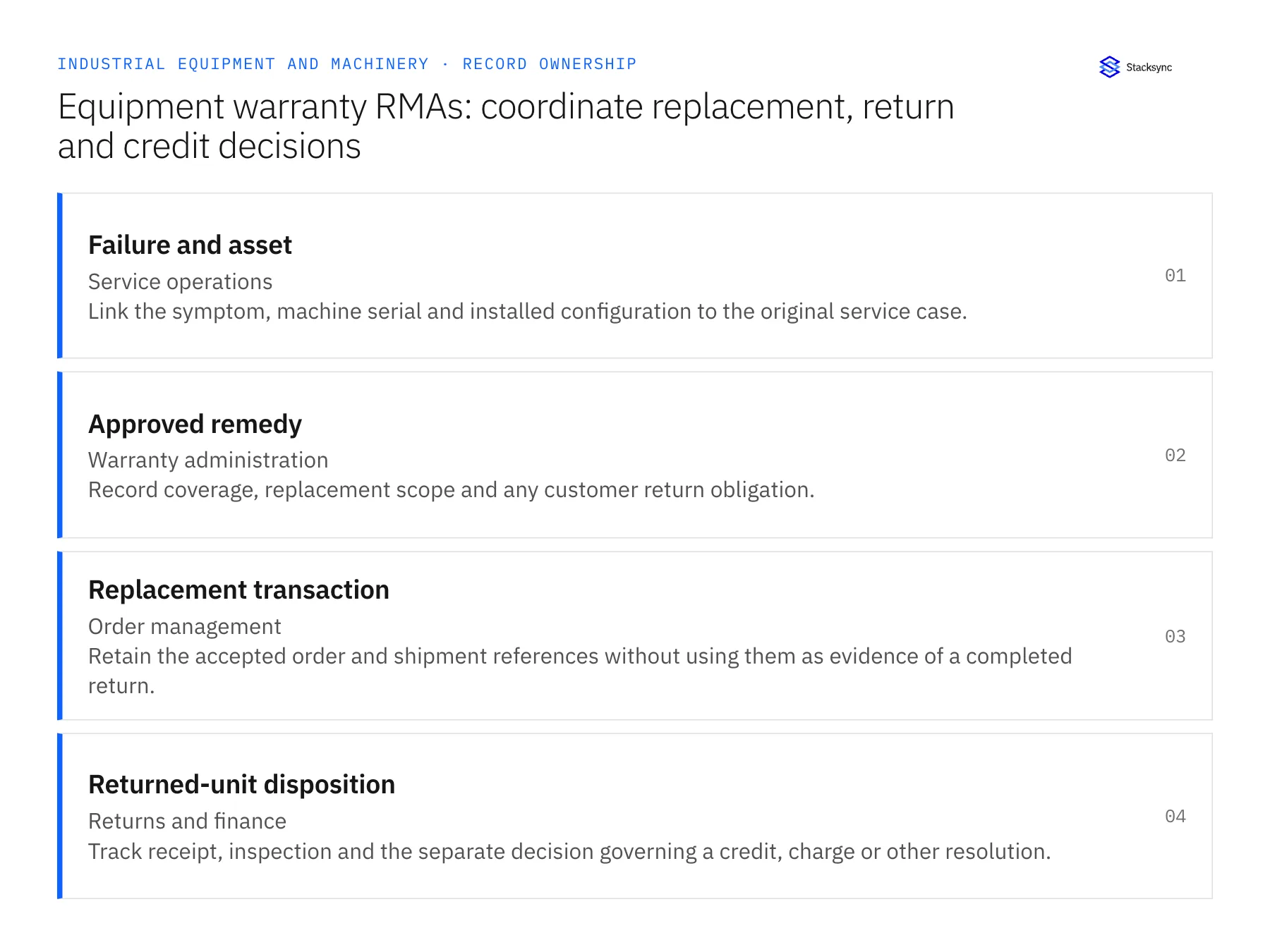
| Failure and asset | Service operations | Link the symptom, machine serial and installed configuration to the original service case. |
| Approved remedy | Warranty administration | Record coverage, replacement scope and any customer return obligation. |
| Replacement transaction | Order management | Retain the accepted order and shipment references without using them as evidence of a completed return. |
| Returned-unit disposition | Returns and finance | Track receipt, inspection and the separate decision governing a credit, charge or other resolution. |
Work through the process
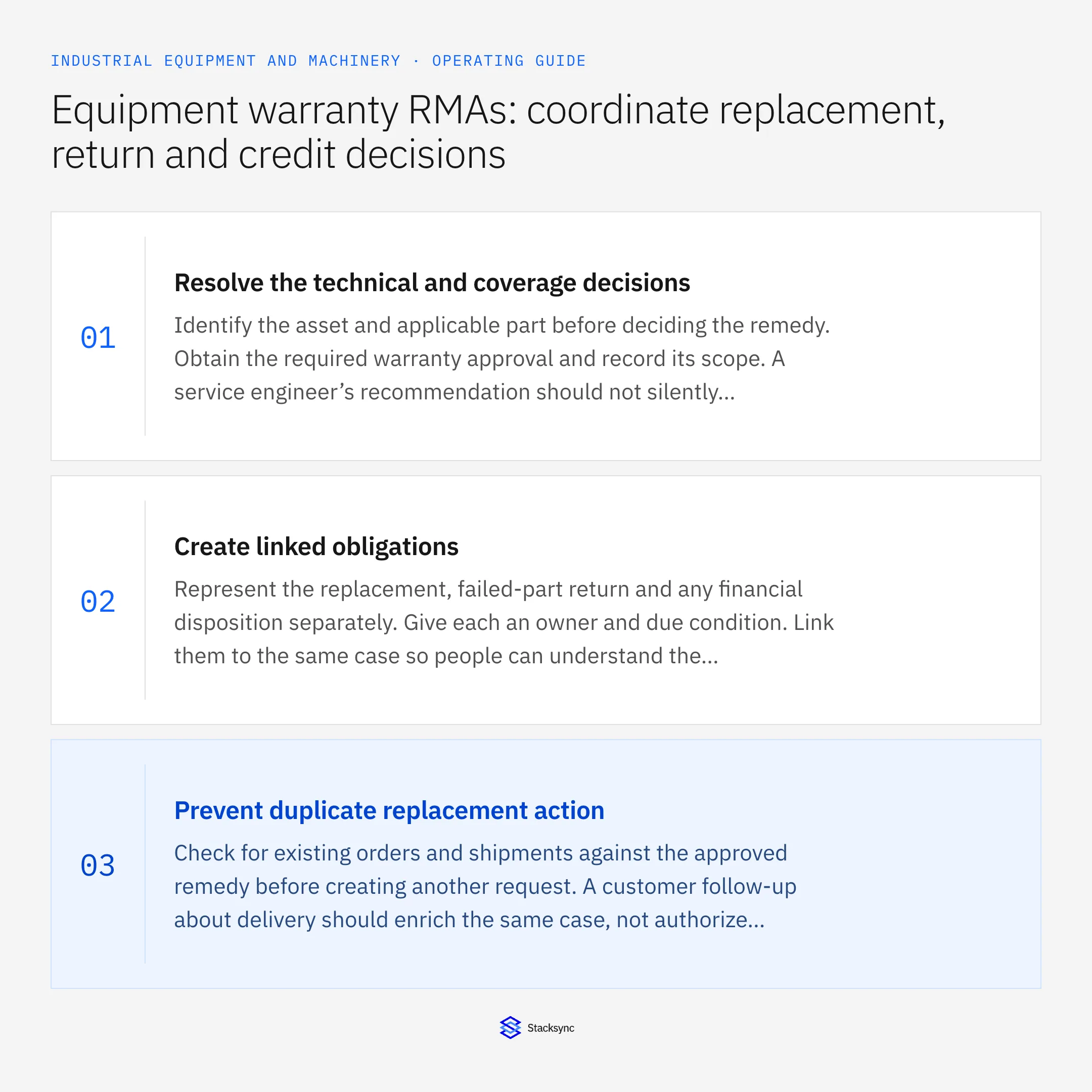
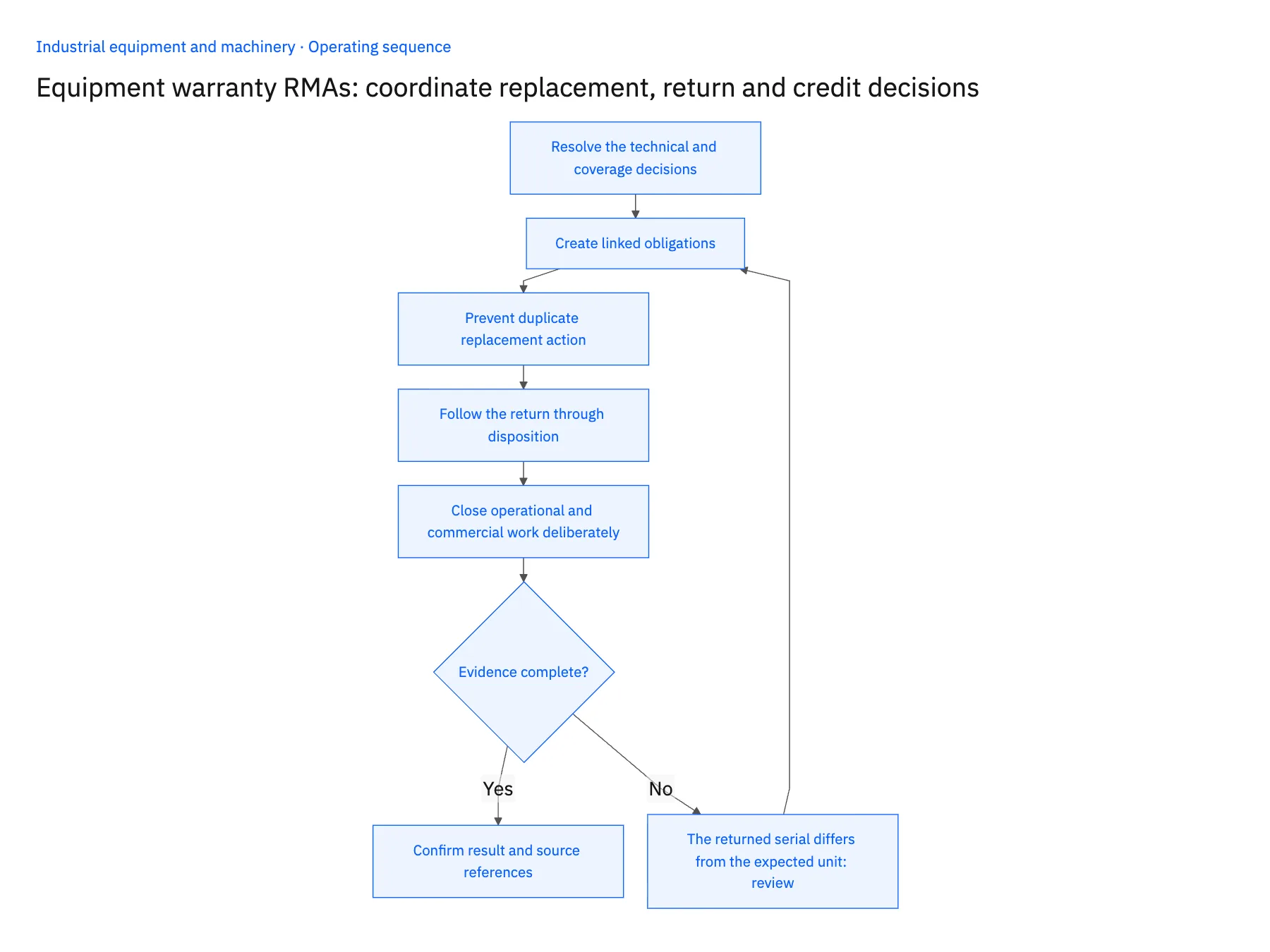
- 01Resolve the technical and coverage decisionsIdentify the asset and applicable part before deciding the remedy. Obtain the required warranty approval and record its scope. A service engineer’s recommendation should not silently determine financial coverage or waive a return requirement.
- 02Create linked obligationsRepresent the replacement, failed-part return and any financial disposition separately. Give each an owner and due condition. Link them to the same case so people can understand the whole remedy without assuming that every obligation shares one completion date.
- 03Prevent duplicate replacement actionCheck for existing orders and shipments against the approved remedy before creating another request. A customer follow-up about delivery should enrich the same case, not authorize another part. Retain uncertain destination responses for reconciliation before retrying.
- 04Follow the return through dispositionCollect the return receipt and inspection outcome, then route the financial decision to its owner. A received box may contain the wrong unit or incomplete items. Preserve those exceptions instead of automatically applying the expected credit.
- 05Close operational and commercial work deliberatelyAllow service to record restored operation while keeping unresolved return or finance tasks open. Define the overall case-closure rule so the remaining obligations remain visible to the team that owns them. Review aging cases without reopening a solved technical issue unnecessarily.
Handle the exceptions explicitly
The returned serial differs from the expected unit
Route the discrepancy to returns and service for resolution. Do not match solely by part description.
The customer needs a second replacement
Require a new supported remedy decision and link it to the prior attempt. Do not reuse the original approval without checking scope.
The machine is repaired but the return is overdue
Keep the technical resolution and return obligation separate, with follow-up handled under the approved commercial policy.
What to verify before expanding
- One approved remedy links to its replacement and return references.
- Shipment of a replacement cannot close an unreceived return obligation.
- Returned-unit discrepancies require disposition before financial action.
- A repeated customer status inquiry creates no new replacement transaction.

Connect this process to the rest of your operation
Explore Stacksync workflows and scope the records and actions against your actual systems. Book a demo with a real failure and asset example and the exception your team handles most often, for example the returned serial differs from the expected unit.
- Commissioning-readiness automation for equipment manufacturers
- Equipment commissioning readiness: connect sales promises, site prerequisites and service dispatch
- AI agents for equipment aftermarket requests: prepare compatible parts proposals
- Equipment parts AI exceptions: serial ambiguity, supersession and incomplete kits
- Coordinate Closed-Won Onboarding Across Salesforce and NetSuite
- Salesforce ERP Integration: Best Real-Time Sync Solutions in 2026
The shared architecture guide covers record matching, ownership, and recovery across systems.
Technical references
FAQ
Frequently asked questions










Related articles