







Make prerequisites visible
Connect the actual visit requirements to the machine and accepted service scope.
 Salesforce
  HubSpot
  NetSuite
  Zendesk
  Microsoft Dynamics 365 Sales
  Dynamics 365 F&O
  Attio
Attio  Pipedrive
  Zoho CRM
  Campfire
  Rillet
  Front
Front  Shopify
  Amazon Seller Central
  SendGrid
 Industrial equipment and machinery
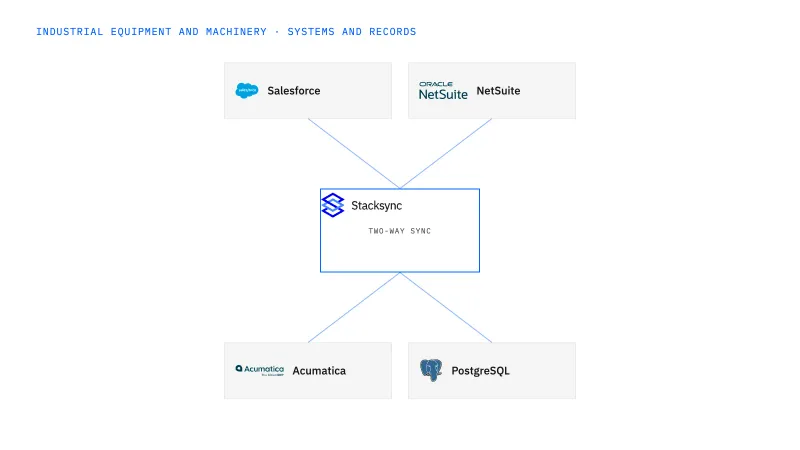
Bring sold service scope, equipment status and site prerequisites into one dispatch-readiness handoff. Stacksync fits builders that coordinate commissioning across sales, order management and service and still rely on repeated check-in messages. Service operations retains dispatch authority while the workflow collects evidence and follows unresolved conditions.
A machine can be shipped and a visit scheduled even though a required accessory or site confirmation is still missing.
Explore your process in a demo, or get our shared two-way sync architecture guide.
When this fits
COOs, service directors and IT leaders at US equipment builders with 100–1,000 employees and a mix of manufacturing, distribution and service.
Connect the actual visit requirements to the machine and accepted service scope.
Route customer, warehouse and service gaps to accountable owners with current evidence.
A late delivery or withdrawn confirmation reopens the readiness decision instead of leaving an obsolete ready flag.
The process, end to end
a service director wants to prevent avoidable last-minute rescheduling. The evaluation should combine a sold commissioning visit with a missing accessory and an unconfirmed site condition, showing the owner and evidence required before dispatch is approved.
Scope your implementation
Review current platform pricing alongside the records, volume, and actions in your process. Use your own operating baseline to evaluate the economics.
Explore your process in a demo, or get our shared two-way sync architecture guide.
From foundation to action
Keep shared customer, order, and operational records aligned, with clear field ownership.
Explore two-way sync 02Move approved work between systems, assign exceptions, and confirm the result.
Explore workflows 03Investigate cross-system questions, assemble the evidence, and prepare the next action.
Explore ai agents (genies) 04Connect trading-partner documents to operational records and exception handling.
Explore ediGo deeper
Before a technician travels, this workflow shows which accessory, site condition or customer confirmation is still missing and who owns resolving it.
Shipping a replacement should not close the return or decide the credit; each RMA obligation stays open until the owner who holds it confirms the outcome.
Explore all industrial equipment and machinery integration and automation guides ↗
Only through a separately approved and demonstrated execution route. Start with reliable readiness evidence and dispatch review.
Service operations owns the dispatch decision; each prerequisite should have its own responsible party.
Measure coordination effort, time to an accurate readiness decision and rescheduling tied to previously discoverable missing prerequisites.
Yes. Put two-way sync first so Salesforce, NetSuite and Postgres agree on the machine serial, the sold commissioning scope and the shipment and accessory status the readiness case depends on. Then add workflows to collect site prerequisite evidence, route gaps to owners and hold the dispatch decision for service operations. Genies come next if the service desk wants installed-machine and part evidence assembled for aftermarket requests. EDI sits apart from readiness and applies to distributor purchase orders with kits and partial shipments.


