


















Source of Truth: Should Your Warehouse or Your CRM Own Customer Data?
A decision guide for teams whose CRM has quietly become a rat's nest of duplicates and stale records. It argues that the cleaner move is to model a single record in the data warehouse, name it the source of truth, and sync it out to every app, rather than trusting whatever the CRM already holds. Covers why the CRM is a shaky record, the warehouse-of-record pattern, how to pick between a warehouse and a database like Supabase or Snowflake, field-level conflict rules, and auto-creating records across systems.
- Author
- Ignacio Malpartida · GTM Engineer
- Published
- Updated
- Read time
- 9 min read

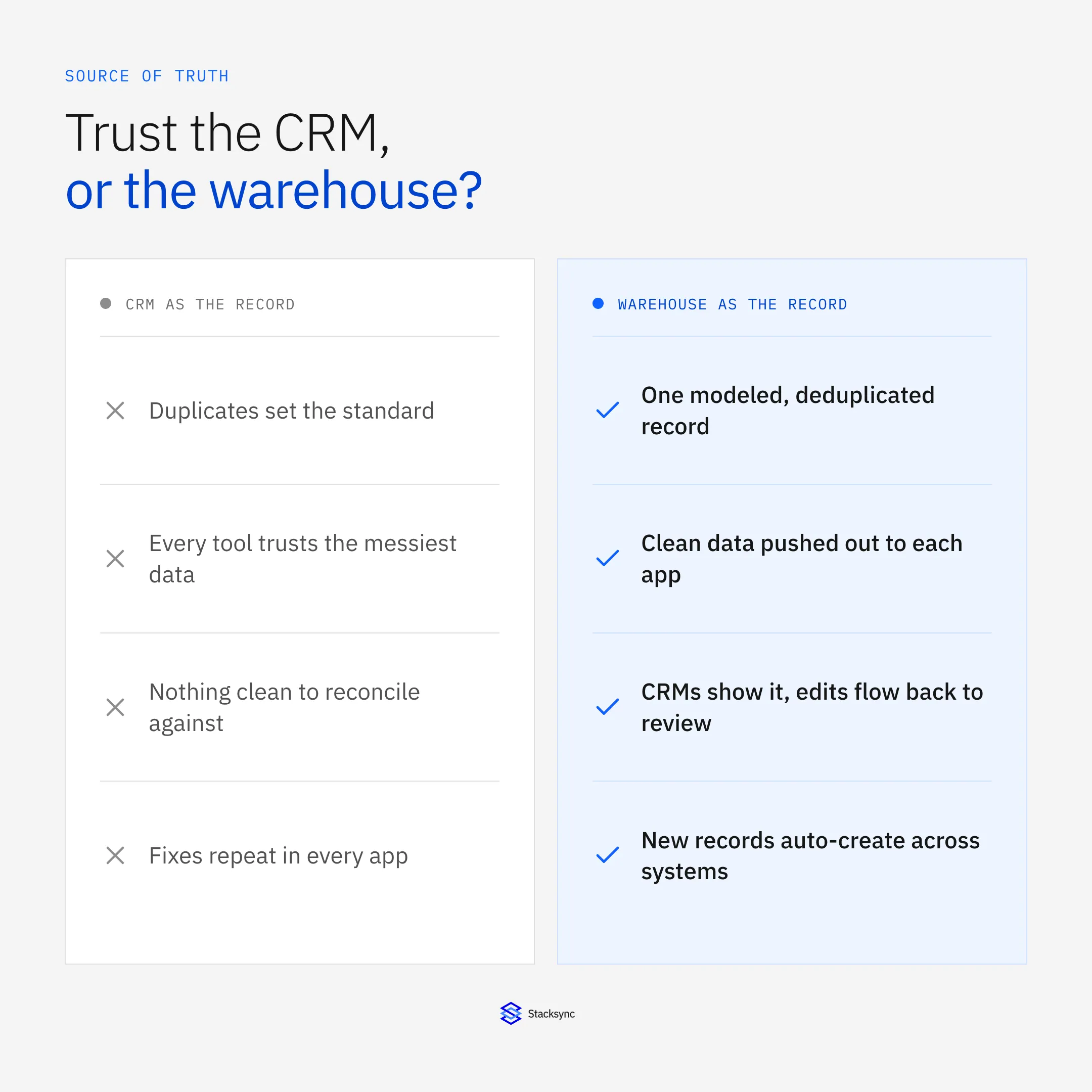
Ask where the truth lives and most teams point at their CRM out of habit. Then someone actually opens it: the same clinic listed four times, contacts with no owner, fields half-filled from an import three years ago. The CRM is not the source of truth so much as the place data goes to get messy. And every integration that trusts it inherits the mess.
The better question is not which system you happen to read from, but which system you decide is authoritative. This guide makes the case that for reconciled customer data, the warehouse is usually the cleaner record, and walks through how to name a source of truth, pick between a warehouse and a database, resolve conflicts per field, and still let reps work in the CRM.
This assumes a two-way sync platform such as Stacksync connecting a warehouse or database to the tools your teams use. If you have not connected the warehouse yet, the Snowflake connection guide covers that first step. Here we focus on the decision that shapes everything downstream: who owns the record.
Why the CRM is a shaky source of truth
A CRM is optimized for people doing work, not for holding a canonical record. Reps create a contact rather than search for it. Imports land without deduplication. Two integrations write the same field on different schedules. None of this is negligence, it is what happens when many hands touch one system all day. The result is a record that is usually right and occasionally, invisibly, wrong.
The damage compounds when other systems trust it. If billing, analytics, and support all read customer data from the CRM, they do not just inherit the good data, they inherit the duplicates and the stale fields too. Every downstream fix is done per app, over and over, because there is no clean record to reconcile against. Declaring the CRM the source of truth locks that problem in.
The warehouse as the record everything agrees with
The warehouse is where you already do the opposite of what the CRM does to data. You model it, deduplicate it, and reconcile it into one clean row per customer. So it is the natural place to hold the authoritative record. The move is to treat the warehouse as the source of truth and sync that clean record out to every app, instead of trusting whatever each app happens to contain.
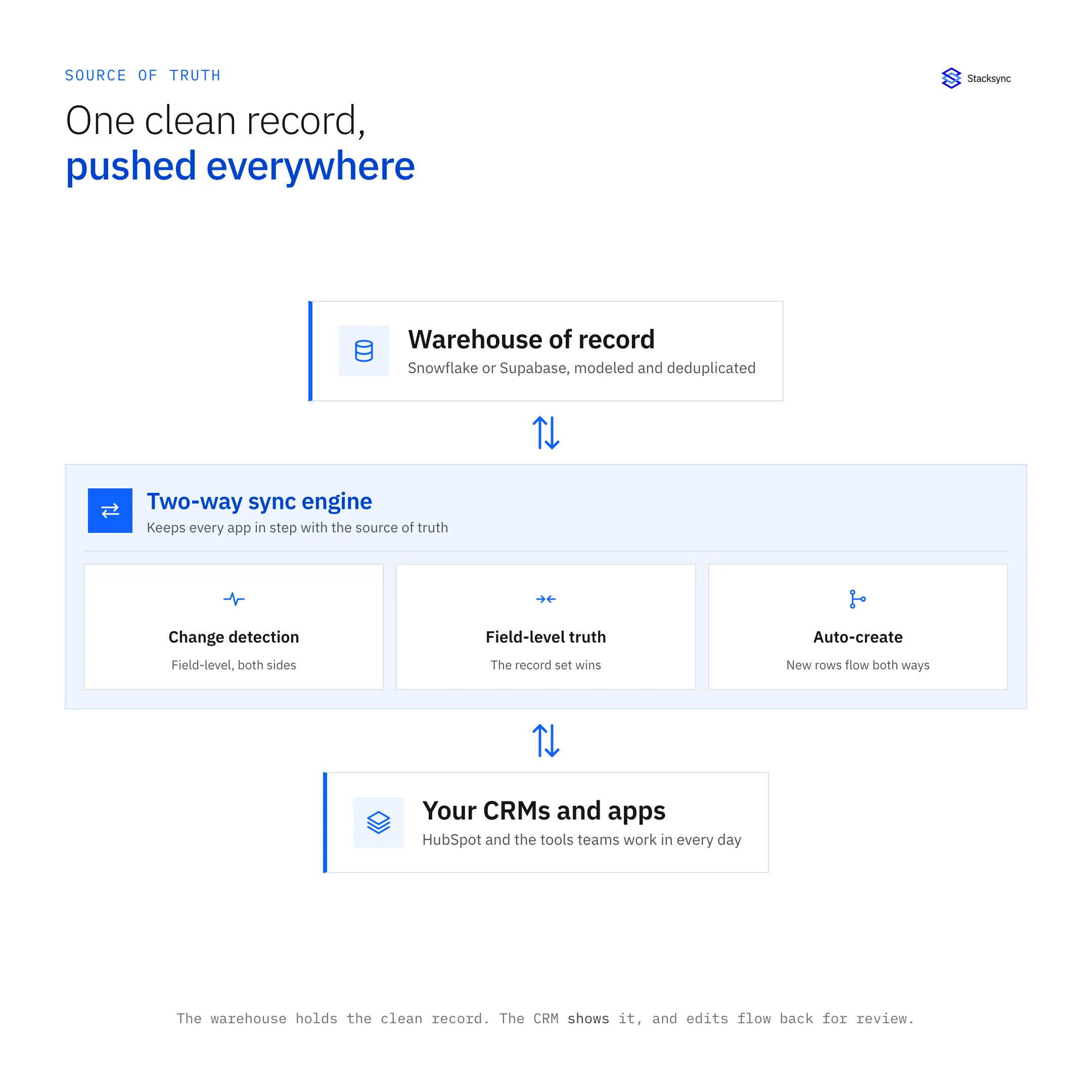
The word that matters is two-way. This is not a nightly dump from the warehouse to the CRM. The warehouse holds the truth, the CRM displays it, and edits made in the CRM flow back to be reconciled against the clean record. Every app inherits one version of the customer, and corrections happen once, in the record, rather than app by app.
Pick your source of truth: warehouse, database, or per field
There is no law that the CRM must be primary, and no law that the warehouse must be either. You pick the system that holds your modeled data and name it the source of truth. For some teams that is Snowflake. For others it is a database like Supabase that already backs their product. The point is to choose deliberately rather than let the choice be made by whichever integration wrote last.
| If your source of truth is... | Good when | How the CRM fits |
|---|---|---|
| A warehouse like Snowflake | Data is modeled and reconciled for analytics and reporting | CRM shows the modeled record, edits flow back for review |
| A database like Supabase | The record already backs your product or app | CRM stays in step with the app's live data |
| Set per field | Some fields are owned by ops, others by the warehouse | Each field wins where it is authoritative, both sides agree |
You choose the record of truth per system or even per field, rather than defaulting to the CRM.
Setting the source of truth per field is the detail that makes this workable in the real world. Ops may own lifecycle stage in the CRM while the warehouse owns the reconciled account and revenue fields. Both can be authoritative for their own fields, and the sync keeps each side honest without forcing one system to win everything.
How conflicts resolve when both sides change
A source of truth only means something when two systems disagree. The same field gets edited in the CRM and updated in the warehouse, and something has to decide which value stands. A rule per field settles it: the owner wins, the winner is written to both, and anything without a rule goes to a review queue instead of one edit quietly clobbering the other.
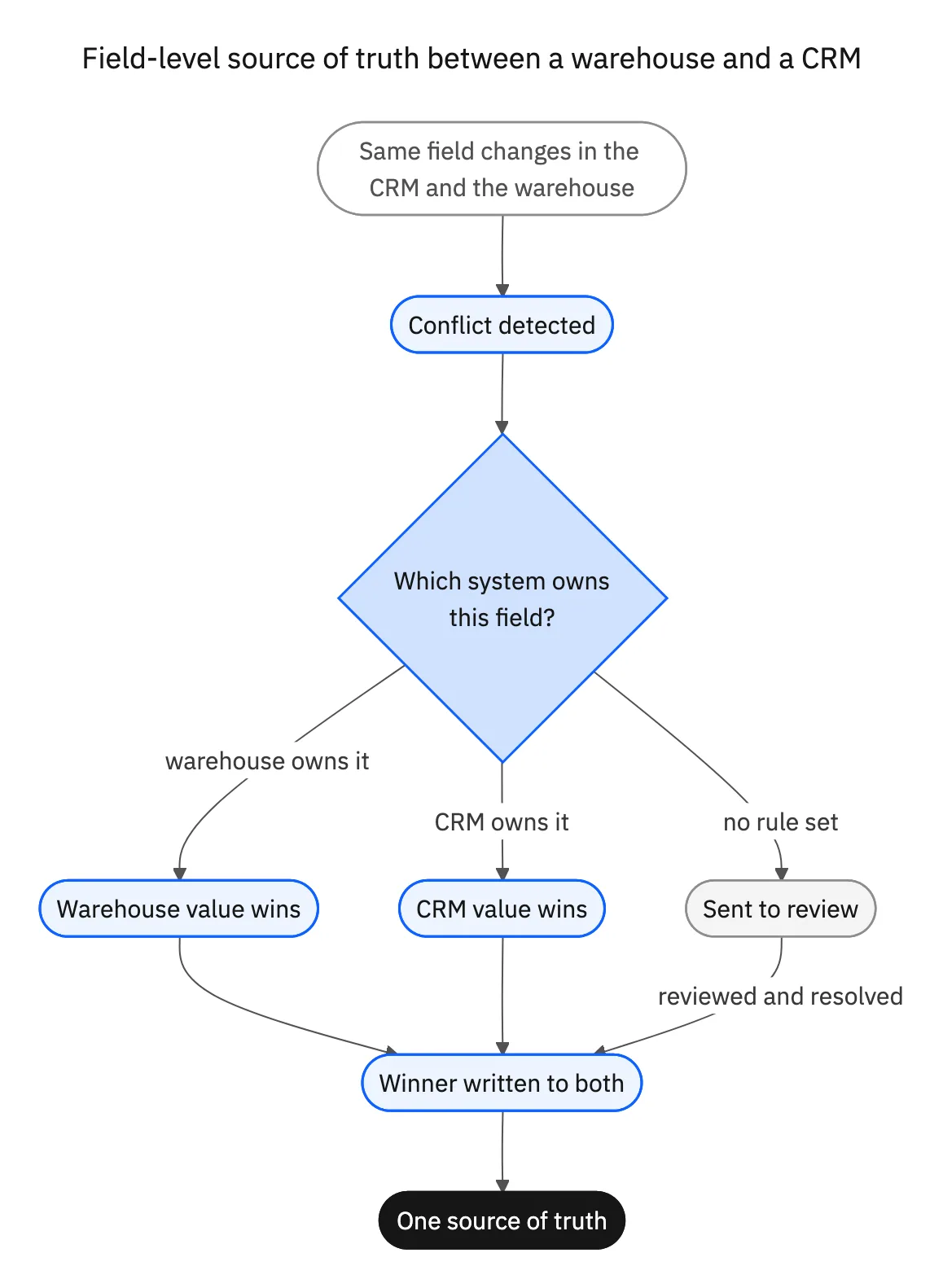
This is what separates a real source of truth from a hopeful one. Without conflict rules, a single source of truth is just a slogan, because the last write always wins and the messy system wins as often as the clean one. With field-level rules and a review queue, the clean record stays clean even though people keep editing data in more than one place.
New records, created the way you choose
Source of truth is not only about who wins an edit, it is also about where new records are born and how they spread. Workflow automation on top of the sync handles this. A new contact in the CRM can auto-create a matching row in the warehouse, or a new record in the warehouse can auto-create in the CRM, in whichever direction you set.
You are not hardcoding one system as the only place a record can start. You are deciding how a new record propagates so it lands everywhere it should, already reconciled. That is what lets a team make the warehouse the record of truth without slowing down the reps who create records in the CRM all day. For chaining this across more than two systems, see multi-hop sync.

Apply this in electrical and electronic components: component identity and approved applicability
An electronic-component allocation view should expose the approved revision and stock context without becoming an accidental source of inventory authority. The NetSuite–Postgres example applies this ownership distinction to operational evidence, engineering restrictions, and the records allowed to drive a decision.
| Record to reconcile | Responsible owner | Rule to preserve |
|---|---|---|
| Component identity | Product operations | Retain internal item, manufacturer part and relevant revision references as distinct identifiers. |
| Approved applicability | Engineering | Record which components or alternatives may satisfy the selected assembly or customer requirement. |
| Demand allocation | Planning | Link eligible supply to the specific demand line and quantity rather than exposing only pooled stock. |
An exception to plan for: A substitute is stocked but not approved. Show it as a candidate for engineering review, outside eligible coverage. Acceptance check for the pilot: restricted demand cannot consume stock that lacks approved applicability.
The electrical and electronic components hub connects the broader operating context. These guides develop the specific record mappings and decisions for this application:
Choose the record, then sync everything to it
The CRM will keep collecting duplicates and half-edits, because that is what a system full of busy people does. The fix is not to police it harder, it is to stop treating it as the definitive record. Model the truth in the warehouse, name it the source of truth, and sync it out so every app agrees. Reps keep their CRM, the data just stops disagreeing with itself.
Whether the record of truth is Snowflake, Supabase, or split per field, the pattern is the same: one clean record, kept in step everywhere by a two-way sync. To map your own source-of-truth rules on real data, book a demo.

FAQ
Frequently asked questions










Related articles