EDI vs API Integration for Supply Chain Data (2026 Guide)
Compare EDI vs API integration for supply chain data. Learn when to use each, how to combine them, and how real-time sync prevents retail compliance penalties.
- Author
- Ruben Burdin · Founder & CEO
- Published
- Updated
- Read time
- 7 min read

EDI vs API integration for supply chain data is not a question of replacement, but of architecture. EDI remains the compliance backbone for retail trading partners, while APIs power real-time operational workflows. The competitive advantage comes from synchronizing both through a unified integration layer that eliminates batch delays and data inconsistencies.
Why This Comparison Matters Now
Supply chains are under pressure to move faster while staying compliant with strict retailer requirements. Companies must exchange structured documents such as 850 purchase orders, 855 acknowledgments, 856 ASNs, and 810 invoices, while simultaneously keeping ERP, WMS, CRM, and ecommerce platforms updated in real time.
This creates a strategic dilemma: rely solely on traditional EDI systems, move toward API-first integration, or combine both in a hybrid model.
What Is EDI in Supply Chain Operations
Electronic Data Interchange is a standardized method for exchanging business documents between trading partners. Major retailers enforce strict implementation guides that suppliers must follow to remain compliant.
For example, suppliers working with Amazon vendors must follow detailed compliance rules for purchase orders and fulfillment, which are typically managed through structured EDI flows. If you operate in that ecosystem, understanding the specific requirements for Amazon EDI integration is essential.
Retailers like Walmart and Costco also maintain strict vendor compliance scorecards and ASN accuracy requirements. Suppliers often review Walmart EDI compliance requirements or Costco EDI guidelines before onboarding to avoid costly chargebacks.
Across all major retailers, EDI remains mandatory for structured B2B transactions. You can explore the broader landscape of retail EDI trading partner integrations to understand how widespread these mandates are.
Strengths of EDI
- Retail compliance standard
- High-volume transaction reliability
- Clear documentation and validation rules
- Predictable audit processes
Limitations of Traditional EDI
Traditional EDI systems are frequently batch-oriented and brittle. Documents are extracted from ERP systems at scheduled intervals, translated, and transmitted later.
This timing gap is one of the main reasons suppliers still struggle with common EDI errors in supply chains, particularly when operational data changes after the file extraction process.
What Is API Integration in Supply Chains
API integration allows systems to communicate in real time using modern web protocols. Instead of sending structured batch files, APIs exchange JSON payloads instantly between platforms.
APIs are ideal for:
- Real-time inventory updates
- Instant order status tracking
- Event-driven notifications
- Internal system synchronization
This is especially important for ecommerce brands managing omnichannel distribution, where EDI integration for ecommerce brands must coexist with API-driven storefront updates.
Strengths of APIs
- Real-time data exchange
- Flexible payload structures
- Faster internal development cycles
- Easier integration with microservices architectures
Limitations of APIs in Retail Context
Retail trading partners rarely replace EDI with APIs. Large enterprises such as The Home Depot, CVS Health via Mercury Gate, and Walgreens continue to require structured EDI documents for compliance and receiving automation.
Suppliers integrating with the The Home Depot EDI program, managing workflows through CVS Health via Mercury Gate EDI, or meeting Walgreens EDI requirements must transmit compliant X12 documents regardless of how their internal systems communicate.
APIs complement EDI but do not replace it in retail ecosystems.
EDI vs API: Core Differences
Document Structure
EDI uses rigid standardized segments governed by retailer implementation guides.
APIs use flexible JSON or XML payloads designed for developer agility.
Timing Model
Traditional EDI relies on batch windows.
APIs enable near real-time communication.
Compliance Requirements
Retailers mandate EDI for official transactions.
APIs are typically optional for internal optimization.
Error Handling
Legacy EDI often detects errors after transmission.
Modern API workflows can validate data instantly before propagation.
The Real Problem Is Not EDI vs API
The deeper issue is synchronization.
When EDI systems extract outdated ERP data during batch windows, documents become misaligned with real inventory or pricing. When APIs update systems instantly but EDI runs on a delay, timing mismatches create chargebacks and compliance penalties.
This is why many organizations describe traditional EDI systems as slow and brittle. The problem is not the standard itself, but the surrounding architecture.
Modern supply chains are moving toward real-time EDI processing to eliminate latency and reduce retailer penalties.
A Modern Hybrid Architecture
Forward-thinking supply chain teams no longer choose between EDI and APIs. They build an integration layer that:
- 01Parses incoming EDI documents directly into structured database tables
- 02Synchronizes ERP, WMS, and CRM data in real time
- 03Validates retailer rules before outbound transmission
- 04Uses APIs internally for instant updates
- 05Converts outbound data back into compliant EDI formats
Parsing EDI files directly into SQL-accessible data, as explained in this guide on how to parse EDI files into a SQL database, allows operations teams to detect discrepancies before they reach trading partners.
This approach also enables automation across 850, 855, and 856 transaction flows, reducing manual intervention and minimizing compliance risk. Learn more about EDI 850, 855, and 856 automation.
Organizations modernizing legacy environments often begin by decoupling translation from operational systems. If you are evaluating that shift, this resource on how to modernize legacy EDI systems outlines the transition path.
When to Use EDI Only
- Mandatory retail compliance programs
- Stable, high-volume B2B document exchange
- Limited need for real-time internal workflows
When to Use API Integration Only
- Internal microservices architectures
- Direct-to-consumer ecommerce without retail EDI mandates
- Real-time event-driven operational applications
When to Combine EDI and API
- Retail suppliers operating across multiple trading partners
- Companies managing both compliance and digital transformation initiatives
- Businesses aiming to eliminate chargebacks while improving operational speed
In practice, most growing suppliers fall into this hybrid category.

The Financial Impact of Choosing the Wrong Architecture
If EDI remains isolated from internal systems:
- Chargebacks increase
- ASN mismatches occur
- Inventory overselling becomes common
- Finance teams reconcile discrepancies manually
If APIs operate without EDI compliance awareness:
- Retailer documents fail validation
- Vendor scorecards decline
- Payment cycles slow down
The cost of misalignment often exceeds the cost of modernization.
Supply Chain Data Strategy in 2026
Supply chains are evolving toward event-driven, real-time architectures. EDI will not disappear because retailers depend on it. APIs will continue to power internal digital transformation.
The competitive advantage lies in synchronizing both layers instead of choosing one over the other.
Apply this in electrical and electronic components: partner order line and part cross-reference
Electronic-component orders show how EDI and operational APIs serve different parts of the same process. Partner documents carry customer part references, reels, and revisions; the accepted ERP mapping and engineering rules determine whether those lines can become actionable demand.
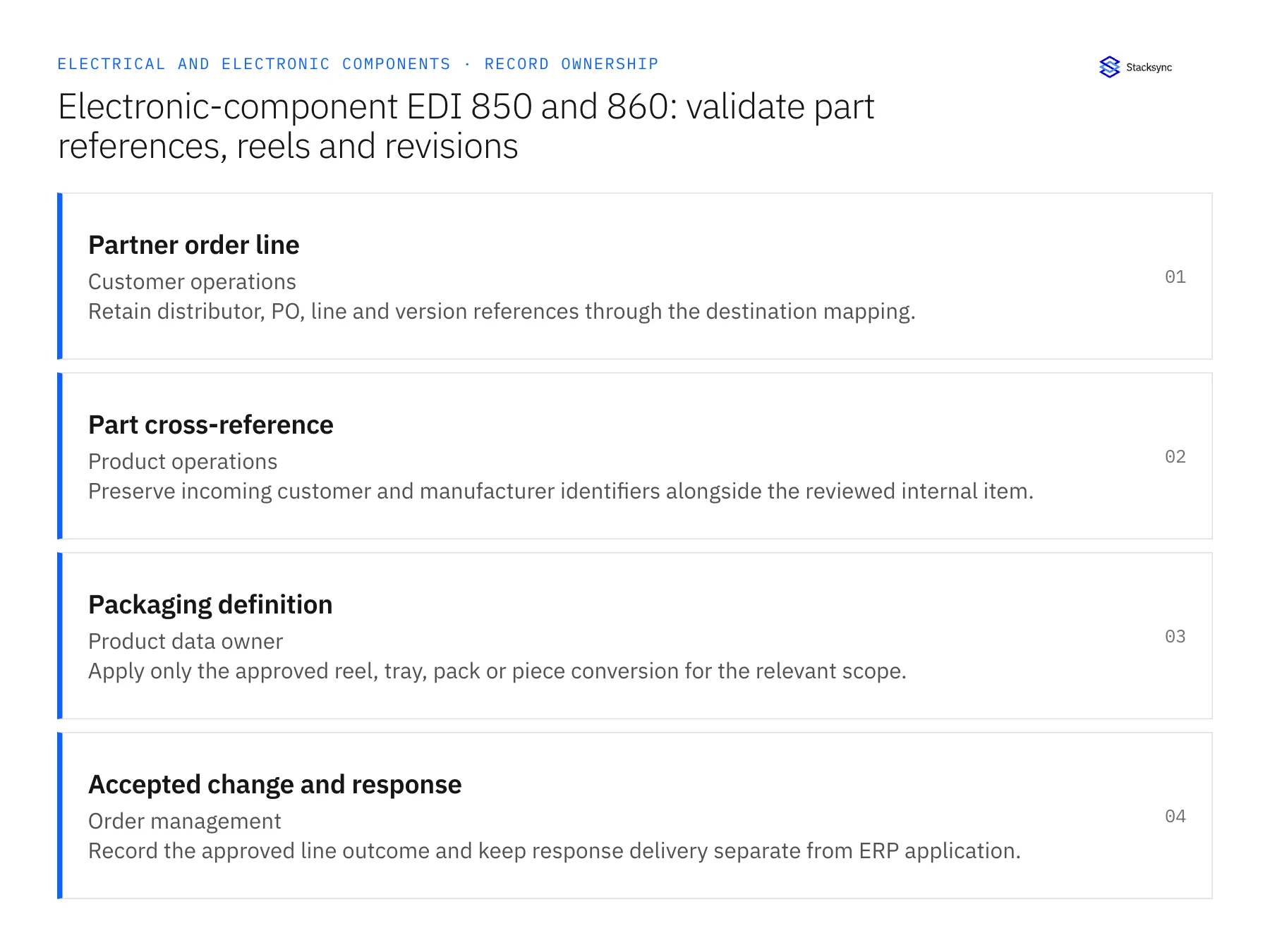
| Record to reconcile | Responsible owner | Rule to preserve |
|---|---|---|
| Partner order line | Customer operations | Retain distributor, PO, line and version references through the destination mapping. |
| Part cross-reference | Product operations | Preserve incoming customer and manufacturer identifiers alongside the reviewed internal item. |
| Packaging definition | Product data owner | Apply only the approved reel, tray, pack or piece conversion for the relevant scope. |
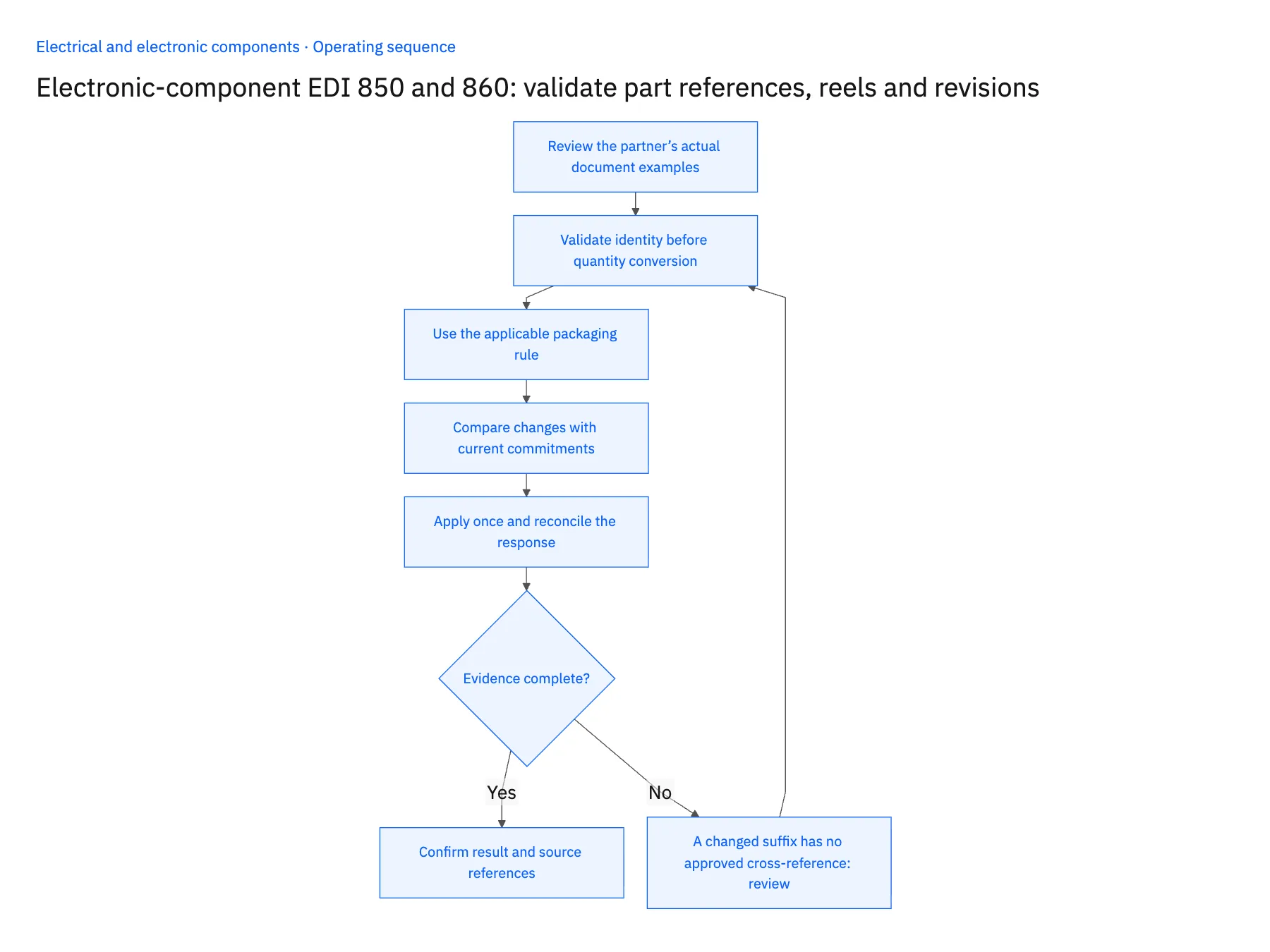
An exception to plan for: A changed suffix has no approved cross-reference. Route the line to product operations and retain both the original and requested references. Acceptance check for the pilot: the exact partner part reference remains traceable after item mapping.
The electrical and electronic components hub connects the broader operating context. These guides develop the specific record mappings and decisions for this application:
- Electronic-component EDI 850 and 860: validate part references, reels and revisions
- EDI order automation for electrical and electronic component manufacturers
Batch Windows Kill Margins. Real-Time Synchronization Protects Them.
EDI vs API is not a debate about standards. It is a decision about data latency, compliance risk, and operational agility.
Organizations that eliminate batch windows, synchronize systems in real time, and treat EDI as structured operational data rather than flat files reduce penalties, improve retailer relationships, and unlock faster decision-making across the supply chain. The question is no longer EDI or API. It is whether your integration layer keeps them aligned.
FAQ
Frequently asked questions










Related articles