Plastics manufacturing: connect Salesforce tooling quotes and NetSuite production orders
Injection molders that track a mold, a sample run and a first production order in one Salesforce opportunity need each commitment kept distinct when it reaches NetSuite.
- Author
- Ruben Burdin · Founder & CEO
- Published
- Read time
- 4 min read

The operating decision
A plastics manufacturer connecting Salesforce and NetSuite should separate tooling commitments from demand for molded parts. The customer may approve a mold, a sample run and a production order at different times under different terms. Two-way sync should preserve those relationships and return their accepted status to the commercial team. An approved tooling quote must not automatically create saleable finished-goods demand or imply that the tool and process are ready for a production release.
Explore the complete plastics and molding integration and automation hub for the systems and processes around this guide.
What this looks like in plastics and molding
An injection molder wins a customer program that includes a new mold and an initial order for housings. Sales tracks both in one opportunity, but the mold requires a separate customer approval and the production price assumes a specific order quantity. When the customer changes the initial quantity, a single synchronized total conceals which commercial commitment changed. The useful handoff keeps tooling, sample acceptance and production demand distinct, allowing the program manager to see what has been approved and what still prevents the first run.
Records, ownership, and update rules
| Record | Owner | Operating rule |
|---|---|---|
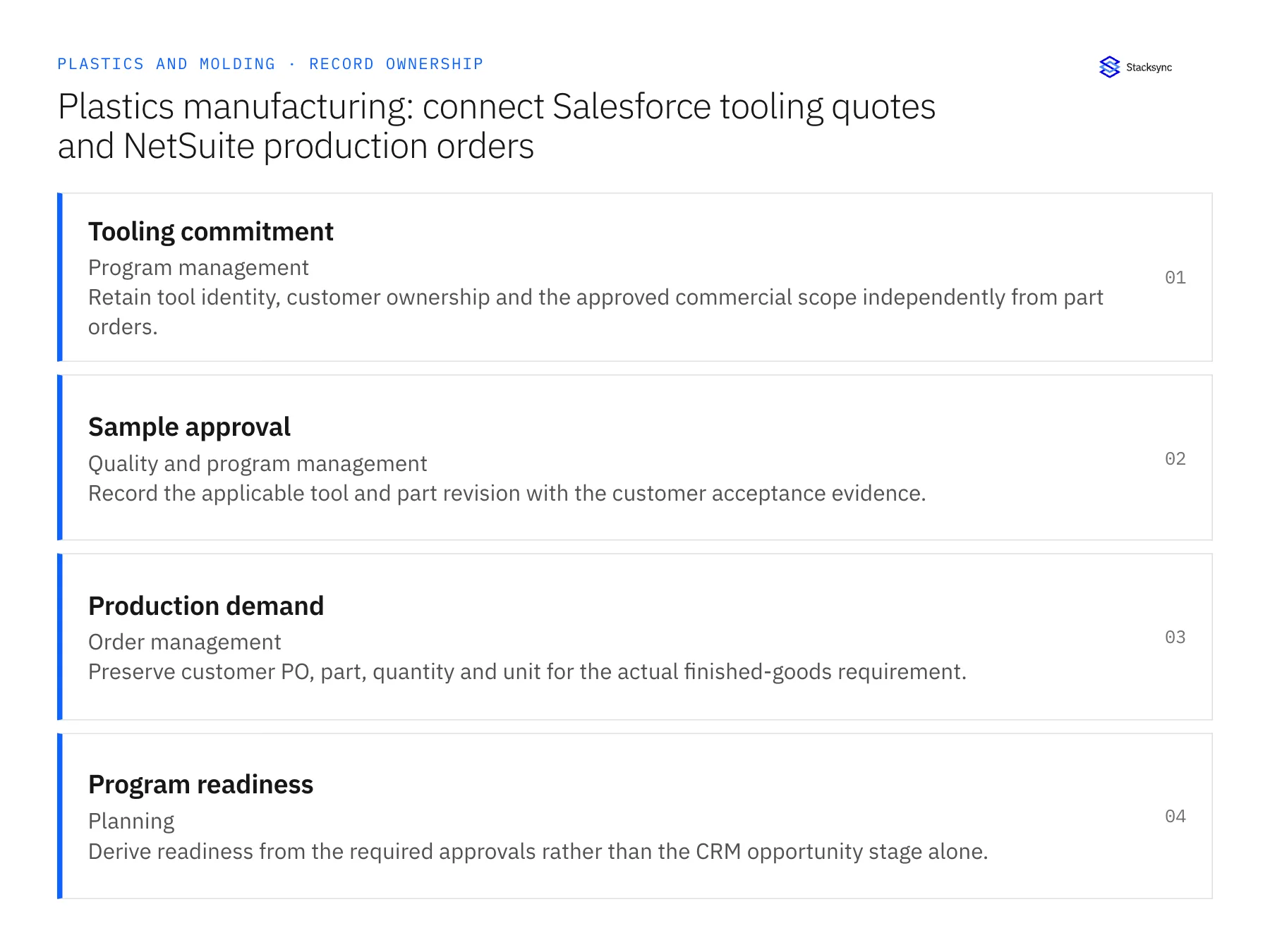
| Tooling commitment | Program management | Retain tool identity, customer ownership and the approved commercial scope independently from part orders. |
| Sample approval | Quality and program management | Record the applicable tool and part revision with the customer acceptance evidence. |
| Production demand | Order management | Preserve customer PO, part, quantity and unit for the actual finished-goods requirement. |
| Program readiness | Planning | Derive readiness from the required approvals rather than the CRM opportunity stage alone. |
Work through the process
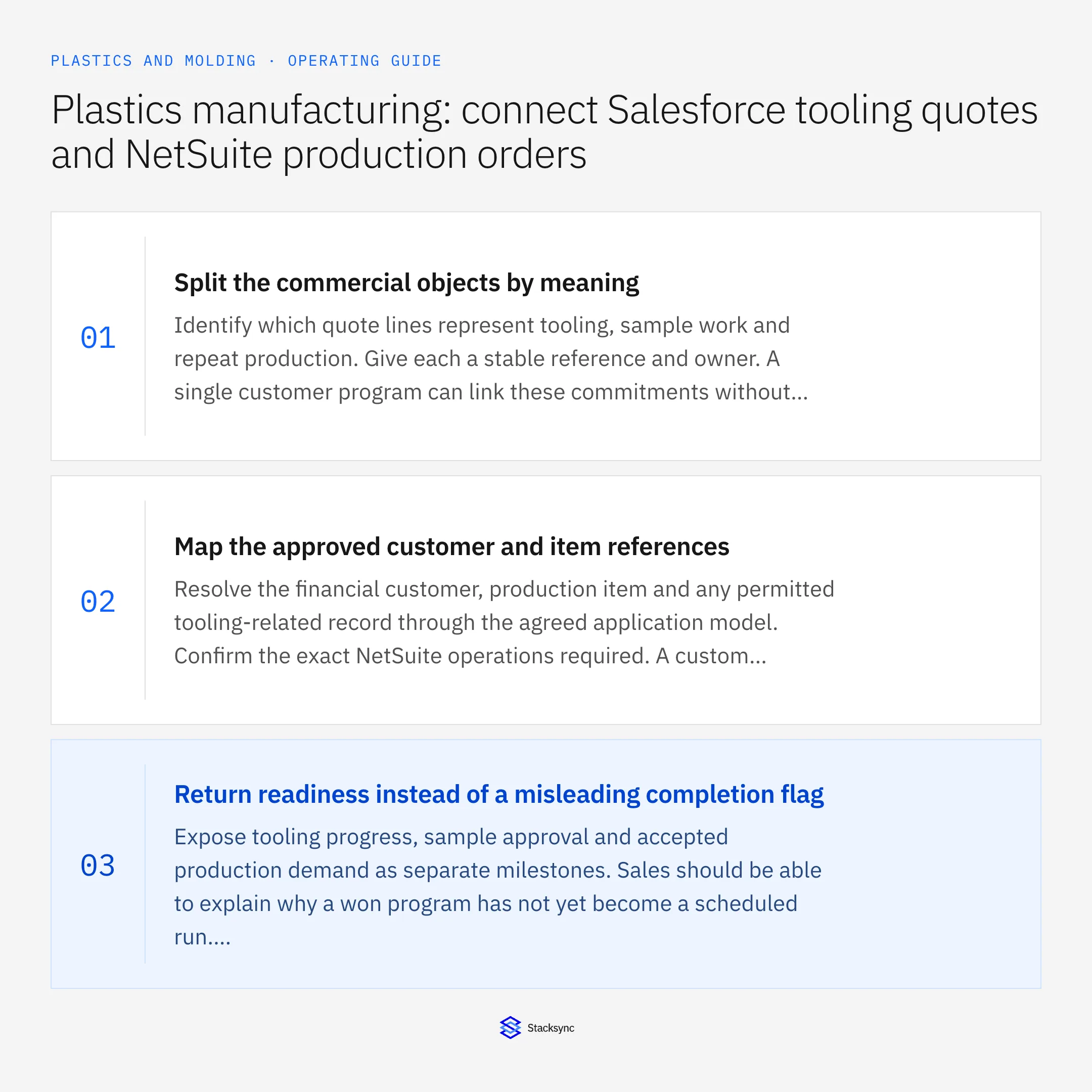
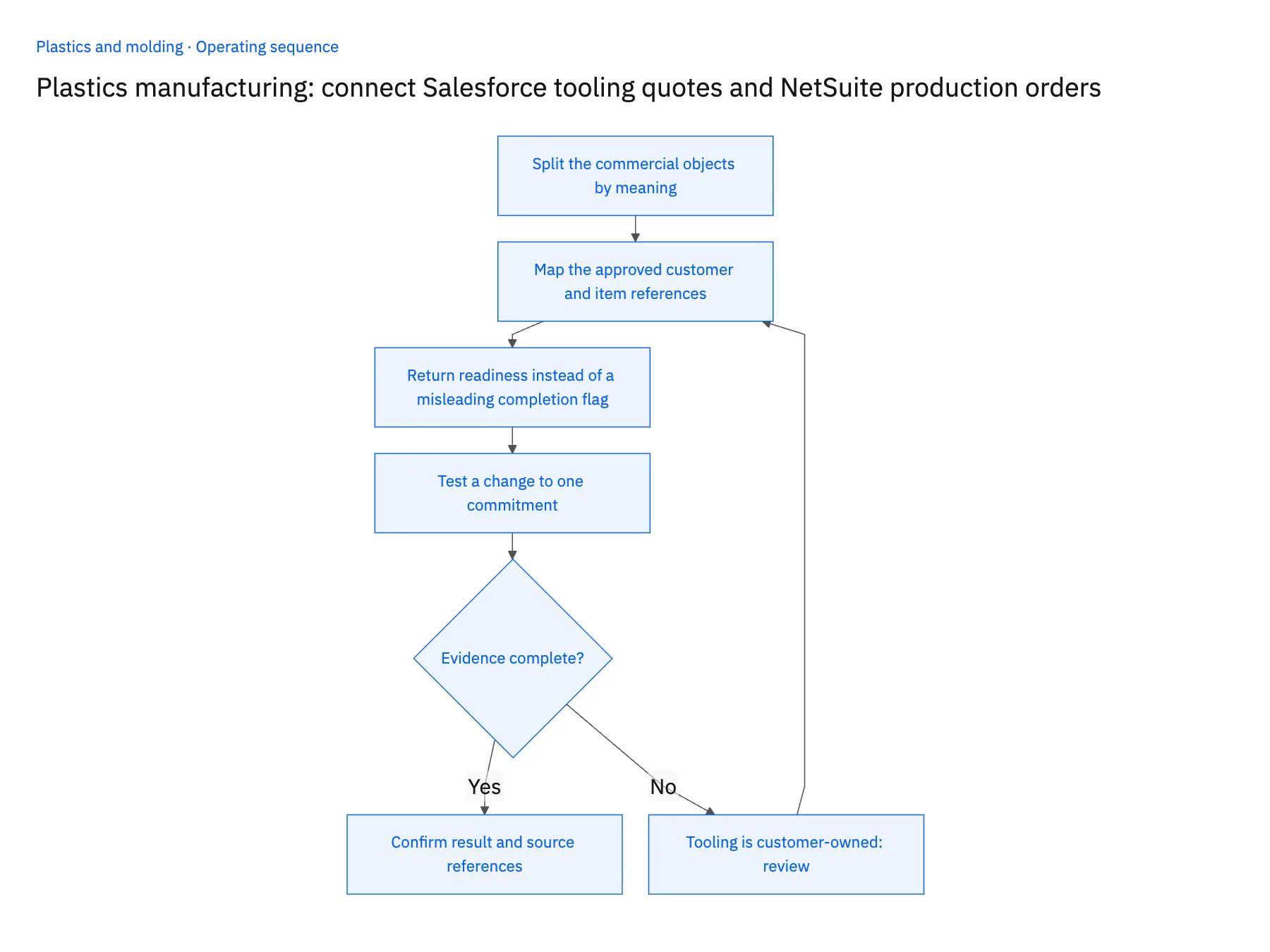
- 01Split the commercial objects by meaningIdentify which quote lines represent tooling, sample work and repeat production. Give each a stable reference and owner. A single customer program can link these commitments without combining their quantities or approval states into one transaction.
- 02Map the approved customer and item referencesResolve the financial customer, production item and any permitted tooling-related record through the agreed application model. Confirm the exact NetSuite operations required. A custom field visible in a quote does not establish a writable destination object for the intended transaction.
- 03Return readiness instead of a misleading completion flagExpose tooling progress, sample approval and accepted production demand as separate milestones. Sales should be able to explain why a won program has not yet become a scheduled run. Keep requested launch dates distinct from dates planning has accepted.
- 04Test a change to one commitmentRevise the initial production quantity while leaving the tooling agreement unchanged. Then change a sample-approval state. Verify that the correct linked records change and that neither action recreates the program or silently alters unrelated financial terms.
Handle the exceptions explicitly
Tooling is customer-owned
Preserve the ownership agreement and relevant references. Do not treat ownership as evidence that the tool is available, qualified or physically at the required plant.
The sample is accepted with conditions
Keep the conditions and responsible owner visible. A conditional approval should not be flattened into an unconditional production-ready flag.
The customer reuses a program number
Match the actual tooling and production references under the program. A familiar program label is not a unique order identity.
What to verify before expanding
- Tooling and production quantities cannot be summed into one demand total.
- A production-order revision leaves the accepted tooling commitment intact.
- Sales can identify which approval blocks the first production release.
- Repeated transmission retains the same linked program and order references.

Connect this process to the rest of your operation
Explore Stacksync two-way sync and scope the records and actions against your actual systems. Book a demo with a real tooling commitment example and the exception your team handles most often, for example tooling is customer-owned.
- Salesforce and NetSuite two-way sync for plastics manufacturers
- NetSuite and Shopify two-way sync for plastics brands
- Plastics brands using NetSuite and Shopify: preserve pack sizes and released stock
- Plastics manufacturing: connect Dynamics resin lots to a SQL Server readiness view
- Plastics manufacturing resin substitutions: coordinate evidence before changing the run
- How to Sync Data Between Applications with Reliable Two-Way Sync
- Optimize NetSuite Shopify Integration and HubSpot Sync with Stacksync
The shared architecture guide covers record matching, ownership, and recovery across systems.
Technical references
FAQ
Frequently asked questions










Related articles