







Keep packs and pieces explainable
Preserve the buyer’s original selling unit alongside the reviewed ERP conversion.
 Salesforce
  HubSpot
  NetSuite
  Zendesk
  Microsoft Dynamics 365 Sales
  Dynamics 365 F&O
  Attio
Attio  Pipedrive
  Zoho CRM
  Campfire
  Rillet
  Front
Front  Shopify
  Amazon Seller Central
  SendGrid
 Plastics and molding
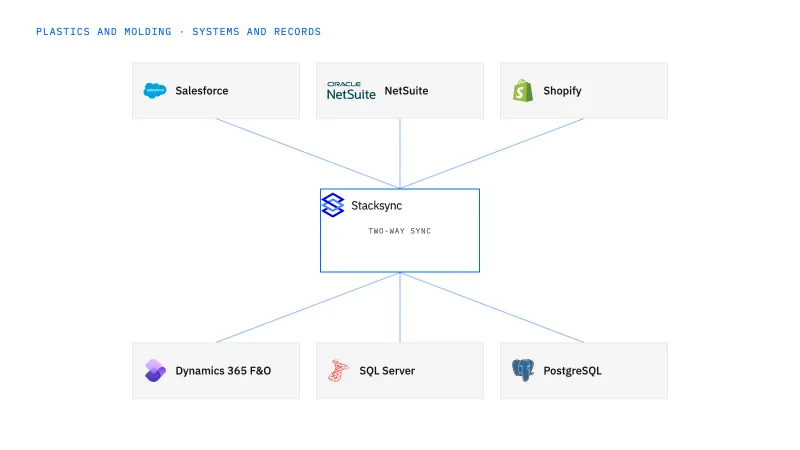
Connect direct-store variants and pack quantities to the approved NetSuite product and order model. Stacksync fits plastics manufacturers combining wholesale production with e-commerce and needing a shared view of released, saleable stock. Define channel allocation and quality eligibility before promising that every finished piece can be sold online.
The store sells packs, the ERP counts pieces, and recently molded stock may still be on hold or reserved for a wholesale order.
Explore your process in a demo, or get our shared two-way sync architecture guide.
When this fits
Plant operations, customer service and IT teams at US injection molders, extruders and plastics manufacturers with 100–1,000 employees.
Preserve the buyer’s original selling unit alongside the reviewed ERP conversion.
Use inventory’s agreed channel policy so held trial output and existing commitments do not inflate the offer.
Retain accepted historical pack definitions while reviewing future variant and packaging changes.
The process, end to end
a plastics brand sells colored products directly while supplying distributors from the same facility. Ask to see a pack-based order and a quality hold on one color, including the resulting quantity interpretation and the accepted order reference.
Scope your implementation
Review current platform pricing alongside the records, volume, and actions in your process. Use your own operating baseline to evaluate the economics.
Explore your process in a demo, or get our shared two-way sync architecture guide.
From foundation to action
Keep shared customer, order, and operational records aligned, with clear field ownership.
Explore two-way sync 02Move approved work between systems, assign exceptions, and confirm the result.
Explore workflows 03Investigate cross-system questions, assemble the evidence, and prepare the next action.
Explore ai agents (genies) 04Connect trading-partner documents to operational records and exception handling.
Explore ediGo deeper
Injection molders that track a mold, a sample run and a first production order in one Salesforce opportunity need each commitment kept distinct when it reaches NetSuite.
A direct store that sells packs while NetSuite counts pieces needs a variant cross-reference, a versioned pack definition and a channel stock rule that excludes held lots.
Two lots of the same resin grade can arrive on one purchase order with different approval states; a readiness view built from Dynamics 365 entities keeps them apart for planning.
Explore all plastics and molding integration and automation guides ↗
No. Product, quantity, order and fulfillment operations need individual scope and permission checks.
A pack conversion, a held lot, a revised pack definition and a repeated order message.
Track quantity corrections, manual order reconciliation and accepted order completion, separating inventory-policy problems from transfer failures.
Two-way sync is the starting point: it keeps the Shopify store variant, the NetSuite item and the reviewed pack definition aligned and carries each channel order line into NetSuite through the object-scoped writes you enable. Workflows come next when a quality hold on a color lot must route the affected commitments to inventory review. Genies come later, gathering the evidence behind a disputed pack conversion so product operations can decide. EDI enters only when distributors send releases as documents, outside the store.


