







Distinguish tooling from part demand
Keep linked commercial commitments visible while preserving their different quantities, ownership and approval states.
 Salesforce
  HubSpot
  NetSuite
  Zendesk
  Microsoft Dynamics 365 Sales
  Dynamics 365 F&O
  Attio
Attio  Pipedrive
  Zoho CRM
  Campfire
  Rillet
  Front
Front  Shopify
  Amazon Seller Central
  SendGrid
 Plastics and molding
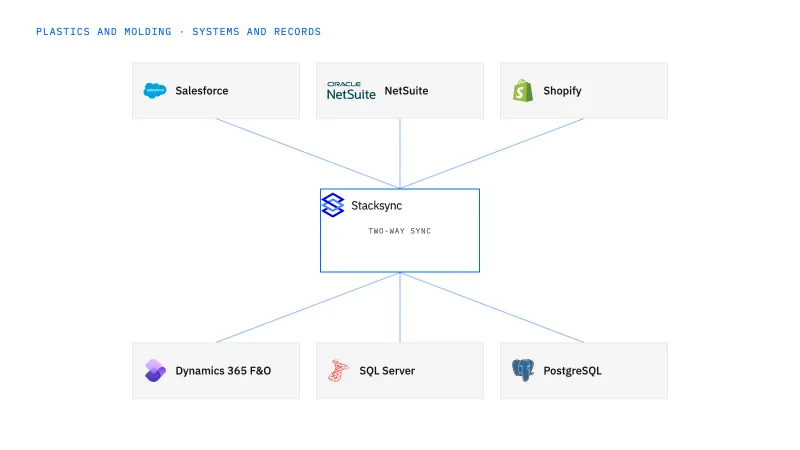
Connect customer programs, tooling commitments and production orders without collapsing them into one ambiguous sales status. Stacksync fits plastics manufacturers where Salesforce tracks the commercial relationship and NetSuite holds accepted order records. Begin with separate ownership for tooling, sample approval and firm finished-goods demand.
Sales reports a program won while operations still needs tooling approval, sample acceptance or a confirmed production release.
Explore your process in a demo, or get our shared two-way sync architecture guide.
When this fits
Plant operations, customer service and IT teams at US injection molders, extruders and plastics manufacturers with 100–1,000 employees.
Keep linked commercial commitments visible while preserving their different quantities, ownership and approval states.
Return the prerequisites still blocking the first accepted run rather than a single optimistic program flag.
Validate the records and operations needed for the selected handoff before enabling transaction changes.
The process, end to end
a molder serves customers that buy tooling and repeat molded parts under one program. A buyer should see the tooling agreement remain stable when the initial production quantity changes, with the remaining approval clearly visible to sales and planning.
Scope your implementation
Review current platform pricing alongside the records, volume, and actions in your process. Use your own operating baseline to evaluate the economics.
Explore your process in a demo, or get our shared two-way sync architecture guide.
From foundation to action
Keep shared customer, order, and operational records aligned, with clear field ownership.
Explore two-way sync 02Move approved work between systems, assign exceptions, and confirm the result.
Explore workflows 03Investigate cross-system questions, assemble the evidence, and prepare the next action.
Explore ai agents (genies) 04Connect trading-partner documents to operational records and exception handling.
Explore ediGo deeper
Injection molders that track a mold, a sample run and a first production order in one Salesforce opportunity need each commitment kept distinct when it reaches NetSuite.
A direct store that sells packs while NetSuite counts pieces needs a variant cross-reference, a versioned pack definition and a channel stock rule that excludes held lots.
Two lots of the same resin grade can arrive on one purchase order with different approval states; a readiness view built from Dynamics 365 entities keeps them apart for planning.
Explore all plastics and molding integration and automation guides ↗
Molders and plastics manufacturers with repeated customer programs and manual reconciliation between commercial milestones and accepted production demand.
Change a production quantity without altering the tooling commitment, then show the separate readiness conditions returned to sales.
Measure program-handoff preparation, missing-approval follow-ups and corrections after order acceptance using comparable program types.
Start with two-way sync between Salesforce and NetSuite so the tooling commitment, sample approval and production demand records carry one identity in both systems, with NetSuite writes scoped to the objects your team has approved. Add workflows when a revised program quantity needs a program manager’s review before planning accepts the change. Genies come next, assembling the approval evidence behind a stalled first run for sales and planning to act on. EDI belongs later, once customers send purchase orders and releases as documents instead of through sales.


