Missing Conversions and Mixed Pack Sizes: Exceptions for Household Order Agents
When two mixed cases lack item-level contents or a pack factor is absent, the Genie holds the comparison and asks the right owner instead of picking a number that balances.
- Author
- Ignacio Malpartida · GTM Engineer
- Published
- Read time
- 5 min read

The operating decision
Household order agents should stop when pack conversions are missing, mixed cases lack item detail, or a product’s effective definition is unclear. Preserve verified evidence and request the exact missing relationship. A model should not infer physical quantities from marketing language or use another customer’s case configuration as a default.
Explore the complete household consumables integration and automation hub for the systems and processes around this guide.
What this looks like in household consumables
A customer orders two mixed cases of cleaning refills. One warehouse document lists total containers, while another lists cases with no composition. The agent cannot determine whether the shipment matched the order until operations supplies the approved item-level contents of those mixed cases.
Records, ownership, and update rules
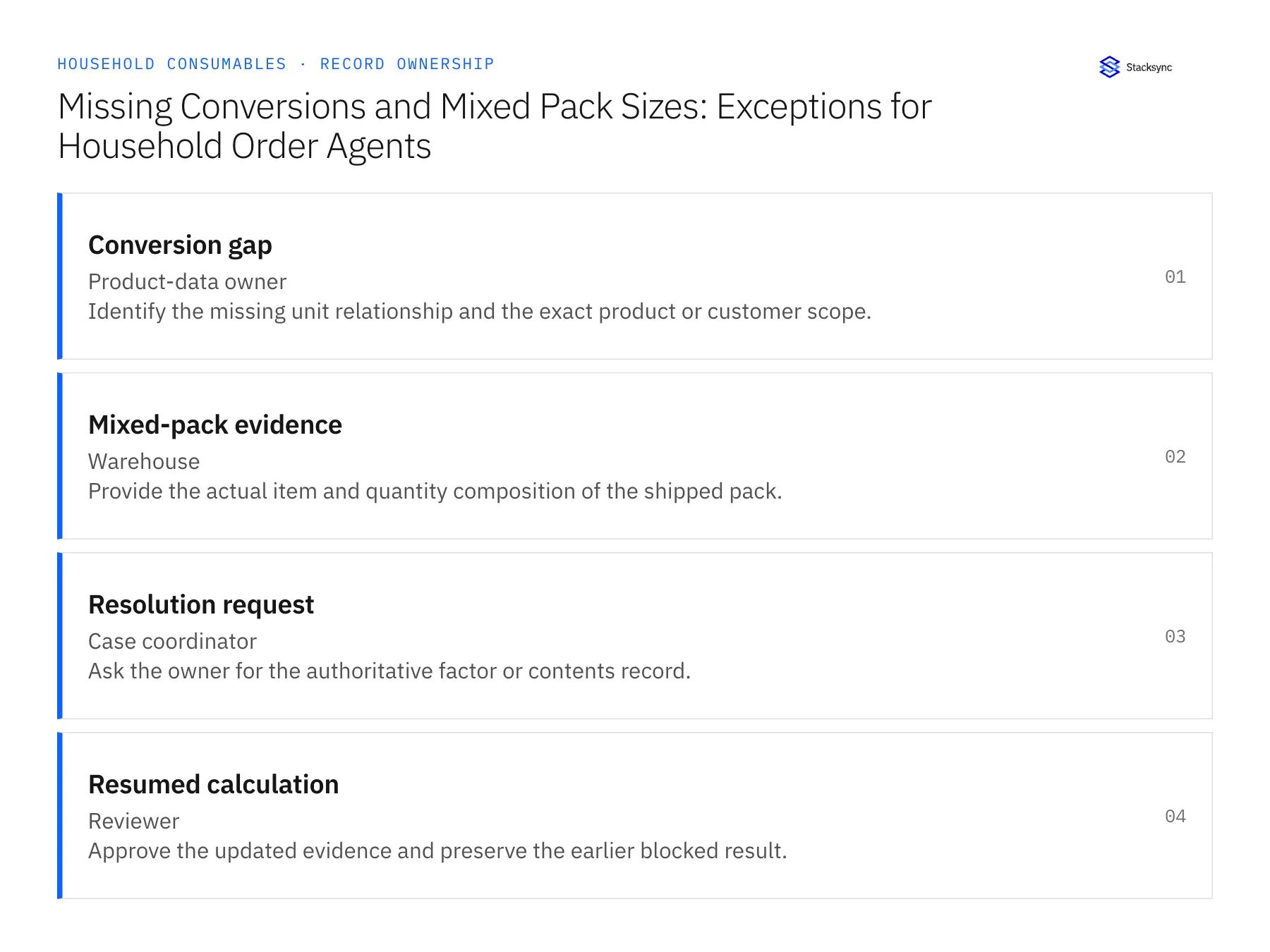
| Record | Owner | Operating rule |
|---|---|---|
| Conversion gap | Product-data owner | Identify the missing unit relationship and the exact product or customer scope. |
| Mixed-pack evidence | Warehouse | Provide the actual item and quantity composition of the shipped pack. |
| Resolution request | Case coordinator | Ask the owner for the authoritative factor or contents record. |
| Resumed calculation | Reviewer | Approve the updated evidence and preserve the earlier blocked result. |
Work through the process
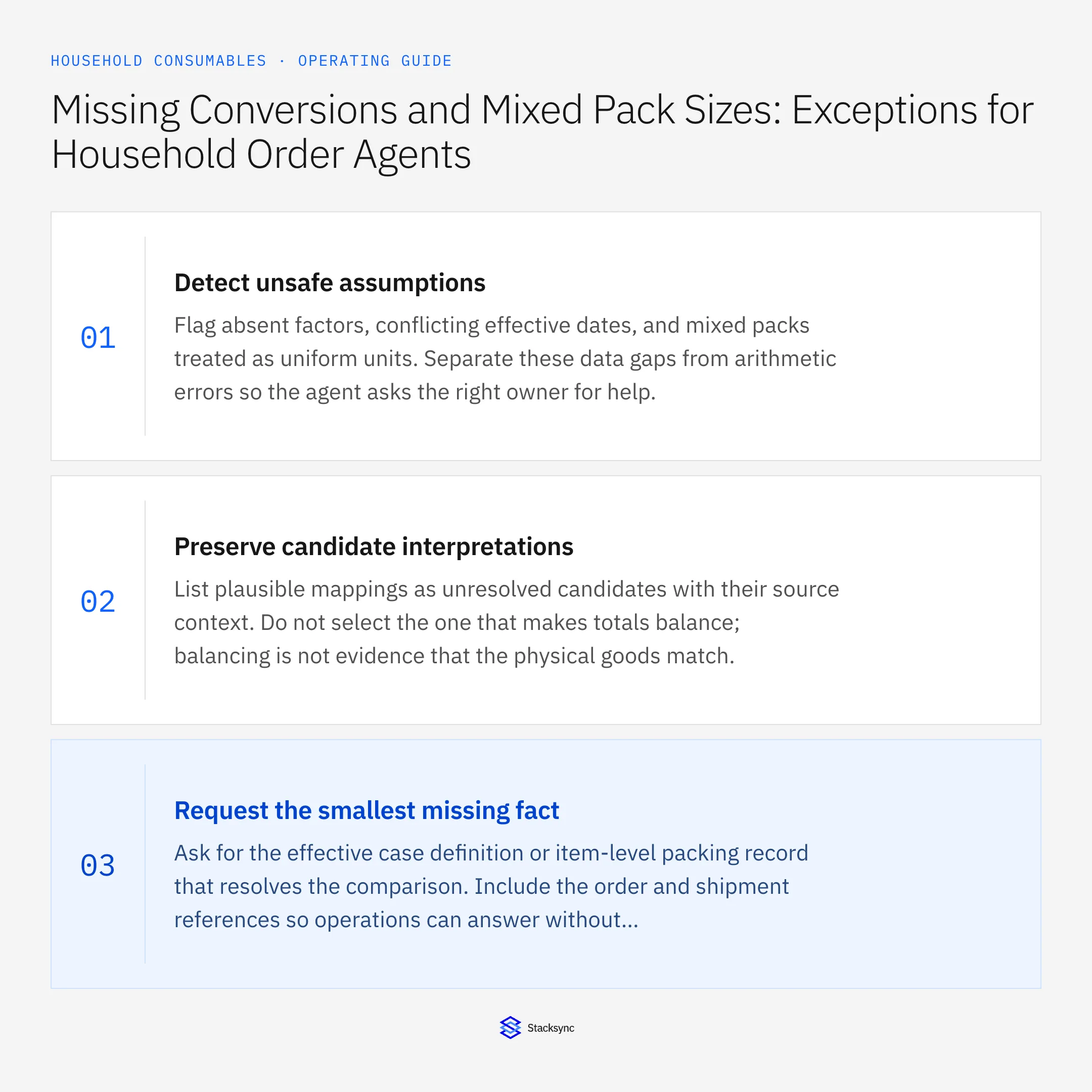
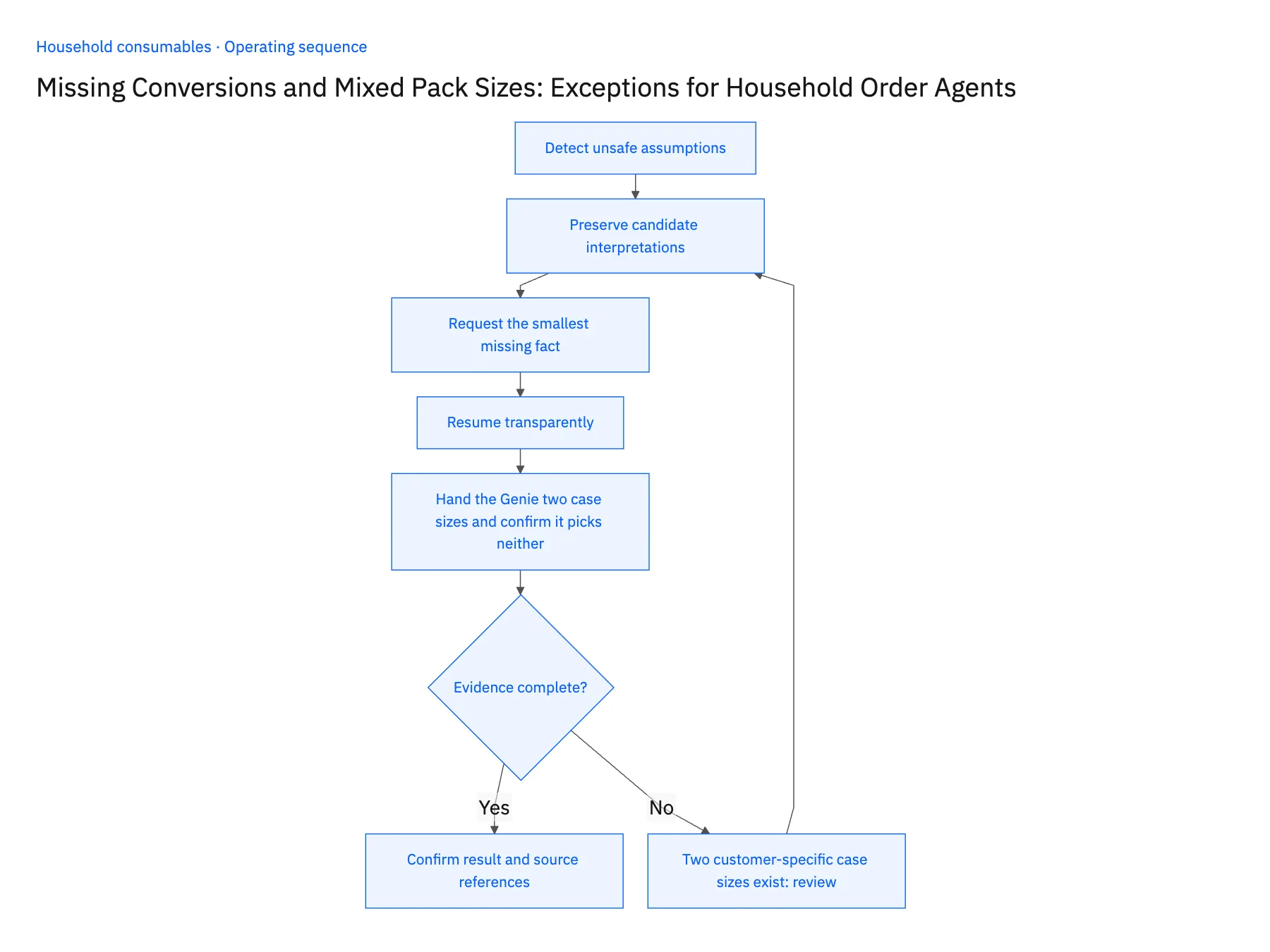
- 01Detect unsafe assumptionsFlag absent factors, conflicting effective dates, and mixed packs treated as uniform units. Separate these data gaps from arithmetic errors so the agent asks the right owner for help.
- 02Preserve candidate interpretationsList plausible mappings as unresolved candidates with their source context. Do not select the one that makes totals balance; balancing is not evidence that the physical goods match.
- 03Request the smallest missing factAsk for the effective case definition or item-level packing record that resolves the comparison. Include the order and shipment references so operations can answer without reconstructing the entire case.
- 04Resume transparentlyAfter approval, recalculate the affected figures and show the changed result. Keep any other unresolved line open instead of treating one corrected conversion as closure of the whole dispute.
- 05Hand the Genie two case sizes and confirm it picks neitherSet up a product whose records carry two customer-specific case definitions, six pouches for one distributor and twelve for another, and remove the test customer's mapping. Run the Genie against a shipment for that customer. The blocked result should name the customer and product it lacks a factor for, list both existing definitions as candidates, and leave the quantity comparison empty. Then record the approved mapping and rerun. The resumed case should show the new factor, its source, and who approved it, next to the earlier blocked state. A shortage figure computed before the mapping existed, or a candidate chosen because it balances, stops the rollout.
Handle the exceptions explicitly
Two customer-specific case sizes exist
Require the correct customer and effective mapping rather than choosing a global default.
Pack changed after the sale
Use the purchased definition unless an approved substitution or repack changes the evidence.
Owner supplies an estimate
Label it as unconfirmed and keep the financial conclusion pending.
What to verify before expanding
- An absent conversion cannot yield an approved quantity conclusion.
- A resumed case records the exact new evidence used in the calculation.
- Two customer-specific case sizes remain separate; resolving one cannot install a global conversion for every customer.
- An estimated factor stays unconfirmed and cannot close the quantity comparison or support a final financial conclusion.

Connect this process to the rest of your operation
Explore Stacksync AI agents (Genies) and scope the records and actions against your actual systems. Book a demo with a real conversion gap example and the exception your team handles most often, for example two customer-specific case sizes exist.
- AI Agents for Household Product Quantity Disputes
- AI Agents for Household Brands: Investigate Refill and Case-Quantity Disputes
- Household Products EDI: Connect Distributor Purchase Orders to Case-Level Shipments
- Shopify–NetSuite Sync for Household Brands: Map Refills, Concentrates, and Multipacks
- Beat Shopify API Rate Limits with Stacksync Real‑Time Sync
- Common EDI Errors in Supply Chain Integrations and How to Fix Them
The shared architecture guide covers record matching, ownership, and recovery across systems.
Technical references
FAQ
Frequently asked questions










Related articles