







Compare like quantities
Preserve each source unit and apply only approved product and pack relationships.
 Salesforce
  HubSpot
  NetSuite
  Zendesk
  Microsoft Dynamics 365 Sales
  Dynamics 365 F&O
  Attio
Attio  Pipedrive
  Zoho CRM
  Campfire
  Rillet
  Front
Front  Shopify
  Amazon Seller Central
  SendGrid
 Household consumables
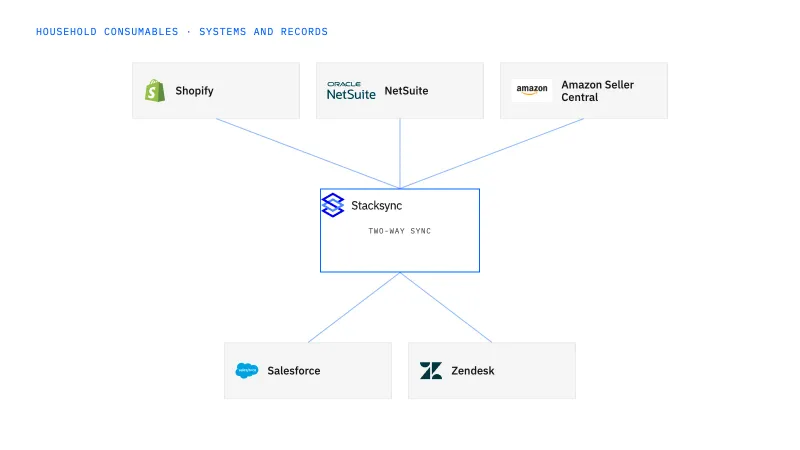
Configure a Genie to investigate refill, multipack, and case-quantity disputes using approved product relationships and actual shipment evidence. This fits teams that manually reconstruct unit conversions before responding to distributor claims. The output is a reviewable comparison and a precise list of missing facts.
The customer, invoice, and warehouse use different units, making a simple shortage claim expensive to investigate.
Explore your process in a demo, or get our shared two-way sync architecture guide.
When this fits
Cleaning, paper, refill, and household-consumable brands combining manufacturing, marketplaces, DTC, and wholesale distribution.
Preserve each source unit and apply only approved product and pack relationships.
Return cited shipment and order facts, reproducible calculations, and unresolved gaps for finance review.
The Genie reads the claim from the Gmail thread, the sold-pack definition and shipment evidence from NetSuite and Postgres, and stops there. It does not post a credit memo, edit a pack definition, or reply to the distributor. A missing or conflicting conversion halts that calculation and becomes a question for product operations. Accounts receivable and finance decide the remedy from the packet.
The process, end to end
A distributor reports missing cases while the warehouse recorded individual refill packages. A useful demo should show original quantities, the approved effective conversion, and the resulting comparison. It should also show that an unknown pack factor stops the conclusion and creates a question for product operations.
Scope your implementation
Review current platform pricing alongside the records, volume, and actions in your process. Use your own operating baseline to evaluate the economics.
Explore your process in a demo, or get our shared two-way sync architecture guide.
From foundation to action
Keep shared customer, order, and operational records aligned, with clear field ownership.
Explore two-way sync 02Move approved work between systems, assign exceptions, and confirm the result.
Explore workflows 03Investigate cross-system questions, assemble the evidence, and prepare the next action.
Explore ai agents (genies) 04Connect trading-partner documents to operational records and exception handling.
Explore ediGo deeper
A quantity-dispute Genie lines up cases, multipacks, and loose refills with their approved conversions and names the missing fact before anyone decides on a credit.
When two mixed cases lack item-level contents or a pack factor is absent, the Genie holds the comparison and asks the right owner instead of picking a number that balances.
Explore all household consumables integration and automation guides ↗
No. A plausible conversion can produce a precise but wrong answer. Missing or conflicting factors require the responsible owner’s evidence.
It keeps all three. The distributor's case count from the Gmail claim, the multipack quantity on the NetSuite invoice, and the loose refill packages in the warehouse record each stay in their own unit, with the approved conversion and its effective version shown beside them. The Genie then states the supported difference, any alternative explanation, and which fact is missing. If the shipment was repacked, it asks for the approved contents record before calculating a shortage. Finance sees a comparison it can reproduce, not a verdict.
Two-way sync between NetSuite and Postgres comes first, so order lines, the sold-pack definition, and shipment evidence sit in one place an agent can cite. Workflows follow when damaged-return dispositions or wholesale replenishment approvals need routing to an owner with the result read back. Then configure this Genie to assemble the quantity claim from Gmail, the conversions, and the shipment facts into an investigation packet for finance. EDI comes last, carrying distributor purchase orders and case-level shipment evidence that later disputes are checked against.


