AI Agents for Household Brands: Investigate Refill and Case-Quantity Disputes
A quantity-dispute Genie lines up cases, multipacks, and loose refills with their approved conversions and names the missing fact before anyone decides on a credit.
- Author
- Ignacio Malpartida · GTM Engineer
- Published
- Read time
- 5 min read

The operating decision
A household quantity-dispute Genie can compare the original sellable pack, shipment evidence, and customer claim while preserving refill, multipack, and case units. Give it approved conversions and require cited records for every material conclusion. The agent should identify the mismatch and next owner without inventing a pack factor or approving a credit.
Explore the complete household consumables integration and automation hub for the systems and processes around this guide.
What this looks like in household consumables
A distributor claims that six cases arrived short, while the warehouse records loose refill packages and the invoice uses multipacks. The numbers appear inconsistent until the approved packaging relationships are applied. The Genie can assemble that comparison, but only if it retains each source unit and the effective pack definition.
Records, ownership, and update rules
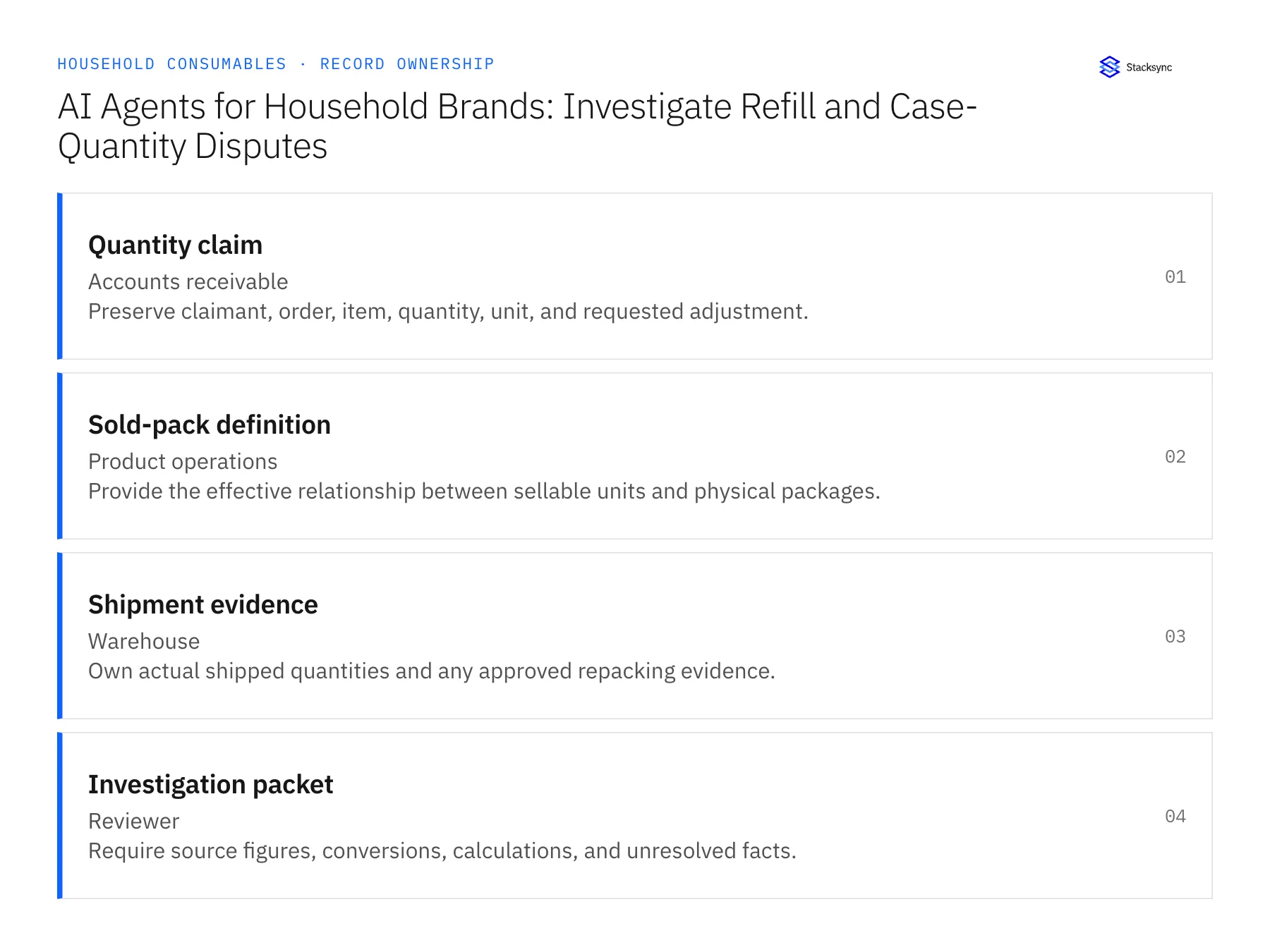
| Record | Owner | Operating rule |
|---|---|---|
| Quantity claim | Accounts receivable | Preserve claimant, order, item, quantity, unit, and requested adjustment. |
| Sold-pack definition | Product operations | Provide the effective relationship between sellable units and physical packages. |
| Shipment evidence | Warehouse | Own actual shipped quantities and any approved repacking evidence. |
| Investigation packet | Reviewer | Require source figures, conversions, calculations, and unresolved facts. |
Work through the process
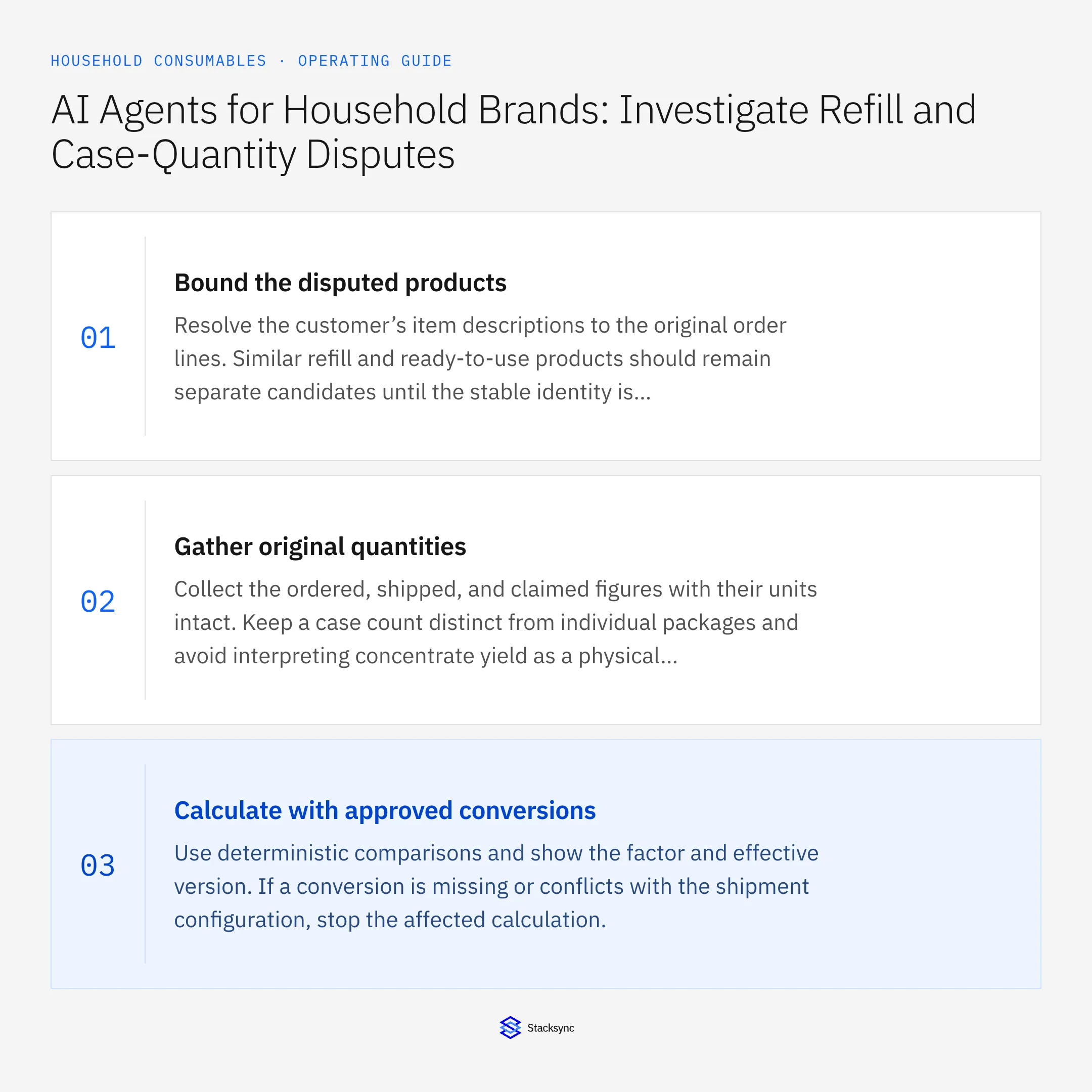
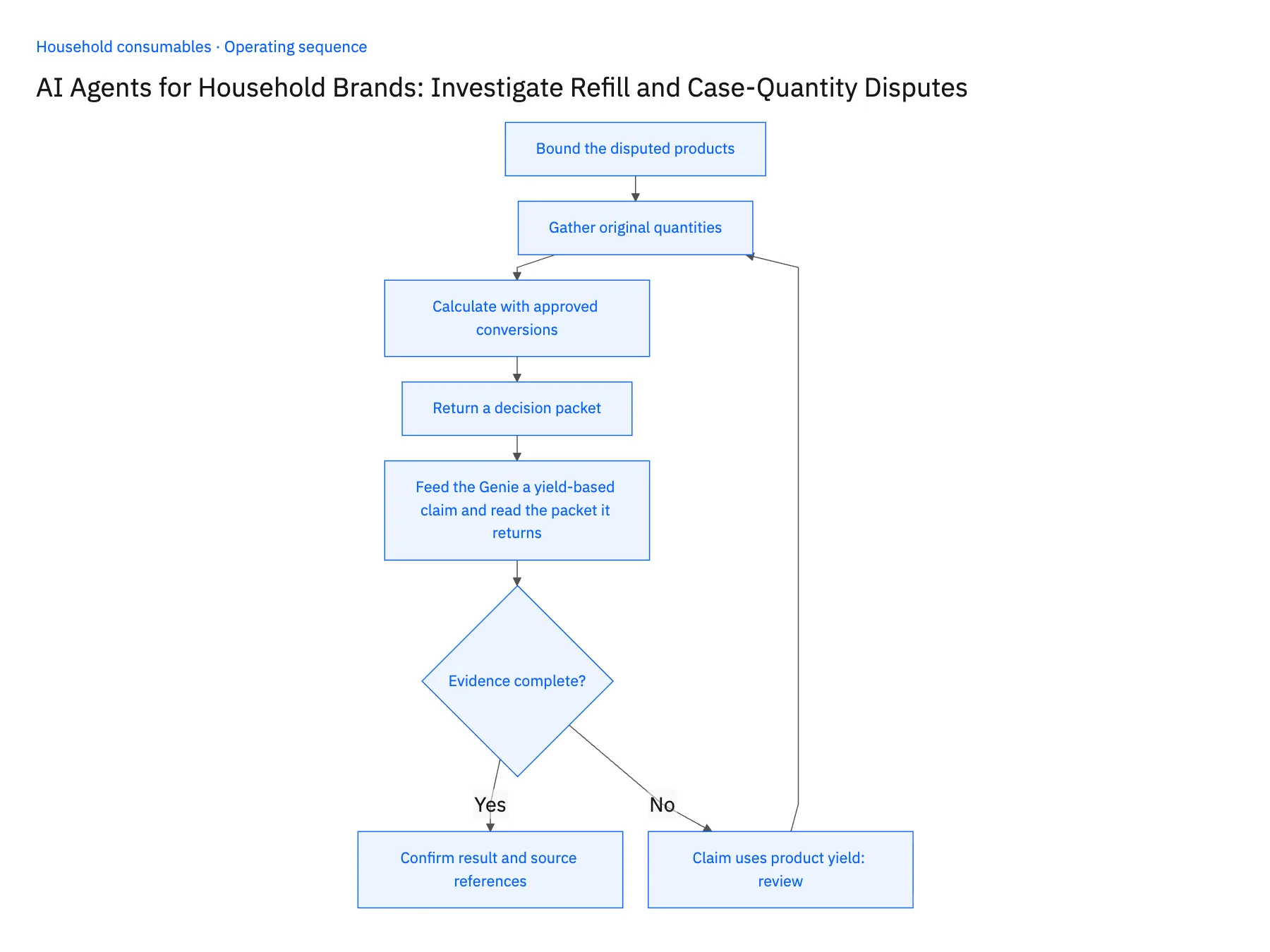
- 01Bound the disputed productsResolve the customer’s item descriptions to the original order lines. Similar refill and ready-to-use products should remain separate candidates until the stable identity is established.
- 02Gather original quantitiesCollect the ordered, shipped, and claimed figures with their units intact. Keep a case count distinct from individual packages and avoid interpreting concentrate yield as a physical quantity.
- 03Calculate with approved conversionsUse deterministic comparisons and show the factor and effective version. If a conversion is missing or conflicts with the shipment configuration, stop the affected calculation.
- 04Return a decision packetDescribe the supported discrepancy, alternative explanations, missing evidence, and responsible next team. A finance reviewer should be able to reproduce the result before accepting a remedy.
- 05Feed the Genie a yield-based claim and read the packet it returnsSend the Genie a distributor email that states a shortage in finished-use volume rather than in packages, referencing a real NetSuite order. The packet should list the ordered quantity in cases, the shipped quantity in refill packages, and the claimed figure in its original unit, each with the conversion record it applied and that record's version. The claimed line should show no physical quantity and an open question to the distributor asking for the package count. If the Genie converts the volume figure into packages, labels the gap a confirmed shortage instead of an unresolved mapping, or drafts a credit amount, the job is not ready and the rollout stops.
Handle the exceptions explicitly
Claim uses product yield
Ask for the actual package quantity involved rather than converting an advertised use amount into stock.
Shipment was repacked
Require the approved contents evidence for the new packaging.
Several orders fit the claim
Request the correct order relationship instead of matching by amount or date alone.
What to verify before expanding
- Every comparison preserves original units and approved conversion evidence.
- The packet distinguishes a verified shortage from an unresolved mapping issue.
- An advertised usage yield cannot substitute for the physical package quantity being disputed.
- A repacked shipment requires its approved contents record before the agent calculates a shortage or proposed adjustment.

Connect this process to the rest of your operation
Explore Stacksync AI agents (Genies) and scope the records and actions against your actual systems. Book a demo with a real quantity claim example and the exception your team handles most often, for example claim uses product yield.
- AI Agents for Household Product Quantity Disputes
- Missing Conversions and Mixed Pack Sizes: Exceptions for Household Order Agents
- Household Products EDI: Connect Distributor Purchase Orders to Case-Level Shipments
- Shopify–NetSuite Sync for Household Brands: Map Refills, Concentrates, and Multipacks
- How to Sync Zendesk with Salesforce: A Two-Way Integration Guide
- Beat Shopify API Rate Limits with Stacksync Real‑Time Sync
The shared architecture guide covers record matching, ownership, and recovery across systems.
Technical references
FAQ
Frequently asked questions










Related articles