

















Common EDI Errors in Supply Chain Integrations and How to Fix Them
Discover the most common EDI errors in supply chain integrations, from mapping failures to ASN mismatches, and learn practical strategies to prevent chargebacks.
- Author
- Ruben Burdin · Founder & CEO
- Published
- Updated
- Read time
- 15 min read

Why EDI Errors Persist in Modern Supply Chains
Electronic Data Interchange handles millions of supply chain transactions daily, from purchase orders and invoices to advance ship notices and inventory updates. When EDI works, it removes manual data entry, accelerates order cycles, and keeps trading partners aligned. When it breaks, the consequences hit fast: chargebacks, shipment delays, inventory discrepancies, and strained partner relationships.
Key Takeaways
- Financial impact: EDI errors can cost businesses 1–5% of gross invoice amounts in retailer chargebacks. A company shipping $80 million annually may face up to $4 million in deductions.
- ASN risk: ASN (Advance Ship Notice) errors generate the highest chargebacks in retail supply chains because mismatches between electronic notifications and physical shipments disrupt receiving and inventory planning.
- Root cause: Most EDI errors stem from data synchronization gaps between ERP, warehouse management, and EDI systems rather than transmission failures.
- Real-time prevention: Real-time integration between warehouse operations and EDI transmission removes batch delays that cause ASN mismatches and content errors.
- Operational cost: Each EDI dispute takes roughly 2 hours to resolve, and 5–25% of inbound receiving orders experience preventable issues that proper validation and configuration can avoid.
The problem is that EDI was designed decades ago, and the supply chains it supports have grown far more complex than the original standards anticipated. A single retailer may require a unique variation of what should be a standard EDI 850 purchase order. One automotive manufacturer discovered they needed 47 different mapping variations for the same transaction type across their supplier base.
This guide breaks down the most common EDI errors in supply chain integrations, explains why they happen, and provides practical approaches to prevent them from draining your margins and your team's time.
Message Content Errors: The Most Frequent Offender
Content errors occur when an EDI document contains missing, incorrect, or malformed data. These are the errors that show up most often and cause the most direct financial damage through chargebacks and rejected transactions.
What Content Errors Look Like in Practice
A content error can be as simple as a wrong item number (GTIN) in a purchase order acknowledgment or a missing invoice recipient GLN (Global Location Number). In EDIFACT transactions, this might appear as a missing NAD+IV segment. In ANSI X12, it could be an invalid element in the N1 loop of an 810 invoice.
Common content error scenarios include:
- Incorrect pricing that does not match the agreed contract terms
- Wrong or missing product identifiers (UPC, EAN, GTIN)
- Quantity mismatches between purchase orders and acknowledgments
- Invalid date formats or missing required date fields
- Truncated address data that fails validation at the receiver
Why Content Errors Happen
Two root causes account for many content errors: stale master data and incomplete onboarding. When a supplier changes a product code in their ERP but that change does not propagate to the EDI mapping layer, every subsequent transaction carries the wrong identifier. When a new trading partner is onboarded without testing all message variants, edge cases surface in production as rejected documents.
EDIFACT and X12 formats were not designed for human readability. Catching errors in raw EDI segments requires specialized knowledge that is increasingly rare. Manual error detection in these formats is time-consuming and still misses issues that only surface when the receiving system tries to parse the document.
How to Prevent Content Errors
The most effective prevention strategy is automated validation before transmission. Pre-send validation rules check that required fields are present, formats match the trading partner's specification, and values fall within acceptable ranges. This catches errors before they leave your system, not after your trading partner rejects the document.
Maintaining accurate master data is the other critical factor. When product codes, pricing, or partner identifiers change in your ERP, those changes need to reach your EDI system immediately. Any delay between the ERP update and the EDI mapping creates a window where outbound documents carry outdated information.
Platforms like Stacksync address this gap by synchronizing data between your ERP and database in real time, so master data changes reach connected systems sooner and outbound documents carry less stale data. Instead of parsing ancient EDI file formats manually, Stacksync converts incoming EDI documents directly into database tables and transforms outgoing data back into compliant EDI formats, reducing the surface area for content errors.
Mapping Failures: When Standards Are Not Standard
EDI standards like EDIFACT, ANSI X12, and GS1 provide a common framework, but every trading partner interprets and extends these standards differently. Mapping failures happen when the translation between your internal data model and a trading partner's EDI requirements breaks down.
The Scale of the Mapping Problem
A standard EDI 850 purchase order looks different depending on which retailer sends it. Walmart, Target, Amazon, and Home Depot each require different field arrangements, segment qualifiers, and conditional logic within the same transaction set. A supplier working with 50 retailers may need to maintain 50 distinct mapping profiles for a single document type.
This complexity multiplies across transaction types. An EDI 856 ASN (Advance Ship Notice) requires precise alignment between shipment data and the original purchase order. An EDI 810 invoice must match both the ASN and the PO. Each document in the chain depends on accurate mapping from the previous step.
Where Mapping Breaks Down
Mapping failures cluster around a few predictable scenarios:
- 01A trading partner updates their EDI specification without adequate notice
- 02A new product category requires fields that the existing map does not include
- 03Regional differences between EDIFACT (international) and X12 (North America) create translation gaps
- 04Custom extensions to standard segments are not reflected in the mapping configuration
- 05Version mismatches between EDI standards (X12 4010 vs 5010) cause parsing failures
How to Prevent Mapping Failures
Partner-specific mapping profiles should be version-controlled and tested against sample transactions before going live. When a trading partner announces a specification change, the updated mapping needs to be validated in a test environment before production traffic switches over.
Automated regression testing catches mapping issues before they affect live transactions. By replaying historical transactions through updated mappings, you can identify field-level discrepancies without risking chargebacks on real orders.
| Error Type | Primary Cause | Prevention Strategy |
|---|---|---|
| Message Content | Stale master data or incomplete partner onboarding | Automated pre-send validation and real-time data sync |
| Mapping Failures | Partner-specific format variations and spec changes | Version-controlled profiles with regression testing |
| ASN Mismatches | Lag between warehouse operations and EDI transmission | Real-time WMS-to-EDI synchronization |
| Sequence Errors | Missing predecessor documents in the transaction chain | ERP rules preventing release without prior confirmations |
| Routing Errors | Incorrect sender/receiver IDs in message headers | Master data validation and ERP-level error visibility |
| Configuration Gaps | Missing EDI setup for new partners or locations | Automated setup routines and mandatory config checks |
| Connection Failures | AS2, SFTP, or VAN connectivity disruptions | Proactive monitoring with automatic retry and alerting |
Key Takeaways
Content and mapping errors cause the majority of chargebacks because they reach trading partners before anyone catches them.
ASN mismatches are the single most penalized error type in retail supply chains, often triggering fines per SKU or per order.
Most EDI errors trace back to data synchronization gaps between ERP, warehouse, and EDI systems rather than protocol failures.
ASN Errors: The Chargeback Trigger
The EDI 856 Advance Ship Notice is the document most likely to generate chargebacks in retail supply chains. ASN errors happen when the data in the electronic notification does not match what physically arrives at the receiving dock. Retailers use ASN data to plan receiving labor, allocate warehouse space, and update inventory systems before the truck arrives. When the ASN is wrong, the entire receiving process breaks.
Common ASN Failure Modes
ASN mismatches take several forms:
- Quantity discrepancies between the ASN and actual carton contents
- Missing or incorrect SSCC-18 labels that do not match ASN data
- Late transmission that arrives after the shipment reaches the dock
- Wrong ship-to location codes that misdirect inventory allocation
- Carton count errors that force manual verification of the entire shipment
Retailers like Walmart, Target, and Costco impose per-incident fines for ASN errors. These penalties typically range from $75 to several hundred dollars per infraction, multiplied by the number of affected SKUs or cartons. For a supplier shipping thousands of orders monthly, even a small ASN error rate generates significant costs.
The Root Cause: Data Lag Between Warehouse and EDI
Most ASN errors trace back to timing. The warehouse picks, packs, and stages a shipment. At some point, that physical activity needs to generate an EDI 856. If the connection between the warehouse management system and the EDI platform relies on batch exports (hourly, or even every 15 minutes), the ASN may not reflect last-minute changes like substitutions, short-picks, or pallet reconfigurations.
The fix requires real-time data flow between warehouse operations and the EDI transmission layer. When a warehouse worker scans the last carton onto a pallet, the ASN should generate immediately from the actual shipment data, not from a scheduled export that may already be stale.
Stacksync provides this real-time bridge for EDI operations. Faster source updates reduce how stale the data behind an outbound document can be, but an ASN matches the physical shipment only when the warehouse confirms the final pick and pack state before the document is generated. The platform parses incoming EDI documents directly into database tables and converts outgoing data back into compliant EDI formats, removing the batch windows that cause many ASN mismatches.
Sequence and Routing Errors: The Silent Blockers
Sequence errors and routing errors do not always trigger immediate chargebacks, but they block transactions from completing and create backlogs that cascade through the order cycle.
Message Sequence Errors
EDI transactions follow a defined workflow. A purchase order (850) generates an order acknowledgment (855), which enables a ship notice (856), which precedes an invoice (810). If a document in this chain fails to transmit, downstream documents get rejected because the receiving system has no context for them.
A buyer who has not received an order response may reject a subsequent advance ship notice. An invoice sent without a corresponding ASN may be held for manual review. These dependencies mean that a single failed transmission can freeze an entire order cycle until someone identifies and resolves the gap.
Prevention requires rules in your ERP system that prevent a document from being released until the preceding document has been confirmed. If the 855 has not been acknowledged, the system should hold the 856 rather than sending it into a rejection.
Routing Errors
Routing errors occur when EDI message headers contain incorrect sender or receiver identifiers. In EDIFACT, this means wrong UNB interchange sender/receiver IDs. In X12, it means incorrect ISA segment qualifiers. The message transmits successfully at the protocol level but gets rejected or misrouted at the application level because the receiving system does not recognize the sender.
These errors typically stem from incorrect master data configuration when onboarding new trading partners or new locations for existing partners. A new distribution center, a changed VAN provider, or an updated interchange ID that was not reflected in the ERP all generate routing failures.
The fix involves making routing configurations visible directly in the ERP interface so business users can spot and correct misconfigurations without waiting for EDI specialists. Automated setup routines that require complete routing configuration before a new partner record can be saved prevent these errors from reaching production.
Connection Failures: When the Pipe Breaks
Connection errors happen at the transport layer, between your EDI system or VAN and your trading partner's EDI system or VAN. Unlike content or mapping errors that involve data quality, connection failures mean documents never reach their destination.
Common Connection Failure Scenarios
- AS2 server downtime at either endpoint
- Expired SSL certificates blocking SFTP connections
- VAN maintenance windows that overlap with critical transmission schedules
- Firewall changes that block previously whitelisted connections
- DNS resolution failures for partner endpoints
Why Connection Errors Are Different
You cannot fully prevent connection errors because EDI relies on distributed systems where you do not control every node. Your trading partner's AS2 server going offline is not something your validation rules can catch. The best mitigation is detection speed and automatic recovery.
Proactive connection monitoring identifies transmission failures within seconds rather than hours. Automatic retry logic with exponential backoff handles transient failures without human intervention. Alerting systems notify the right teams when retries are exhausted so they can escalate with the trading partner or VAN.
The Financial Impact of EDI Errors on Supply Chains
EDI errors are not abstract technical problems. They translate directly into financial penalties, operational overhead, and damaged trading partner relationships.
Chargebacks and Compliance Fines
Retailer chargebacks for EDI non-compliance typically range from 1% to 5% of the supplier's gross invoice amount. A company shipping $80 million in goods annually could face up to $4 million in deductions. Individual infractions generate penalties from $75 to several thousand dollars, and these are often multiplied by the number of affected orders or SKUs.
The EDI 856 ASN drives the most chargebacks. Late ASNs, quantity mismatches, and labeling errors account for the largest share of retailer deductions. Invoice errors (EDI 810) and purchase order acknowledgment issues (EDI 855) contribute the remainder.
Operational Cost of Error Resolution
Each EDI dispute requires approximately 2 hours to resolve. Research from GS1 indicates that 5-25% of inbound receiving orders encounter problems that could have been prevented through proper validation and configuration. For a supplier processing thousands of orders per week, this translates to a full-time team dedicated to EDI error resolution instead of value-adding work.
Relationship Damage
Chronic EDI errors erode trading partner confidence. Retailers track supplier performance through scorecards that weigh EDI compliance alongside fill rates, on-time delivery, and quality metrics. Repeated violations can result in reduced order allocations, loss of preferred supplier status, or termination of the trading relationship.

Building an EDI Error Prevention Strategy
Preventing EDI errors requires addressing the three layers where problems originate: data quality, system integration, and operational processes.
Layer 1: Data Quality and Master Data Governance
Master data accuracy is the foundation. Product identifiers, partner codes, pricing, and location data must be consistent across your ERP, warehouse management system, and EDI platform. Any discrepancy between these systems will eventually surface as a content error in an outbound EDI document.
Governance processes should include:
- Automated validation when master data records are created or modified
- Mandatory fields that prevent incomplete records from being saved
- Regular reconciliation between ERP master data and trading partner requirements
- Change management workflows that update all downstream systems when a record changes
Layer 2: Real-Time System Integration
The majority of EDI errors trace back to data synchronization failures between internal systems. When your ERP, WMS, and EDI platform operate on different update schedules, the gaps between them become error-producing windows.
Real-time integration closes these windows. When a product code changes in the ERP, the EDI mapping should reflect that change immediately. When a warehouse completes a shipment, the ASN should generate from live data, not from a batch export that ran 30 minutes ago.
Stacksync eliminates these batch windows for EDI operations. The platform synchronizes data between your ERP, database, and EDI systems in real time, so outbound documents are generated from current business data rather than a stale export. With pre-built EDI connectors for retailers, distributors, and suppliers, teams can go live in days instead of the months required by traditional EDI middleware. Manage your supply chain data with the simplicity of SQL queries rather than legacy file parsers.
Layer 3: Monitoring and Operational Visibility
EDI cannot be a black box. Business teams in procurement, sales, and logistics need visibility into EDI message status so they can react to issues before they become chargebacks.
Effective monitoring includes:
- 01Real-time dashboards showing transmission status for all active trading partners
- 02Automated alerts when documents fail validation, transmission, or acknowledgment
- 03Error classification that distinguishes between data issues (fixable internally) and connection issues (requiring partner coordination)
- 04Historical error analytics that identify recurring patterns and their root causes
Apply this in household consumables: distributor item and purchase-order line
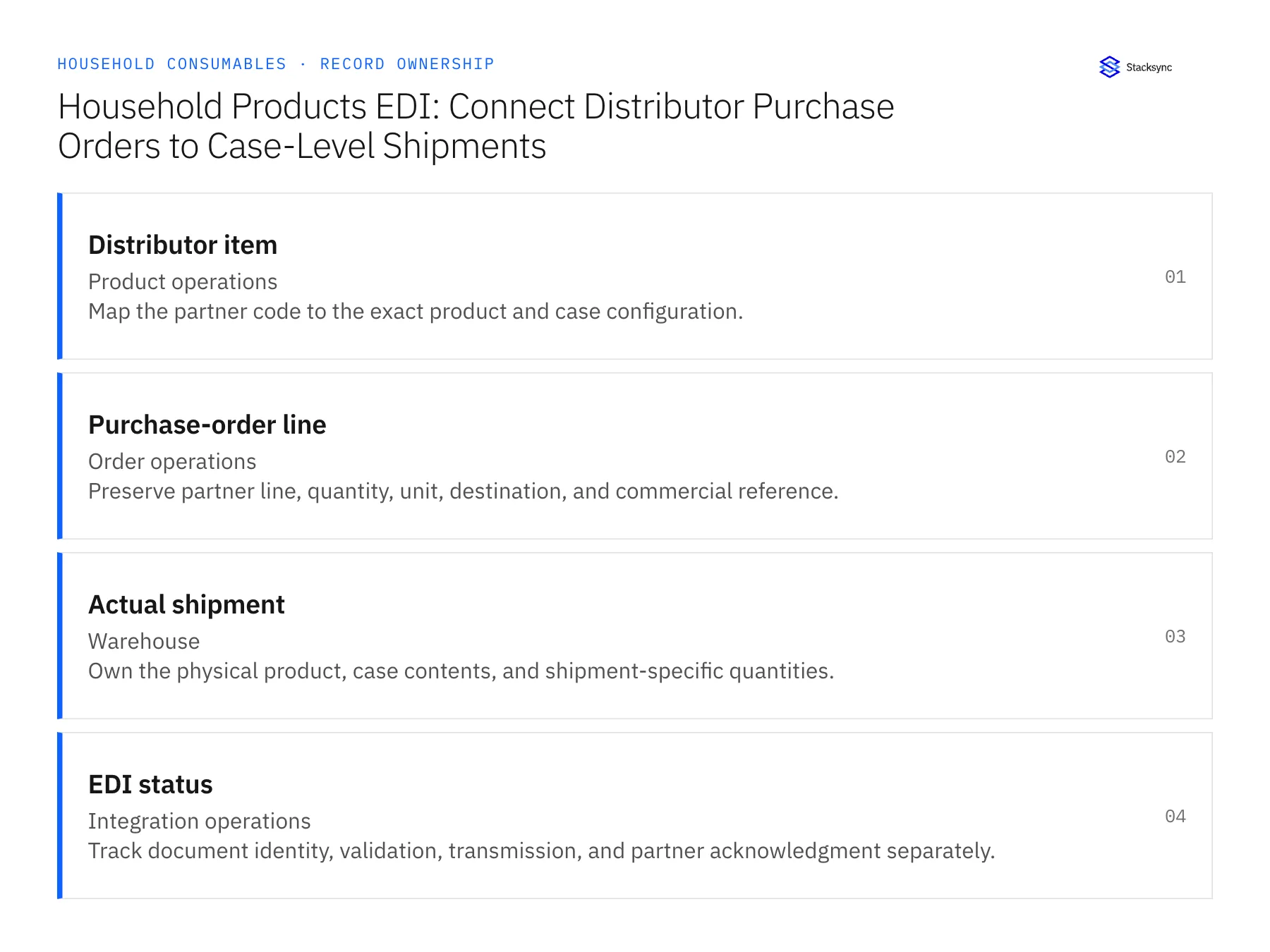
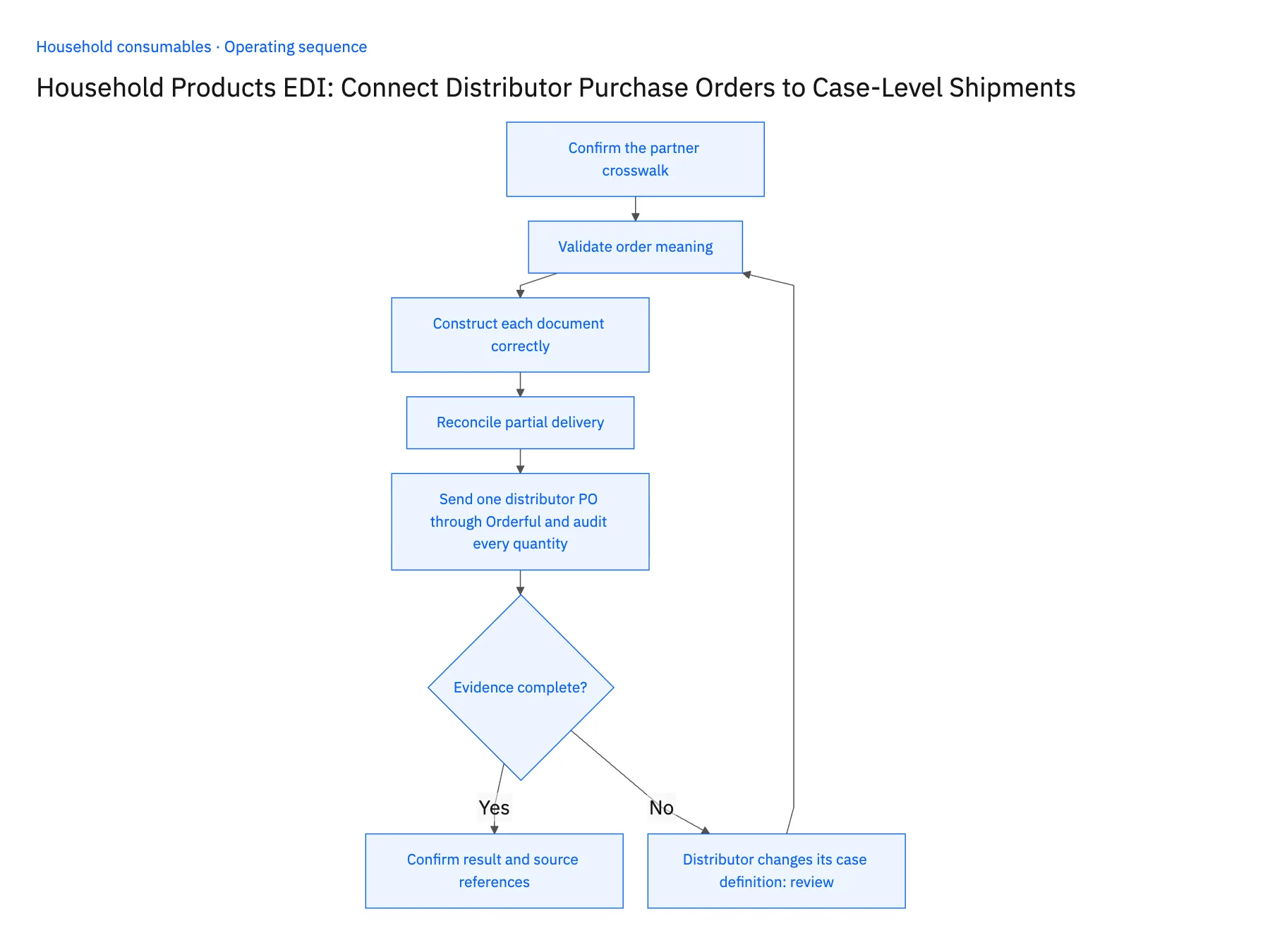
Household distributor documents can pass syntax checks while using an ecommerce multipack in place of the ordered case. The linked guide applies item, unit, destination, and effective-pack checks to that business error before the ERP order or shipment document is accepted.
| Record to reconcile | Responsible owner | Rule to preserve |
|---|---|---|
| Distributor item | Product operations | Map the partner code to the exact product and case configuration. |
| Purchase-order line | Order operations | Preserve partner line, quantity, unit, destination, and commercial reference. |
| Actual shipment | Warehouse | Own the physical product, case contents, and shipment-specific quantities. |
An exception to plan for: Distributor changes its case definition. Version the mapping and review open orders before applying the new factor. Acceptance check for the pilot: distributor cases cannot silently inherit an ecommerce multipack definition.
The household consumables hub connects the broader operating context. These guides develop the specific record mappings and decisions for this application:
Eliminate EDI Complexity Before It Becomes Chargebacks
EDI errors are preventable, but prevention requires systems that keep data synchronized across your ERP, warehouse, and trading partner connections without batch delays or manual handoffs. The pattern behind most EDI failures is the same: data changes in one system and does not reach another system before a transaction fires.
Closing that gap means replacing batch-oriented integration with real-time data synchronization across every system in your supply chain. Six capabilities (real-time sync, workflow automation, event queues, databases, EDI, and monitoring) on one platform, without stitching together separate tools for each function.
Explore how Stacksync transforms legacy EDI complexity into simple database interactions, with pre-built connectors for trading partners and real-time synchronization that reduces the data lag behind many EDI errors.
FAQ
Frequently asked questions










Related articles