Manufacturing warranty parts: connect service requests to an approved replacement order
A failed pump case moves from customer asset label to manufacturer serial, coverage ruling and approved replacement package, with separate sign-offs before the order is placed.
- Author
- Ignacio Malpartida · GTM Engineer
- Published
- Read time
- 4 min read

The operating decision
A warranty-parts handoff should connect the service case to the installed asset, coverage decision, compatible replacement and approved order. These are separate records with different owners. Automate the collection of serial history, shipment evidence and available stock, then route technical and commercial exceptions to service and finance. A customer saying a part is under warranty does not establish eligibility, and a part with a similar description is not automatically an approved replacement.
Explore the complete manufacturing integration and automation hub for the systems and processes around this guide.
What this looks like in manufacturing
An industrial manufacturer receives a service case for a failed pump on an older machine. The customer supplies its own asset label, while the ERP stores the original machine serial and a later replacement assembly. Service wants to help quickly, but the current catalog part may require an adapter that was not present in the original build. The handoff needs to resolve the installed configuration, establish the applicable coverage and prepare the correct replacement package before order management allocates stock or finance approves a no-charge transaction.
Records, ownership, and update rules
| Record | Owner | Operating rule |
|---|---|---|
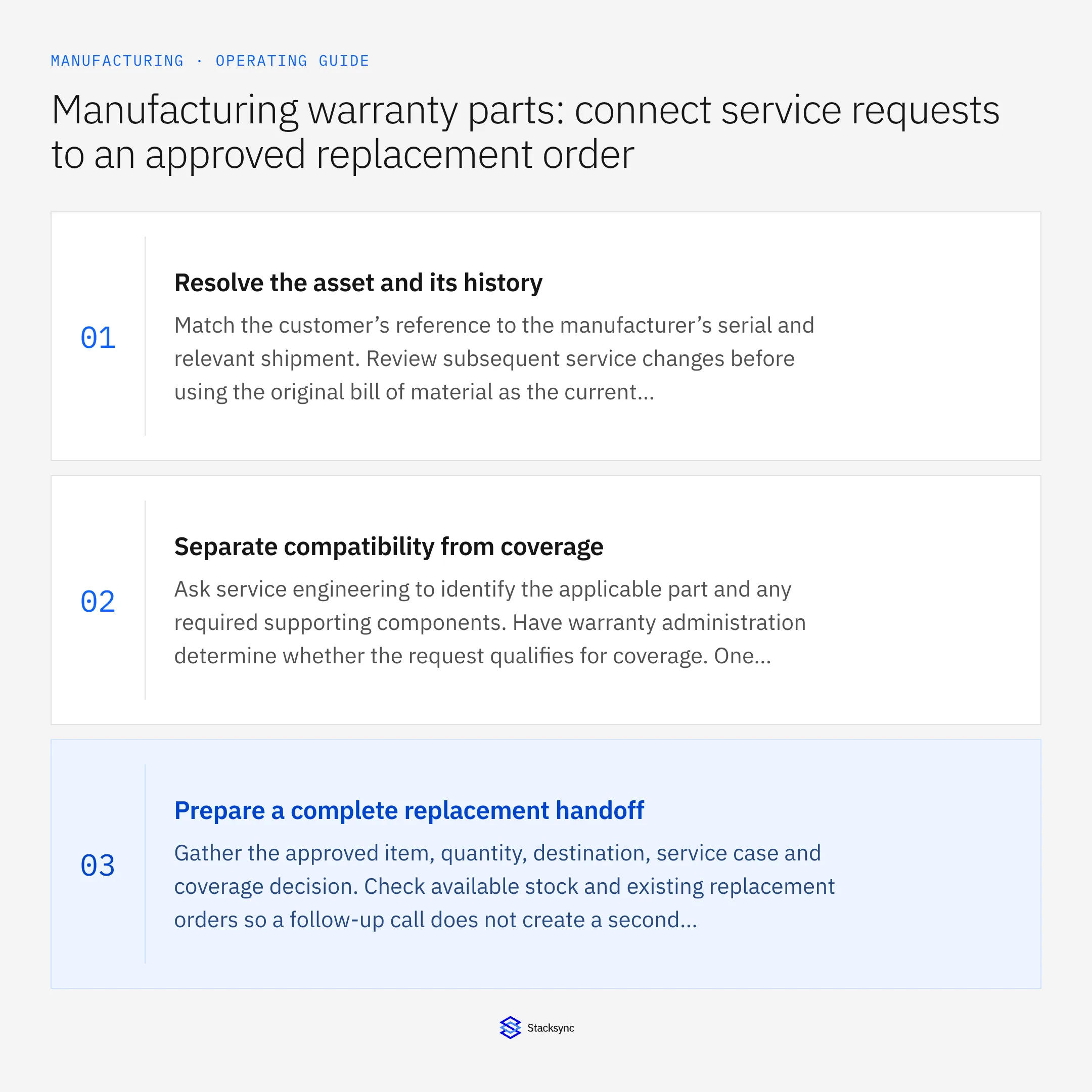
| Service case | Service operations | Keep the reported failure, customer asset reference and requested remedy linked to the original request. |
| Installed asset | Service engineering | Resolve manufacturer serial, shipped configuration and any approved field modifications. |
| Coverage decision | Warranty administration | Record eligibility, limits and the approving owner separately from technical diagnosis. |
| Replacement request | Order management | Preserve the approved part, quantity, delivery location and financial treatment before preparing an order. |
Work through the process
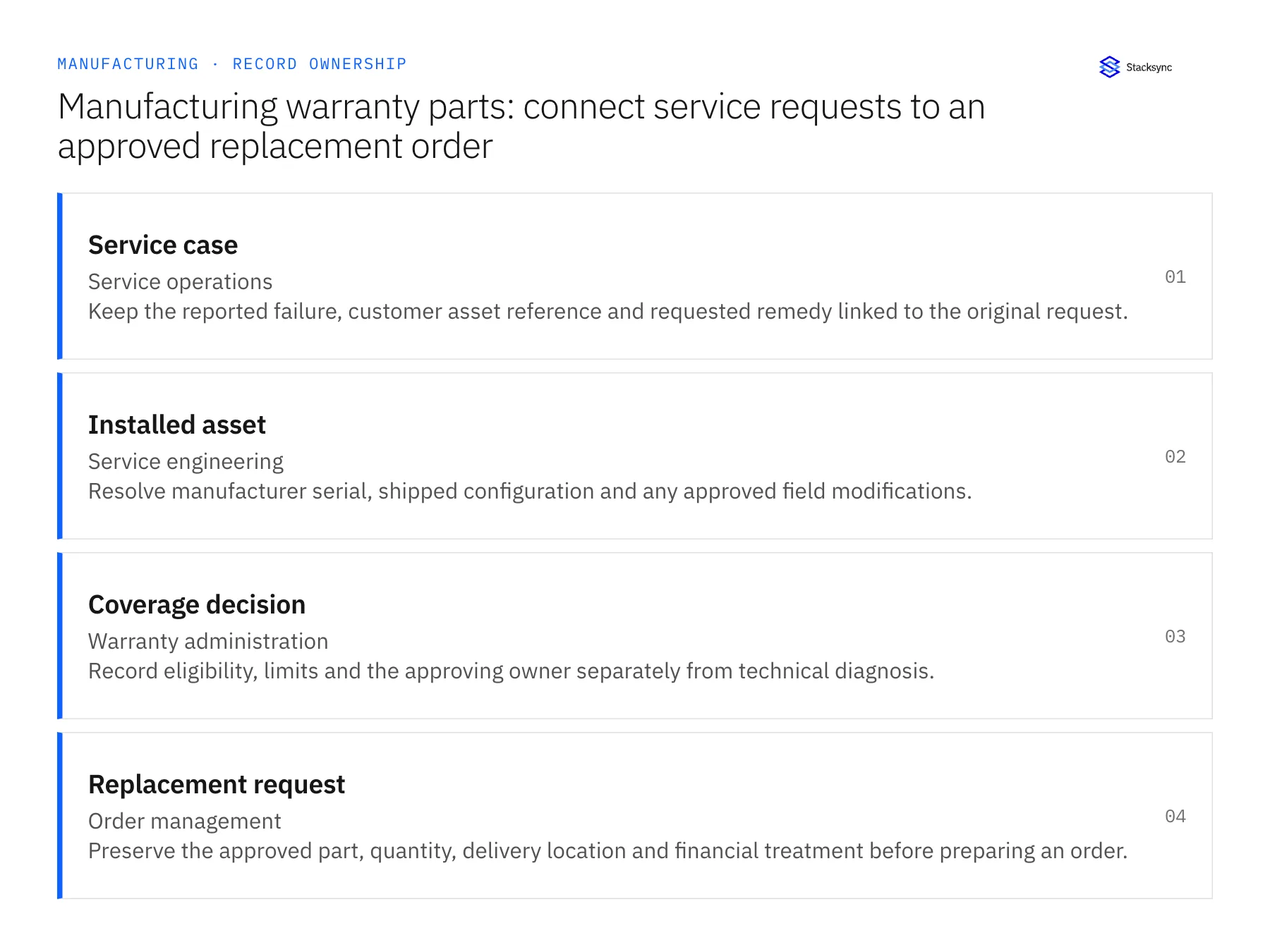
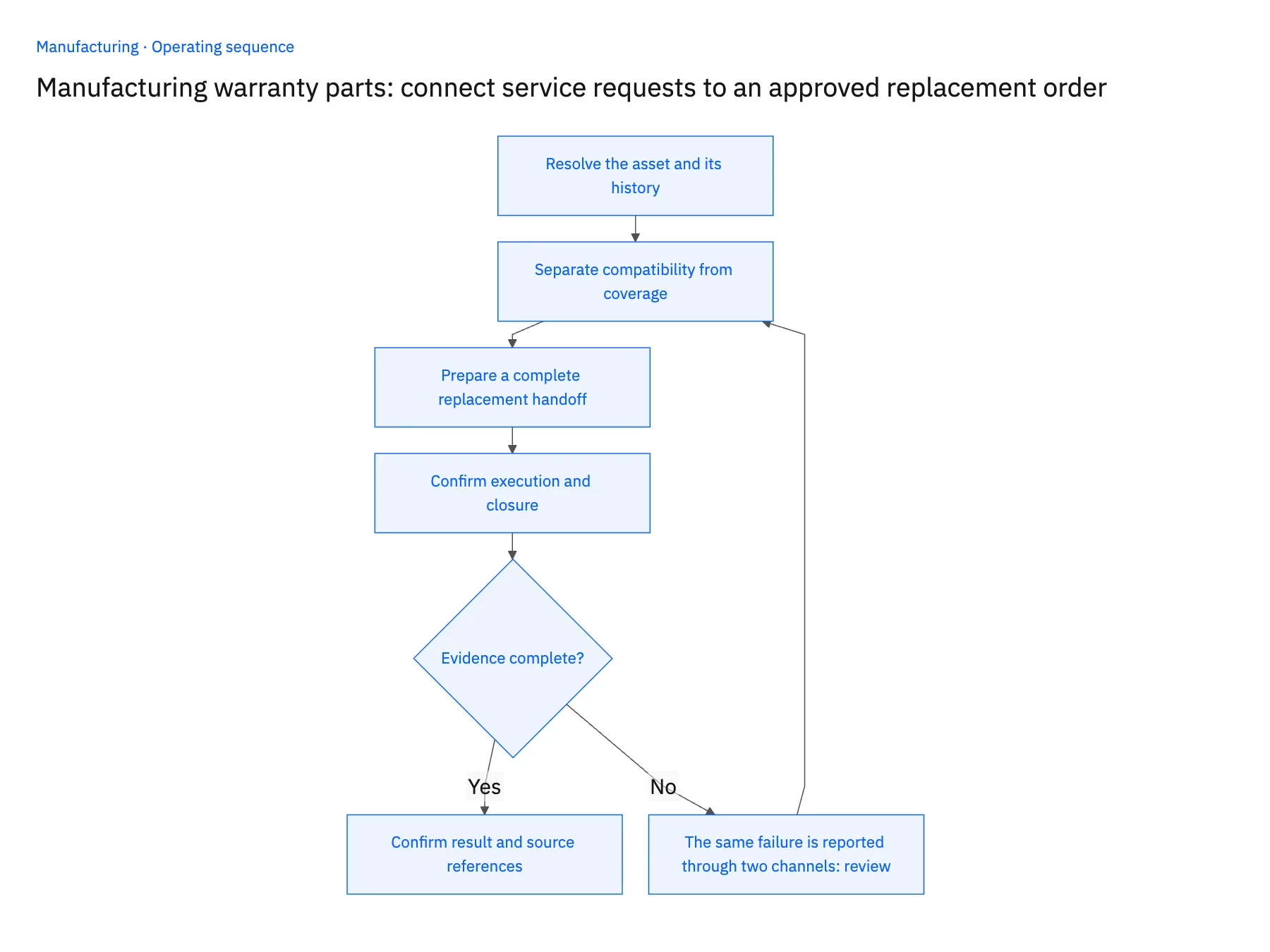
- 01Resolve the asset and its historyMatch the customer’s reference to the manufacturer’s serial and relevant shipment. Review subsequent service changes before using the original bill of material as the current installed configuration. Route unidentified or conflicting assets to service operations for clarification.
- 02Separate compatibility from coverageAsk service engineering to identify the applicable part and any required supporting components. Have warranty administration determine whether the request qualifies for coverage. One approval must not imply the other: a technically correct part may still require a commercial quote.
- 03Prepare a complete replacement handoffGather the approved item, quantity, destination, service case and coverage decision. Check available stock and existing replacement orders so a follow-up call does not create a second shipment. Record any installation prerequisite that affects whether the replacement will solve the problem.
- 04Confirm execution and closureUse the verified order operation and retain its accepted reference on the case. Track shipment and required return obligations separately. Service closes the case when the agreed remedy is confirmed, not merely when a replacement order number exists.
Handle the exceptions explicitly
The same failure is reported through two channels
Link duplicate cases to one replacement decision and order reference. Preserve both conversations without treating them as two independent entitlements.
A superseded part requires an adapter
Include the approved kit or supporting items in the proposal. Do not substitute a new part solely because the catalog marks the old one inactive.
The customer disputes coverage
Keep the technical recommendation available while routing the commercial decision to warranty administration. Avoid delaying evidence collection or granting an unauthorized credit.
What to verify before expanding
- A replacement proposal identifies the installed machine and current applicable configuration.
- Technical compatibility and financial coverage have separately traceable approvals.
- Repeated service requests do not create duplicate replacement orders.
- Case closure reflects the agreed remedy and any return requirement rather than order creation alone.

Connect this process to the rest of your operation
Explore Stacksync workflows and scope the records and actions against your actual systems. Book a demo with a real service case example and the exception your team handles most often, for example the same failure is reported through two channels.
- Manufacturing order revisions after production release: automate the review handoff
- AI agents for manufacturing order intake: turn email and PDFs into reviewable ERP drafts
- Manufacturing AI order intake exceptions: SKU, unit-of-measure and duplicate checks
- Acumatica to Salesforce Sales Order Sync: Mapping, Status, and Backfill
- Making SQL Server and NetSuite Agree on the Same Record
The shared architecture guide covers record matching, ownership, and recovery across systems.
Technical references
FAQ
Frequently asked questions










Related articles