Manufacturing AI order intake exceptions: SKU, unit-of-measure and duplicate checks
Item identity, unit conversion, revision precedence and duplicate requests each get their own check, so a forwarded PO or an old pack description does not become accepted demand.
- Author
- Ignacio Malpartida · GTM Engineer
- Published
- Read time
- 5 min read

The operating decision
Manufacturing AI order intake becomes useful when it handles ambiguity explicitly. Build separate checks for item identity, unit conversion, revision precedence and duplicate requests. Each exception should identify the blocked line, show the conflicting evidence and name the person who can resolve it. A Genie can investigate and propose a correction, but it should not turn a similar SKU, an assumed pack count or a repeated customer email into an accepted production requirement.
Explore the complete manufacturing integration and automation hub for the systems and processes around this guide.
What this looks like in manufacturing
A component supplier receives a PO for twelve reels. The customer part number matches a known item, but the pack size changed last quarter and the attachment still shows the older description. A second employee forwards the same order later with a new subject line. A basic extraction workflow can create two orders using the wrong base quantity. A defensible exception process checks the customer-item agreement, the effective pack definition and the customer PO identity before presenting one reviewed order proposal.
Records, ownership, and update rules
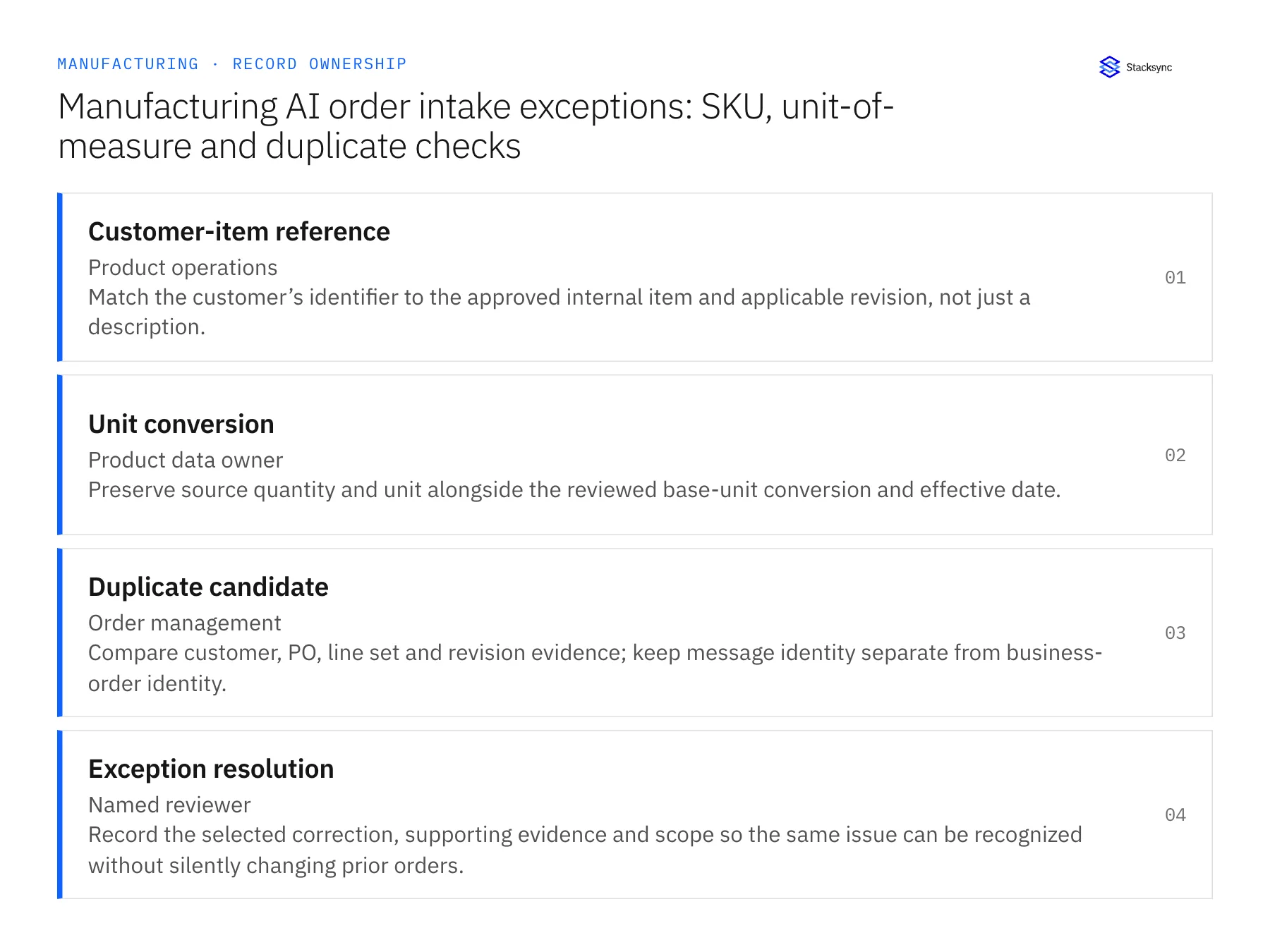
| Record | Owner | Operating rule |
|---|---|---|
| Customer-item reference | Product operations | Match the customer’s identifier to the approved internal item and applicable revision, not just a description. |
| Unit conversion | Product data owner | Preserve source quantity and unit alongside the reviewed base-unit conversion and effective date. |
| Duplicate candidate | Order management | Compare customer, PO, line set and revision evidence; keep message identity separate from business-order identity. |
| Exception resolution | Named reviewer | Record the selected correction, supporting evidence and scope so the same issue can be recognized without silently changing prior orders. |
Work through the process
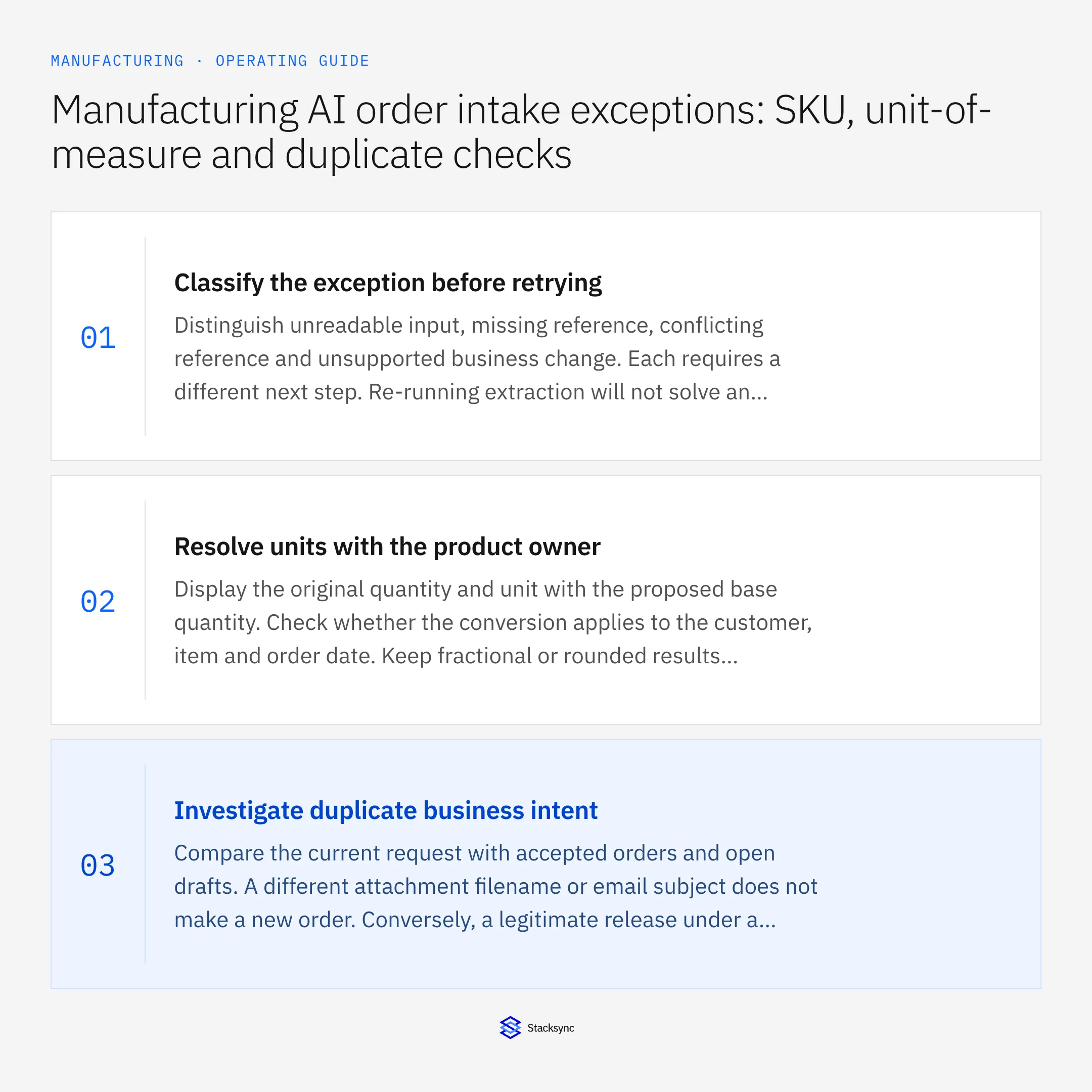
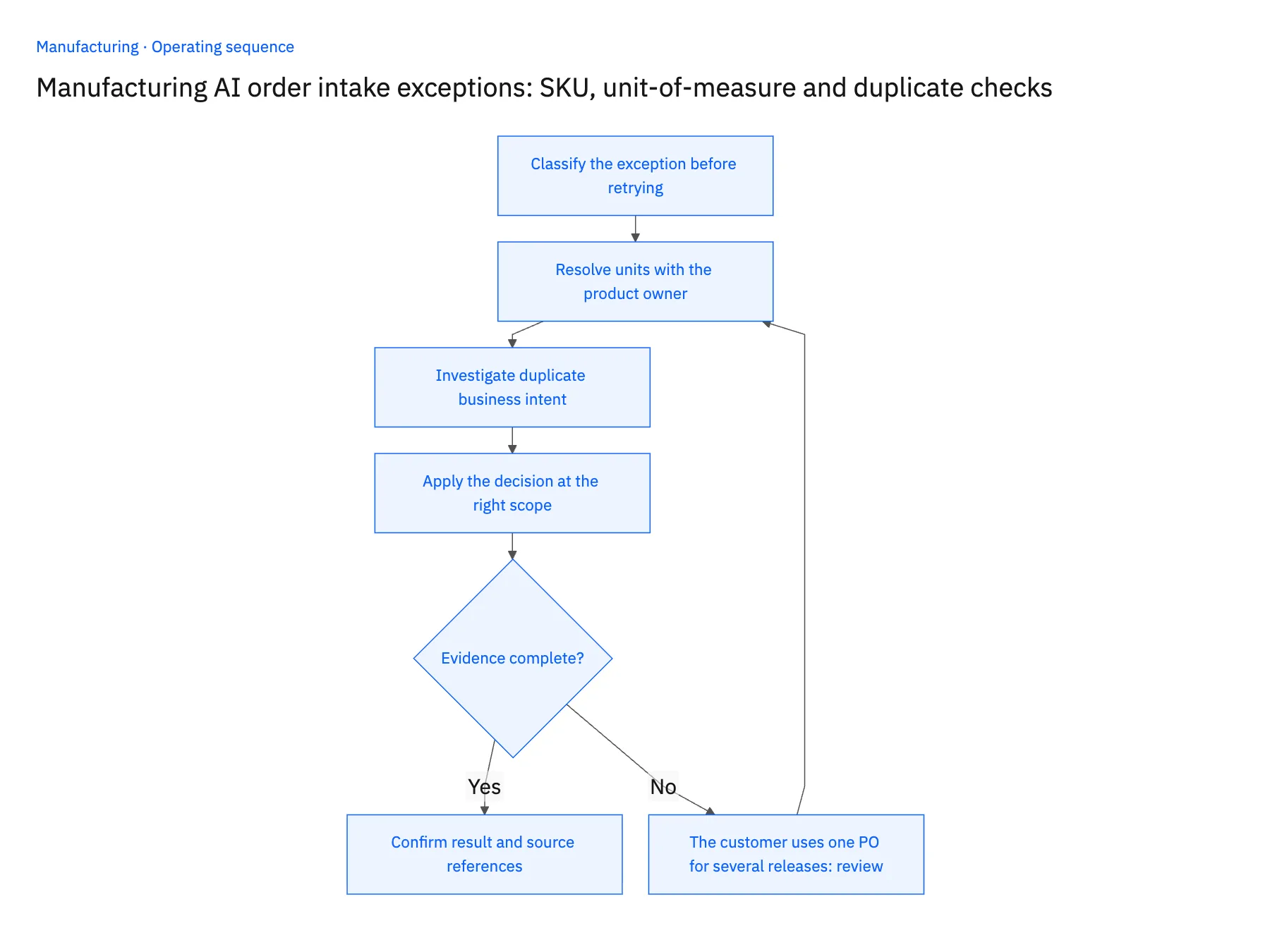
- 01Classify the exception before retryingDistinguish unreadable input, missing reference, conflicting reference and unsupported business change. Each requires a different next step. Re-running extraction will not solve an absent pack definition or a customer PO that already exists in another intake queue.
- 02Resolve units with the product ownerDisplay the original quantity and unit with the proposed base quantity. Check whether the conversion applies to the customer, item and order date. Keep fractional or rounded results visible and prevent the workflow from inventing a conversion to satisfy a required ERP field.
- 03Investigate duplicate business intentCompare the current request with accepted orders and open drafts. A different attachment filename or email subject does not make a new order. Conversely, a legitimate release under a blanket PO may be new demand; inspect the release reference rather than rejecting every repeated PO number.
- 04Apply the decision at the right scopeLet a reviewer resolve the current line, approve a reusable cross-reference or request customer clarification. Keep those actions distinct. A one-time correction should not silently become a global master-data rule, and a new approved rule should not rewrite historical transactions without a separate review.
Handle the exceptions explicitly
The customer uses one PO for several releases
Use the agreed release identifier and sequence to distinguish new demand from a resend. Ask order management when the partner’s convention is unknown.
The source says boxes but the master says pieces
Block quantity acceptance until the conversion is confirmed. Preserve both representations so the reviewer can see why the calculated total changed.
The item appears obsolete
Present approved replacement or supersession evidence if available. Do not substitute a similar active item without technical and commercial approval.
What to verify before expanding
- A forwarded duplicate produces one accepted business order even when message metadata differs.
- Every converted quantity retains its original unit and the approved conversion used.
- A new blanket release is distinguishable from a replay of an existing release.
- Reviewer decisions are scoped to the current case unless a master-data change is explicitly approved.

Connect this process to the rest of your operation
Explore Stacksync AI agents (Genies) and scope the records and actions against your actual systems. Book a demo with a real customer-item reference example and the exception your team handles most often, for example the customer uses one PO for several releases.
- AI agents for manufacturing order intake: turn email and PDFs into reviewable ERP drafts
- Manufacturing EDI 850 and 860: accept orders and revisions without duplicate demand
- Salesforce and Acumatica for manufacturing: turn an approved quote into a traceable order
- NetSuite AI Agents: Building SLMs for Instant Insights
- Real-Time Sync for Manufacturing ERP & Shop Floor Data
The shared architecture guide covers record matching, ownership, and recovery across systems.
Technical references
FAQ
Frequently asked questions










Related articles