








Do You Have to Pay for Salesforce MCP? What Stays Off the HPI Meter
Which Salesforce traffic avoids Headless Platform Interaction charges, five legitimate ways to pay less or nothing, and the shortcuts that break your contract.
- Author
- Ignacio Malpartida · GTM Engineer
- Published
- Read time
- 5 min read

Do you have to pay for Salesforce MCP?
Short answer: For registered AI agents calling a production org, yes, once metering starts. Salesforce will bill each successful call, over MCP or a direct API, as one Headless Platform Interaction (HPI) in Flex Credits. Switching protocols or servers doesn't change that. You can still keep a lot of traffic off the meter: build and test in sandboxes, keep fixed-logic integrations as integrations, serve agent reads from a synced database, and cut the calls each task makes.
Status on October 24, 2026: announced, not yet metered, rate per HPI still TBA.
What exactly gets metered?
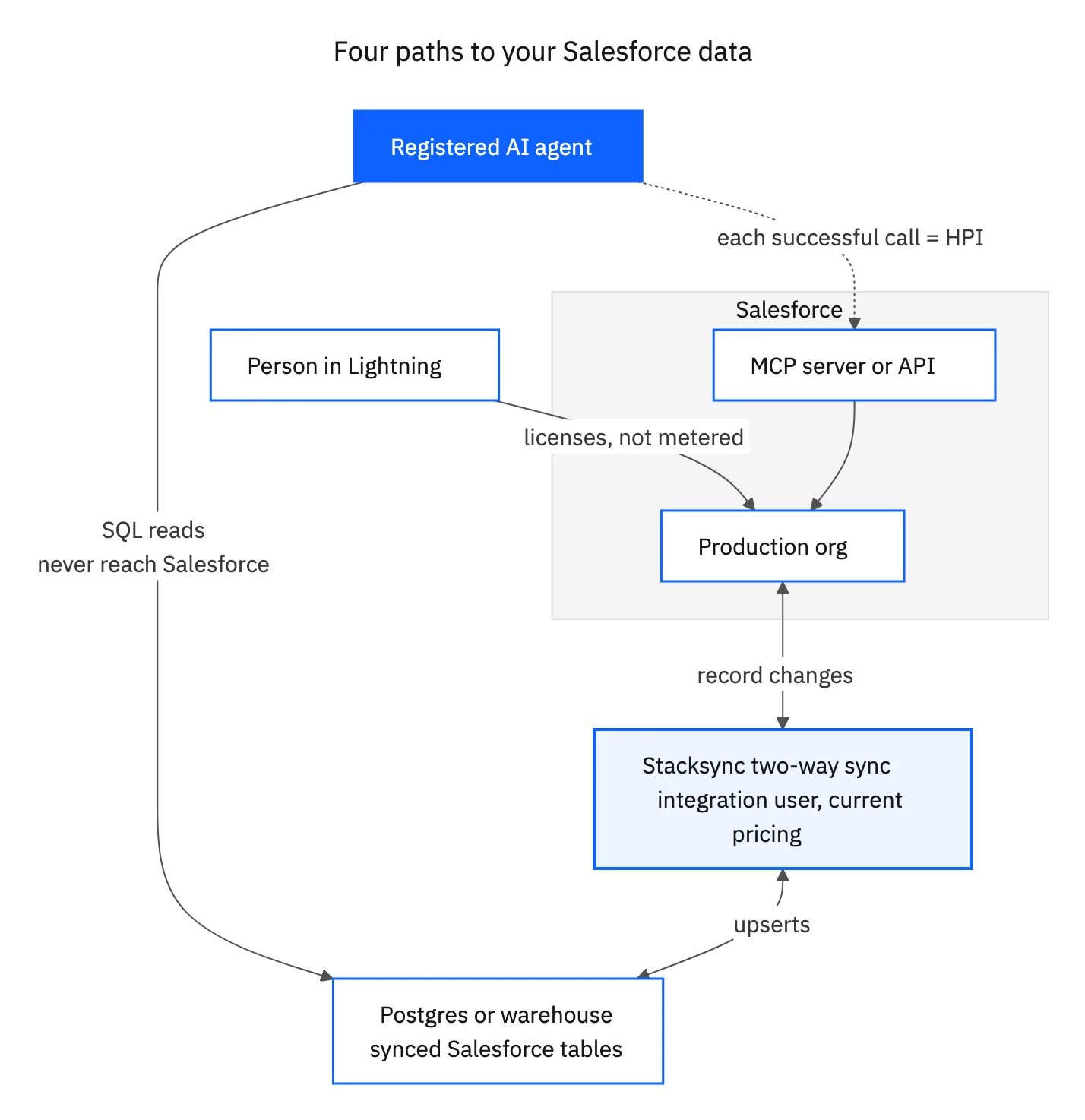
Salesforce's help article on the change says every successful call a registered agent makes to Salesforce, over MCP or a direct API, is metered as an HPI. What makes a connection an agent is its credentials: Salesforce asks you to reconfigure MCP clients and API agents to present the OAuth credentials of a registered agent, which "allows Salesforce to classify the connecting app as an agent."
The pricing explainer covers the formula and the rate card.
Which traffic stays off the meter?
| Traffic | Metered as HPI? | Source |
|---|---|---|
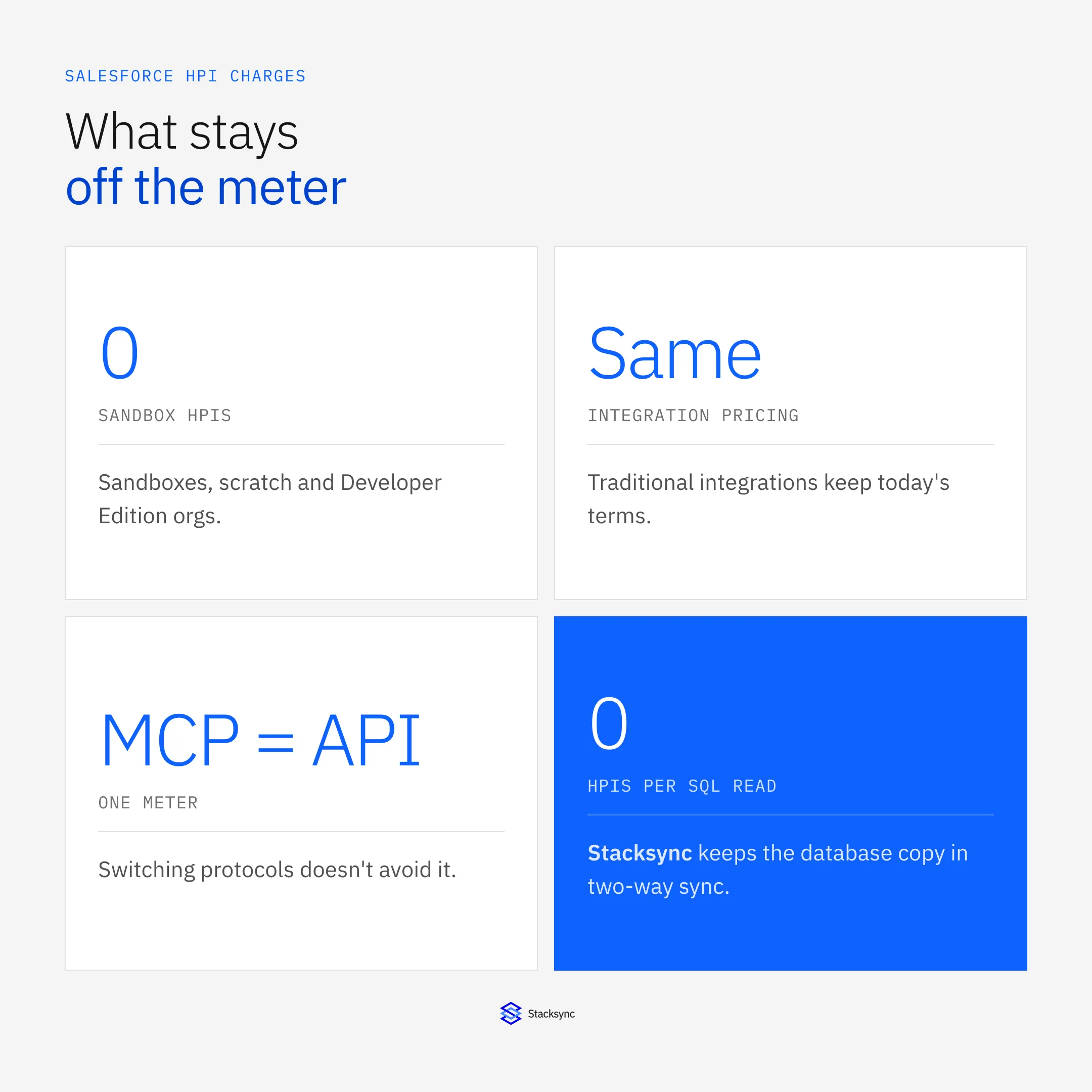
| Agent calls in sandboxes, scratch orgs, and Developer Edition orgs | No | Salesforce |
| Traditional integrations, such as a scheduled sync | No. Pricing "stays exactly as it is today" | Salesforce |
| A person using Salesforce in the browser | No | Salesforce |
| Failed calls | No. Only successful calls count | Salesforce |
| Agent SQL queries against your own synced database | No. The query never reaches Salesforce | How the meter works |
| Registered agent calls in production, over MCP or API | Yes | Salesforce |
Five legitimate ways to pay less, or nothing
1. Build and test where Salesforce doesn't meter
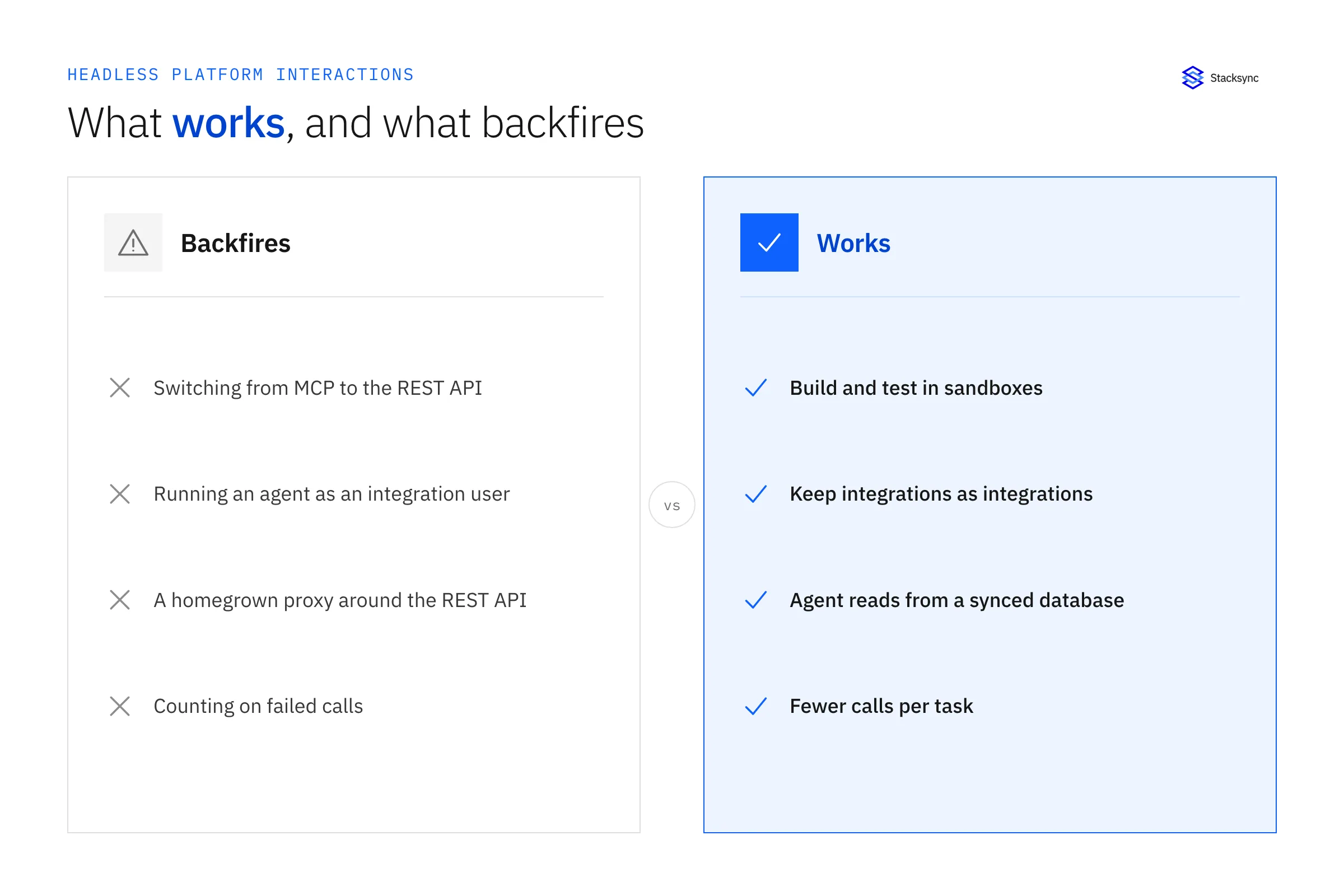
Do all agent development, prompt tuning, and evaluation in sandboxes or scratch orgs. Use them to count calls per task before anything reaches production.
2. Keep integrations as integrations
A nightly sync or middleware flow with fixed logic has no reason to become an agent. Leave it on its integration user, where Salesforce says pricing doesn't change. Our guide to moving integrations to MCP sorts which ones should move.
3. Serve agent reads from a synced database
This is the biggest lever, because agents read far more than they write. Keep Salesforce in two-way sync with Postgres or a warehouse, and give agents a read-only SQL tool. Their reads stop reaching Salesforce, and only writes remain as HPIs. Stacksync runs that sync as an integration on its own integration user, within an API budget you set. Our guide to moving agent reads to a synced database has the steps.
4. Cut calls per task
Every call you remove is an HPI you don't pay for. Cache schema in the prompt, combine reads into one SOQL query, and wrap multi-step writes in one Flow tool. See seven ways to cut Salesforce agent costs.
5. Buy credits deliberately
Flex Credits expire at the order end date with no rollover, so a large pre-purchase made before you know your volume can go unused. Pay-as-you-go bills monthly at list price with no minimums. Measure first, then negotiate a named HPI rate and a committed volume at renewal. Salesforce says an org can enable Flex Credit usage by buying Salesforce Foundations, currently listed at $0, or another qualifying SKU.
What doesn't work
- Switching from MCP to REST. Salesforce meters registered agent calls on both.
- Hiding an agent behind an integration user. Salesforce requires agents to register, within three months of its notice for MCP use and at renewal for existing API agents. Skipping registration risks your contract and leaves you without an audit trail.
- Building a homegrown proxy around the REST API. Salesforce's security guidance warns against it in place of the hosted servers, and a registered agent behind it is still metered.
- Counting on failures. Failed calls aren't metered, but an agent that fails often retries until it succeeds, and you pay for that.

What's still unclear?
Salesforce hasn't said how it classifies agent activity that reaches Salesforce indirectly, such as an agent writing to Postgres and a sync carrying that change to Salesforce, or an agent triggering a middleware flow. Until it does:
- Keep agent and integration credentials separate.
- Keep agent writes on Salesforce Flow or MCP tools.
- Ask your account executive for a written answer on indirect traffic before you build pricing on it.
To see what's left after these steps, run your numbers through our cost estimates, then set up Flex Credit tracking and alerts.
Sources
- Salesforce Help, Understand AIforce Impact (Knowledge Article 005360285)
- Salesforce Ben, Salesforce Will Charge Flex Credits for Agentic MCP and API Calls (September 24, 2026)
- Vantage Point, Salesforce Will Meter Agentic MCP and API Calls: What to Do Now (updated October 10, 2026)
- Salesforce, Flex Credits Rate Card (updated August 31, 2026)
- Salesforce, Flexible Buying Models
- Salesforce Developers, Hosted MCP Servers Best Practices

FAQ
Frequently asked questions





Explore these integrations and topics
- connectorSalesforce integrations
- platformDatabase synchronization
- platformAI agent operations
- Database synchronization guidesWork through database change capture, application writes, and reliable record reconciliation.
- AI agent operations guidesExplore practical Genies workflows across industries, with source evidence, human approvals, and confirmed outcomes.
Related articles