








How Much Will Salesforce MCP Cost? Budget Estimates for Five Team Sizes
Estimate your Salesforce MCP and AI agent bill before metering starts. Monthly budgets for pilots, sales teams, mid-market, enterprise, and automated agents at 1, 5, and 20 credits per call.
- Author
- Ignacio Malpartida · GTM Engineer
- Published
- Read time
- 5 min read

How much will Salesforce MCP cost?
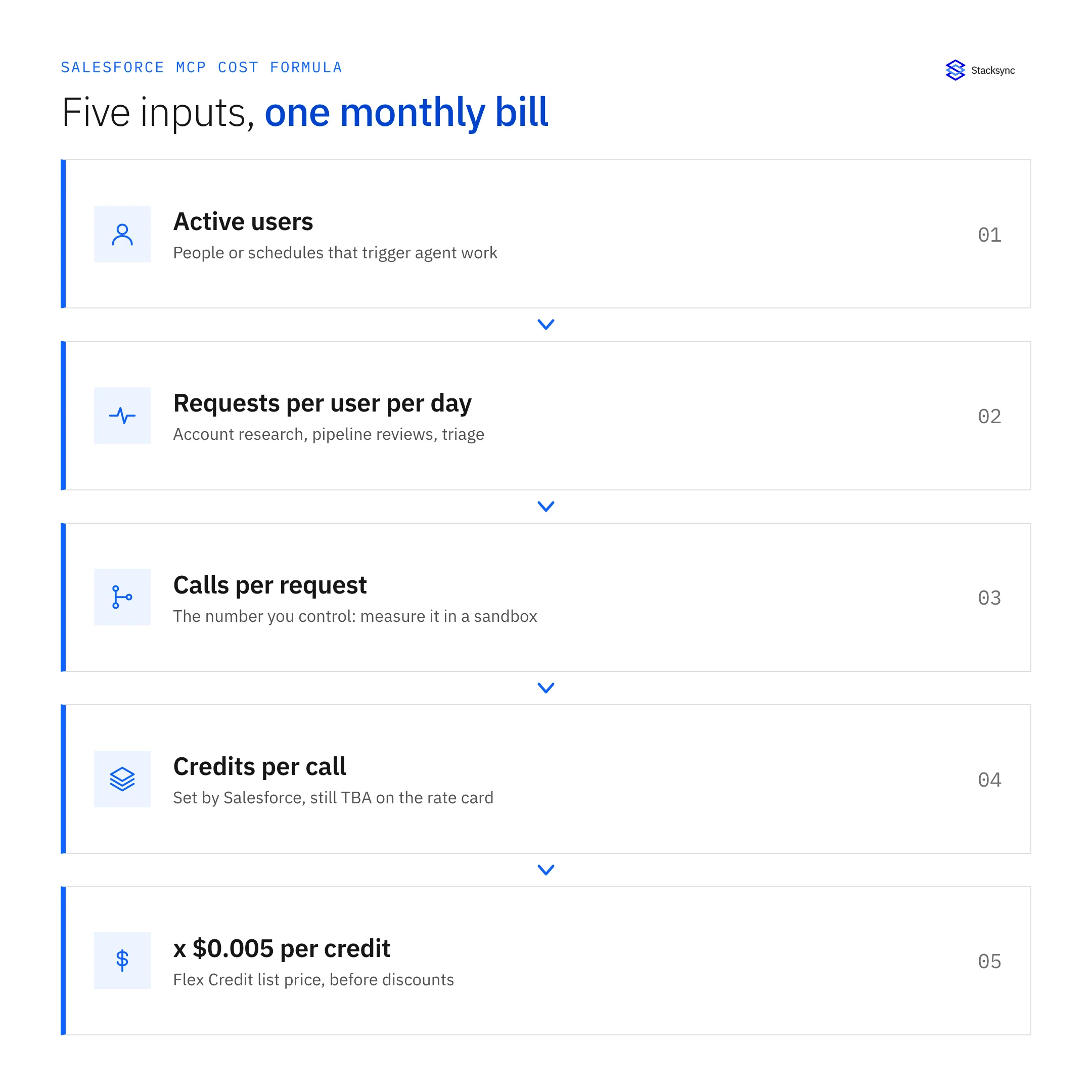
Short answer: At Salesforce's list price of $0.005 per Flex Credit, a 25-person sales team making 20,000 agent calls a month would pay between $100 and $2,000 a month, depending on whether one Headless Platform Interaction costs 1 or 20 credits. A 500-person enterprise deployment making 1 million calls would pay $5,000 to $100,000. Salesforce hasn't published the per-call rate yet, so model a range and measure calls per task now.
These are hypothetical scenarios built on list prices as of October 23, 2026. They are not Salesforce quotes.
The formula behind every estimate
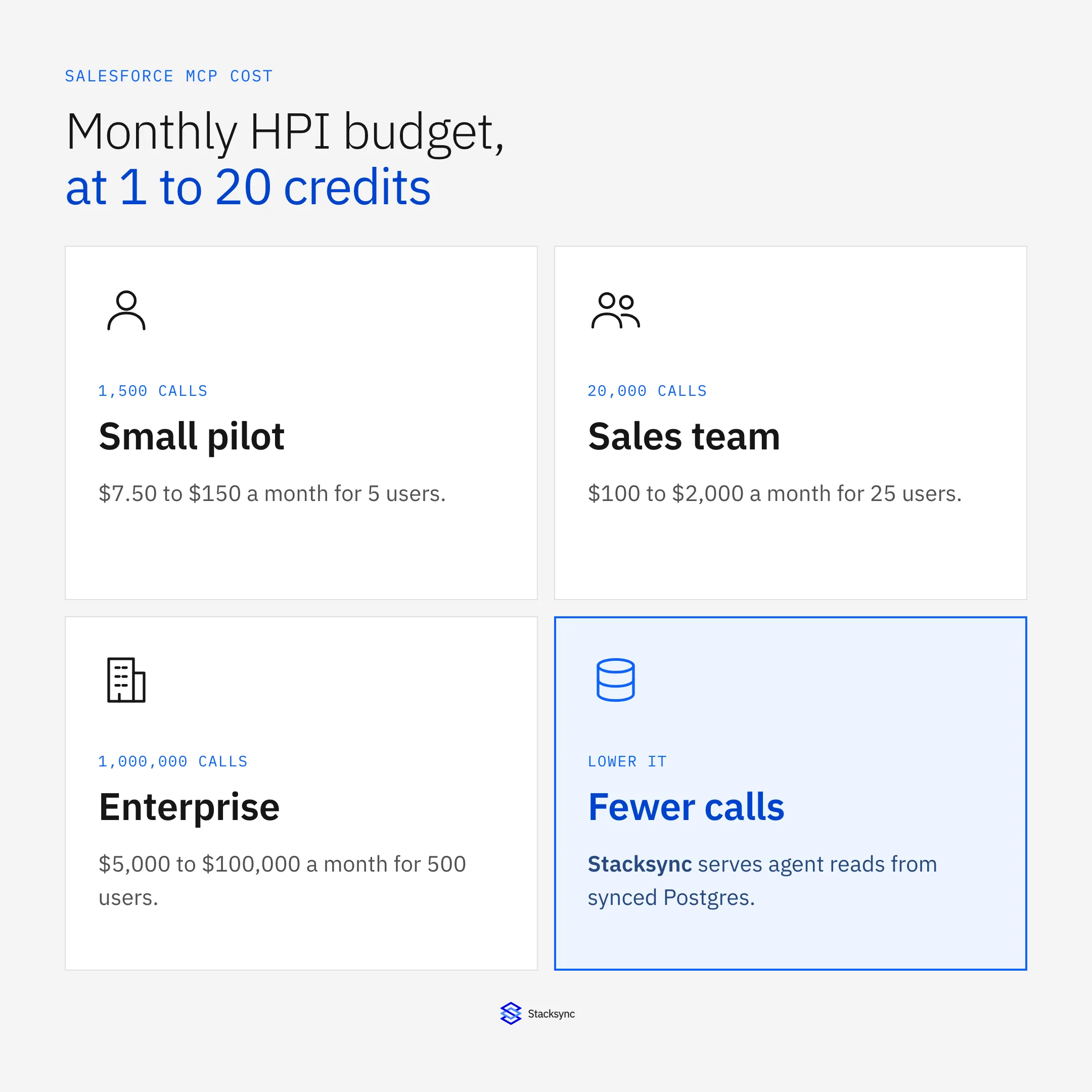
Monthly cost = users × requests per user per day × calls per request × working days × credits per call × $0.005
Five inputs drive the result. You control four of them. Salesforce controls the fifth, the credits per call. The pricing explainer covers what counts as a call.
We use 20 working days a month for human-driven scenarios and 30 days for always-on automation. We price each scenario at 1, 5, and 20 credits per call to show the spread.
Monthly budget estimates
| Profile | Assumed usage | Calls / month | 1 credit/call | 5 credits/call | 20 credits/call |
|---|---|---|---|---|---|
| Small pilot | 5 users × 5 requests/day × 3 calls | 1,500 | $7.50 | $37.50 | $150 |
| Growing sales team | 25 users × 10 requests/day × 4 calls | 20,000 | $100 | $500 | $2,000 |
| Mid-market deployment | 100 users × 15 requests/day × 5 calls | 150,000 | $750 | $3,750 | $15,000 |
| Enterprise deployment | 500 users × 20 requests/day × 5 calls | 1,000,000 | $5,000 | $25,000 | $100,000 |
| Automated agent workload | 10,000 calls/day × 30 days | 300,000 | $1,500 | $7,500 | $30,000 |
Annualize the enterprise row and the range runs from $60,000 to $1.2 million a year. That spread is why you need the multiplier in writing before you scale.
These figures cover HPI consumption only. Add your Salesforce licenses, your AI provider's fees, and any other metered Salesforce services. Subtract any included credits or negotiated discounts.
Calls per request matter most
Salesforce charges a fixed price per interaction. The agent decides how many interactions a request takes. Take a common request: "Research Acme, then update the renewal opportunity and log a follow-up."
| Agent behavior | Calls | Cost at 5 credits | Cost at 20 credits |
|---|---|---|---|
| Lean: one combined SOQL read, one update, one task | 3 | $0.075 | $0.30 |
| Typical: schema lookup, search, account read, contacts, opportunity read, update, task | 7 | $0.175 | $0.70 |
| Chatty: repeats schema lookups, retries searches, reads records one at a time | 15 | $0.375 | $1.50 |
Multiply the gap by the growing sales team's 5,000 requests a month. At 20 credits per call, the lean agent costs $1,500 and the chatty agent costs $7,500 for the same work. Prompt design and tool design now show up on the invoice. Our guide to cutting Salesforce agent costs covers the fixes.
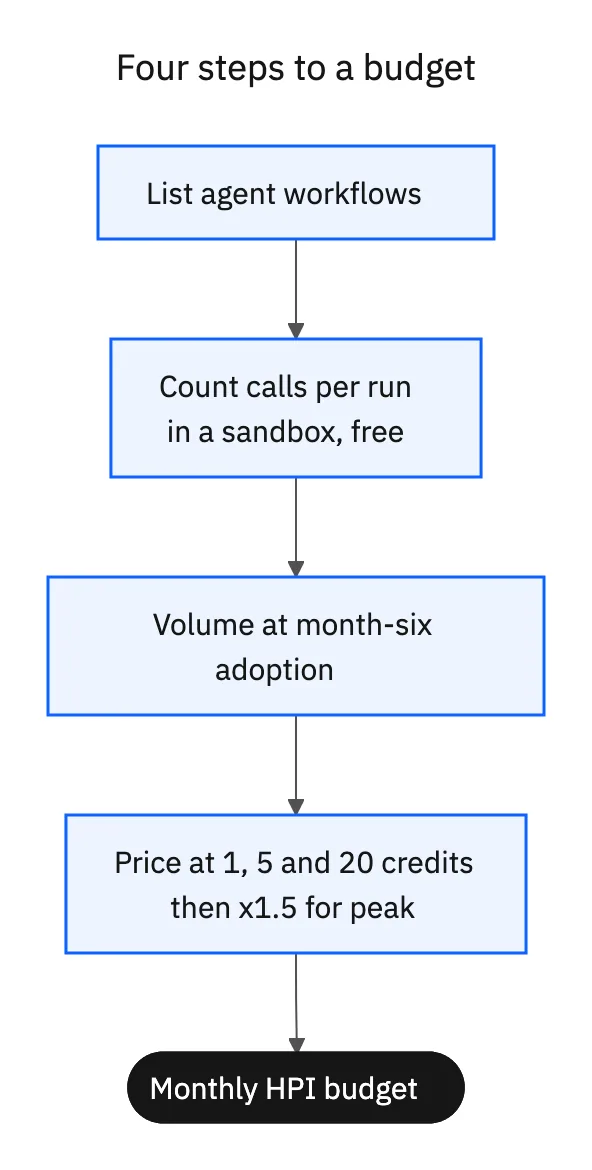
Build your own estimate in four steps
- 01List the workflows. Write down each job an agent will do: account research, pipeline review, lead triage, case summaries.
- 02Count calls per run in a sandbox. Sandbox and scratch org calls aren't metered, so you can run each workflow 20 times and log the tool calls for free. Use the median, then note the 90th percentile.
- 03Estimate volume at target adoption. Use the adoption you expect in month six, not the pilot. Multiply requests per user by active users and working days.
- 04Price it at three rates and stress-test the peak. Run 1, 5, and 20 credits per call. Then multiply your busiest month by 1.5. Quarter-end pipeline reviews and renewal seasons spike usage.
Worksheet
| Workflow | Runs / month | Median calls / run | Calls / month |
|---|---|---|---|
| Account research | |||
| Pipeline review | |||
| Lead triage | |||
| Case summary | |||
| Total |
Multiply the total by credits per call and $0.005.
What makes your bill higher than the table
- Retries and loops. An agent that fails a query and tries again pays for every successful attempt.
- Schema discovery on every request.
getObjectSchemacalls add up when the agent runs them per conversation instead of caching them. - Record-by-record reads. Ten
getRelatedRecordscalls cost ten times one SOQL query with a subquery. - Automated agents. Background agents run every day, not 20 days a month, and nobody watches them.
- Multiple agents per org. Each registered agent adds its own traffic.

What makes it lower
- Reads served from a database. If your agents query a synced Postgres or warehouse copy of Salesforce data, those reads never reach Salesforce. Stacksync keeps that copy current in both directions. See Salesforce to Postgres two-way sync. Confirm with Salesforce how it classifies your sync traffic.
- Flows instead of field-by-field writes. One custom tool that calls a Flow can replace several create and update calls.
- Free development. Build and evaluate in sandboxes, where HPIs aren't metered.
- Negotiated rates. A named rate with a cap beats pay-as-you-go.
Sources
- Salesforce Ben, Salesforce Will Charge Flex Credits for Agentic MCP and API Calls (September 24, 2026)
- Vantage Point, Salesforce Will Meter Agentic MCP and API Calls: What to Do Now
- Salesforce, Flex Credits rate card
- Redress Compliance, Salesforce Headless 360 pricing in 2026

FAQ
Frequently asked questions





Related articles