









Salesforce MCP Pricing Explained: Headless Platform Interactions and Flex Credits
Salesforce will meter AI agent calls over MCP and APIs as Headless Platform Interactions billed in Flex Credits. What counts, what's excluded, the formula, and the dates.
- Author
- Ignacio Malpartida · GTM Engineer
- Published
- Read time
- 6 min read
How will Salesforce charge for MCP?
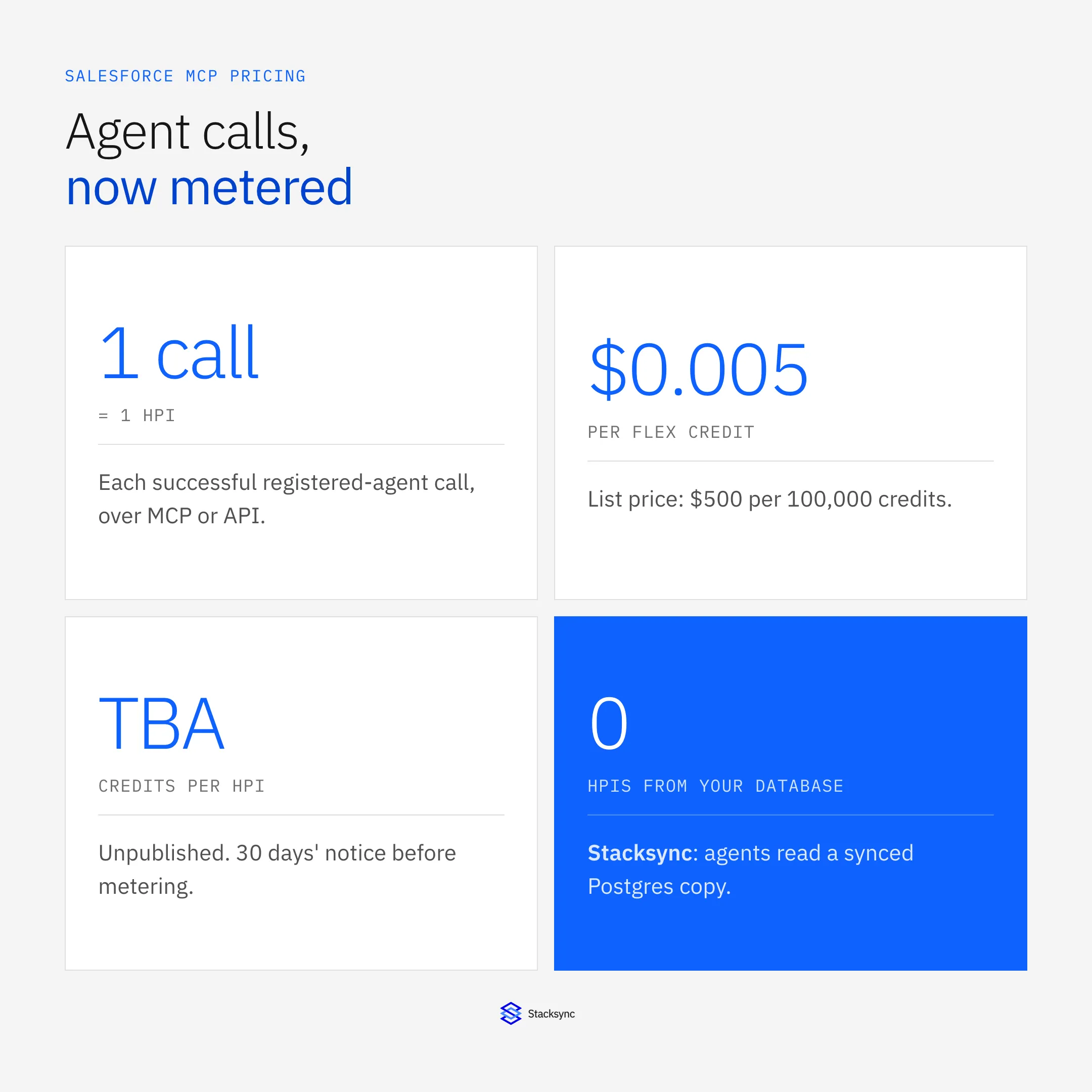
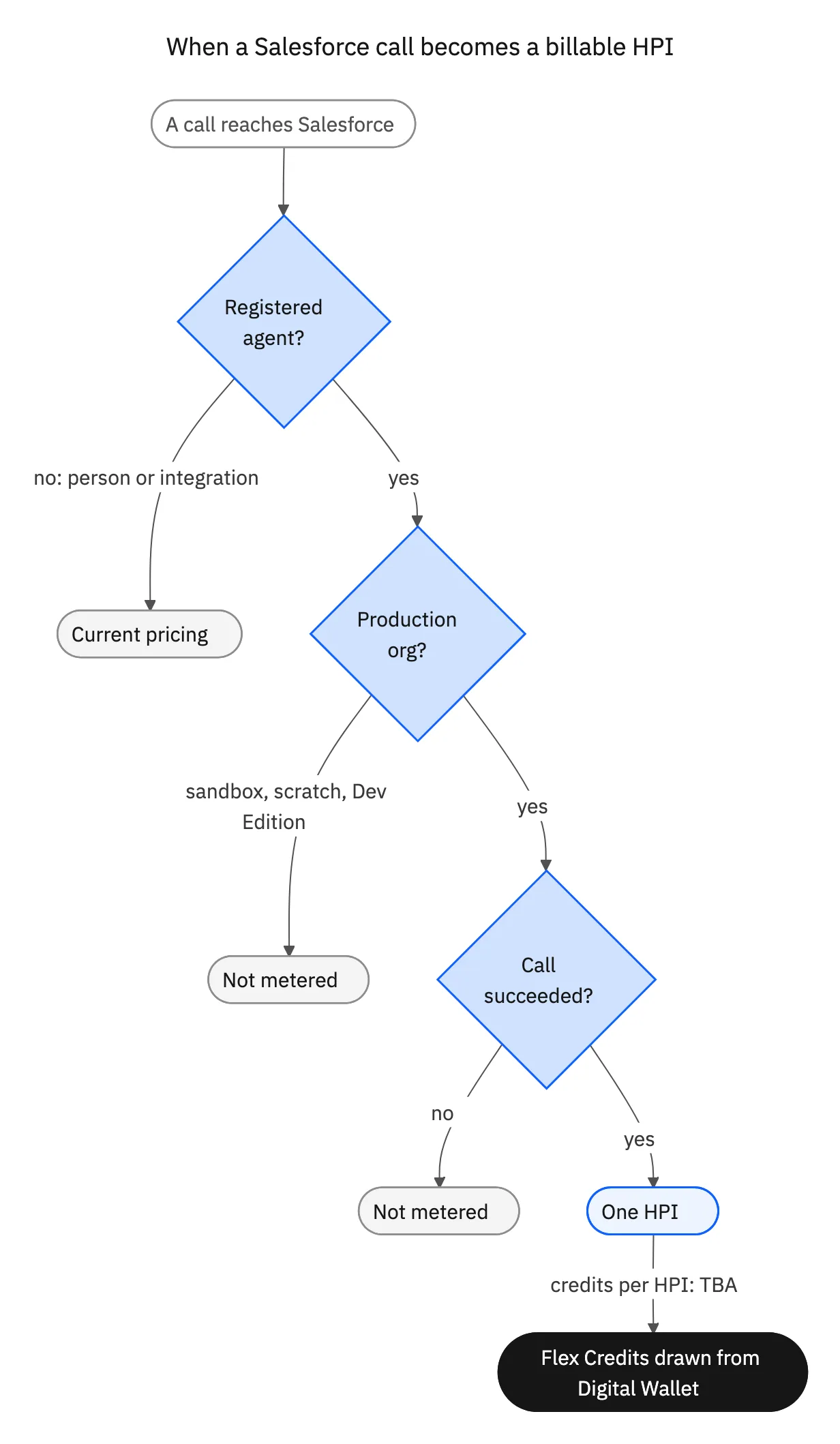
Short answer: Salesforce will count each successful call that a registered AI agent makes to a production org, over MCP or a direct API, as one Headless Platform Interaction (HPI). Each HPI consumes Flex Credits from your Digital Wallet. Flex Credits list at $500 per 100,000 ($0.005 each). Salesforce has not published how many credits one HPI costs: the rate card lists it as "TBA." Salesforce says it will give 30 days' notice before metering starts.
Status as of October 23, 2026: announced, not yet metered, multiplier unpublished.
What changed?
In September 2026, Salesforce told customers it would bill agentic access to its platform. The change ships with two other pieces of its Headless Toolkit:
- Agentic Identity. Each AI agent gets its own registered identity, credentials, and permissions instead of acting under a human user's login.
- Consumption billing. Once you register an agent, Salesforce tracks its calls in Digital Wallet and charges Flex Credits per successful interaction.
Salesforce's help article "Understand AIforce Impact" (published September 17, 2026) set the direction. Vantage Point reports that Salesforce targets November for the security controls, agent registration, and billing model. Salesforce has not announced a public date for metering to begin. If someone on your team heard "December," treat it as unconfirmed until you see the 30-day notice.
What counts as a Headless Platform Interaction?
| Traffic | Counts as HPI? |
|---|---|
| A registered agent calls a Salesforce MCP server in production | Yes |
| A registered agent calls a Salesforce REST or other API directly in production | Yes |
| A failed call | No. Salesforce meters successful calls |
| Any agent call in a sandbox, scratch org, or Developer Edition org | No |
| A traditional, non-agentic integration (for example, a scheduled middleware sync) | No. It keeps current pricing |
| A human using Salesforce in the browser | No |
Two details matter more than the rest.
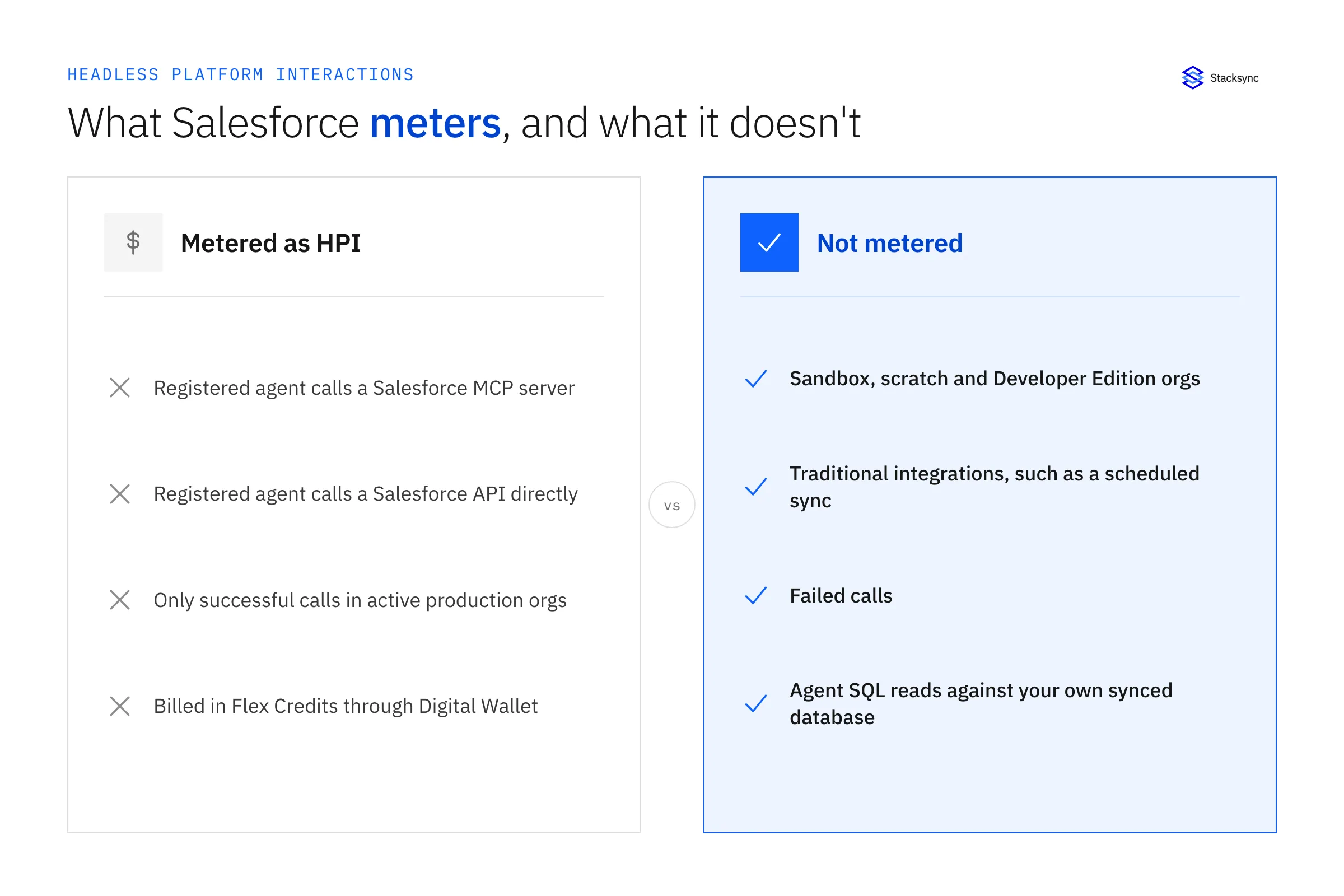
Switching from MCP to the API doesn't avoid the meter. Salesforce bills registered agent traffic on both paths. Rebuilding an agent on raw REST calls changes nothing on the invoice.
Salesforce charges per interaction, and the agent decides how many interactions a task takes. A Salesforce spokesperson told Salesforce Ben that the cost per interaction does not vary, but the number of interactions depends on the agent's behavior, harness, and prompts. A chatty agent costs more than a disciplined one for the same outcome.
How do Flex Credits work?
Flex Credits are Salesforce's shared consumption currency for Agentforce and now for agentic platform access.
- List price: $500 per 100,000 credits, or $0.005 per credit.
- Where you see usage: Digital Wallet, which tracks consumption and can alert you at thresholds.
- How you buy: pre-purchase, pre-commit, or pay-as-you-go.
- What else draws on them: standard Agentforce actions list at 20 credits each. That is a separate usage type. Don't use it as a proxy for the HPI rate.
The formula
Monthly HPI cost = successful agent calls per month × credits per HPI × $0.005
Because Salesforce hasn't set the middle term, model it as a range. At 1 credit per call, a call costs half a cent. At 5 credits, 2.5 cents. At 20 credits, 10 cents.
| Credits per HPI | Cost per call | Cost of a 6-call task | Cost of 100,000 calls |
|---|---|---|---|
| 1 | $0.005 | $0.03 | $500 |
| 5 | $0.025 | $0.15 | $2,500 |
| 20 | $0.10 | $0.60 | $10,000 |
These are sensitivity scenarios, not Salesforce prices. For budgets by team size, see Salesforce MCP cost estimates.
What's excluded from the meter?
- Non-production orgs. Sandboxes, scratch orgs, and Developer Edition orgs don't meter HPIs, so you can build and test agents without credit burn.
- Traditional integrations. Salesforce says existing API-based integrations keep their current pricing and security arrangements.
- The MCP servers themselves. Redress Compliance reports that Enterprise Edition and above include basic hosted MCP access with no separate SKU. The billing applies to agent usage, not to turning the servers on.
You still pay your normal Salesforce licenses and API allocations, and you pay your AI provider separately. HPI is a new line on top.

What's still unknown
Ask your account executive these questions and get answers in writing:
- 01The multiplier. How many Flex Credits will one HPI consume, and will the rate be locked for your contract term?
- 02The start date. When does your org's 30-day notice period begin?
- 03Classification at the edges. How does Salesforce classify an integration platform or middleware flow that an agent triggers? Vantage Point notes that Salesforce hasn't published a test for these borderline cases.
- 04Shared credentials. What happens to traffic on a shared integration user that serves both agents and scheduled jobs?
- 05Included credits. Do your existing Agentforce or Flex Credit balances cover HPIs, and can unused credits carry over?
What to do this month
- Inventory agents. List every MCP client and AI agent that touches production, with its owner, connected app, user, and objects. The Agentic Identity checklist walks through it.
- Measure calls per task in a sandbox. Sandbox calls are free, and they tell you the one number that drives your bill.
- Set Digital Wallet alerts before metering starts.
- Cut calls per task. Fewer schema lookups, combined queries, and reads served from a database copy all reduce HPIs. See how to cut Salesforce agent costs.
- Use your renewal. Negotiate a named HPI rate, a cap, and usage visibility.
Sources
- Salesforce Ben, Salesforce Will Charge Flex Credits for Agentic MCP and API Calls (September 24, 2026)
- Vantage Point, Salesforce Will Meter Agentic MCP and API Calls: What to Do Now (updated October 10, 2026)
- Salesforce Help, Understand AIforce Impact (Knowledge Article 005360285)
- Salesforce, Flex Credits rate card
- Salesforce, Digital Wallet
- Redress Compliance, Salesforce Headless 360 pricing in 2026

FAQ
Frequently asked questions





Related articles