







Track the actual module
Keep a stable identity and the supporting project and design references across custody events.
 Salesforce
  HubSpot
  NetSuite
  Zendesk
  Microsoft Dynamics 365 Sales
  Dynamics 365 F&O
  Attio
Attio  Pipedrive
  Zoho CRM
  Campfire
  Rillet
  Front
Front  Shopify
  Amazon Seller Central
  SendGrid
 Modular and prefab building supply and installation
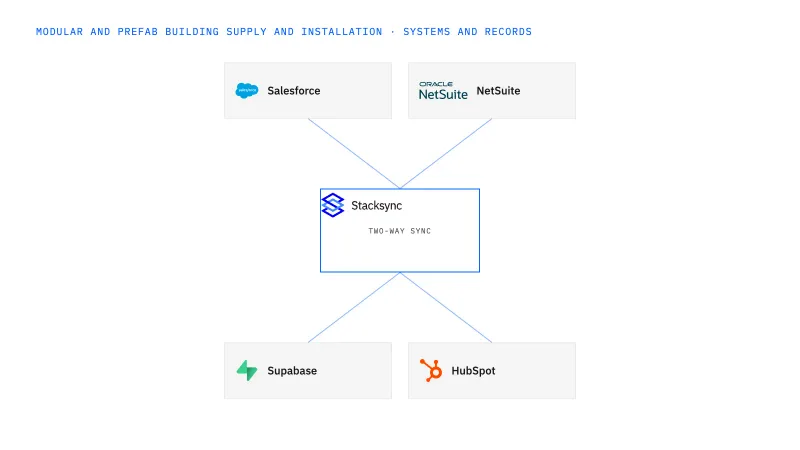
Connect approved NetSuite module and project context to a Supabase delivery register. Preserve module identity and separate release, dispatch, receipt, condition and acceptance events. The app can collect permitted evidence, while supported ERP actions and project authorization are scoped explicitly.
A delivered project flag hides modules still at the factory, condition issues and scope the customer has not accepted.
Explore your process in a demo, or get our shared two-way sync architecture guide.
When this fits
US modular and prefab building companies with 100–1,000 employees that combine manufacturing or supply with onsite delivery and installation.
Keep a stable identity and the supporting project and design references across custody events.
Record physical arrival and the authorized contractual decision independently, including partial scope.
Use application grants and row policies so recording delivery does not automatically confer approval authority.
The process, end to end
a building ships in several loads. The site receives some modules and holds one for a condition review. The register gives logistics and finance a shared evidence view without calling the whole project accepted.
Scope your implementation
Review current platform pricing alongside the records, volume, and actions in your process. Use your own operating baseline to evaluate the economics.
Explore your process in a demo, or get our shared two-way sync architecture guide.
From foundation to action
Keep shared customer, order, and operational records aligned, with clear field ownership.
Explore two-way sync 02Move approved work between systems, assign exceptions, and confirm the result.
Explore workflows 03Investigate cross-system questions, assemble the evidence, and prepare the next action.
Explore ai agents (genies) 04Connect trading-partner documents to operational records and exception handling.
Explore ediGo deeper
Link Salesforce module options to the released design revision and NetSuite order so sales edits cannot rewrite released scope or blur factory and site milestones.
Track module identity through factory release, shipment, site receipt and acceptance without treating those events as equivalent.
Connect prefab buyer and project context to a portal with explicit dealer, contractor and owner access.
Explore all modular and prefab building supply and installation integration and automation guides ↗
No. It records a logistics event; acceptance requires the agreed evidence and authorized decision.
Use stable event identifiers and reconcile the prior result so a retry does not duplicate evidence.
A partial shipment, condition exception, corrected module ID and user restricted to one project.
Begin with two-way sync between NetSuite and Supabase so the register reads approved module identity and project context and returns only the permitted event updates. Workflows follow once receipt, condition and acceptance events need routing: a held module to the acceptance owner, a corrected module ID to whoever reviews the audit trail. Genies then gather custody and acceptance evidence by module into a billing review that finance still decides. EDI stays separate, carrying supplier shipment documents into NetSuite receiving rather than syncing register records.


