







Unify the request context
Keep the service need, asset reference and accepted quote linked across the commercial and order handoff.
 Salesforce
  HubSpot
  NetSuite
  Zendesk
  Microsoft Dynamics 365 Sales
  Dynamics 365 F&O
  Attio
Attio  Pipedrive
  Zoho CRM
  Campfire
  Rillet
  Front
Front  Shopify
  Amazon Seller Central
  SendGrid
 Industrial equipment and machinery
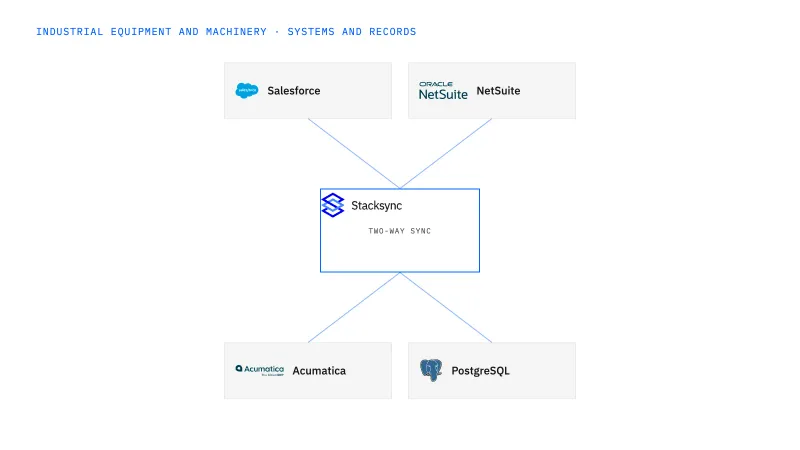
Connect aftermarket requests and accepted parts quotes to Acumatica order status. Stacksync fits equipment manufacturers where service and sales share urgent parts requests but still ask order management to reconstruct availability and progress. Preserve the asset and approved part recommendation while keeping commercial acceptance and operational commitment explicit.
Two employees can quote the same urgent request, while neither has the complete view of compatibility, accepted order or promised shipment.
Explore your process in a demo, or get our shared two-way sync architecture guide.
When this fits
COOs, service directors and IT leaders at US equipment builders with 100–1,000 employees and a mix of manufacturing, distribution and service.
Keep the service need, asset reference and accepted quote linked across the commercial and order handoff.
Return operational status while distinguishing a requested expedite from a confirmed commitment.
Compatibility and warranty treatment remain separate decisions; transactional actions are scoped to verified operations.
The process, end to end
an aftermarket director wants service and account managers to see one accepted parts request tied to the installed machine. Ask to see a duplicate inquiry, an approved kit and a shortage without creating another order or promising an unaccepted expedite.
Scope your implementation
Review current platform pricing alongside the records, volume, and actions in your process. Use your own operating baseline to evaluate the economics.
Explore your process in a demo, or get our shared two-way sync architecture guide.
From foundation to action
Keep shared customer, order, and operational records aligned, with clear field ownership.
Explore two-way sync 02Move approved work between systems, assign exceptions, and confirm the result.
Explore workflows 03Investigate cross-system questions, assemble the evidence, and prepare the next action.
Explore ai agents (genies) 04Connect trading-partner documents to operational records and exception handling.
Explore ediGo deeper
Equipment builders can tie a sold machine's accepted option set to its NetSuite order lines and route later option changes for review instead of overwriting the build.
Keep the manufacturer's serial stable across owner changes and customer asset tags, with a retrofit history that explains the installed configuration.
When two employees quote the same urgent component, a shared request reference across Salesforce and Acumatica keeps one accepted order and its compatibility evidence.
Explore all industrial equipment and machinery integration and automation guides ↗
Yes, where distributor, ship-to and installed-asset relationships are explicit. The buying account need not be the machine’s owner.
Follow one accepted quote into its order, then repeat the request through another channel and confirm that the existing transaction is recognized.
Track time to an accepted parts handoff, duplicate-order review and corrections caused by missing asset or compatibility context.
Begin with two-way sync between Salesforce and Acumatica so the aftermarket request, approved part recommendation and accepted quote stay linked to the Acumatica parts order, with writes limited to the endpoint entities you verify. Add workflows when a warranty replacement needs the coverage decision and part compatibility matched before anyone prepares a replacement. Genies follow when service wants serial, retrofit and supersession evidence assembled into a review packet. EDI comes last, as a transport for distributor purchase orders with kits and partial shipments, not as two-way sync.


