








Salesforce MCP Server: Every Endpoint, Tool, and What AI Agents Can Do
A complete map of Salesforce's hosted MCP servers: the four SObject endpoints, every tool they expose, product servers, custom tools, and what an AI agent can do with each.
- Author
- Ignacio Malpartida · GTM Engineer
- Published
- Read time
- 7 min read

What does the Salesforce MCP server cover?
Short answer: Salesforce's hosted MCP (Model Context Protocol) lets an AI client such as Claude or ChatGPT work with your org through a fixed set of servers. Four SObject servers handle CRM records: sobject-reads (query and search), sobject-mutations (create and update), sobject-deletes (delete), and sobject-all (everything). Product servers add Data 360, Tableau Next, CRM Analytics, CMS content, and Setup. Admins can also publish Flows, Apex, and catalog APIs as custom tools. Every call runs under the connected user's permissions and sharing rules.
Last verified against Salesforce's Hosted MCP Servers documentation on October 23, 2026.
What is the Salesforce MCP server?
MCP is an open protocol that lets an AI model call tools in another system. Salesforce hosts its own MCP servers, so you don't run or maintain anything. You point an MCP client at a server URL, sign in with OAuth, and the model can read schema, query records, and make changes.
Three facts shape how you use it:
- 01Admins enable each server. Standard servers ship disabled. An admin turns on the ones the org needs.
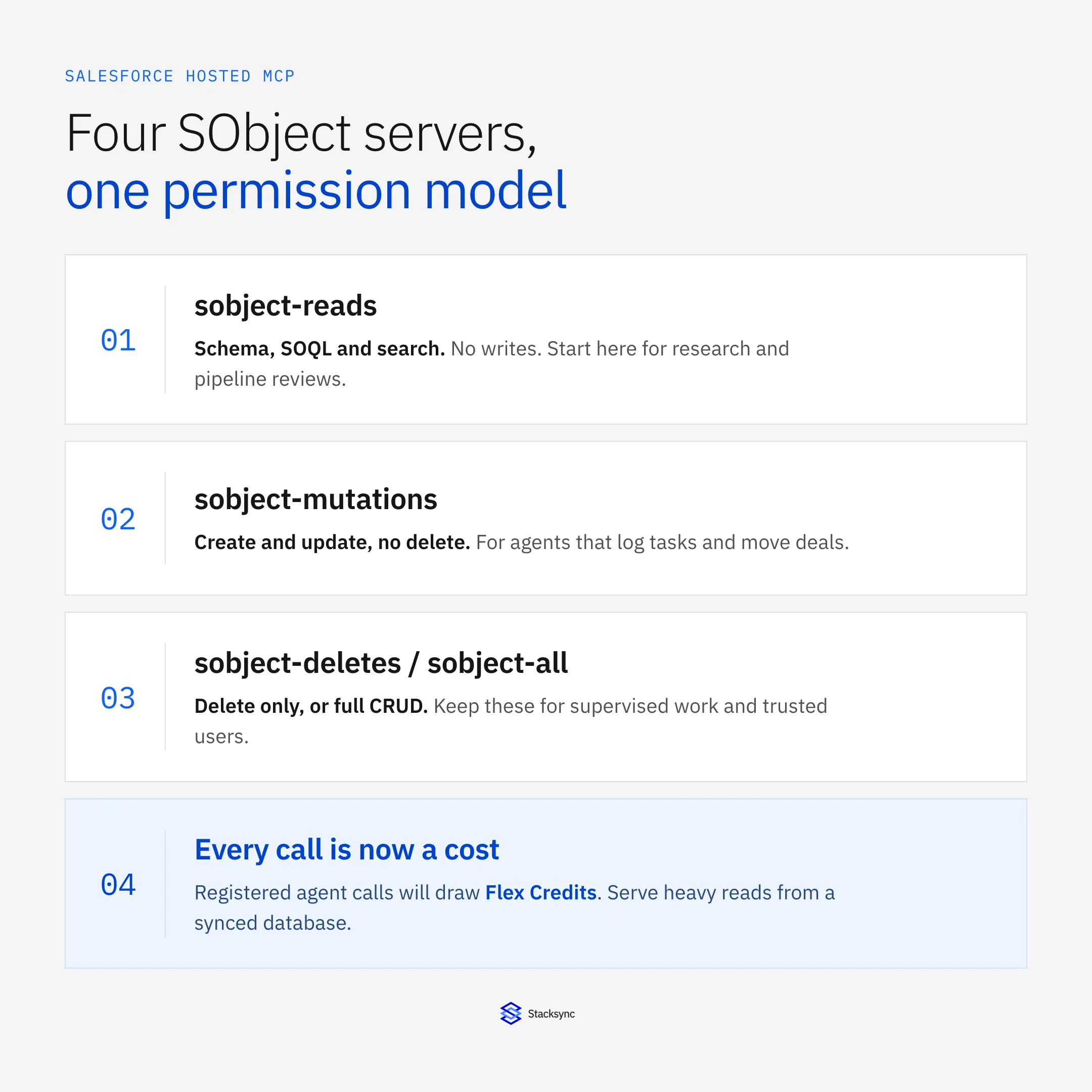
- 02Salesforce fixes the tool sets. You can't add or remove tools on a standard server. To control what an agent can do, you pick a narrower server.
- 03Salesforce security applies to every call. Field-level security, object permissions, and sharing rules gate each tool. An agent can't edit a field the user can't edit in Lightning.
What endpoints does Salesforce MCP cover?
All SObject servers share one base URL.
- Production:
https://api.salesforce.com/platform/mcp/v1/platform/<server> - Sandbox and scratch orgs:
https://api.salesforce.com/platform/mcp/v1/sandbox/platform/<server>
| Server | Endpoint suffix | Operations | Pick it when |
|---|---|---|---|
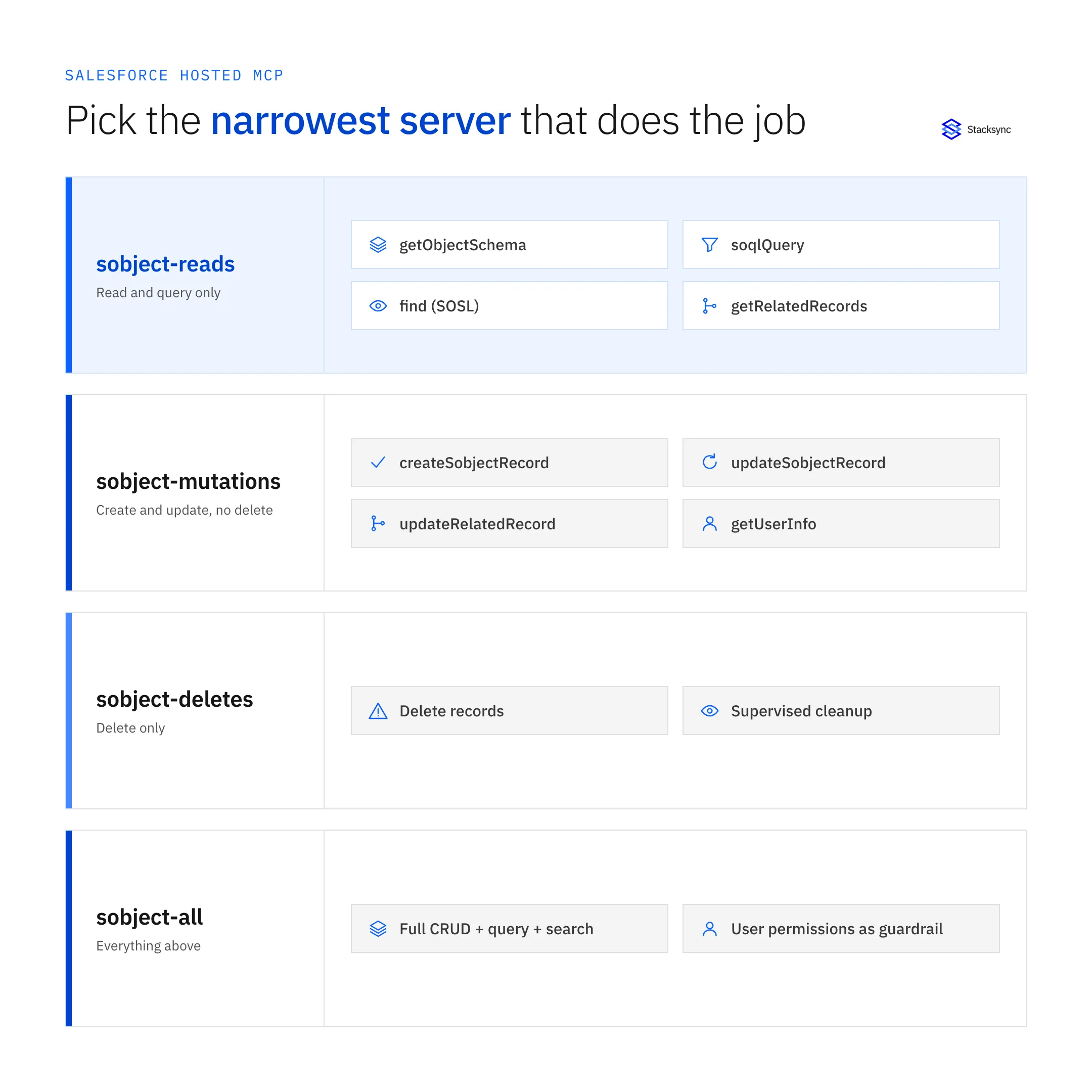
| SObject Reads | platform/sobject-reads | Schema, SOQL, search, relationships. No writes. | You want analysis, pipeline reviews, or account research with zero write risk |
| SObject Mutations | platform/sobject-mutations | Create and update. No delete. | Agents log tasks, update stages, or create leads |
| SObject Deletes | platform/sobject-deletes | Delete only | You run a supervised cleanup job |
| SObject All | platform/sobject-all | Full CRUD plus query, search, relationship traversal | A trusted user wants full productivity and you rely on their permissions as the guardrail |
All four servers cover standard and custom objects.
Which tools does the SObject All server expose?
sobject-all holds the full tool set. The narrower servers expose subsets of it.
| Tool | What it does | Notes |
|---|---|---|
getObjectSchema | Returns a compact index of business objects, or full field detail for one object | Includes admin-written guidance, such as "use Calculated_ACV__c instead of Amount" |
soqlQuery | Runs a SOQL query | Supports parent lookups and child subqueries. Caps at 50,000 records per transaction |
find | Runs a SOSL text search across objects | Returns up to 2,000 records. Use it when you don't know which object holds the data |
getUserInfo | Returns the signed-in user's ID, role, profile, manager, and timezone | Lets the agent resolve "my accounts" |
listRecentSobjectRecords | Lists records the user viewed or changed recently | Resolves "that opportunity I was looking at" |
getRelatedRecords | Walks a relationship from a parent record | Example: every Contact on an Account |
createSobjectRecord | Creates a record | Fails on missing required fields or validation rules |
updateSobjectRecord | Updates fields on a record by ID | Leaves omitted fields unchanged |
updateRelatedRecord | Updates a parent record through a child-to-parent path | Works up to five levels deep |
| Delete tool | Deletes a record | Available on sobject-all and sobject-deletes only |
What can you do with it? Example prompts by server
Salesforce's own examples show the range:
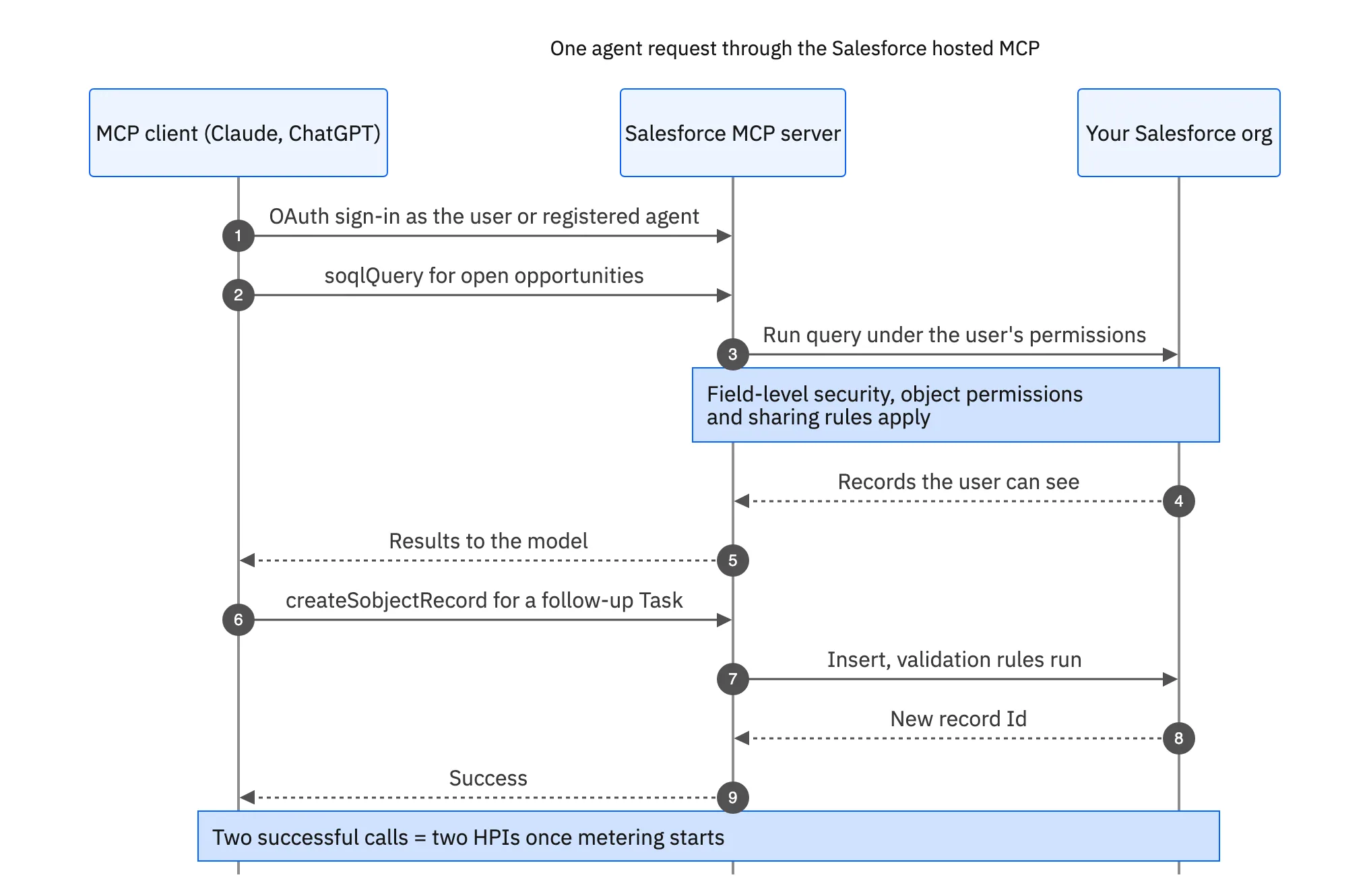
- Reads: "Show me all open opportunities in the Manufacturing industry over $500K, grouped by owner."
- Reads: "Find every Contact associated with Acme Corp and return their names, titles, and email addresses."
- Mutations: "Create a follow-up task for every Account where the last activity date is more than 90 days ago."
- Mutations: "Update the Stage on opportunity Acme Renewal to Closed Won and set the Close Date to today."
A realistic sales request chains several tools. "Find opportunities over $30K with no recent activity, summarize the account, and create follow-up tasks" runs a SOQL query, walks to related contacts and activities, then creates one task per opportunity. Count those calls. Under Salesforce's new billing model, each successful call from a registered agent will consume Flex Credits. Our Salesforce MCP pricing guide explains the meter.
What else does Salesforce MCP cover beyond CRM records?
Product-specific servers
| Server | Coverage | Status |
|---|---|---|
| Data 360 | Query unified customer data with SQL | Available |
Tableau Next (analytics/tableau-next) | Semantic models, KPIs, dashboard metadata, natural-language analytics | Available |
| CRM Analytics | Apps, dataset schemas, SAQL queries, dashboard and lens metadata. Read-only | Beta, sandbox and scratch orgs only |
| Content Read-Only / Content Write | Salesforce CMS workspaces, channels, content, folders | Available |
| Headless 360 | Setup and platform capabilities through Discover, Describe, and Dispatch tools, plus Archive Connect | Beta |
| Metadata Grounding | Discover objects, fields, LWCs, flows, Apex classes, permission sets | Beta |
Custom tools you publish
Admins and developers can expose existing logic as MCP tools without new integration code:
- Flows built in Flow Builder
- Apex invocable actions (
@InvocableMethod) @AuraEnabledApex methods that already back Lightning components- Apex REST endpoints (
@RestResource) - APIs registered in the API Catalog, including standard platform APIs and a subset of Connect APIs
- Prompt Builder templates, surfaced as MCP prompts where the client supports them
This is where the hosted MCP stops being a generic CRUD layer. If your org already runs a "Create Renewal Opportunity" flow with validation and approvals, the agent can call that flow instead of writing records field by field.
Salesforce DX MCP is a separate thing
Salesforce also ships a DX MCP server for developers. It retrieves and deploys metadata, runs Apex tests, manages scratch orgs, and assigns permission sets. Use it in your IDE. Use the hosted servers above for business data.

What the Salesforce MCP doesn't do
- It doesn't expose every Salesforce API. You get the fixed standard tools plus whatever custom tools your admins publish.
- It doesn't bypass permissions. If a user can't see a field, the agent can't either.
- It doesn't give you bulk data movement.
soqlQuerycaps at 50,000 records per transaction andfindat 2,000. Agents that need to scan millions of rows belong on a database copy of your Salesforce data. See how Stacksync syncs Salesforce to Postgres. - It won't stay free for agent traffic. Salesforce plans to meter successful calls from registered agents as Headless Platform Interactions. See the pricing explainer.
How to choose a server: a quick decision path
- 01Does the agent only answer questions? Use
sobject-reads. - 02Does it log work or move deals forward? Use
sobject-mutations. Keep deletes out of reach. - 03Does it clean up data under supervision? Add
sobject-deletesfor that one workflow. - 04Does a power user want one connection for everything? Use
sobject-alland rely on that user's permission set. - 05Does the task involve business rules? Publish the existing Flow or Apex action as a custom tool.
Salesforce is also rolling out Agentic Identity, which gives each agent its own credentials and permissions instead of borrowing a user's. Plan your server choices with that model in mind. Our Agentic Identity checklist covers the admin steps.
Sources
- Salesforce Developers, Standard MCP Servers Reference
- Salesforce Developers, SObject All MCP Server
- Salesforce Developers, Products Supporting MCP
- Salesforce Ben, Salesforce Will Charge Flex Credits for Agentic MCP and API Calls (September 24, 2026)

FAQ
Frequently asked questions





Related articles