Genies for Modular Progress-Billing Reviews: Assemble Factory Milestones, Delivery Proof, and Site Acceptance
Use Genies to prepare modular progress-billing evidence while preserving contract-specific milestone decisions.
- Author
- Ignacio Malpartida · GTM Engineer
- Published
- Read time
- 5 min read

The operating decision
A modular progress-billing Genie can assemble the evidence relevant to a contract's billing milestone: approved factory completion, delivery records, site acceptance and authorized variations. Give it the actual milestone definitions and ask it to show which evidence supports each requirement. The agent should prepare a finance review packet, not infer that factory completion or shipment automatically makes an amount billable. Finance and project authorities interpret the agreement and approve the financial action.
Explore the complete modular and prefab building supply and installation integration and automation hub for the systems and processes around this guide.
What this looks like in modular and prefab building supply and installation
A modular supplier's agreement has separate commercial milestones for factory progress, delivery and site acceptance. Several modules have shipped, but only part of the delivered scope has been accepted, and one variation remains unapproved. Finance needs a clear evidence view for the current billing review. A Genie can gather the relevant records and explain which portions are supported while leaving the disputed or missing items visible.
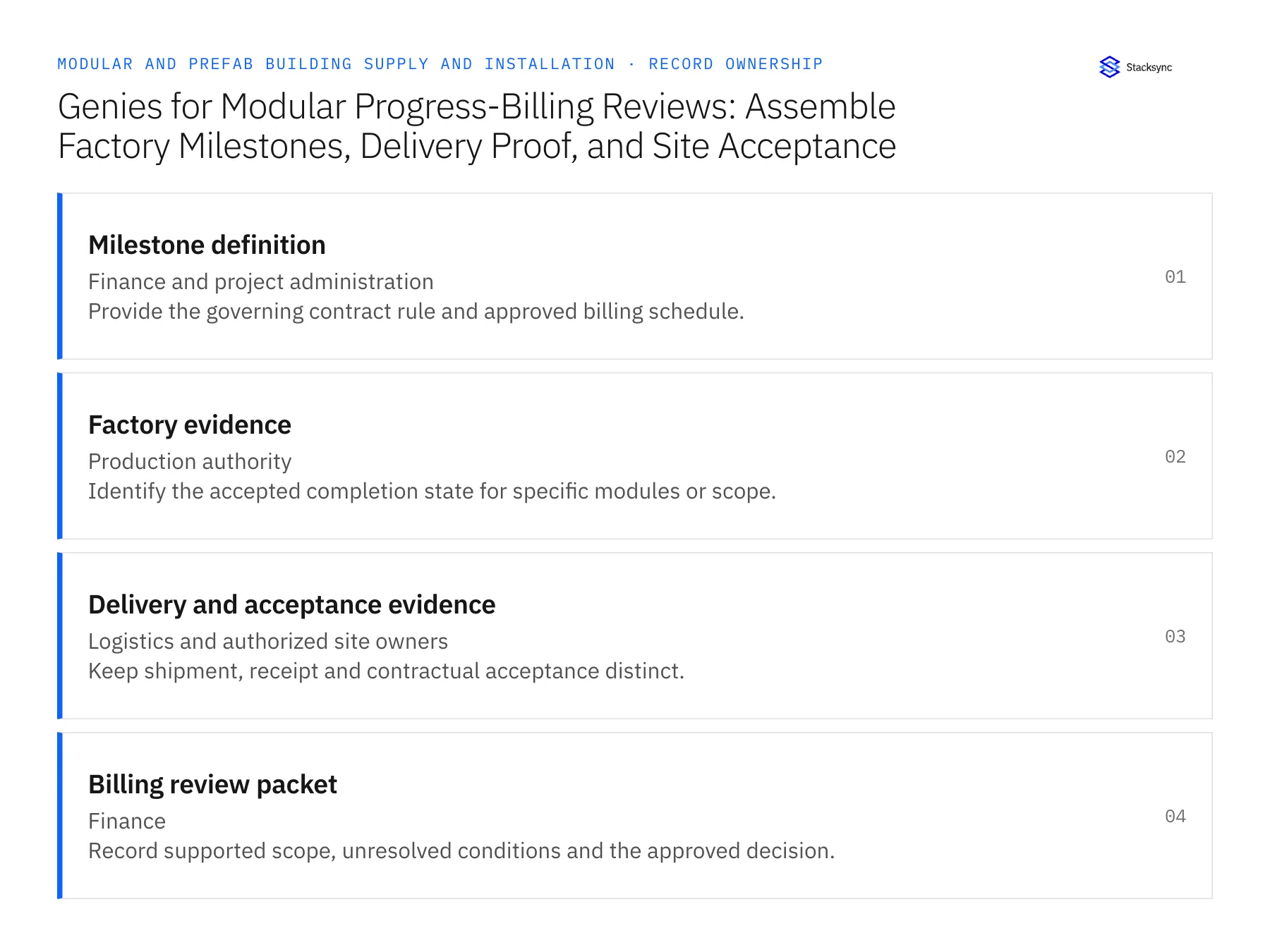
Records, ownership, and update rules
| Record | Owner | Operating rule |
|---|---|---|
| Milestone definition | Finance and project administration | Provide the governing contract rule and approved billing schedule. |
| Factory evidence | Production authority | Identify the accepted completion state for specific modules or scope. |
| Delivery and acceptance evidence | Logistics and authorized site owners | Keep shipment, receipt and contractual acceptance distinct. |
| Billing review packet | Finance | Record supported scope, unresolved conditions and the approved decision. |
Work through the process
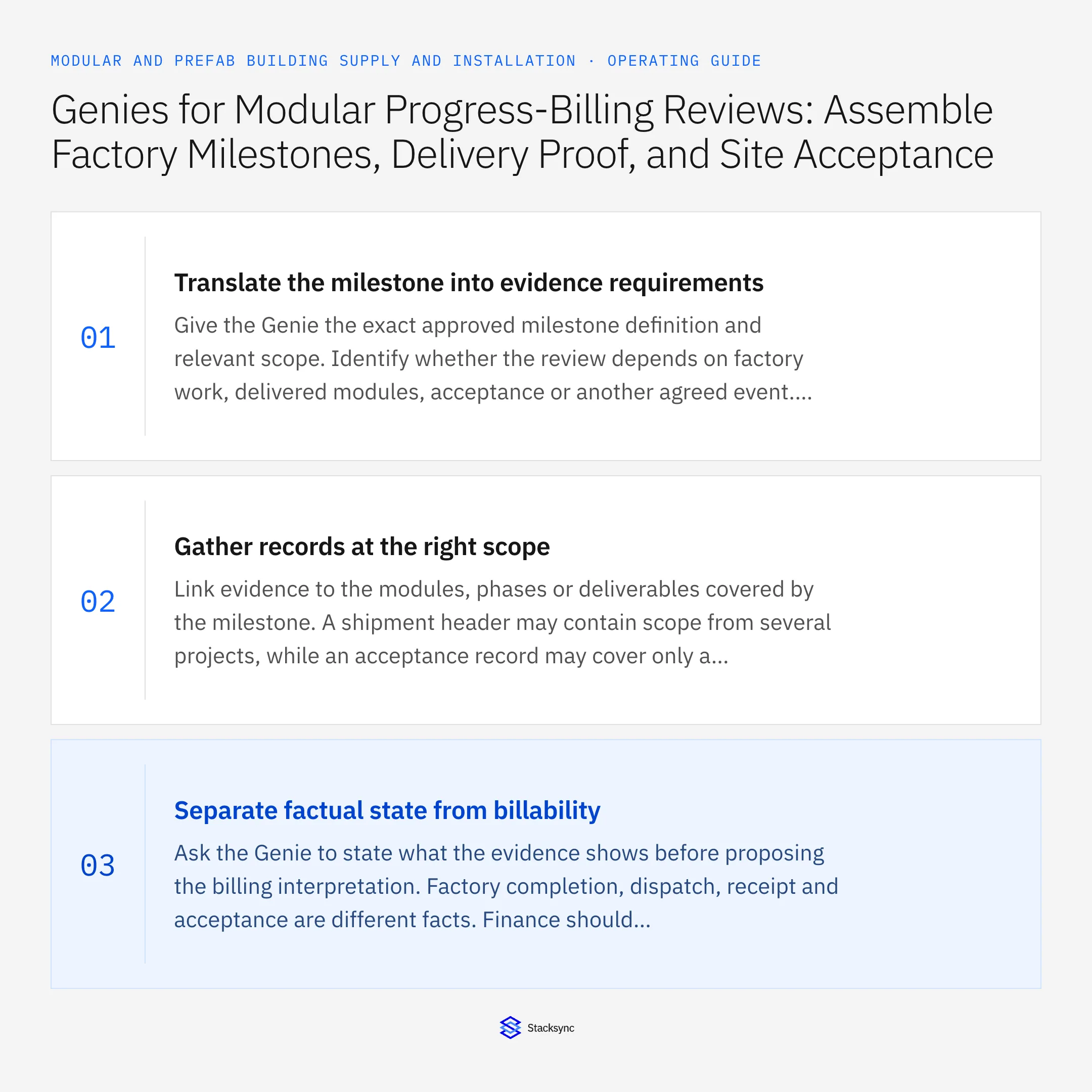
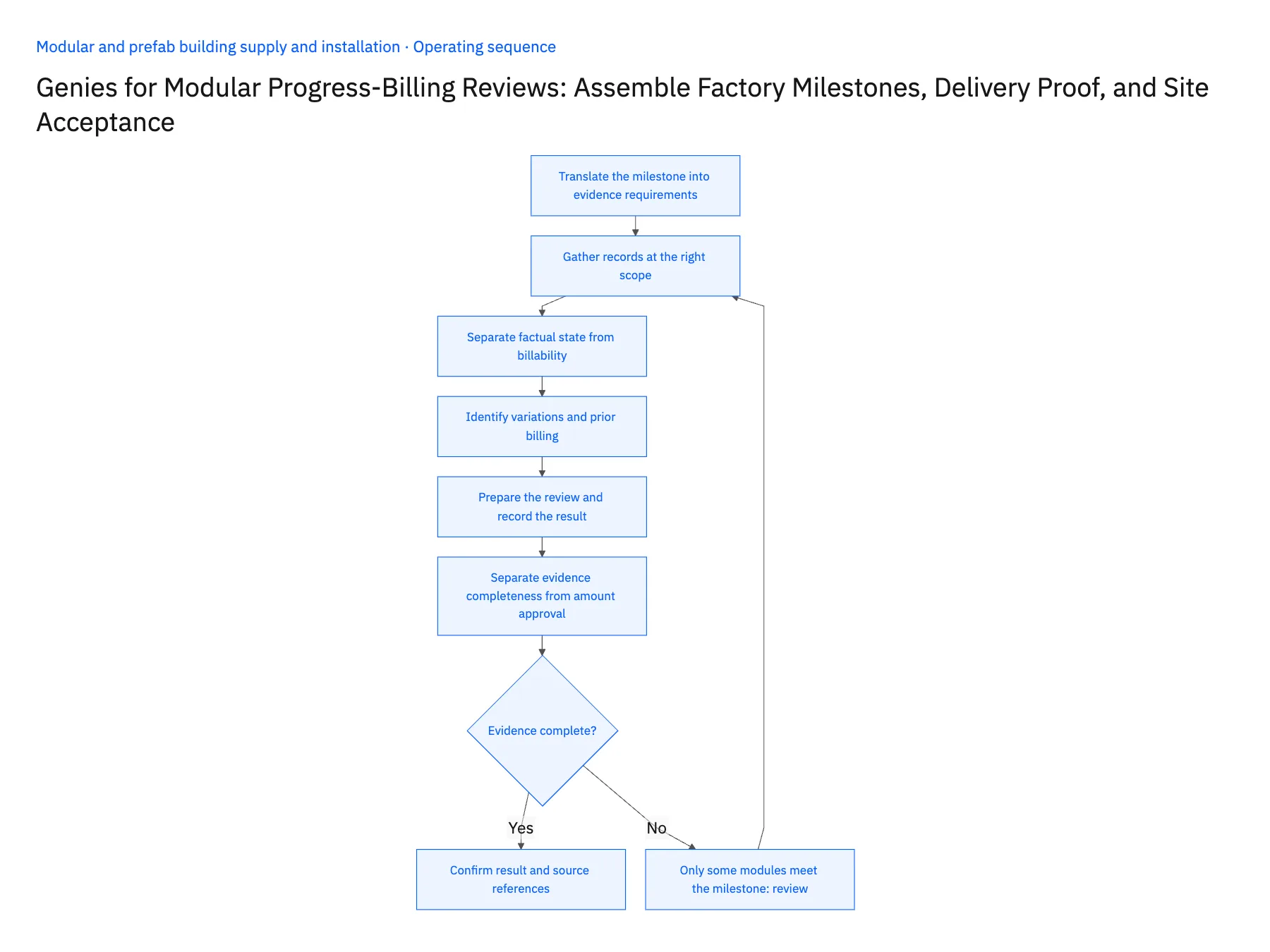
- 01Translate the milestone into evidence requirementsGive the Genie the exact approved milestone definition and relevant scope. Identify whether the review depends on factory work, delivered modules, acceptance or another agreed event. Do not use a generic progress percentage as a substitute for the contract's billable condition.
- 02Gather records at the right scopeLink evidence to the modules, phases or deliverables covered by the milestone. A shipment header may contain scope from several projects, while an acceptance record may cover only a subset. Require the agent to preserve those boundaries rather than treating any related document as complete proof.
- 03Separate factual state from billabilityAsk the Genie to state what the evidence shows before proposing the billing interpretation. Factory completion, dispatch, receipt and acceptance are different facts. Finance should review how the agreement turns those facts into a permitted amount or action.
- 04Identify variations and prior billingCompare the proposed scope with approved changes and amounts already handed off or billed. Flag unapproved variations and possible overlap. Use deterministic calculations and existing financial references to prevent a repeated review from presenting the same milestone as new billable work.
- 05Prepare the review and record the resultDeliver a packet with source links, supported scope and explicit unresolved questions. After finance decides, record the approval and destination reference. If acceptance or scope evidence changes later, route a correction against the original packet rather than overwriting the historical decision.
- 06Separate evidence completeness from amount approvalA packet can contain every required document while finance still needs to review the applicable amount, prior billing or commercial interpretation. Show evidence complete and billing approved as different states. This lets the project team stop chasing documents once its work is done while finance retains the outstanding decision. Conversely, an expected amount in the billing schedule should not hide missing delivery or acceptance evidence for the current milestone.
Handle the exceptions explicitly
Only some modules meet the milestone
Present the supported subset and let finance apply the contract's partial-billing rule.
Variation is performed but unapproved
Keep it outside approved billable scope unless the authorized process resolves it.
Milestone may already be billed
Show the existing financial reference and stop a duplicate handoff.
What to verify before expanding
- Every milestone conclusion points to the governing rule and evidence.
- Shipment cannot substitute for acceptance when acceptance is required.
- Prior billing is checked before a new handoff.
- Finance owns the accepted billable interpretation and action.

Connect this process to the rest of your operation
Explore Stacksync AI agents (Genies) and scope the records and actions against your actual systems. Book a demo with a real milestone definition example and the exception your team handles most often, for example only some modules meet the milestone.
- Modular Progress-Billing Exceptions: Partial Deliveries, Unapproved Variations, and Missing Acceptance Records
- Prefab Supplier EDI: Reconcile Component Orders With Factory Receipts and Direct-to-Site Deliveries
- Modular Building Manufacturers: Align Salesforce Project Configurations With NetSuite Orders and Milestones
- Eliminating Duplicate Records When You Sync CRM Systems: Best Practices for Clean Data
- Modernize Legacy EDI Without Replacing Your ERP
The shared architecture guide covers record matching, ownership, and recovery across systems.
Technical references
FAQ
Frequently asked questions










Related articles