


















What to Demand From a Pipedrive Integration Platform
A buyer’s guide to choosing an integration platform for Pipedrive. It explains what separates an enterprise iPaaS from a marketplace app, why real-time two-way sync matters when Pipedrive is the home your sales team works in, and the coverage, reliability, and security a CRM deployment should hold a platform to. Covers the Pipedrive API and its rate limits, how a sync engine keeps Pipedrive in step with your ERP, shared inbox, warehouse, and databases, and how to evaluate one.
- Author
- Ruben Burdin · Founder & CEO
- Published
- Read time
- 9 min read

Pipedrive earns its place by being the CRM sales teams actually use. It is light, fast, and built around the pipeline, which is exactly why growing companies pick it over something heavier. But the moment it becomes the home your reps work in all day, a second problem appears: every other system, the ERP that bills the deal, the shared inbox customers write into, the warehouse that reports on all of it, has to agree with what Pipedrive says.
That is an integration problem, and how you solve it decides whether your pipeline data is trustworthy or a source of constant reconciliation. An iPaaS, an integration platform as a service, is how most teams solve it without building and babysitting the plumbing themselves. But the label covers a lot of ground, from thin one-way marketplace apps to full real-time sync platforms. This guide lays out what an enterprise iPaaS for Pipedrive actually has to do, so you can tell the two apart.
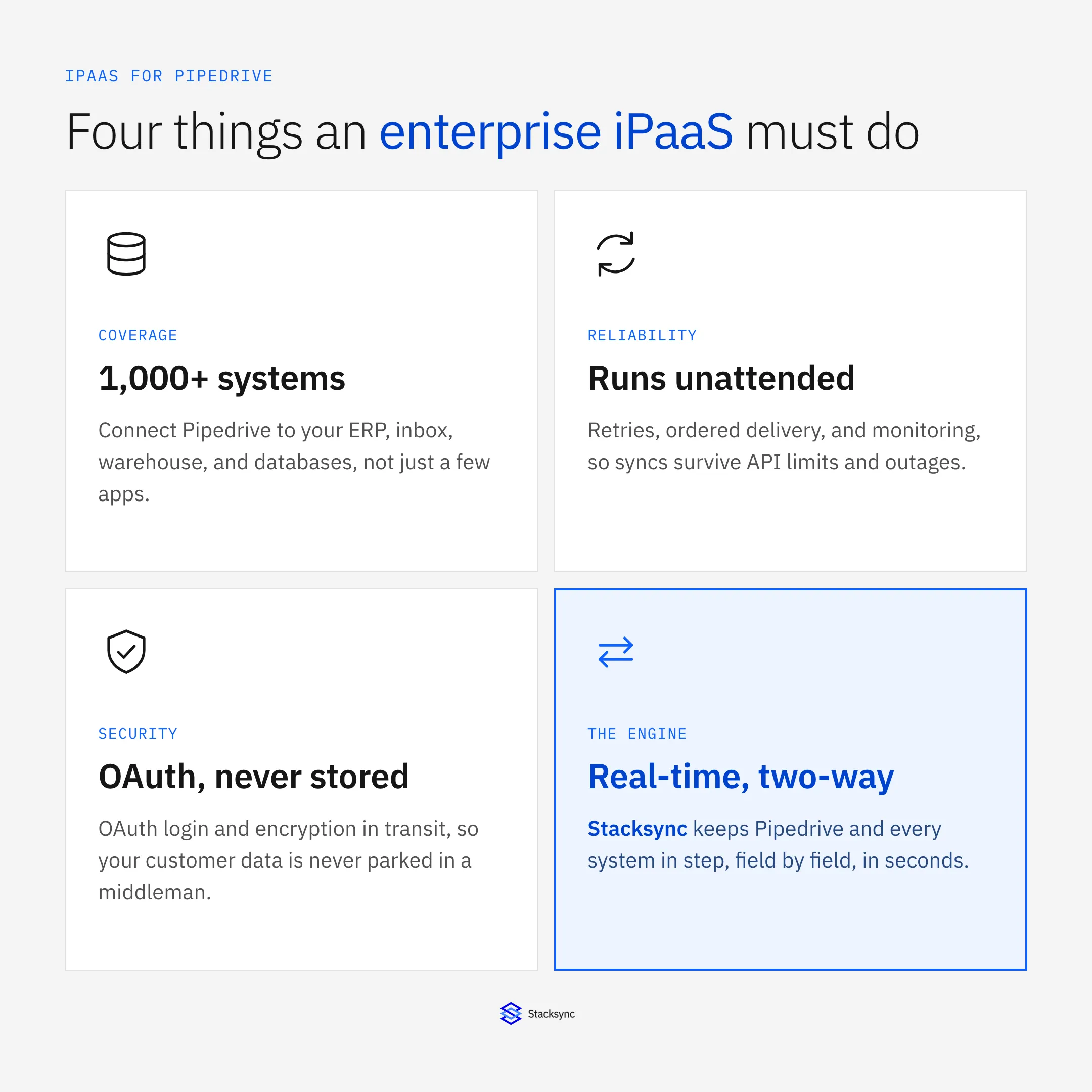
The short version: coverage, reliability, security, and a real two-way sync engine underneath. Miss any one and you are back to CSV exports, marketplace one-offs, and stale records. If you want the platform view of the CRM first, the Pipedrive connector page covers the surface area; here we focus on what makes an integration platform hold up in production.
Why real-time two-way sync is the baseline
A CRM is not a passive destination. Reps edit deals and contacts in Pipedrive all day, and the same customers are edited in the ERP, the support inbox, and the database. If integration only moves data one way, the other system drifts out of date the moment someone touches a record there, and you are left with a nightly job trying to reconcile two versions of the truth.
Real-time two-way sync removes that gap. A change on either side is reflected on the other within seconds, and when both sides change the same field, a conflict policy decides the winner rather than the last export silently overwriting good data. For a CRM that reps live in and that feeds billing and reporting, that consistency is the baseline, not a premium feature. It is also what separates an iPaaS built for a system sales works in from one built to copy data into a dashboard.
What the platform looks like underneath
It helps to picture an enterprise iPaaS as three layers. At the top are your systems, Pipedrive next to your ERP, shared inbox, warehouse, and databases. In the middle is the sync engine that keeps them in step. At the bottom is the reliability layer that lets the whole thing run unattended.
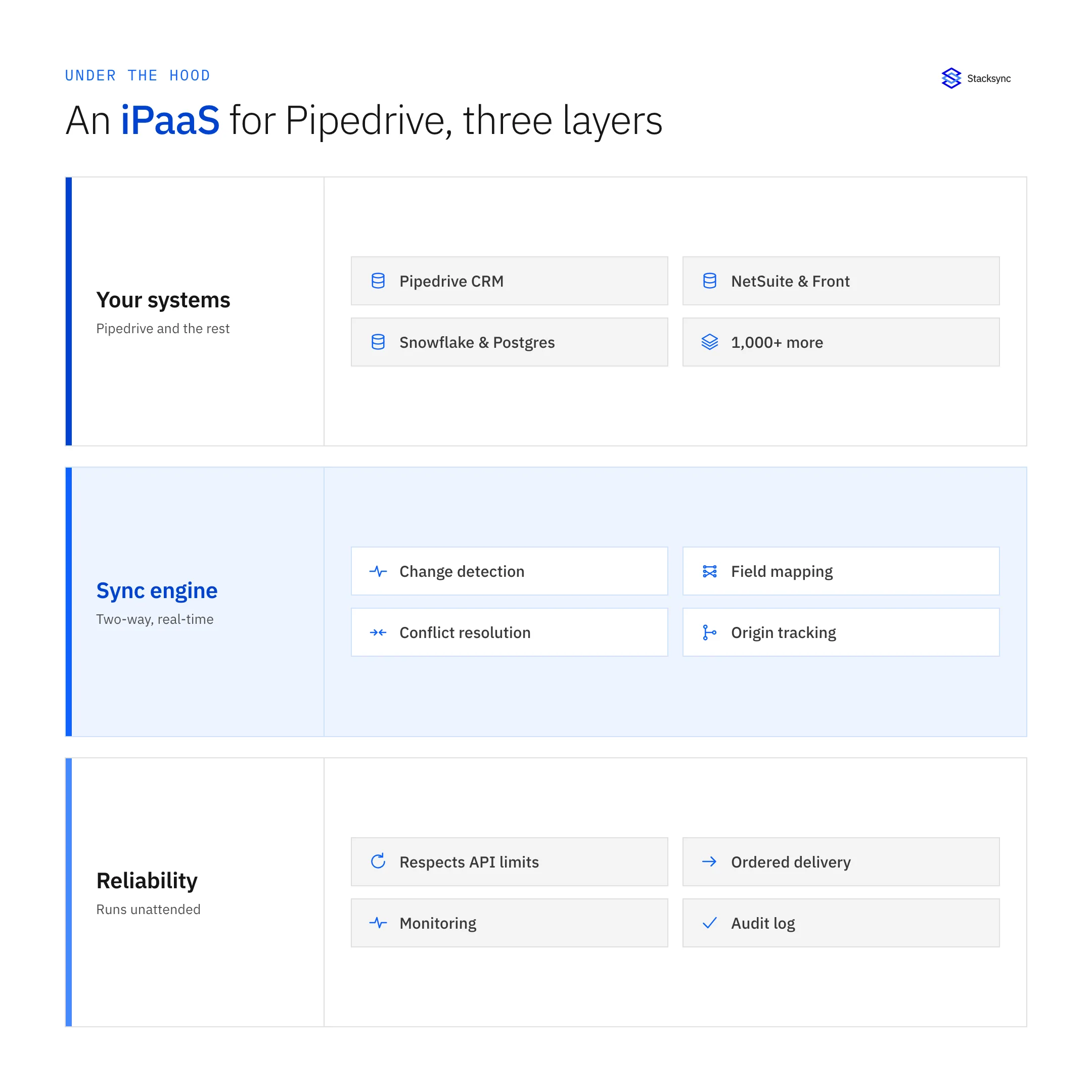
The engine layer is where the real work happens: field-level change detection so only what changed moves, origin tracking so a write does not echo back around, field mapping between two different schemas, and conflict resolution under one shared policy. The reliability layer is what makes it enterprise-grade: it respects the Pipedrive API rate limits, delivers changes in order, retries with backoff, and keeps a monitorable audit log. A tool that has the top layer but not the two below it is a connector, not a platform.
The Pipedrive API, and staying under its limits
All integration with Pipedrive goes through its REST API, which enforces rate limits: a request budget per API token and per company, scaled by plan, plus daily caps. Those limits exist to stop any one integration from starving the rest, and they are the single most common thing that breaks a naive Pipedrive integration.
| Nightly full export | Field-level two-way sync | |
|---|---|---|
| What moves | Every record, every run | Only the fields that changed |
| API pressure | High, burns the rate budget | Low, stays well under limits |
| Freshness | Stale until the next run | Seconds behind the change |
| Write-back to Pipedrive | A separate job to build | Built in, both directions |
| When a limit is hit | The job fails, you re-run it | Backs off and retries on its own |
Why a field-level two-way sync survives the Pipedrive API limits that break a full export.
An enterprise iPaaS treats those limits as a design constraint, not an afterthought. It moves the minimum data, spaces requests out, and backs off automatically when Pipedrive signals it is close to a limit. The result is a sync that keeps up in real time without ever getting your Pipedrive account throttled.
Connecting Pipedrive to the rest of your stack
The reason to run one platform instead of a folder of marketplace one-offs is that a single engine can hold Pipedrive in step with everything at once. The same two-way sync that keeps Pipedrive and your ERP consistent also keeps it consistent with the shared inbox, the warehouse, and the app database, each configured on its own but running on the same engine.
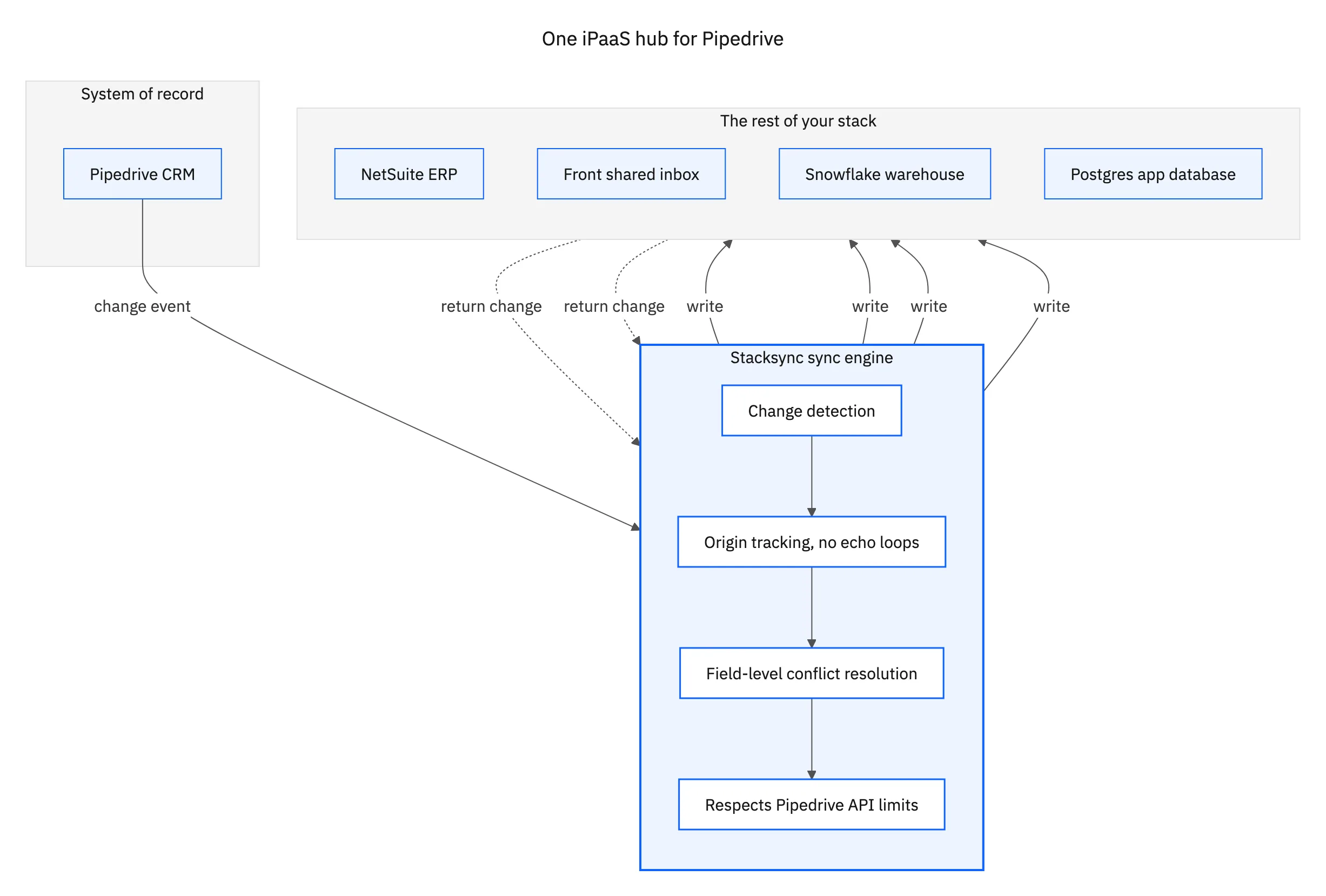
That fan-out is where the coverage requirement earns its place. If the platform only connects Pipedrive to a short list of popular apps, you will hit the one system it does not cover within a quarter. A broad iPaaS connects Pipedrive to more than a thousand systems on the same engine, so adding the next one is configuration, not a new project. Specific pairings each have their own guide: Pipedrive and NetSuite, Pipedrive and Salesforce, Pipedrive and Front, and Pipedrive and Snowflake.

How to evaluate one
When you compare platforms, push past the connector list and test the four things that decide whether it holds up. Ask each vendor to sync a Pipedrive object both ways in a sandbox, then edit the same record on both sides at once and watch how the conflict is resolved. That one test tells you more than a feature grid.
- Coverage. Does it connect Pipedrive to your ERP, inbox, warehouse, and databases, or only to a handful of popular apps?
- Direction and speed. Is it genuinely two-way and real time, or a one-way export on a schedule dressed up as a sync?
- Reliability. Does it respect the Pipedrive rate limits, retry on failure, deliver in order, and give you monitoring and an audit log?
- Security. OAuth login so your data is never stored in a middleman, encryption in transit, role-based access, and logs your security review can actually pass.
If a platform can do all four for one pairing, it can usually do them for the rest of your stack, because the same engine handles each one. That is the whole promise of an iPaaS: you solve the integration once and reuse it, instead of rebuilding it per system.
One platform, held to a real bar
An enterprise iPaaS for Pipedrive is not a marketplace app with a nicer logo. It is coverage across your real systems, real-time two-way sync as the default, reliability that survives the Pipedrive API limits, and OAuth-based security a review can pass. Hold every candidate to those four, and the field narrows quickly.
Stacksync was built to clear that bar: real-time two-way sync, more than a thousand connectors, field-level conflict resolution, OAuth login that never stores your data, and the reliability layer that keeps it running unattended. To see it hold Pipedrive in step with the rest of your stack, book a demo.

FAQ
Frequently asked questions










Related articles