







Keep the approved build identifiable
Link accepted options and commercial lines without relying on the current opportunity description as the specification.
 Salesforce
  HubSpot
  NetSuite
  Zendesk
  Microsoft Dynamics 365 Sales
  Dynamics 365 F&O
  Attio
Attio  Pipedrive
  Zoho CRM
  Campfire
  Rillet
  Front
Front  Shopify
  Amazon Seller Central
  SendGrid
 Industrial equipment and machinery
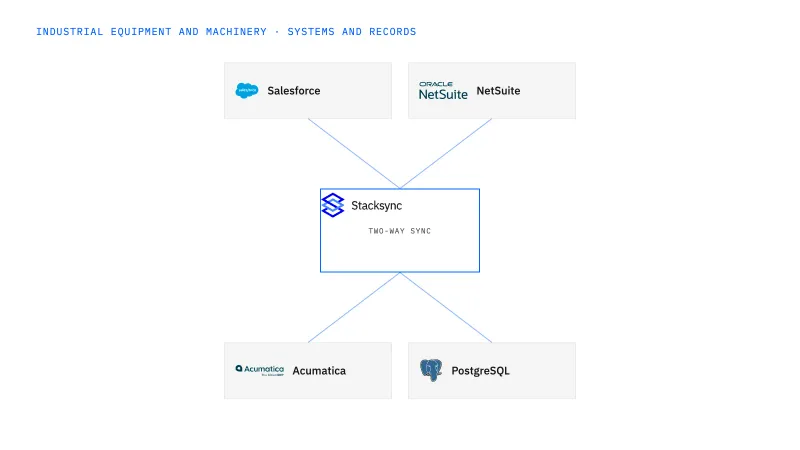
Connect approved equipment configurations and commercial orders across Salesforce and NetSuite. Stacksync fits builders whose sales, engineering and order-management teams repeatedly reconcile what was sold with what production accepted. Preserve configuration versions and operational ownership while returning the order milestones account managers need.
The opportunity says the machine is sold, but its approved options, services and delivery commitment are scattered across separate records.
Explore your process in a demo, or get our shared two-way sync architecture guide.
When this fits
COOs, service directors and IT leaders at US equipment builders with 100–1,000 employees and a mix of manufacturing, distribution and service.
Link accepted options and commercial lines without relying on the current opportunity description as the specification.
Show the accepted order and release conditions so sales can explain progress without reconstructing it from emails.
Route later option changes with their impact while validating the exact ERP operations required for execution.
The process, end to end
an equipment builder sells machines with options and commissioning services. Evaluate one configured order and a later option change, then inspect whether the original accepted build remains traceable while the requested revision receives the right review.
Scope your implementation
Review current platform pricing alongside the records, volume, and actions in your process. Use your own operating baseline to evaluate the economics.
Explore your process in a demo, or get our shared two-way sync architecture guide.
From foundation to action
Keep shared customer, order, and operational records aligned, with clear field ownership.
Explore two-way sync 02Move approved work between systems, assign exceptions, and confirm the result.
Explore workflows 03Investigate cross-system questions, assemble the evidence, and prepare the next action.
Explore ai agents (genies) 04Connect trading-partner documents to operational records and exception handling.
Explore ediGo deeper
Equipment builders can tie a sold machine's accepted option set to its NetSuite order lines and route later option changes for review instead of overwriting the build.
Keep the manufacturer's serial stable across owner changes and customer asset tags, with a retrofit history that explains the installed configuration.
When two employees quote the same urgent component, a shared request reference across Salesforce and Acumatica keeps one accepted order and its compatibility evidence.
Explore all industrial equipment and machinery integration and automation guides ↗
It can be when the approved configuration and handoff records are defined. An undefined engineering process should be clarified before automating its order consequences.
A configured machine, a service line, a repeated handoff and a changed option after procurement has begun.
Compare handoff preparation time, configuration clarification and corrections discovered after order release, using similar equipment orders.
Start with two-way sync between Salesforce and NetSuite so the approved configuration, its commercial lines and the order milestones share one order identity, with NetSuite writes limited to the order objects you approve. Add workflows when a post-acceptance option change needs its purchasing and schedule impact routed to an approver before the accepted build changes. Genies come later, when service wants serial and installed-configuration evidence assembled for aftermarket part proposals. EDI is a separate step for distributor purchase orders that carry kits and partial shipments into NetSuite.


