






















What Is a Value-Added Reseller (VAR)? How VARs Make Money in Software
A value-added reseller buys software, adds services, and resells the result. Here is how VARs make money, and where sync fits.
About the author

Devin Archer
Head of Partnerships
Devin Archer is Head of Partnerships at Stacksync, where he runs the partner program for referral, reseller and OEM partners. He works with consultants, agencies and technology vendors on how to sell and deliver real-time two-way sync. Based in Vail, Colorado.
Key takeaways
- A value-added reseller buys software from a vendor, adds services such as implementation and support, and resells the result as a complete solution.
- The test is the invoice: a customer that pays only for licenses bought from a reseller, one that also pays for services bought from a VAR.
- VARs earn from license margin, services and recurring support or managed revenue. The recurring layer decides whether the business grows.
- Integration makes a VAR bundle hard to replace, because it is specific to the customer's systems.
- There is no universal VAR license. Requirements come from each vendor's partner program.
What is a value-added reseller?
A value-added reseller (VAR) is a company that buys software or hardware from a vendor, adds its own services, and resells the result to an end customer as a complete solution. The value added is everything the customer pays for beyond the license: implementation, integration, customization, training and ongoing support. In software, that usually means a Salesforce, HubSpot, Acumatica or Dynamics practice, or a NetSuite Solution Provider, that sells the platform and then makes it work inside the customer's business.
VARs earn in three layers: a margin on the license, fees for the services around it, and recurring revenue from support, managed work and renewals. The layer that separates a VAR that grows from one that plateaus is usually the services layer, and the part of it that ages best is integration, because a system that stays connected to the rest of a customer's stack keeps needing its partner. This guide defines a VAR, compares it with a plain reseller, an MSP, a systems integrator and a referral partner, walks through the revenue model, and shows how a VAR can add real-time two-way sync to its bundle as a Stacksync reseller partner.
It is written for ERP and CRM consultancies, IT service firms and agencies that resell or implement software, and for anyone trying to work out what the term actually means.
What does a value-added reseller add?
A value-added reseller sits between a software vendor and an end customer. The vendor builds the product and sets the price. The VAR buys it under a partner agreement, usually at a discount to list, sells it to the customer, and wraps it in work the customer would otherwise have to do alone or buy from someone else. The customer gets one accountable party for the whole outcome instead of a license and a to-do list.
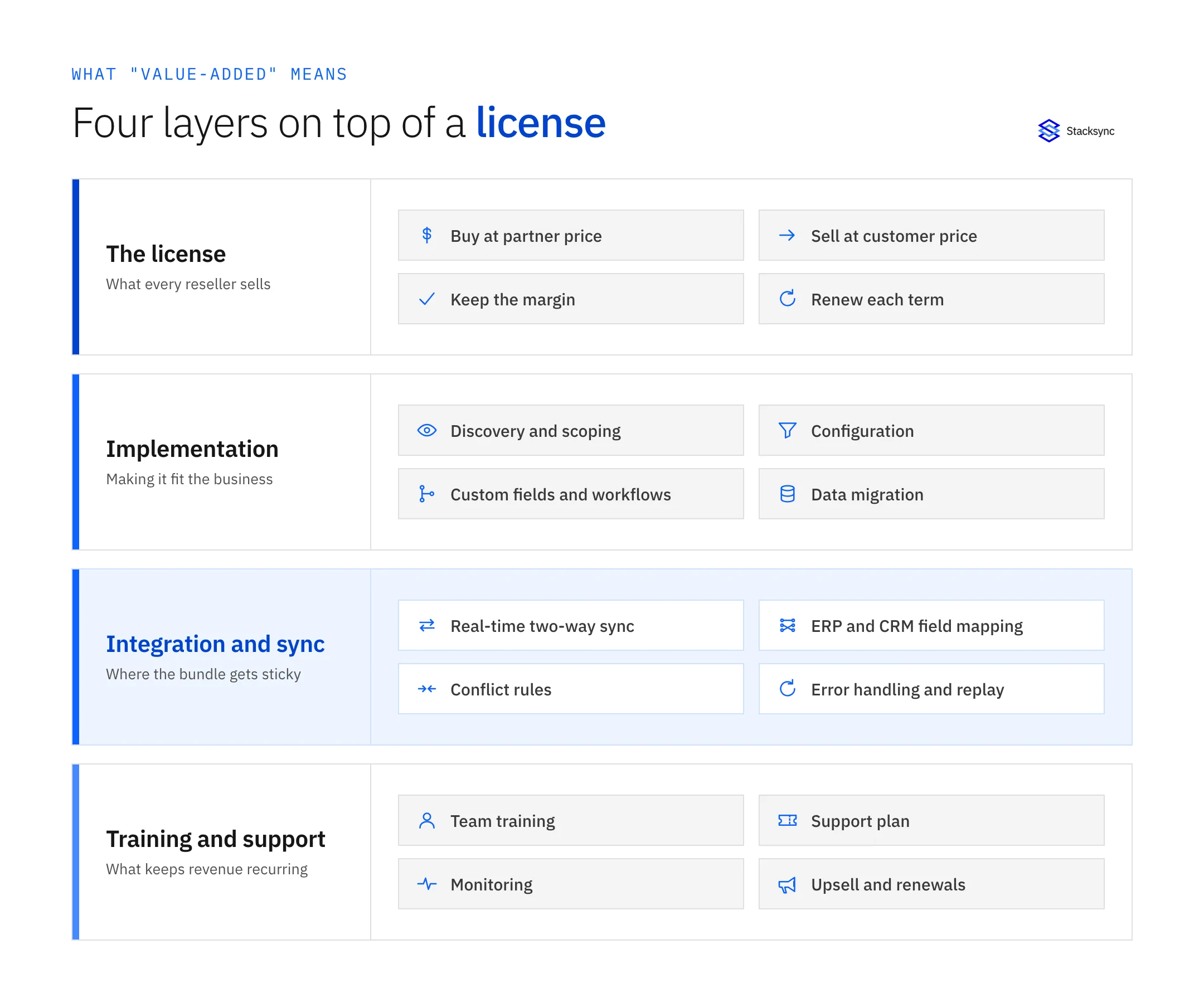
The value added is not a fixed list, but in software it clusters into four layers.
- The license. The product itself, bought at a partner price and sold at the customer price.
- Implementation and customization. Scoping, configuration, custom fields and workflows, and data migration.
- Integration. Connecting the product to the customer's other systems so the data agrees everywhere it is used.
- Training and support. Getting the team productive, then answering the phone after go-live.
Oracle NetSuite's Solution Provider program is a familiar example of the model. Partners in it sell NetSuite licenses, implement the platform and support it afterward, and the partner is the customer's primary relationship from scoping through go-live.
What is the difference between a VAR and a plain reseller?
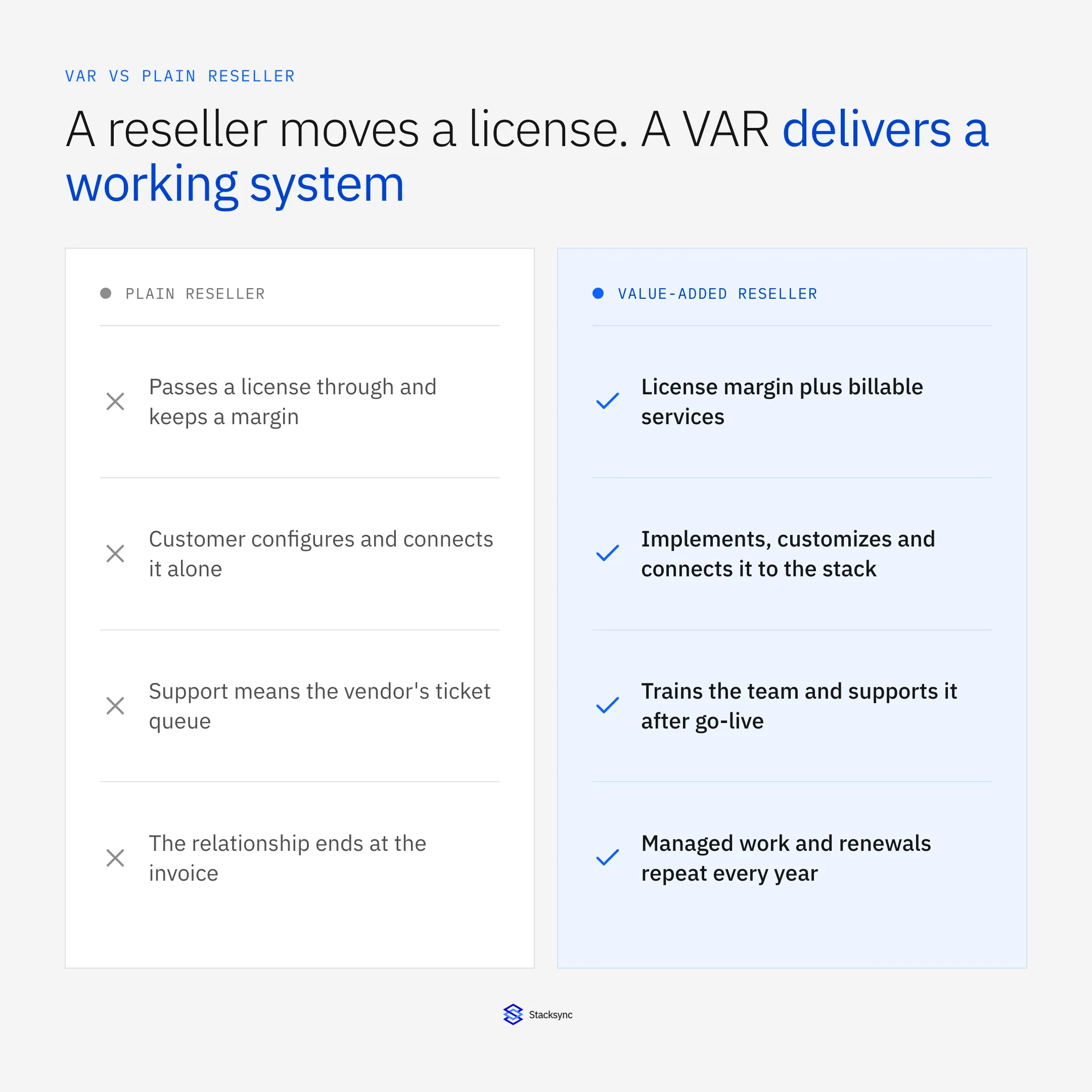
A plain reseller moves a license. It buys a product, sells it at a markup and stops there, and the customer configures, integrates and supports it alone or goes back to the vendor. A VAR makes the same sale and then does the work that makes the product useful, and charges for it.
The practical test is the invoice. If the customer pays only for licenses, it bought from a reseller. If it also pays for scoping, configuration, integration, training or support hours, it bought from a VAR.
The labels overlap in practice. Vendors often call every authorized seller a reseller in the contract and reserve VAR for partners with a services practice. Read the partner agreement, not the label.
How do value-added resellers make money?
Most VARs run three revenue lines at once, and the mix decides how healthy the business is.
- License margin. The VAR buys at a partner price and sells at the customer price, and keeps the difference. The size of the discount depends on the vendor and the partner program, and for a services-led VAR it is rarely the largest line.
- Services. Implementation, customization, data migration, integration and training are billed as project fees or hourly rates. For many software VARs this line is bigger than the resale margin, though the ratio varies by vendor and by product.
- Recurring revenue. Support plans, managed administration and renewals turn a one-time project into a relationship. Some vendors also pay partners a margin or commission on subscription renewals.
The trade-off is timing. License margin and project fees arrive when the deal closes and the project ships, then stop. Recurring revenue arrives every month but takes longer to build. The strongest VARs treat the project as the way to earn the recurring contract, and design each engagement so there is something to manage afterward.
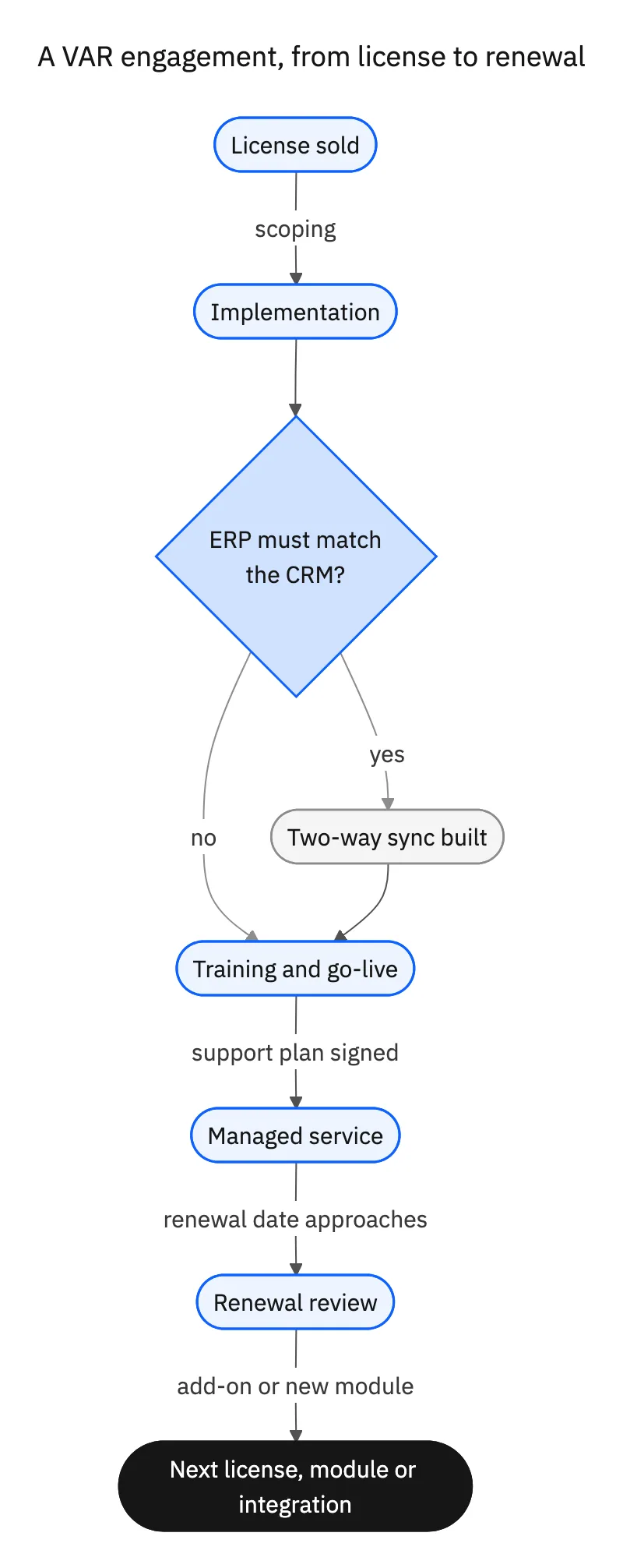
A typical engagement runs as a path with a loop at the end: the license and the implementation pay first, the integration work and the support plan create the recurring layer, and the renewal review reopens the cycle.
VAR vs reseller vs MSP vs systems integrator vs referral partner
These five terms describe different ways of earning from someone else's software. The table compares them on what matters most to a vendor or a buyer: what the partner does, who owns the customer relationship, and how it earns.
| Partner type | What it does | Who owns the customer | How it earns |
|---|---|---|---|
| Value-added reseller (VAR) | Buys a product, adds implementation, integration, training or support, and resells it as a complete solution | The VAR, usually through its own contract with the customer | License margin, project fees and support |
| Reseller | Buys a product and resells it, often with little or no added work | The reseller for the transaction, while the customer often deals with the vendor afterward | Margin on the license |
| Managed service provider (MSP) | Runs and monitors a customer's IT or applications on an ongoing basis | The MSP, through a recurring service contract | Monthly or annual subscription fees |
| Systems integrator (SI) | Designs and connects several systems, often from different vendors, into one working solution | The SI, for the length of the project and often beyond | Project and consulting fees, sometimes a reseller margin |
| Referral partner | Introduces the vendor to a prospect and does not sell or deliver | The vendor, which closes and contracts the deal | A referral fee on the deal |
Real partners blend these roles. A NetSuite VAR that also runs a managed support desk is a VAR and an MSP at once.
What is the difference between a VAR and an MSP?
A VAR is built around a transaction, the sale and delivery of a product, and earns mostly from license margin and projects. An MSP is built around a service, running a customer's systems month after month, and earns mostly subscription fees. The difference is the shape of the revenue, not the skills. Many firms do both: they resell the platform, implement it, then take over administration under a managed contract. For a VAR deciding whether to add managed services, the practical answer is that the implementation project is usually the way into the managed contract.
What is the difference between a VAR and a systems integrator?
A systems integrator's core skill is making several systems, often from different vendors, work as one, and it typically stays neutral on which products the customer buys. A VAR is anchored to specific products it resells and knows deeply, and it earns a margin on what it recommends. The two overlap whenever a VAR's bundle includes integration, which is why an ERP VAR that connects the ERP to the customer's CRM is doing systems integration work as part of the sale.
What is a referral partner?
A referral partner is the lightest role in the table. It introduces a prospect and the vendor does the selling, contracting and delivery. It earns a fee, carries no inventory and owns no customer contract, which makes it a low-commitment way to start a vendor relationship before moving up to reselling. All five sit inside the wider set of channel partner models.
Where does integration make a VAR bundle sticky?
License margin is the easiest part of a VAR's revenue for a competitor to copy, and training is the easiest to commoditize. The integration layer is harder to replace, because it is specific to the customer's systems and it keeps changing as those systems do.
Take a NetSuite VAR. The ERP go-live goes well: chart of accounts, items, price lists, the invoicing flow. Then the sales team asks why customers, quotes and order status still live in Salesforce or HubSpot and are updated by hand. A scheduled export covers part of it, until an order changes in the ERP an hour after the export ran and a rep quotes stale data. The VAR that can say both systems agree, in both directions, has turned a finished project into a working system the customer will not want to swap out.
That is a two-way sync problem. A change in NetSuite has to reach the CRM, a change in the CRM has to reach NetSuite, and there has to be a rule for which system wins a field when both change. Building that yourself means writing and maintaining middleware for every customer, which is a services trap: the work is billable once and then turns into unpaid support. A sync platform makes it a repeatable part of the bundle instead. Turning that upkeep into a monthly service is covered in managed integration services for consultants.
For the mechanics, see bi-directional sync explained with real examples and the NetSuite and Salesforce integration page, or start from the NetSuite, Salesforce, HubSpot and Acumatica connectors.

How does a VAR work as a Stacksync reseller partner?
Stacksync runs a partner program with three tracks, and every track keeps 100% of the partner's services and implementation revenue. Stacksync does not compete with partners on services. What differs is how much of the commercial relationship the partner takes on.
- Referral: introduce Stacksync to clients and earn a referral fee. Stacksync closes the deal, and there is no quota.
- Reseller: own the commercial relationship, transact Stacksync for your customers and earn structured margin. This is the VAR track.
- OEM: license the platform under your own brand and build a vertical offering on it.
As an illustration, picture an ERP consultancy that implements NetSuite for mid-market distributors. On the reseller track it registers the opportunity in the Partner Portal, and deal registration protects a registered opportunity from competitive encroachment, including from Stacksync direct sales. It quotes Stacksync next to the NetSuite work, transacts it for the customer and earns structured margin on the contract. It bills the implementation, field mapping and rollout as its own services and keeps all of that revenue. The sync keeps running after go-live, and the consultancy stays the customer's first call. Margin terms are shared during onboarding and are not published, so this article does not quote any. The OEM version of this path is laid out in the white-label integration platform buyer's guide.
Getting started is short. The Partner Academy has three tracks: Foundation, which is free and self-paced, Implementation Specialist and Solution Architect. Resellers get a dedicated sandbox for demos and proofs of concept. Onboarding takes about two weeks, and from kickoff to a first deal is typically 4 to 8 weeks.
The model is already in use. Atypical Tech is listed as a reseller and ERP integration firm that connects NetSuite and Dynamics with Stacksync real-time two-way sync, and Blu Banyan, a NetSuite Solution Provider and SuiteApp developer, is also a Stacksync partner. You can browse others in the partner directory.
If this fits your practice, apply as a reseller, or compare all three tracks on the become-a-partner page.
Do VARs need certifications, and how do you become one?
There is no universal VAR license. What you need depends on the vendor. Most publishers run a partner program with an application, a signed reseller agreement and, often, certified staff, and some add minimum sales targets or tiers with better discounts. Terms differ widely, so read each vendor's program before you commit.
- 01Pick a product you can implement well. A VAR is only as good as its depth in the platform it sells.
- 02Apply to the vendor's partner program and sign the reseller agreement.
- 03Certify the people who will sell and deliver.
- 04Build a repeatable services package around it: scoping, implementation, integration and training.
- 05Add a support or managed plan so part of the revenue recurs.
Adding a second vendor for the integration layer is a common step once the core practice is running. The reseller track above is one way to do it without giving up any of your services revenue.
Become a Stacksync partner
If you already sell or implement NetSuite, Salesforce, HubSpot, Acumatica or Dynamics, the most direct way to make your bundle harder to replace is to include real-time two-way sync in it. Pick the track that fits: referral if you want to introduce clients and earn a fee, reseller if you want to own the relationship and earn margin, or OEM if you want to build under your own brand. Every track keeps 100% of your services revenue.
Become a Stacksync partner and start with a two-minute application.

FAQ
Frequently asked questions









Related articles



PARTNER PROGRAM
Become a Stacksync partner
Build and sell real-time two-way sync as an extension of our team. Get certification, deal protection, co-marketing and the technical resources to grow a high-margin practice.


