






















What Is a Channel Partner? Referral, Reseller and OEM Programs Explained
A channel partner sells, refers or supports a vendor's product. Here is how referral, reseller and OEM models differ.
About the author

Devin Archer
Head of Partnerships
Devin Archer is Head of Partnerships at Stacksync, where he runs the partner program for referral, reseller and OEM partners. He works with consultants, agencies and technology vendors on how to sell and deliver real-time two-way sync. Based in Vail, Colorado.
Key takeaways
- A channel partner sells, refers, delivers or supports a vendor's product without being part of the vendor.
- Every partner model answers three questions: who owns the customer, who sends the invoice, and how the partner gets paid.
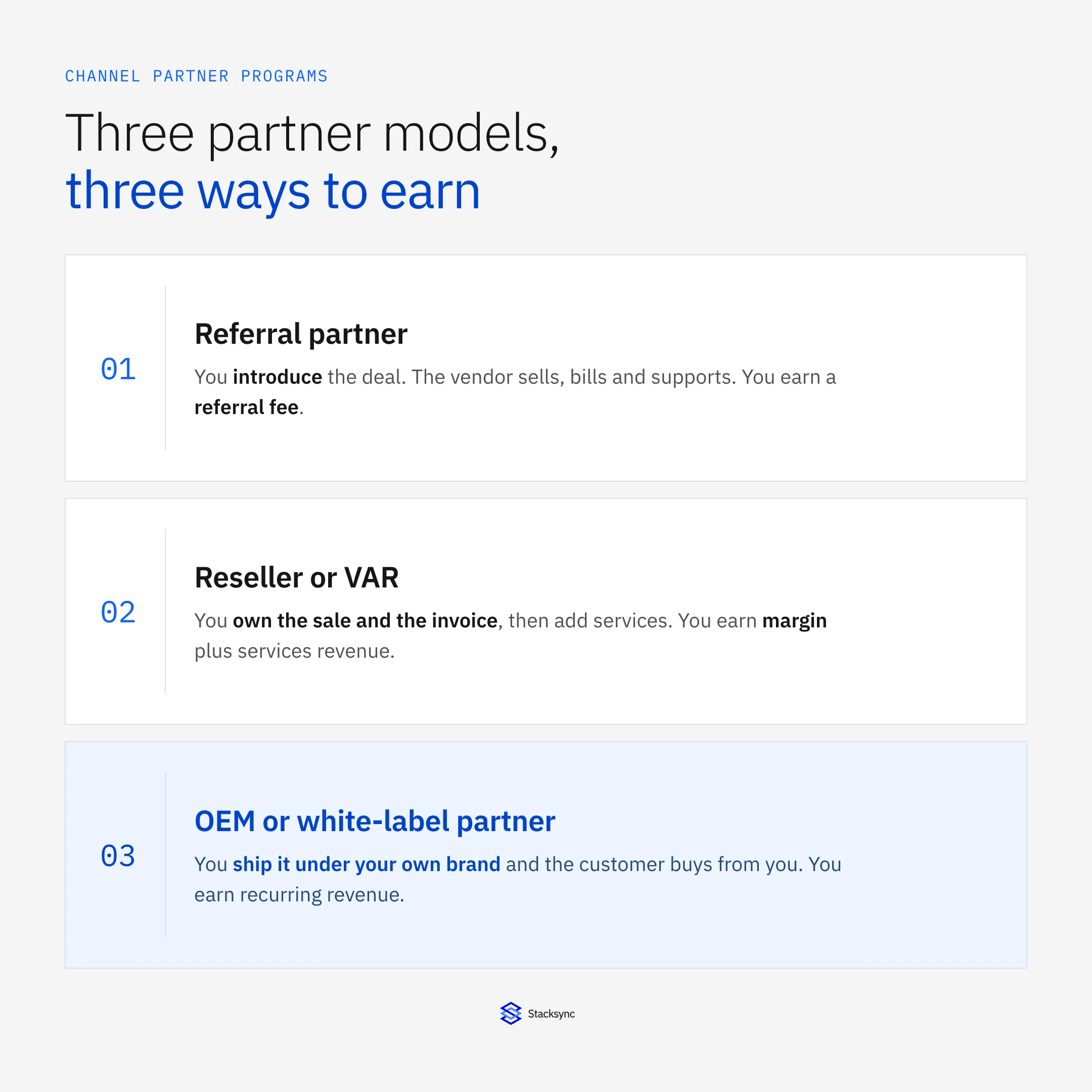
- Referral partners introduce deals, resellers own the relationship and earn margin, and OEM partners embed the product under their own brand.
- Partners earn from referral fees, resale margin, services, recurring managed revenue and co-marketing funds. Ask whether you keep your services revenue.
- Start with the lightest model that fits and move up when the pipeline justifies it.
What is a channel partner?
A channel partner is a company or independent professional that sells, refers, delivers or supports a vendor's product without being part of the vendor. The vendor reaches customers it could not reach alone, and the partner gets paid through a referral fee, a discount on resale, or the services revenue it earns around the product. A channel partner program is the set of rules that decides which of those roles you can play, who owns the customer, and how you are paid.
The term is an umbrella, and that is where most explanations go wrong. A referral partner who hands over an introduction and a reseller who invoices the customer are both called channel partners, yet they run very different businesses. This guide defines each model (referral, reseller and OEM) in plain terms, compares them side by side, and then walks through one real program, Stacksync's, as a worked example.
If you are a consultant, agency or IT firm deciding whether to partner with a software vendor, the short version is to choose by who should own the customer relationship, not by the biggest headline payout. If you would rather see a program end to end first, jump to how the Stacksync partner program works.
The three questions behind every partner model
Every partner model is an answer to three questions: who owns the customer relationship, who sends the invoice, and how does the partner get paid. Portals, tiers, certifications and co-marketing budgets are packaging around those three answers.
Lined up on those questions, the common models fall on a spectrum. The further down the list, the more of the deal the partner owns, and the more effort and commitment it takes.
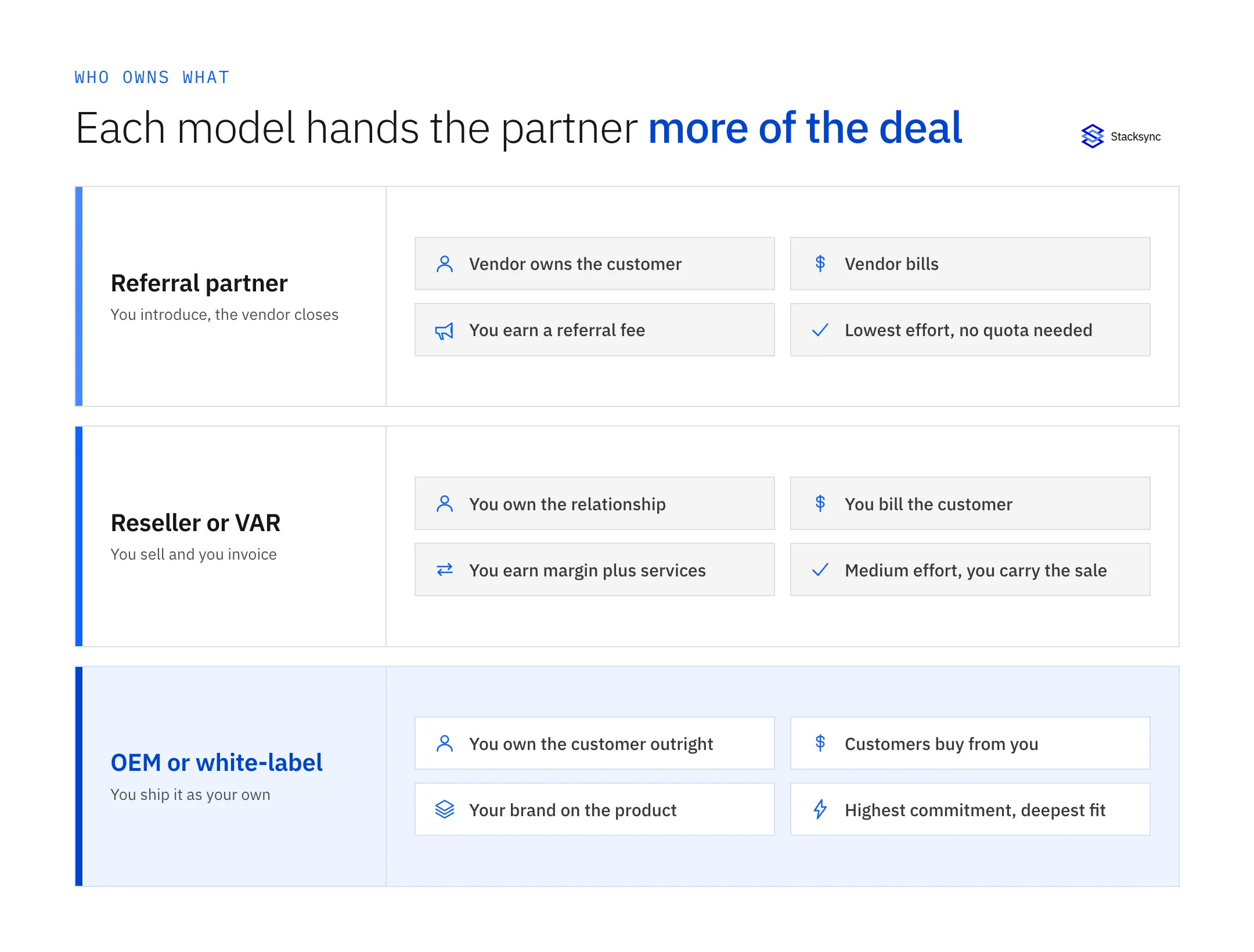
Partner programs vary by vendor, so treat these labels as vocabulary rather than a standard. The same word can mean different things in two contracts, which is why you should read who bills and who supports before you read the program name.
What is a referral partner?
A referral partner introduces a vendor to someone who needs its product. The vendor runs the sale, signs the contract, bills the customer and supports the product. The partner is usually paid a referral fee or commission when the deal closes, sometimes on the first contract only and sometimes over the life of the account, depending on the program.
A concrete case: an ERP consultant hears from three clients this quarter that their CRM and ERP disagree about customer records. She does not want to build or run the tooling herself. She introduces one client to a vendor, the vendor takes it from there, and she keeps doing the consulting work she was hired for.
Referral suits consultants, agencies and advisors who have trusted client relationships but no wish to sell or support software. The trade-off is control. You have no say in how the sale is handled, so refer only vendors you would use yourself.
What is a reseller partner, and what is a VAR?
A reseller sells a vendor's product to its own customers. The reseller owns the commercial relationship, usually sends the invoice, and earns margin: the gap between what it pays the vendor and what the customer pays. The exact mechanics differ by program, and some vendors pay a discount off list price while others pay a margin share.
A value-added reseller, or VAR, adds work around the product: implementation, configuration, integration, training and support. In software the added value is often where the customer's trust sits, and for many partners the services earn more than the resale margin itself. For the full picture, see what a value-added reseller is and how VARs earn.
That is the practical difference between referral and reseller. A referral partner sends the customer to the vendor. A reseller keeps the customer and brings the vendor in behind the sale. Resale suits implementers and IT firms that already own the client relationship and are comfortable with contracting, billing and first-line support.
What is an OEM or white-label partner?
An OEM partner embeds a vendor's technology inside its own product or service and sells the result under its own brand. White-label is the same idea with the vendor's name removed, so the customer may never see it. The partner owns the customer, the pricing, the packaging and the front line of support. The vendor is the engine behind the brand.
The partner earns recurring revenue from its own product, less whatever platform fee it pays the vendor. This is the highest-commitment model. You own the product promise, and you depend on the vendor's roadmap and reliability to keep it. It fits software companies and vertical specialists building a product or practice they intend to run for years, for example a healthcare or finance software vendor that wants data sync to ship as one of its own features. The buyer's checklist for this model is in our white-label integration platform guide.
Other channel partner types you will hear about
Partner-program guides usually add a few more categories. They mostly combine the three core models above with a different emphasis.
- Distributor. Buys in volume and sells to resellers rather than to end customers, earning a margin spread across its reseller network. It creates a multi-tier channel.
- Managed service provider (MSP). Runs and supports a technology for a client as an ongoing service, and earns recurring revenue.
- Systems integrator (SI). Designs and implements multi-vendor solutions, usually for larger customers. It is paid mostly for services rather than product margin.
- Technology or ISV partner. Builds a product that integrates with the vendor's platform, and is rewarded with shared pipeline and ecosystem exposure more than with margin.
- Affiliate. Promotes the product through content or an audience and earns a commission per lead or sale, usually without a relationship with the customer beyond the click.
Channel partner types compared
The table puts the models on the same axes. Read across a row to see the whole deal: who holds the customer, who sends the invoice, and where the money comes from.
| Model | Who owns the customer | Who bills | How the partner earns | Effort | Best for |
|---|---|---|---|---|---|
| Referral | Vendor | Vendor | Referral fee or commission | Low | Consultants and agencies with trusted clients |
| Reseller or VAR | Partner | Partner | Margin plus services revenue | Medium | Implementers that already own the client relationship |
| MSP | Partner | Partner | Recurring service revenue | Medium to high | Firms that run technology for clients month to month |
| Systems integrator | Shared, project by project | Partner, for services | Services revenue | Medium to high | Large multi-vendor implementations |
| Technology or ISV | Varies | Varies | Shared pipeline and ecosystem exposure | Medium | Software vendors whose product connects to the platform |
| OEM or white-label | Partner | Partner | Recurring revenue on its own product | High | Software companies and vertical builders |
| Affiliate | Vendor | Vendor | Per-lead or per-sale commission | Low | Publishers, communities and creators |
Channel partner types compared. Terms vary by vendor, so confirm the details in each program's agreement.
The flow of money and responsibility is easier to see when you follow one deal through the three core models.
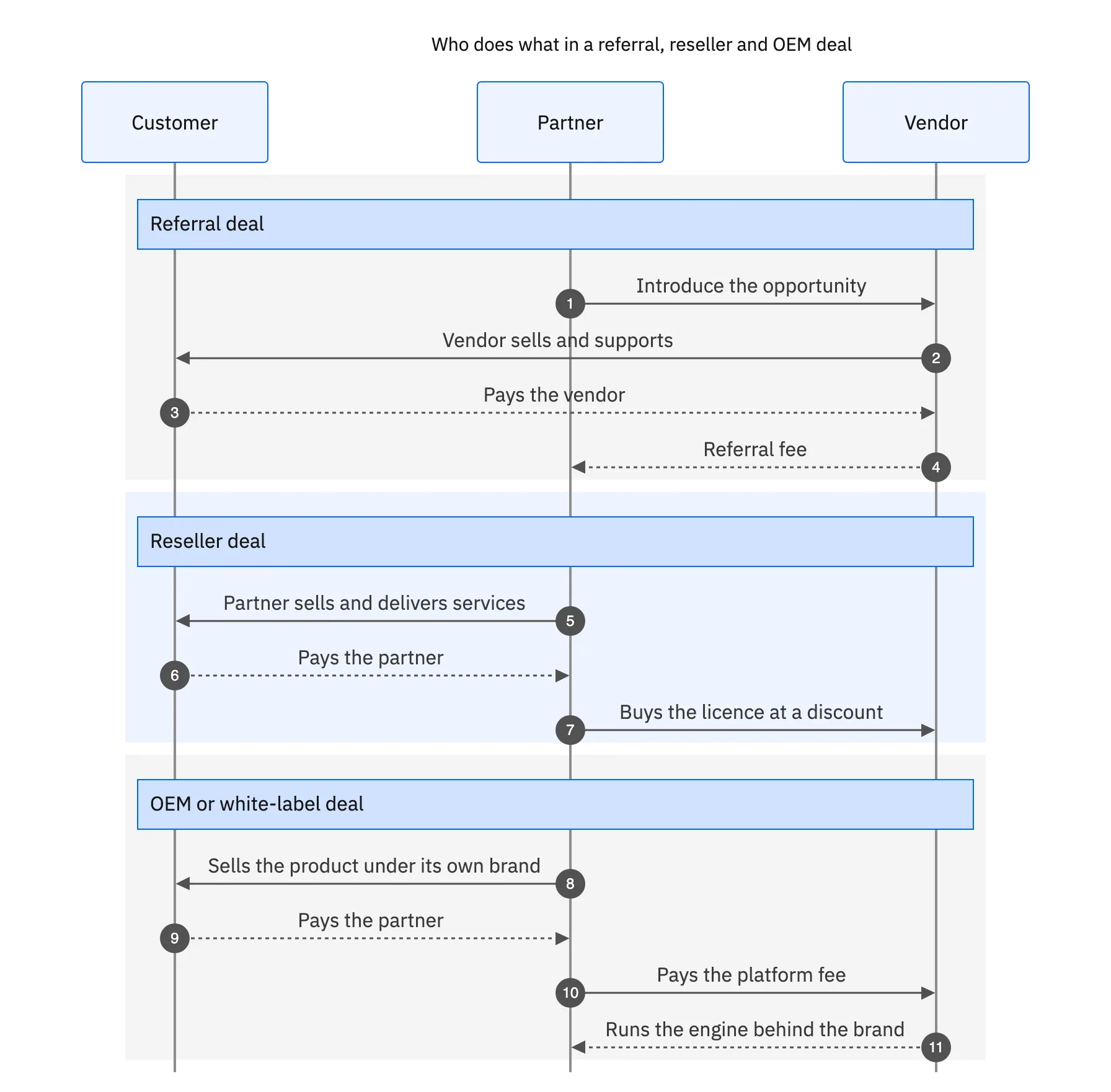
In a referral deal the partner is out of the loop after the introduction. In a reseller deal the partner sits in the middle of the money. In an OEM deal the customer may never know the vendor exists.
How do channel partners make money?
Partners are paid from a small set of sources, and most successful ones combine two or three.
- Referral fees. A one-off fee or commission when a referred customer signs, sometimes recurring.
- Resale margin. The difference between the partner's cost and the customer's price on the licences it sells.
- Services revenue. Implementation, configuration, migration, training and consulting billed to the customer. For many partners this is the largest line.
- Recurring managed revenue. Monitoring, administration and support sold as a subscription on top of the product.
- Co-marketing funds. Some programs co-invest in joint campaigns, often called market development funds (MDF).
The headline percentage matters less than what you keep. Ask whether the program lets you keep your services revenue or whether the vendor competes for it. Ask whether an opportunity you register is protected if the vendor's own sales team contacts the same client. A generous margin is worth little if you can lose the deal to a direct rep. If you sell a managed service on top, see how integration consultants turn projects into recurring revenue.

How to choose a partner program
Work through these questions before you sign anything.
- Who should own the customer? If you want to stay the trusted advisor without selling software, referral fits. If you already sell and bill, resale fits.
- Do you want to invoice for the product? Billing brings margin and also collections, renewals and first-line support.
- Do you keep your services revenue? Get a clear yes or no in writing.
- Is deal registration real? Find out how an opportunity is protected and for how long.
- What enablement is included? Look for training, certification and a sandbox where you can build and demo before a customer is involved.
- What are you committing to? Check for quotas, minimums, exclusivity and how easily you can move between tiers.
Start with the lightest model that fits and move up when the pipeline justifies it. Stepping up from referral to reseller is much easier than unwinding a commitment you were not ready for.
One example: how Stacksync's three partner tracks map to the model
Stacksync builds real-time two-way sync between systems such as Salesforce, NetSuite and HubSpot, so the consultants who implement those platforms are its natural partners. Its program has three tracks, one for each core model above.
- Referral. You introduce the opportunity and Stacksync closes it. You earn a referral fee on the initial contract, with no quota or commitment. See the referral track.
- Reseller. You own the commercial relationship, transact Stacksync for your customers and earn structured margin. See the reseller track.
- OEM. You white-label the platform under your own brand, with a dedicated Partner Success Manager, access to the product roadmap and co-marketing with MDF co-investment. See the OEM track.
Some things are the same on every track. You keep 100% of your services and implementation revenue, and Stacksync never competes with you on services. Deal registration in the Partner Portal protects the opportunities you register. Training runs through the Partner Academy, which has a free self-paced Foundation course plus Implementation Specialist and Solution Architect tracks, and you get a dedicated sandbox environment. Onboarding takes about two weeks, and the time from kickoff to a first deal is typically 4 to 8 weeks.
Stacksync does not publish commission percentages or margins on its site. The partnerships team shares the current terms during onboarding, after an application is approved. You can see the partners already in the program in the partner directory, and Blu Banyan's partnership is one example of a software vendor building on the platform.
Become a Stacksync partner
If you advise or implement for companies whose systems do not talk to each other, become a Stacksync partner. The application takes about two minutes and the partnerships team replies within two business days.
Not sure which track fits? Start with the referral track if you would rather introduce than sell, choose the reseller track if you own the client relationship, or look at OEM if you want to ship sync under your own brand. You can start where it fits today and move up as your Stacksync practice grows.

FAQ
Frequently asked questions









Related articles



PARTNER PROGRAM
Become a Stacksync partner
Build and sell real-time two-way sync as an extension of our team. Get certification, deal protection, co-marketing and the technical resources to grow a high-margin practice.


