






















White-Label Integration Platform: Offer Real-Time Sync Under Your Own Brand
A white-label integration platform lets you offer real-time sync under your own brand. Here is what to require before you sign.
About the author

Devin Archer
Head of Partnerships
Devin Archer is Head of Partnerships at Stacksync, where he runs the partner program for referral, reseller and OEM partners. He works with consultants, agencies and technology vendors on how to sell and deliver real-time two-way sync. Based in Vail, Colorado.
Key takeaways
- A white-label integration platform is licensed from a vendor and offered to your customers under your own brand.
- White label, embedded iPaaS, OEM and reseller are different things: two describe how you sell, one how you license, one what you build.
- Test branding depth early: which surfaces carry your brand, and which cannot.
- Require a separate tenant per customer, connectors that support the direction you need, and clear ownership of the customer contract.
- Real-time two-way sync lets you promise that your customers' systems agree, not just their reports.
What is a white-label integration platform?
A white-label integration platform is an integration product you license from a vendor and offer to your own customers under your own brand: your name on the product, your contract on the invoice, your team on the support line, and the vendor's engine doing the syncing underneath. It is not the same thing as an embedded iPaaS, which is a toolkit you use to build integrations into your own software. If you are a consultancy, agency, ISV or ERP vendor comparing the two, the deciding question is whether you want to sell integration as a service or ship it as a feature.
This guide is the buyer's version. It defines white label, embedded iPaaS, OEM and reseller in plain terms, lays them side by side, lists what to require from any vendor before you put your name on their product, and explains what real-time two-way sync changes about the promises you can make to customers. We have already written a head-to-head on one narrow question, Stacksync white label versus a Powered by Fivetran arrangement. This post is the wider checklist, and it applies to any vendor you are evaluating, including us.
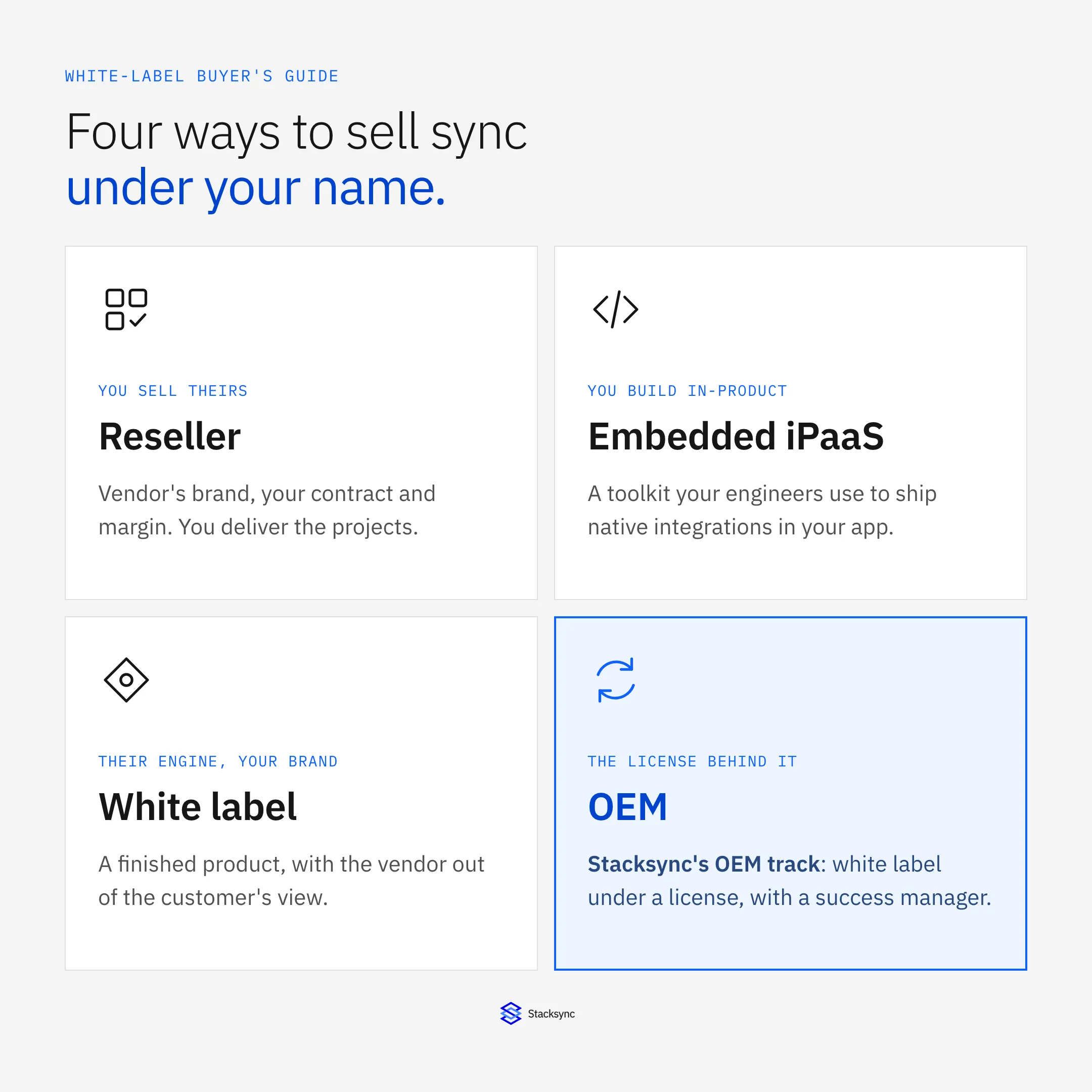
The short version: choose a reseller arrangement if you want to sell the vendor's product and keep your own services revenue, choose an embedded iPaaS if integrations are a feature your engineers will build into your product, and choose a white-label OEM license if you want customers to buy real-time sync from you, as yours. The rest of the post is how to tell which one you are.
How deep does white-label branding go?
White label software is an old model: one company builds the product, another sells it under its own name. White label SaaS is the same idea with a subscription attached. What is newer is applying it to integration, where the product is a running sync between your customer's own systems, such as their CRM, their ERP and their database. The label describes who the customer believes they are buying from. With a white-label platform the vendor's branding is removed or replaced with yours, so the customer deals with one company.
What varies enormously is how deep the removal goes, and that is the first thing to test. At the shallow end is a connect screen where your customer authorizes access to their systems, with the vendor's logo taken off. Further along, the same screens are themed with your colors, fonts and terminology. At the far end, the whole product experience is yours: your name, your contract, your support line, and a vendor the customer never hears about.
The public docs of the embedded platforms show that range. Merge describes white-labeling its Link component as removing the Merge branding shown at the bottom of it. Nango lets you set theme colors for its Connect UI and remove the "Secured by Nango" mention. Prismatic lets you set a custom theme and font, and even rename the terms its embedded marketplace uses. Workato documents iframe-based embedding with branding customization. These are different products for different jobs. The point is that "white label" on a pricing page can mean a logo swap or a fully resold product, so ask which one you are buying.
For a resold sync offer it helps to draw the line between what is yours and what is the vendor's. Your customer deals with you. You package, price and support the offer. A licensed platform runs the sync underneath, and the customer's own systems are where the data lives.
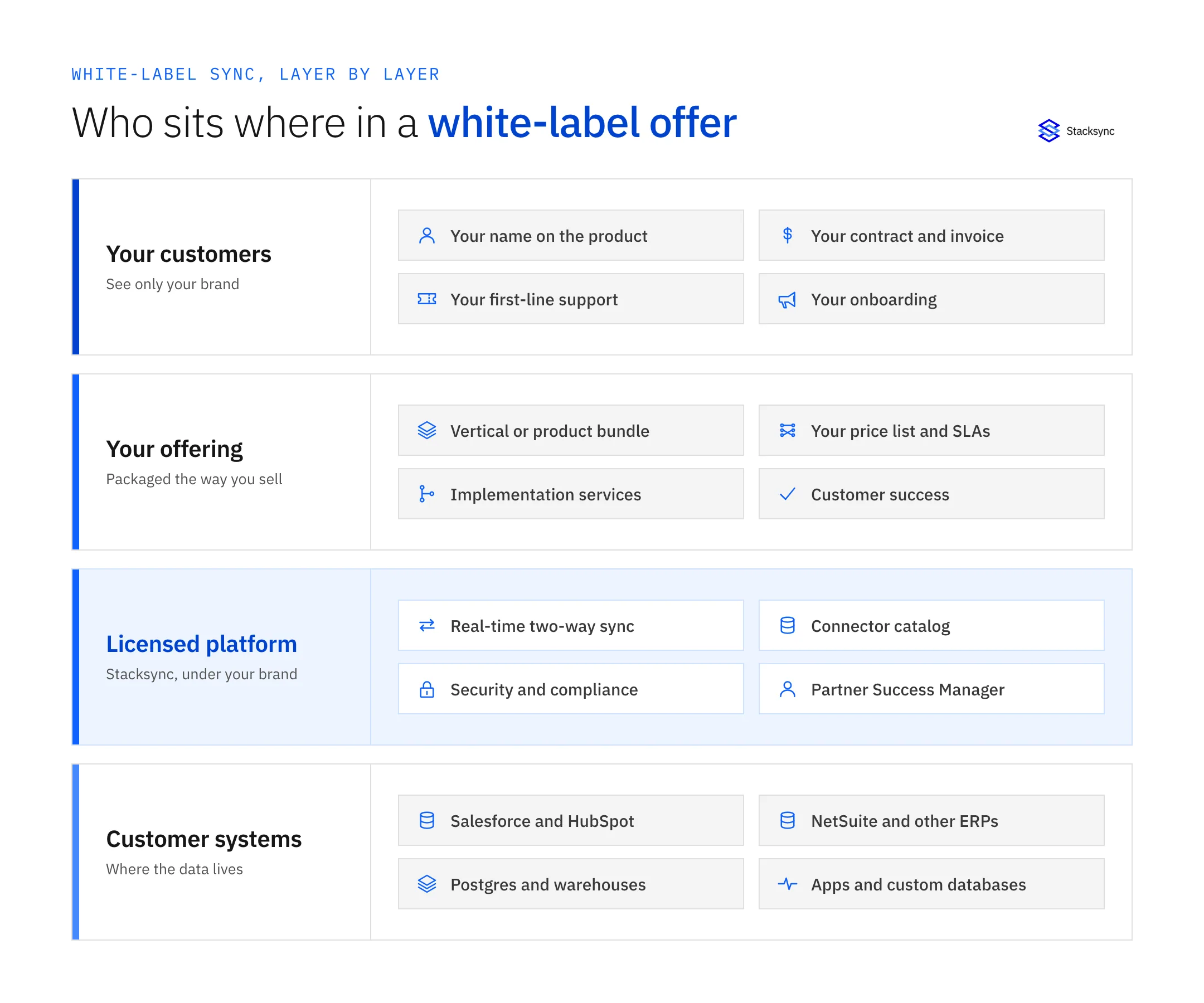
Everything above the blue band is your business. The blue band is the part you are renting, so it is the part to inspect before you sign.
White label vs embedded iPaaS vs OEM vs reseller: which do you need?
These four terms get used interchangeably in sales calls. They describe different things. Two describe how you sell (reseller and white label), one describes how you license (OEM), and one describes what you build with (embedded iPaaS).
- Reseller. You transact the vendor's product for your customers, usually under the vendor's brand, own the commercial relationship, earn margin and deliver the implementation. Choose it when your clients already trust you to run their CRM or ERP projects and the vendor's name on the product is fine or even helpful. Stacksync's reseller track works this way.
- White label. The vendor's finished product, sold under your brand, with the vendor out of the customer's view. Choose it when the brand is the point: a vertical product, an ERP add-on, an agency's managed data service.
- OEM. A licensing structure. You license the platform and embed it in your own product or practice, with the vendor's terms sitting behind yours. White label describes what the customer sees, and OEM describes the contract between you and the vendor, so most white-label deals are really OEM licenses, and an OEM iPaaS license is the usual way to get one. Choose it when you plan to build a recurring-revenue business on the platform for the long term.
- Embedded iPaaS. A toolkit for software companies to build and ship native integrations inside their own product, so their customers can connect their own apps from a marketplace or a connect screen. Prismatic describes the category as connecting a SaaS product to its customers' other apps, with multi-tenancy and white labeling built in, in contrast to an enterprise iPaaS that handles a company's own internal integrations. Your engineers build the integrations and you maintain them. Choose it when integrations are a feature of your software and need to feel native inside your app.
Embedded platforms differ in how much you build. Merge takes a unified API approach: build once against a normalized model and get many integrations from it. Nango is built around integrations written as code, with managed auth, syncs and per-customer configuration. Workato Embedded brings its recipe engine into your product with customer accounts and multi-tenancy. All three answer how to give users integrations inside your app. A white-label sync offer answers a different question: how to sell a running, maintained sync between systems your customers already own.
A short test: if customers buy integration from you as a service or a packaged offer, you want a reseller or white-label arrangement. If customers use integration as a feature inside your software, you want an embedded iPaaS. If you want your brand on it and a long-term license underneath, you want white label delivered as an OEM license. A reseller that also implements is a value-added reseller; for all the models side by side, see channel partner types explained.
How do the four models compare?
The same four options on the axes that decide which one fits.
| Reseller | Embedded iPaaS | White label | OEM license (the Stacksync OEM track) | |
|---|---|---|---|---|
| Brand the customer sees | The vendor's, with your services around it | Yours, inside your product | Yours, vendor out of view | Yours, under a license |
| Where the customer meets it | In your projects and statements of work | Inside your app, as a connect screen or marketplace | As your product or managed service | As your product, or a practice built on the platform |
| What you build and maintain | Implementations for each client | The integrations themselves, and their upkeep | Packaging, onboarding and support | Packaging, onboarding, support and a vertical offer |
| Commitment | Low | Engineering headcount | Medium | Long term, a contract with the vendor |
| Best fit | Consultancies and agencies with an existing client base | SaaS teams that need native, in-app integrations | Vertical products, ERP add-ons, managed data services | ISVs, ERP vendors and practices building recurring revenue on one platform |
| Main risk | The vendor's brand carries the relationship | An integration backlog on your own roadmap | Support you now own for someone else's engine | Dependence on one vendor's roadmap, so check exit terms |
Stacksync's OEM track is a white-label license: your brand on the front, the Stacksync engine behind it.
What should you require from a white-label integration vendor?
Every vendor says white label. These ten requirements separate the ones that mean it, and all can be checked before you sign.
- Branding depth. Ask which surfaces carry your brand: the authorization screens, emails, documentation, the admin interface, error messages. Get it in writing which can be replaced and which cannot. A vendor who can theme a screen is not the same as one that lets your customer never learn its name.
- Multi-tenant isolation. Each customer should be a separate tenant with its own credentials, its own sync configuration and its own audit trail, so that one customer's incident, key rotation or deletion request never touches another's. Ask how tenants are separated and whether one can be offboarded cleanly.
- Connector catalog, and how new connectors arrive. Count the systems your customers actually use, not the total on the slide. Check the direction each connector supports, because a read-only connector stays read-only however it is packaged. Ask who builds a missing one. Stacksync lists more than 300 connectors.
- An embedded marketplace or connect flow. If customers will set up their own syncs, check for an embedded flow where they authorize their own systems, and whether it can carry your branding. If you provision on their behalf, an API or an admin console matters more than a customer-facing screen.
- Pricing, and who holds the contract. Find out what you pay per customer, per connection or per record, what the minimums are, and how the price moves when a customer grows. The customer contract should be yours. Ask what direct-sale rights the vendor keeps, and whether deals you register are protected from the vendor's own sales team.
- Support ownership. Decide who takes the first call. Ask for the escalation path and response targets. A vendor whose support goes straight to your customers has quietly ended the white label.
- Data residency and compliance. Ask for the attestations rather than a summary: the SOC 2 Type II report, the ISO 27001 certificate, HIPAA terms if you serve health data, GDPR terms, and where processing happens. Stacksync has SOC 2 Type II, HIPAA, GDPR and ISO 27001 in place, and its security page lists processing-region pinning across 25+ regions.
- SLAs you can pass through. If you promise customers that changes propagate in real time, the vendor's uptime and latency commitments have to support that, or you are carrying the gap yourself.
- Roadmap access. The vendor's roadmap becomes yours. Ask whether you can see it early, how connector requests are prioritized, and how breaking changes are announced. Stacksync's OEM track includes access to the product roadmap.
- Exit and portability. Ask what happens if you leave, or they do: whether mappings and configuration can be exported, how long syncs keep running during a migration, and what the customer sees. In a two-way sync both systems keep their own data, so the data is not the lock-in. The configuration is.
What does a multi-tenant white-label sync look like in practice?
The shape is the same whichever vendor you pick. Your branded layer sits on top: the offer, the contract, the onboarding and the first-line support. Underneath, the platform runs one mapped sync per customer, kept apart from every other customer's. At the bottom are the customer's own systems, syncing both ways with their own tenant and nobody else's.
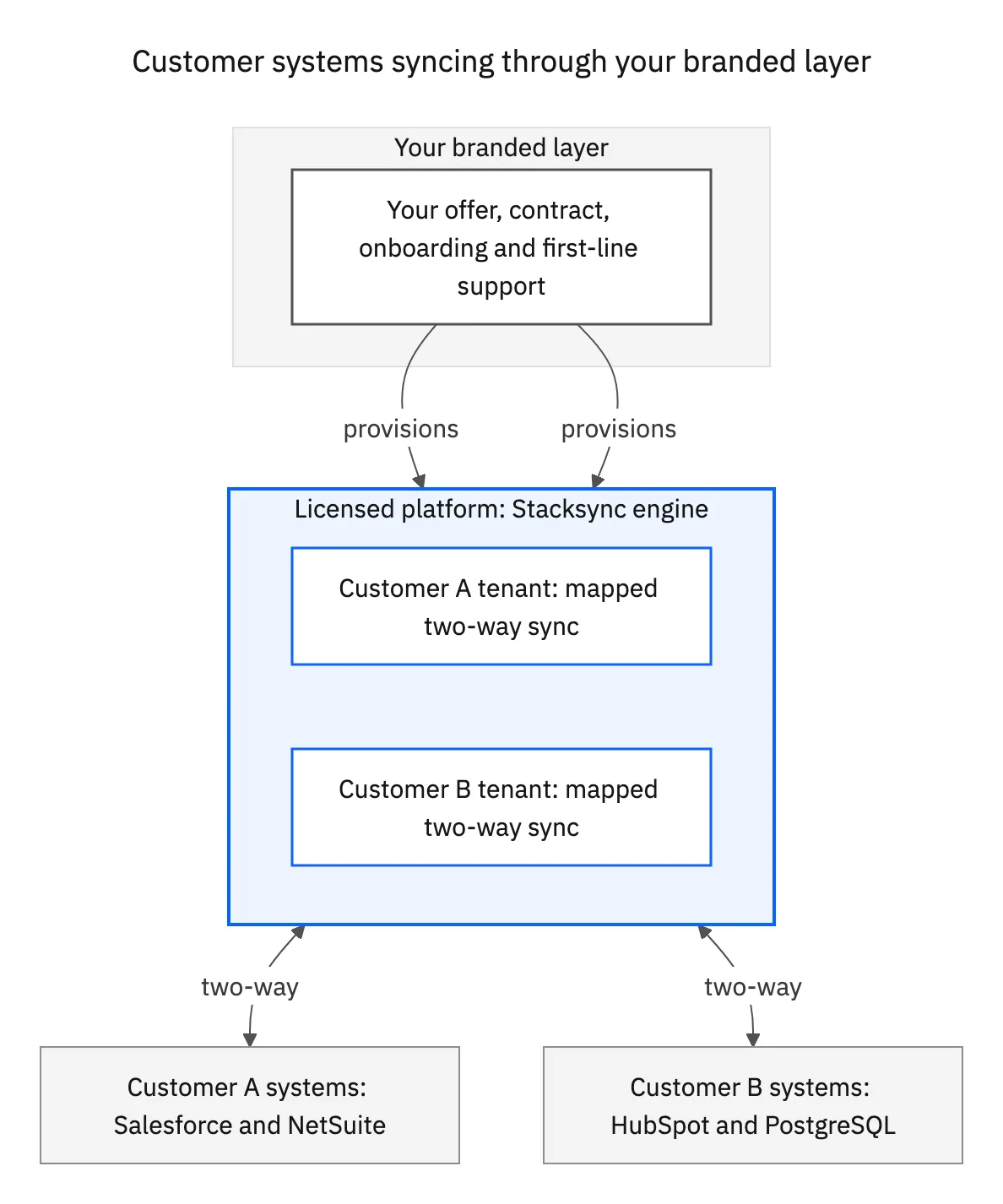
The practical consequence is that onboarding a new customer is adding a tenant, not starting a project. The first customer carries the design work: the objects, the field mappings and the rules for which system wins a conflict. The tenth reuses most of it. That reuse is where a white-label offer earns its margin, so ask each vendor how a second customer differs from the first.
How does real-time two-way sync change what you can promise customers?
Many integration offers that get white-labeled move data one way, from a source into a warehouse, on a schedule. That is replication, and it supports reporting. It does not support "when a rep updates the customer in your app, the ERP has it seconds later", because nothing writes back. Real-time two-way sync keeps both systems current: a change in either is applied to the other, with rules for what happens when both change at once. That lets you promise things a batch job cannot.
- The customer's systems agree, not just their reports. The CRM and the ERP hold the same account, the same order status and the same balance, so nobody re-keys data or reconciles a spreadsheet on Fridays.
- Changes arrive in real time, not at the next batch window. An update in one system does not wait for a nightly job to be visible in the other.
- Field ownership is a setting. Per field, you can decide which system is the source of truth and where write-back is disabled, so a finance field is edited in the ERP and a sales field in the CRM.
- Conflicts have a rule. When two people edit the same record at once, the outcome is defined in advance, not found out by the customer.
Keep the promise honest. What is possible depends on the connector and the object: a system that only allows reads stays read-only. The safest way to make a real-time claim is to pilot one customer pair, with real data, before it goes on your price list. Our two-way sync examples show the pattern on real systems.

What does the Stacksync OEM track include?
Stacksync's partner program has three tracks: referral, reseller and OEM. The OEM track is the white-label one. It is built for partners who serve a specific vertical such as healthcare, financial services or construction, or who want to embed real-time two-way sync in their own product or practice. What it includes, as published on the partner pages:
- White-label and OEM rights. License the platform under your own brand.
- A dedicated Partner Success Manager and access to the product roadmap.
- Co-marketing and market development funds (MDF), with joint demand generation and co-branded campaigns.
- 100% of your services and implementation revenue. Every track keeps it, and Stacksync never competes with you on services.
- Deal registration in the Partner Portal, so registered opportunities are protected from competitive encroachment, including from Stacksync direct sales.
- Compliance in place: SOC 2 Type II, HIPAA, GDPR and ISO 27001.
- A fast start. Onboarding takes about two weeks, and kickoff to first deal is typically 4 to 8 weeks.
If that matches what you are looking for, the OEM partner page has the application, and the partnerships team replies within two business days. If you would rather sell and deliver Stacksync than rebrand it, the reseller track is the closer fit, and you can compare all three on the become a partner page. To see who already delivers Stacksync for customers, browse the partner directory.
How do you price a white-label integration offer?
There is no honest universal number, and the vendor's terms set your floor, so start there. OEM terms are not printed on Stacksync's partner page, so ask for them early when you scope the partnership, and do the same with any other vendor before you build a price list.
Three shapes work in practice. A flat plan per customer is the easiest to sell and to forecast. A price per connection or per sync pair scales with the value each customer gets. A bundle inside your own product tiers makes integration a feature of the plan instead of a line item. Whichever you choose, price on what the customer gets, such as hours of re-keying removed, not on vendor cost plus a fixed markup. Keep the recurring subscription separate from the one-time implementation, which is services revenue and yours to price. Then model your largest customer, the one with the most connections and the highest change volume, before you publish anything. That is the account where a bad price model loses money. Consultancies that sell this as a managed service can price it as a retainer instead: see how to price integration work.
A short checklist before you sign
Eight questions to put to every vendor, in the order they tend to matter.
- Which surfaces can carry my brand, and which cannot, in writing?
- Is every customer a separate tenant with its own credentials and audit trail?
- Does each connector I need support the direction I need, read and write?
- Who holds the customer contract, and are my registered deals protected from the vendor's own sales team?
- Who takes the first support call, and what is the escalation path?
- Which compliance attestations and processing regions can I show a customer?
- What uptime and latency commitments can I pass through?
- What can I export if I leave, and what does the customer see when I do?
Ready to offer real-time two-way sync under your own brand? Apply as an OEM partner, or compare the referral, reseller and OEM tracks on the become a partner page. The partnerships team replies within two business days.

FAQ
Frequently asked questions









Related articles



PARTNER PROGRAM
Become a Stacksync partner
Build and sell real-time two-way sync as an extension of our team. Get certification, deal protection, co-marketing and the technical resources to grow a high-margin practice.


