Confirm Rescheduled Deliveries Without Premature Booking Promises
A rescheduled delivery is booked only after dispatcher confirmation is recorded.
- Author
- Stacksync · App tips writer
- Published
- Read time
- 6 min read

“Requested,” “accepted,” and “booked” are different states
A rescheduled delivery is booked only after dispatcher confirmation is recorded. A customer can accept a proposed receiving window while transport capacity remains unconfirmed. An operations manager can approve the expense while the dock slot remains unavailable. Communicating these states accurately prevents a second missed commitment created by the recovery process itself.
Use a record that separates proposed slot, customer agreement, operations cost approval, dispatcher decision, and delivery outcome. This does not require a new enterprise system; it requires explicit fields or states in the existing Postgres-backed process and consistent language on the Zendesk ticket.
Evidence needed to resolve the exception
Use this exception guide when reviewing a proposed Genie workflow or investigating a case that cannot proceed confidently. The tables describe operational decisions to configure in your environment. They are not claims that a connected application automatically supplies your organization’s policies, identity mappings, or approval process.
| System or owner | Evidence and responsibility |
|---|---|
| Postgres | Shipment updates, available slots and transport options, rescheduling state, and dispatcher confirmation. |
| Salesforce | Delivery commitments and account context. |
| Zendesk | Customer coordination, agreement, and progress updates. |
| NetSuite | Approved additional operational costs. |
| Operations | Approval of added costs and operational feasibility. |
Required context for this workflow design.
Handle rejection as a continuation of the same request
If the dispatcher rejects a proposed slot, record that decision and reason, then retrieve another feasible option. Do not erase the rejected proposal, because the customer and operations team may already have acted on it. The next option should carry its own time window and cost implications.
Ask the customer to agree when the appointment changes. Obtain a new cost approval if the alternative changes the approved expense. An approval for an afternoon local carrier does not authorize a next-day premium carrier. Reuse the shipment and case identity to keep the history coherent while tracking proposal versions separately.
Distinguish confirmation from fulfillment of the promise
Once dispatch confirms, state the exact booked window, location, and relevant instructions supported by the record. If a later shipment update threatens that booking, resume coordination instead of leaving the customer with an outdated confirmation. A system that only sends the first rescheduling message misses this operational responsibility.
Closure requires the delivery outcome, not merely a confirmed slot. Reconcile the final event with the shipment and keep partial deliveries or missing completion evidence open for follow-up. Measure time spent awaiting each party separately: a long customer response time needs a different intervention from repeated dispatcher rejections.
Decision table for common exceptions
Use the condition in the first column to choose the next action. The final column describes the boundary that must remain true while the case is unresolved. Apply the organization’s actual policy and source records to the live case; do not treat an illustrative condition as proof that the condition exists.
| Observed condition | Next action | Required boundary |
|---|---|---|
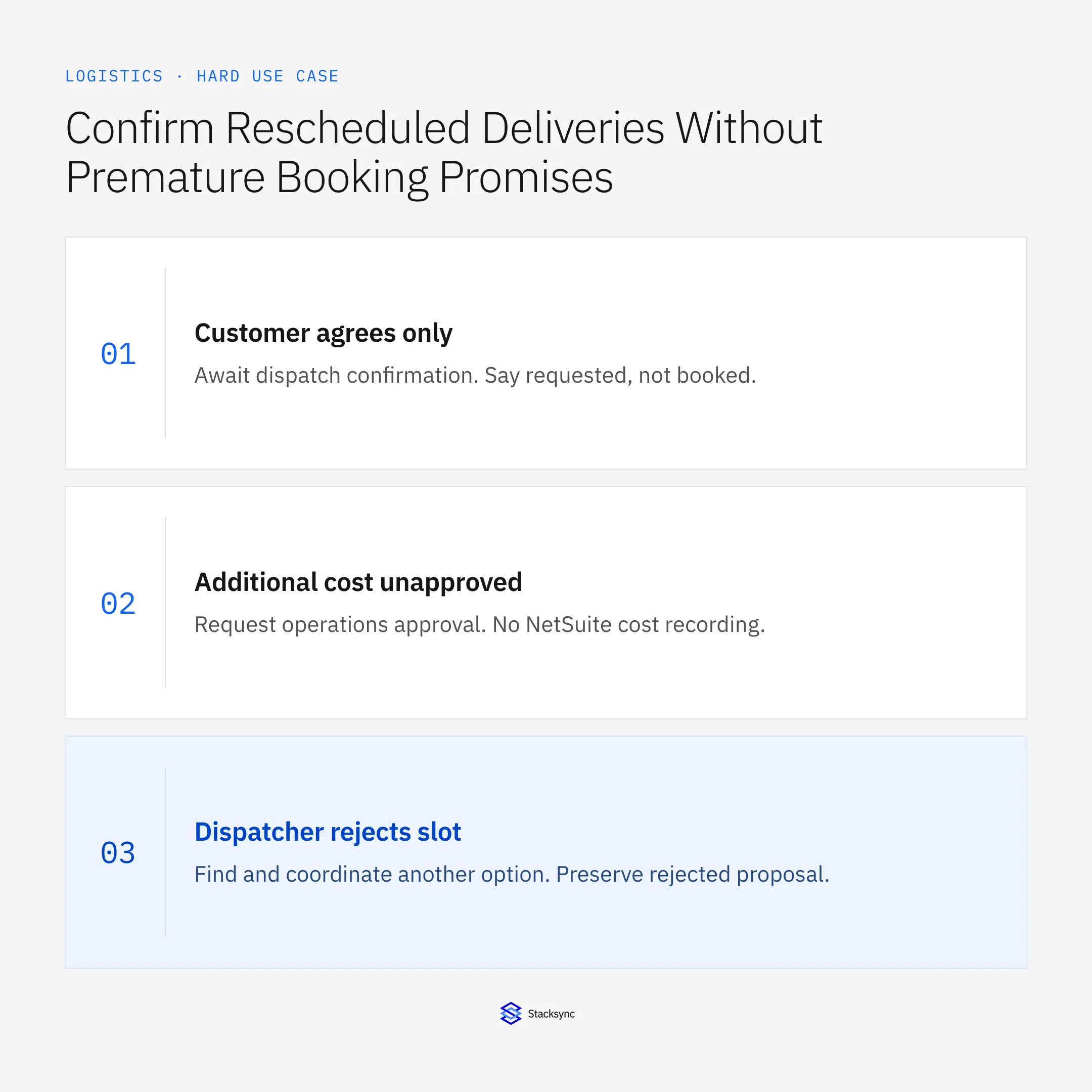
| Customer agrees only | Await dispatch confirmation | Say requested, not booked |
| Additional cost unapproved | Request operations approval | No NetSuite cost recording |
| Dispatcher rejects slot | Find and coordinate another option | Preserve rejected proposal |
| Appointment booked | Continue shipment monitoring | Delivery remains outstanding |
Exception decisions for missed delivery appointments.
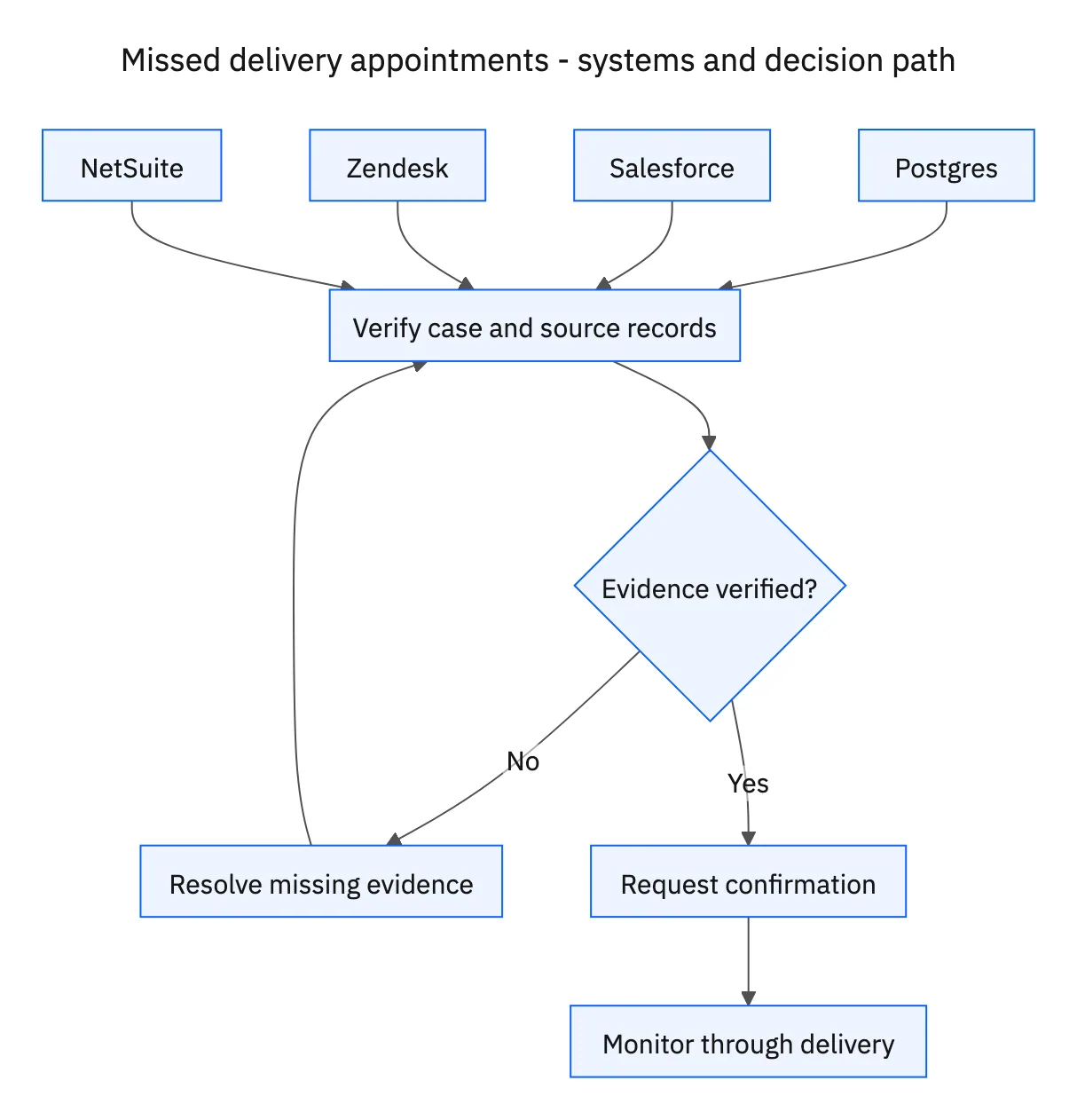
Illustrative exception and recovery
Dispatch rejects the accepted afternoon slot because transport capacity was consumed. The workflow records the rejection, offers another operationally available window, and obtains agreement on the new time before requesting confirmation again.
This example uses fictional records to show the decision logic. It is not a customer case study or a claim of measured results. In a live case, retain the actual record IDs and evidence behind each statement, and replace all illustrative quantities or timing assumptions with the approved operational inputs.
What to record before resuming
A Postgres rescheduling record linked to the Zendesk case, containing proposal history, customer agreement, approved extra cost, dispatcher confirmation, and final delivery evidence.
Preserve the original finding and the evidence that resolves it. Record which person or system supplied the clarification, which proposal it applies to, and the action now permitted. Do not erase the uncertainty from the history: a later reviewer needs to understand why the case paused and why it resumed.
Boundaries that remain in force
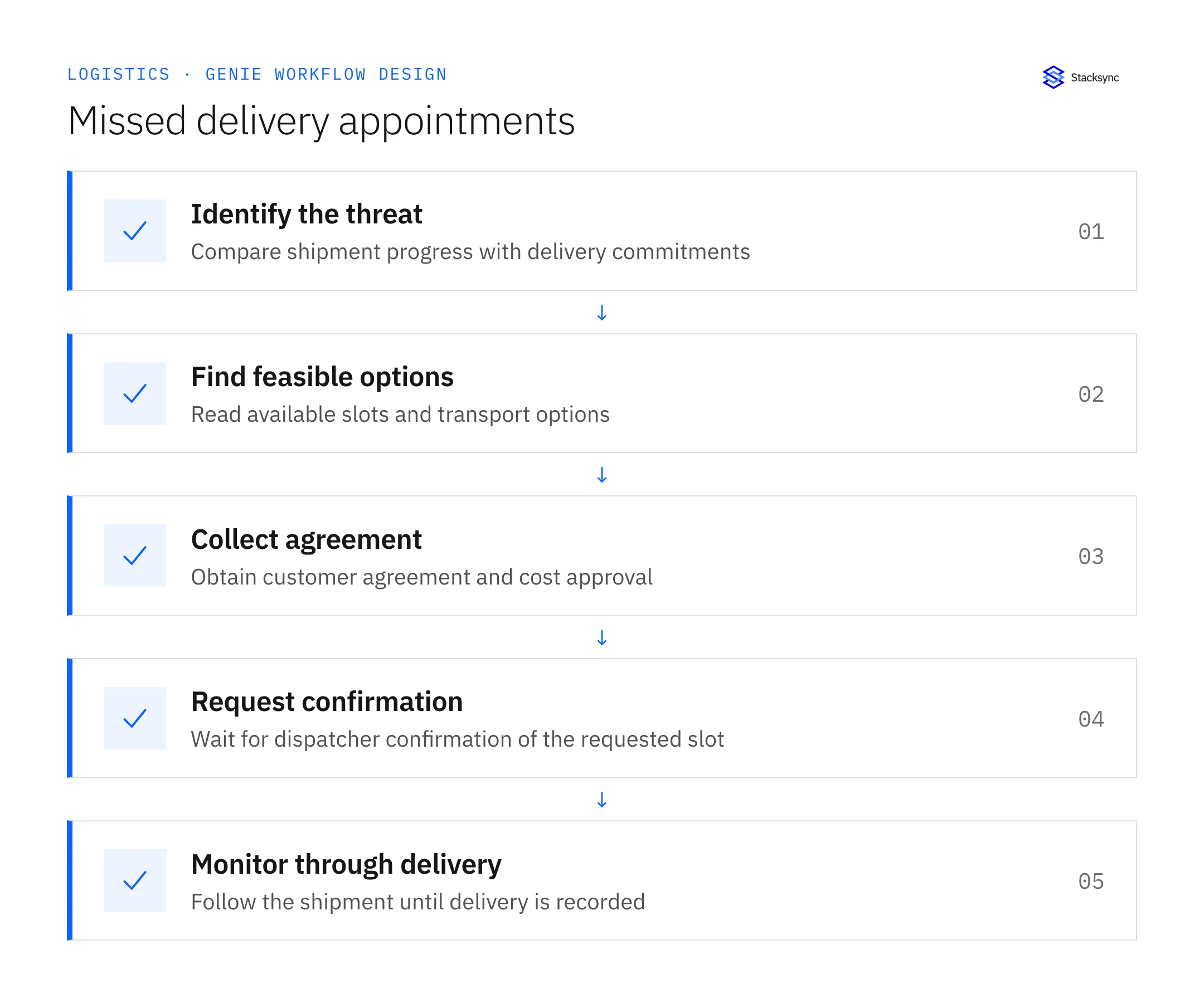
- Use available slots and transport options from operational records.
- Get customer agreement and operations approval for added costs before NetSuite recording.
- Persist the request in Postgres and wait for dispatcher confirmation before saying booked.
- On rejection find another option and follow the shipment through delivery.

Review the case before restarting
First verify that the new evidence resolves the original blocker rather than a different issue. Then check whether the case, source records, or proposed action changed during the wait. A response attached to the right ticket can still be insufficient if it refers to an earlier proposal or leaves a required quantity, identity, or approval unresolved.
Run the relevant row from the decision table as a review scenario. Confirm that the job stops at the required boundary, asks for the specified information or decision, and resumes from the confirmed state. If a write or message may already have succeeded, inspect its destination before repeating it; if this job only prepares a draft or report, verify that it stays within that output scope.
- Bookings communicated only after dispatcher confirmation
- Time waiting on customer, operations, and dispatcher decisions
- Rescheduled shipments reaching recorded delivery
Track unresolved cases by their actual blocker and owner. A case waiting for clarification needs a different next action from one waiting for a confirmed result. Review the evidence when the state changes, and keep any still-unresolved completion condition visible instead of treating a successful intermediate step as the end of the work.
Give your Genie a job description
Copy the job description below. It preserves the scope and decision boundaries of this use case. Configure the referenced systems, record relationships, policies, and approval owners in your workspace before enabling the job.
Paste this into “Give your Genie a job description.” Explore Stacksync Genies.
Implementation references
These first-party references document the underlying records and interfaces. The cross-system sequence, approvals, and completion rules in this article are a proposed operational configuration; validate them against your connected workspace before enabling it.

FAQ
Frequently asked questions
Explore these integrations and topics
Related articles