Resolve Partial Deliveries and Missing Delivery Documents
Resolve a partial-delivery request by reconciling expected units against each confirmed delivery event.
- Author
- Stacksync · App tips writer
- Published
- Read time
- 6 min read

A delivery event does not always cover the whole shipment
Resolve a partial-delivery request by reconciling expected units against each confirmed delivery event. Explain which portion has arrived, which remains outstanding, and which documents support each event. Do not attach one signed document and describe the entire shipment as complete unless its evidence covers all expected quantities.
Use a stable shipment reference and line identifiers. A redelivery, split consignment, or correction may have separate events. Adding event quantities without checking whether one supersedes another can overstate what arrived. Preserve corrections and the source event relationship rather than treating every timestamp as a new delivery.
Evidence needed to resolve the exception
Use this exception guide when reviewing a proposed Genie workflow or investigating a case that cannot proceed confidently. The tables describe operational decisions to configure in your environment. They are not claims that a connected application automatically supplies your organization’s policies, identity mappings, or approval process.
| System or owner | Evidence and responsibility |
|---|---|
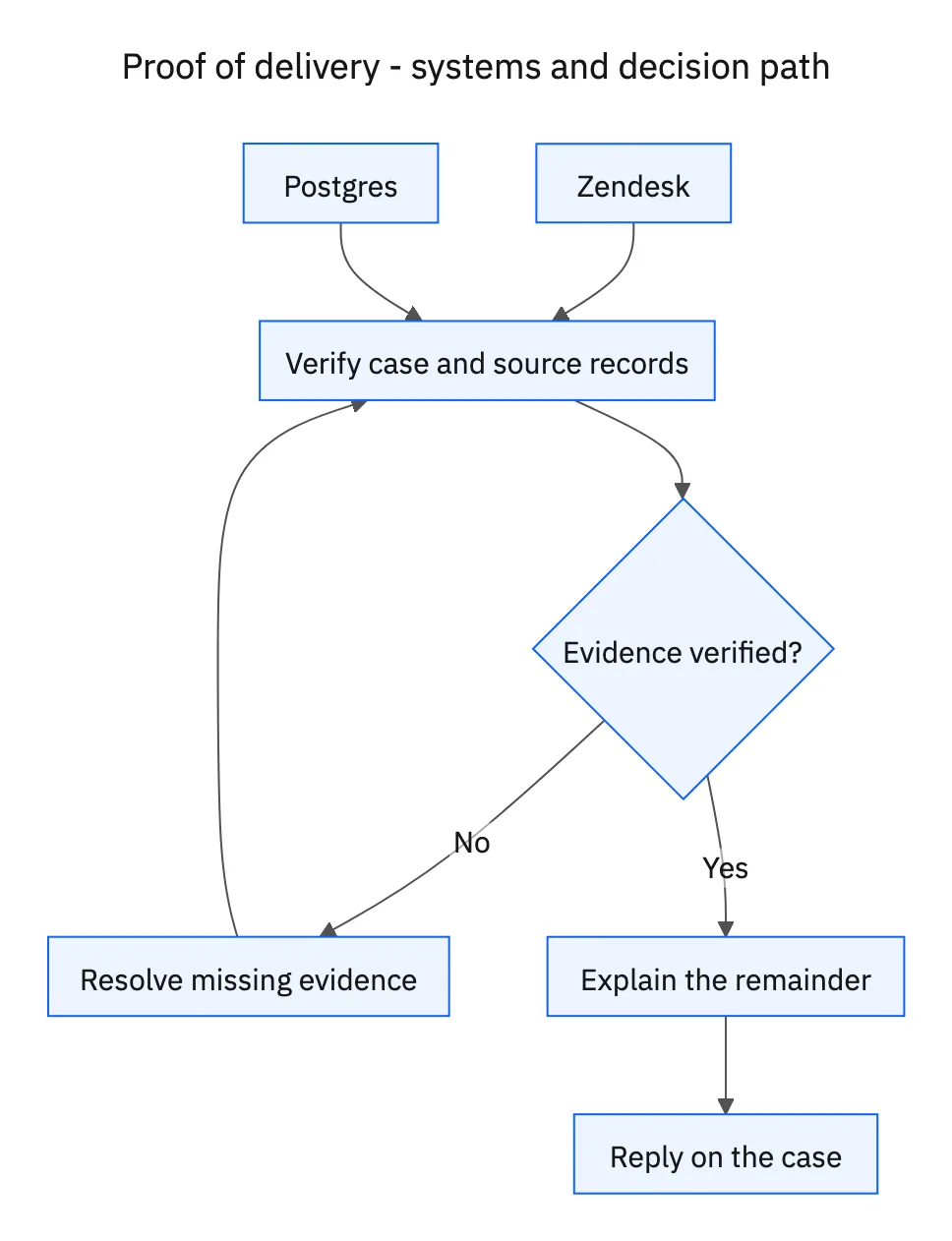
| Zendesk | Verified requester context, the original request, and the customer-facing response. |
| Postgres | Shipment ownership, delivery events, item quantities, and authorized document links. |
Required context for this workflow design.
Separate missing documents from missing deliveries
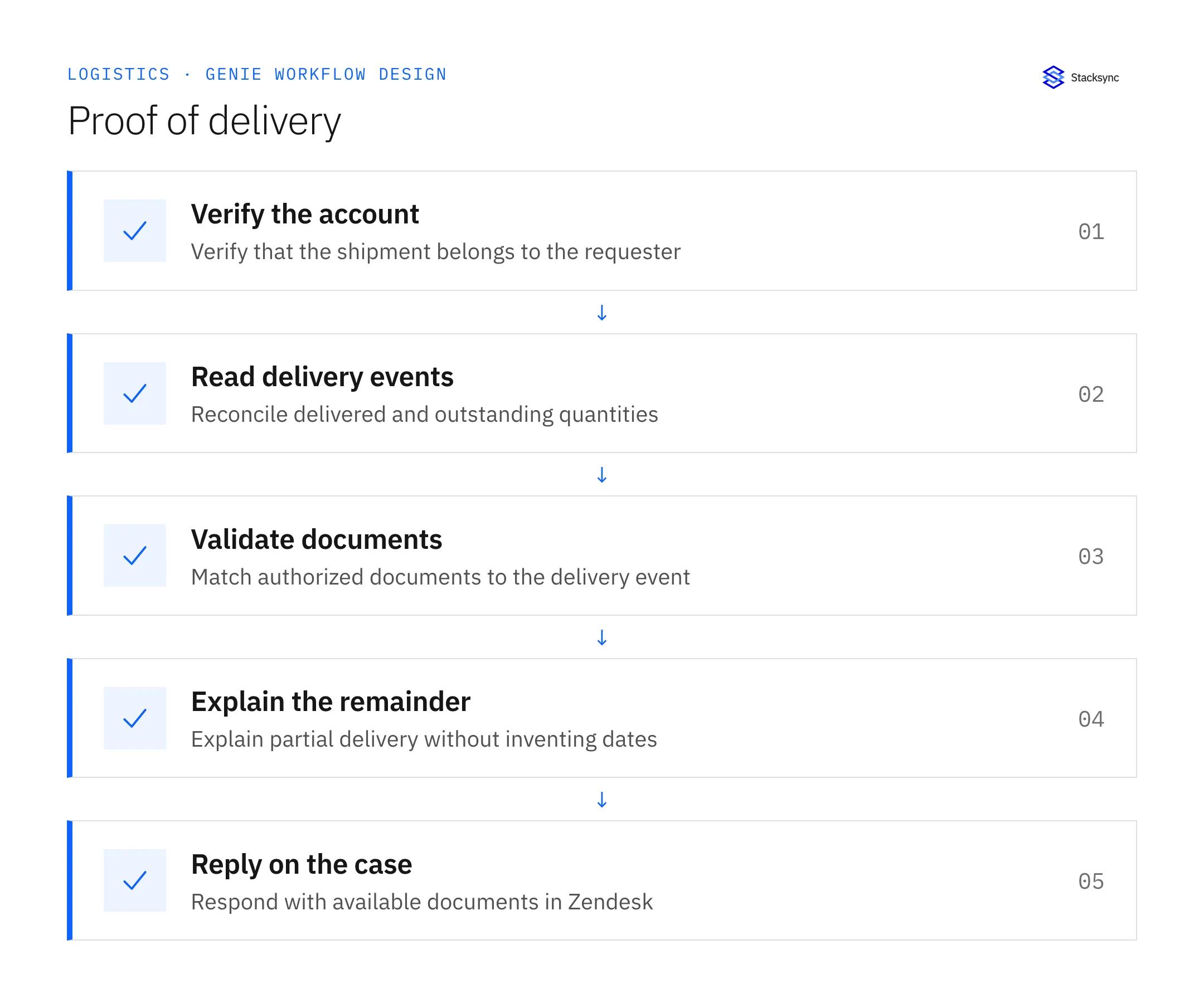
Three cases need different replies. A delivery event with no document link needs document retrieval. A document for fewer units than expected needs an explanation of the outstanding quantity. A shipment with no delivery event needs a status investigation. None of these should be converted automatically into “delivered in full.”
If the document exists but the link is expired, obtain a new authorized link through the configured document process. If the record points to the wrong account, stop sharing and investigate the mapping. A working download is not sufficient evidence that the requester should receive it.
Respond to disputes without overstating the evidence
When the customer says an item is missing despite a recorded delivery, explain what the record shows and which units it covers. Keep their report attached to the same case. A signature or status can be relevant evidence while the discrepancy remains unresolved; the automation should not make a liability determination.
An effective reply names the shipment, summarizes the confirmed quantity, links the appropriate documents, and states the specific information still being checked. If the shipment belongs to a different account, provide no partial preview of its destination or recipient. Route the access issue through verification first, then repeat the lookup with the verified identity.
Decision table for common exceptions
Use the condition in the first column to choose the next action. The final column describes the boundary that must remain true while the case is unresolved. Apply the organization’s actual policy and source records to the live case; do not treat an illustrative condition as proof that the condition exists.
| Observed condition | Next action | Required boundary |
|---|---|---|
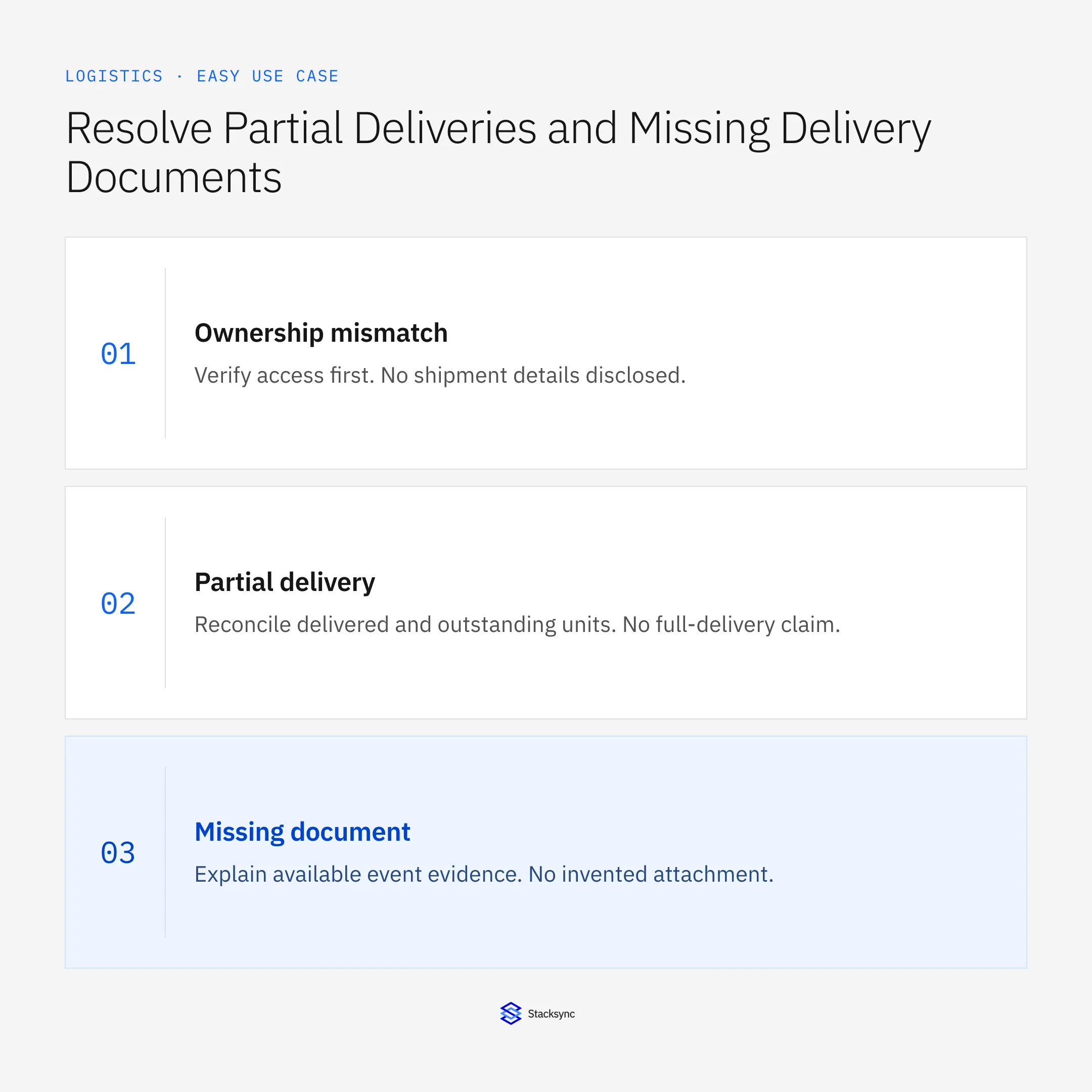
| Ownership mismatch | Verify access first | No shipment details disclosed |
| Partial delivery | Reconcile delivered and outstanding units | No full-delivery claim |
| Missing document | Explain available event evidence | No invented attachment |
| Expired authorized link | Request a valid authorized link | Do not broaden permissions |
Exception decisions for proof of delivery.
Illustrative exception and recovery
A customer supplies a valid shipment number owned by another account. The system finds a signed document, but the workflow withholds both the document and delivery details while support verifies access.
This example uses fictional records to show the decision logic. It is not a customer case study or a claim of measured results. In a live case, retain the actual record IDs and evidence behind each statement, and replace all illustrative quantities or timing assumptions with the approved operational inputs.
What to record before resuming
A Zendesk response with the verified shipment reference, delivered and outstanding quantities, recorded delivery details, and authorized links to the matching documents.
Preserve the original finding and the evidence that resolves it. Record which person or system supplied the clarification, which proposal it applies to, and the action now permitted. Do not erase the uncertainty from the history: a later reviewer needs to understand why the case paused and why it resumed.
Boundaries that remain in force
- Verify shipment ownership against the requester’s account before disclosure.
- Match documents to the actual shipment and delivery event.
- Reconcile delivered and outstanding quantities; do not infer a missing delivery date.
- Share available authorized links through the existing Zendesk ticket.

Review the case before restarting
First verify that the new evidence resolves the original blocker rather than a different issue. Then check whether the case, source records, or proposed action changed during the wait. A response attached to the right ticket can still be insufficient if it refers to an earlier proposal or leaves a required quantity, identity, or approval unresolved.
Run the relevant row from the decision table as a review scenario. Confirm that the job stops at the required boundary, asks for the specified information or decision, and resumes from the confirmed state. If a write or message may already have succeeded, inspect its destination before repeating it; if this job only prepares a draft or report, verify that it stays within that output scope.
- Requests with verified account ownership
- Replies that reconcile partial-delivery quantities
- Document requests still awaiting an authorized link
Track unresolved cases by their actual blocker and owner. A case waiting for clarification needs a different next action from one waiting for a confirmed result. Review the evidence when the state changes, and keep any still-unresolved completion condition visible instead of treating a successful intermediate step as the end of the work.
Give your Genie a job description
Copy the job description below. It preserves the scope and decision boundaries of this use case. Configure the referenced systems, record relationships, policies, and approval owners in your workspace before enabling the job.
Paste this into “Give your Genie a job description.” Explore Stacksync Genies.
Implementation references
These first-party references document the underlying records and interfaces. The cross-system sequence, approvals, and completion rules in this article are a proposed operational configuration; validate them against your connected workspace before enabling it.

FAQ
Frequently asked questions
Related articles