Answer Application Status Requests Using Official Records
An application status response should verify the requester’s access, retrieve the official status, and explain the outstanding applicant-visible requirements and next administrative step.
- Author
- Stacksync · App tips writer
- Published
- Read time
- 6 min read

Answer from the official applicant-visible record
An application status response should verify the requester’s access, retrieve the official status, and explain the outstanding applicant-visible requirements and next administrative step. The workflow helps an applicant understand the record. It does not decide the application, reveal internal reviewer notes, or estimate an unrecorded approval date.
Start with the Zendesk request and the organization’s established identity and authorization process. An application number identifies a record but does not prove access to it. A representative may need a recorded authorization relationship. When access cannot be verified, resolve that issue before retrieving information for disclosure.
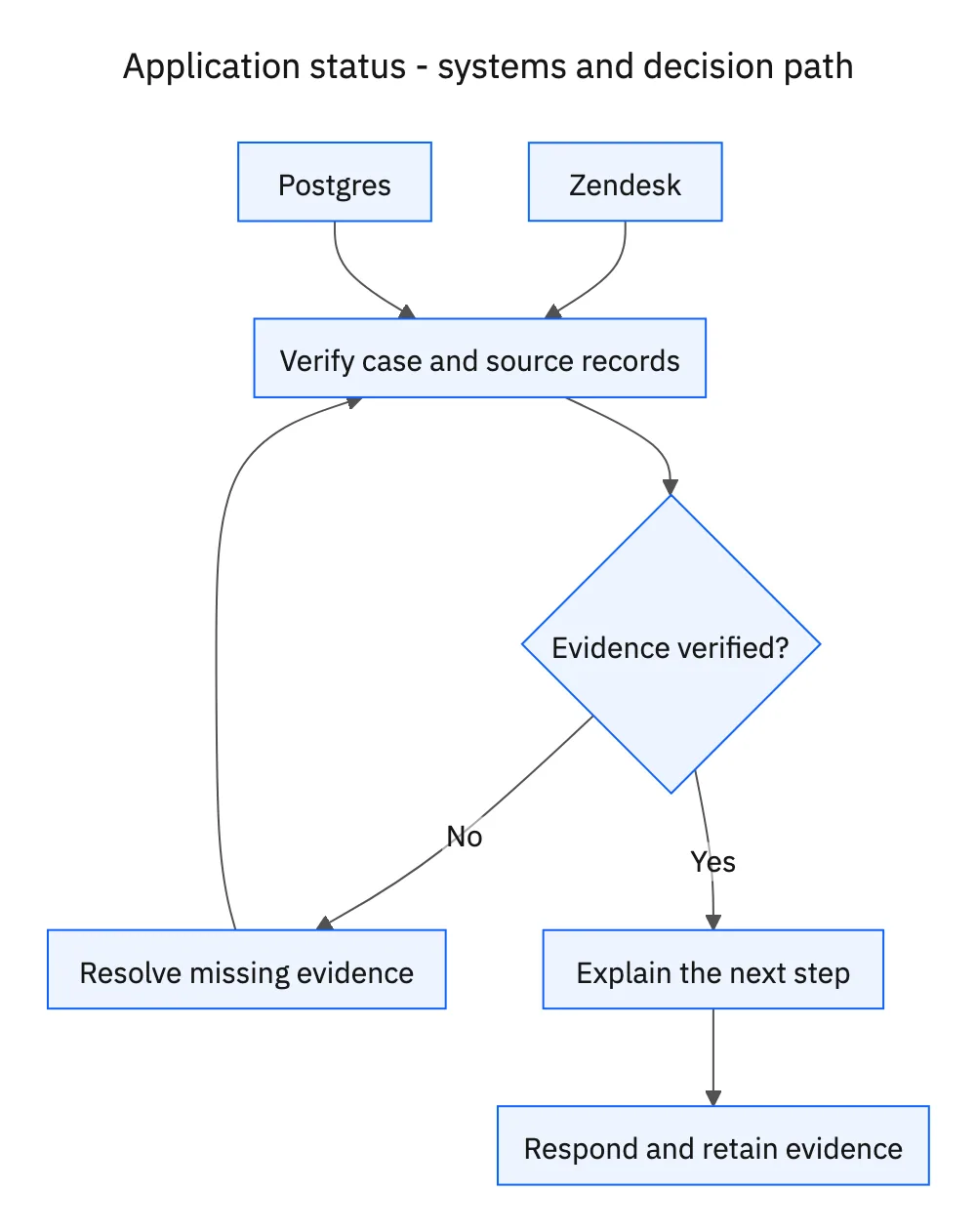
Systems and prerequisites
This is a workflow design to configure with Stacksync Genies and your existing systems. Connecting an application does not by itself establish the permissions, record mappings, approval routing, or operational process described here. Before enabling the job, confirm which records the Genie can read, which actions it can take, and who receives clarification or approval requests.
| System or owner | Evidence and responsibility |
|---|---|
| Zendesk | Applicant inquiry, verified access context, and response through the official support channel. |
| Postgres | Official application status, applicant-visible requirements, and recorded next administrative step. |
Required context for this workflow design.
Keep applicant-visible information separate from internal review
Read the official status and the fields approved for applicant visibility from Postgres. Use an explicit allowed-field view or equivalent access boundary in the implementation. Internal notes should not be included in the material used to draft the external response merely because they live in the same database table or query result.
Explain outstanding requirements in plain language while preserving their official meaning. If a document is recorded as missing, identify the document and the recorded submission step. Do not add a new requirement because it seems typical for that application type. If records conflict, route the discrepancy to the responsible administrative team.
State the next step without promising the outcome
Distinguish the applicant’s next action from the administration’s next action. If the applicant must submit a recorded requirement, explain how the official process says to do that. If review is pending with nothing outstanding from the applicant, state that status without suggesting they need to invent another submission.
Use dates only when the official system records them and label what they represent. A submission deadline is not an approval promise. Reply through Zendesk and preserve the record reference internally so staff can trace the explanation. When status data is stale or unavailable, report that the update needs verification rather than improvising a reassuring timeline.
A five-step operating sequence
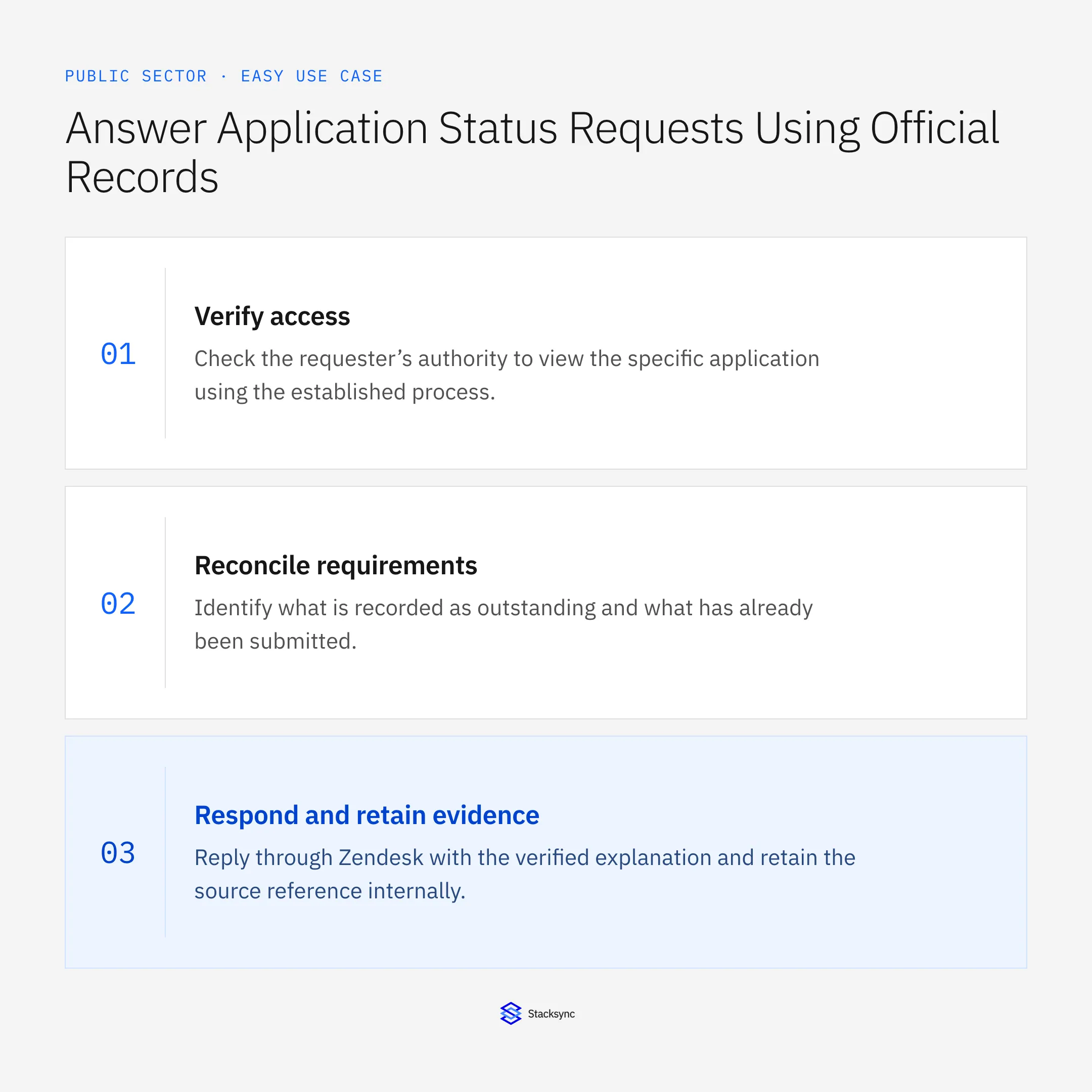
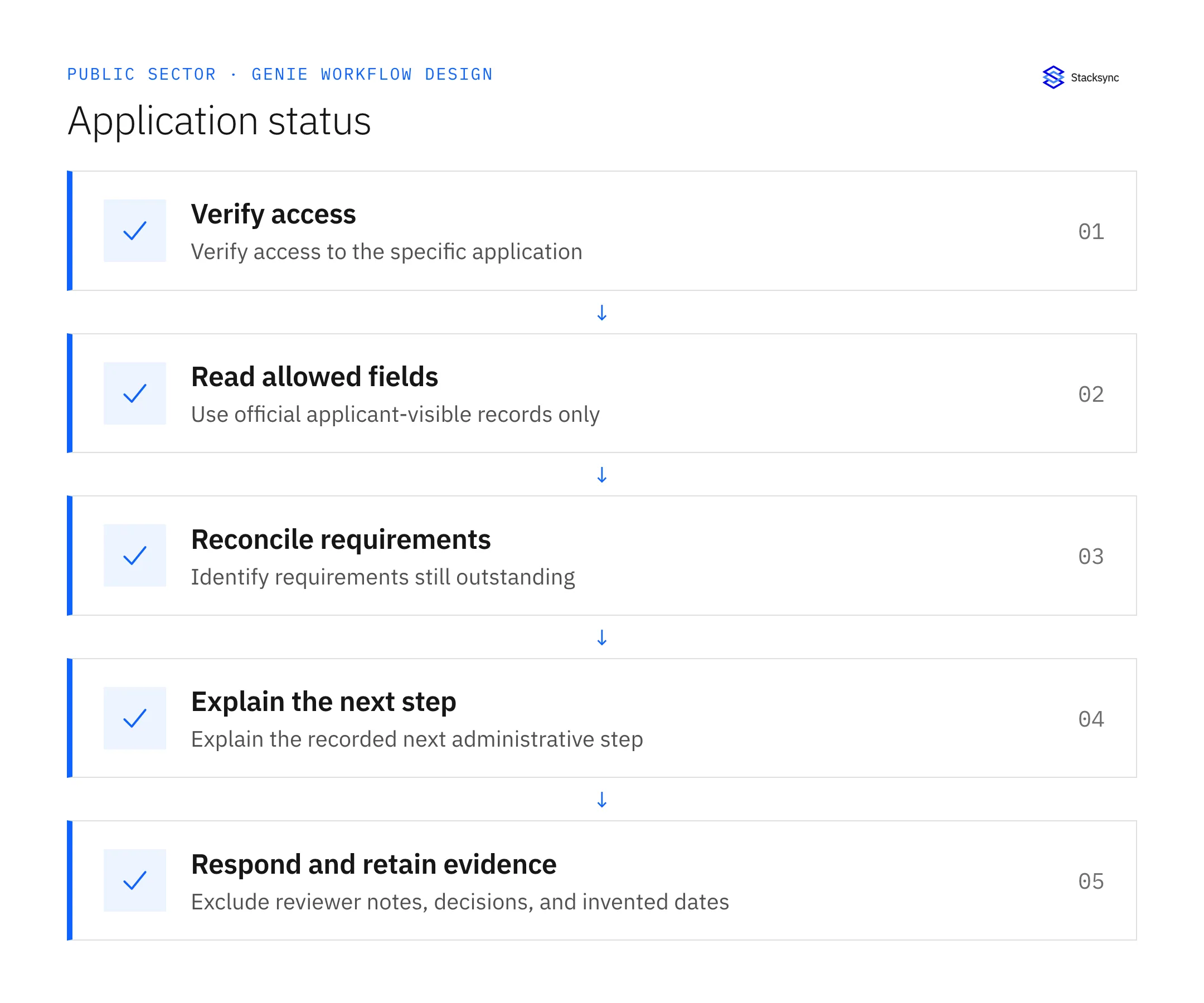
- 01Verify accessCheck the requester’s authority to view the specific application using the established process. For representatives, verify the recorded relationship. Knowing the application number alone should not release status, document requirements, or other applicant information.
- 02Read allowed fieldsRetrieve the official status and applicant-visible requirements from Postgres. Limit the drafting context to those fields. Do not pass internal reviewer notes to the response generator and rely on it to decide which private details can be paraphrased.
- 03Reconcile requirementsIdentify what is recorded as outstanding and what has already been submitted. Preserve distinctions between received and accepted where the official process uses them. Route contradictions for administrative review rather than changing a requirement’s status yourself.
- 04Explain the next stepState the applicant’s action or the next recorded administrative stage in plain language. Use only recorded dates and explain their meaning. Do not convert a submission deadline or target into a promise that the application will be approved.
- 05Respond and retain evidenceReply through Zendesk with the verified explanation and retain the source reference internally. If status evidence is unavailable, identify that the update needs verification. Do not disclose internal notes or make an approval decision to finish the conversation.
Illustrative workflow example
An authorized applicant’s record shows a missing address document and a recorded upload step. The Zendesk reply identifies that requirement and step. It does not estimate when the application will be approved after upload.
This example uses fictional records to show the decision logic. It is not a customer case study or a claim of measured results. In a live case, retain the actual record IDs and evidence behind each statement, and replace all illustrative quantities or timing assumptions with the approved operational inputs.
What the handoff should contain
An applicant-visible Zendesk response supported by verified access, official status, outstanding requirements, and the recorded next administrative step.
Keep the evidence reference, observation time, current owner, and outstanding decision with the case. A colleague taking over should be able to distinguish a proposal from a confirmed result without reading every previous message. If a source value changes while the case is waiting, recheck the affected decision before proceeding.
Approval and completion checklist
- Verify requester access to the specific application before disclosure.
- Retrieve official status and applicant-visible requirements only.
- Explain outstanding items and the recorded next administrative step.
- Never disclose reviewer notes, make approval decisions, or promise unrecorded dates.

Validate the job before enabling it
Start with a small reviewed set of cases from the systems above. Include a complete case, an ambiguous match, a missing source record, and an interrupted action where the result is uncertain. Use a draft or test environment for validation and compare the output with the source records before allowing the configured production actions.
For this job, the most important checks are verify requester access to the specific application before disclosure. Never disclose reviewer notes, make approval decisions, or promise unrecorded dates. Record the expected result before the trial, then compare both the proposed action and the final evidence. A fluent message is not a passing result if it skips one of these conditions.
- Responses preceded by application-specific access verification
- Status explanations supported by applicant-visible records
- Replies containing unauthorized notes or unrecorded date promises
Use these as operating measures, not promised performance improvements. Establish the current baseline and review exceptions with the team that owns the process. Investigate an increase in incorrect matches, unauthorized actions, or premature closure before expanding the job’s scope.
Give your Genie a job description
Copy the job description below. It preserves the scope and decision boundaries of this use case. Configure the referenced systems, record relationships, policies, and approval owners in your workspace before enabling the job.
Paste this into “Give your Genie a job description.” Explore Stacksync Genies.
Implementation references
These first-party references document the underlying records and interfaces. The cross-system sequence, approvals, and completion rules in this article are a proposed operational configuration; validate them against your connected workspace before enabling it.

FAQ
Frequently asked questions
Related articles