







Make multisite customers recognizable
Keep the portfolio relationship visible while preserving the physical site and approved payer for each job. A property-manager change should not erase service history.
 Salesforce
  HubSpot
  NetSuite
  Zendesk
  Microsoft Dynamics 365 Sales
  Dynamics 365 F&O
  Attio
Attio  Pipedrive
  Zoho CRM
  Campfire
  Rillet
  Front
Front  Shopify
  Amazon Seller Central
  SendGrid
 Commercial HVAC, plumbing and electrical contractors
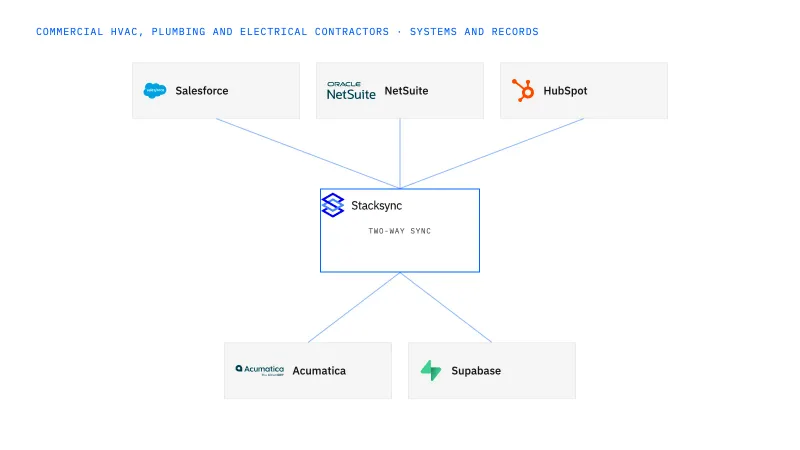
Connect the customer relationship in Salesforce with the approved billing and project context in NetSuite. For commercial HVAC, plumbing and electrical groups, the useful starting point is a shared customer, site and job identity. Stacksync can keep permitted record changes aligned while each team retains ownership of its decisions.
National accounts, local sites and legal billing customers rarely fit into one identical account record.
Explore your process in a demo, or get our shared two-way sync architecture guide.
When this fits
US commercial HVAC, plumbing, electrical and multi-trade service groups with 100–1,000 employees.
Keep the portfolio relationship visible while preserving the physical site and approved payer for each job. A property-manager change should not erase service history.
Show approved invoice and project references in the customer workspace. Financial release and payment decisions remain with the authorized finance process.
Review Salesforce eligibility and NetSuite object-specific read and write support for the intended records before enabling changes.
The process, end to end
a regional MEP group serves a national property customer through several branches. The account manager needs portfolio visibility, dispatch needs precise sites, and finance needs the right payer. A shared cross-reference lets those views agree without collapsing separate legal customers.
Scope your implementation
Review current platform pricing alongside the records, volume, and actions in your process. Use your own operating baseline to evaluate the economics.
Explore your process in a demo, or get our shared two-way sync architecture guide.
From foundation to action
Keep shared customer, order, and operational records aligned, with clear field ownership.
Explore two-way sync 02Move approved work between systems, assign exceptions, and confirm the result.
Explore workflows 03Investigate cross-system questions, assemble the evidence, and prepare the next action.
Explore ai agents (genies) 04Connect trading-partner documents to operational records and exception handling.
Explore ediGo deeper
Connect commercial MEP service sites to the right relationship account, billing customer and operating branch.
Keep MEP renewal opportunities aligned with the actual contract term, covered sites and approved service status.
Give field teams current parts context while keeping truck-stock adjustments and reservations under inventory control.
Explore all commercial HVAC, plumbing and electrical contractors integration and automation guides ↗
It also fits commercial plumbing, electrical and multi-trade groups with recurring customer, site and billing handoffs.
Only if the approved finance ownership and supported action allow it. Two-way sync does not grant blanket financial authority.
Bring a multisite customer and a failed handoff. Review the record mapping, ownership and observable success criteria.
Start with two-way sync between Salesforce and NetSuite so account teams, dispatch and finance share one customer, site and job identity, with the approved payer owned in NetSuite. Add workflows when emergency callouts need rate authorization routed to an approver before the billing handoff. Bring in Genies when supervisors want technician notes, parts and sign-off assembled into a closeout packet for review. Consider EDI last, for HVAC equipment purchase orders, backorders and receipts exchanged with distributors.


