







Release the correct revision
Record approvals against the exact gate or assembly configuration and invalidate affected decisions when it changes.
 Salesforce
  HubSpot
  NetSuite
  Zendesk
  Microsoft Dynamics 365 Sales
  Dynamics 365 F&O
  Attio
Attio  Pipedrive
  Zoho CRM
  Campfire
  Rillet
  Front
Front  Shopify
  Amazon Seller Central
  SendGrid
 Fencing fabrication and installation
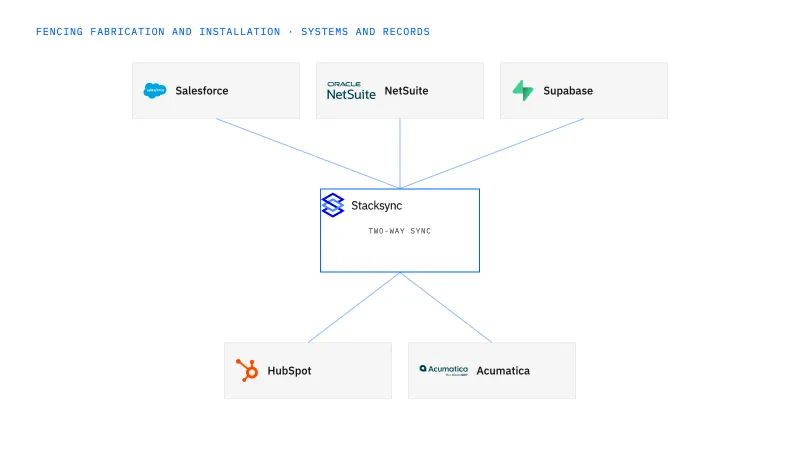
Coordinate custom-gate orders from controlled drawings through fabrication and installation. The workflow keeps customer acceptance, technical release, material readiness and site scheduling distinct. Each handoff carries the accepted revision and the evidence needed by the next owner.
The shop starts from one drawing while the installation team and customer discuss another.
Explore your process in a demo, or get our shared two-way sync architecture guide.
When this fits
US commercial fencing and gate businesses with 100–1,000 employees that fabricate or supply materials and install projects.
Record approvals against the exact gate or assembly configuration and invalidate affected decisions when it changes.
Include material and fabrication progress in postrelease change reviews so the commercial consequence is visible.
Finished fabrication does not establish staging, site access or a confirmed crew assignment.
The process, end to end
a customer accepts the gate appearance while a final dimension remains unresolved. The workflow preserves the commercial decision but holds fabrication release until the qualified owner confirms the production requirement.
Scope your implementation
Review current platform pricing alongside the records, volume, and actions in your process. Use your own operating baseline to evaluate the economics.
Explore your process in a demo, or get our shared two-way sync architecture guide.
From foundation to action
Keep shared customer, order, and operational records aligned, with clear field ownership.
Explore two-way sync 02Move approved work between systems, assign exceptions, and confirm the result.
Explore workflows 03Investigate cross-system questions, assemble the evidence, and prepare the next action.
Explore ai agents (genies) 04Connect trading-partner documents to operational records and exception handling.
Explore ediGo deeper
Coordinate custom-gate drawing approval, production release and installation scheduling through separate controlled decisions.
Turn fencing field changes into reviewed quantities and billable revisions without losing measurement or approval evidence.
Explore all fencing fabrication and installation integration and automation guides ↗
No. Qualified technical and production personnel retain design and fabrication authority.
The workflow should identify the affected scope so unchanged approved work stays recognizable.
Review whether production and installation use the same accepted revision and whether changed prerequisites reach their owners before release.
Yes, in most cases. Two-way sync between Salesforce and NetSuite keeps the customer scope approval and the order the shop builds against pointed at one drawing revision. This workflow then adds the handoffs: dimensional review to the technical owner, fabrication release to the production authority, site release to scheduling. Genies follow when coordinators want the outstanding prerequisites, measurement references and work-in-progress evidence collected for those approvers. EDI is a separate transport for steel and fence-material supplier documents into NetSuite, not a workflow step.


