


















TikTok Shop and NetSuite: One Order, One Set of Numbers
What real two-way sync between TikTok Shop and NetSuite requires. It compares a one-way order import against a live sync, maps each TikTok Shop object to its NetSuite record, walks through the lifecycle of one order including cancellations and refunds, and covers conflict policy and origin tracking.
- Author
- Ruben Burdin · Founder & CEO
- Published
- Read time
- 8 min read

Ask a finance team whether TikTok Shop is connected to NetSuite and the answer is usually yes. Look at what is actually running and it is normally an import: orders are pushed in once, a sales order is created, and after that the two systems stop talking. The record is accurate for about as long as it takes a buyer to change their mind.
Then they drift. A buyer cancels and the warehouse still picks the box. An address is corrected in the app and the label prints the old one. A partial refund is issued on the storefront and shows up in NetSuite three weeks later, at close, as a difference someone has to explain.
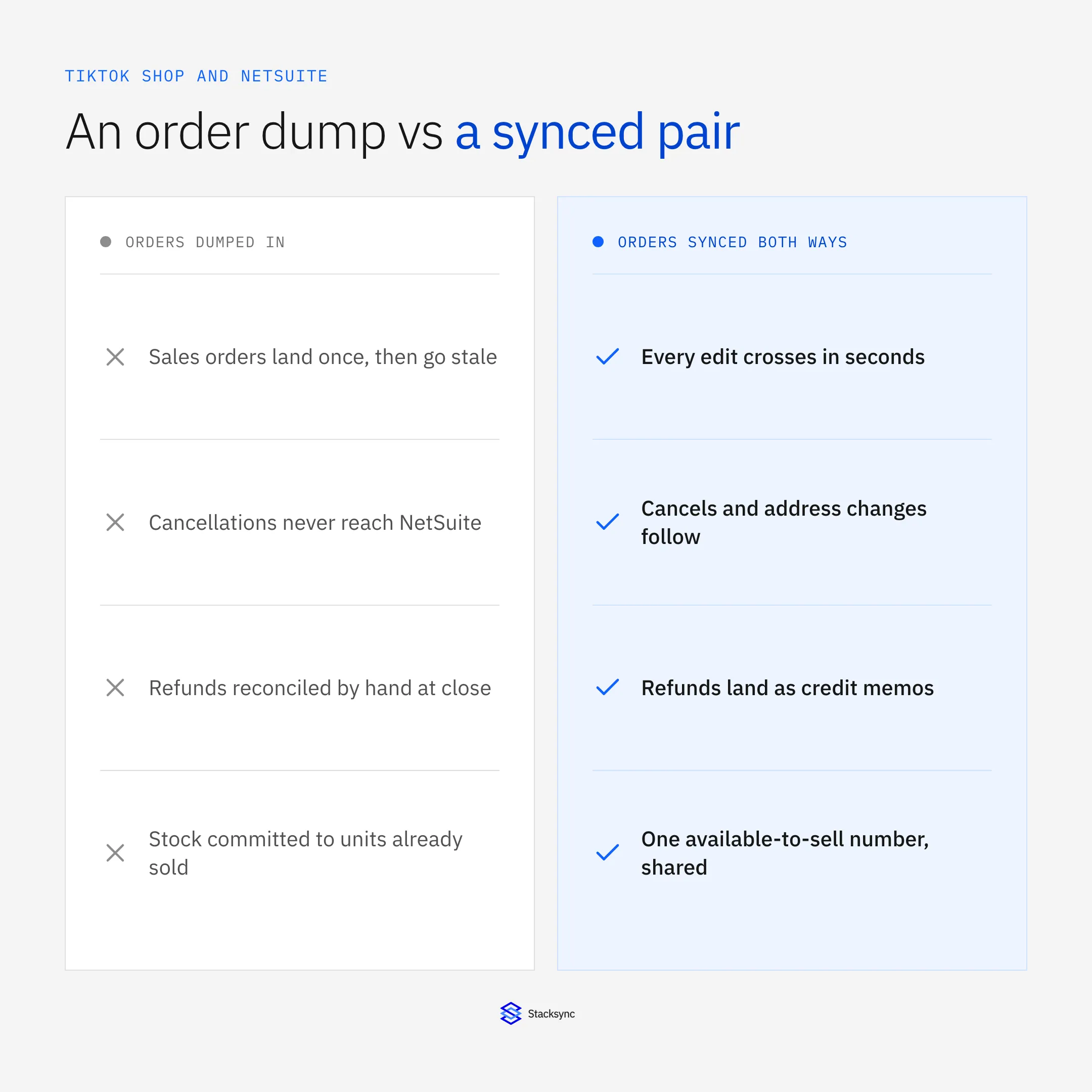
A two-way sync is a different thing, and it needs four things an import never does. This post covers all four. The platform view is in the guide to an enterprise iPaaS for TikTok Shop.
Where the order import runs out
An import is fine while an order is a single event. It stops being fine the moment the order has a life after checkout, which on TikTok Shop is most orders.
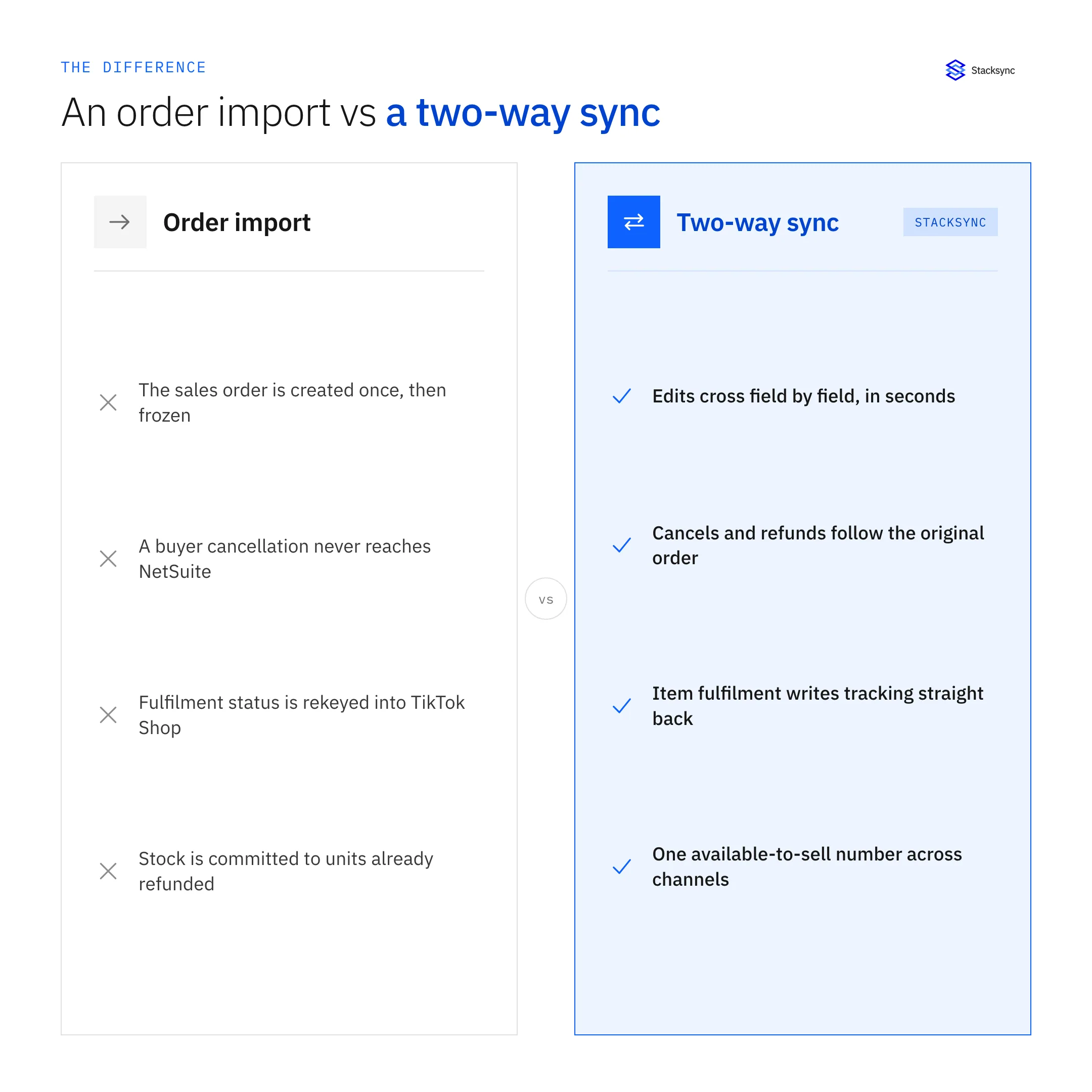
The failures start small. Someone fixes a shipping address in the app and the ERP never hears about it. Fulfilment status is copied across by hand at the end of a shift. Then they stop being small: stock stays committed to units that were refunded, and the available-to-sell number in NetSuite no longer matches what the shop is willing to sell.
What two-way actually requires
The difference is not the number of pipes. Two one-way feeds pointed at each other is how you build an echo, not a sync. What makes it work is that both directions share the same change detection, the same matching, and one conflict policy.
Change detection has to be field level. If the sync writes whole records, a fulfilment update overwrites the address correction a support agent made twenty seconds earlier, and the parcel goes to the wrong door. Writing only the field that moved is what makes it safe for both sides to hold the same record open.
Matching has to be deterministic. The TikTok Shop order ID lives on the NetSuite sales order as an external ID, so a retry after a timeout updates the existing record rather than creating a second sales order for the same shipment. Guessing on customer name and date is how a duplicate is born.
And every write needs an origin tag. Once the sync writes into NetSuite, that write is a change in NetSuite. Without a tag it reads as a new edit, gets sent back to TikTok Shop, reads as a new edit again, and the loop does not stop on its own.
Which record maps to what
Most of the setup work is agreeing this map once. Not everything should be two-way: identity and status belong on both sides, accounting treatment stays with the ERP.
| TikTok Shop | NetSuite | Direction |
|---|---|---|
| Order | Sales order (external ID) | Both ways |
| Listing and SKU | Item | NetSuite to TikTok Shop |
| Available stock | Item availability by location | Both ways, warehouse wins |
| Shipping address | Sales order address | TikTok Shop to NetSuite |
| Shipment and tracking | Item fulfilment | NetSuite to TikTok Shop |
| Refund | Credit memo | TikTok Shop to NetSuite |
| Settlement payout | Deposit or journal | TikTok Shop to NetSuite, read-only |
Orders and stock move both ways. Item cost, tax treatment, and the ledger stay owned by NetSuite so the storefront cannot overwrite them.

The life of one order
Two questions decide whether the sync can be trusted. What happens when the same field changed on both sides between writes, and how does the system know that a write it just made is its own?
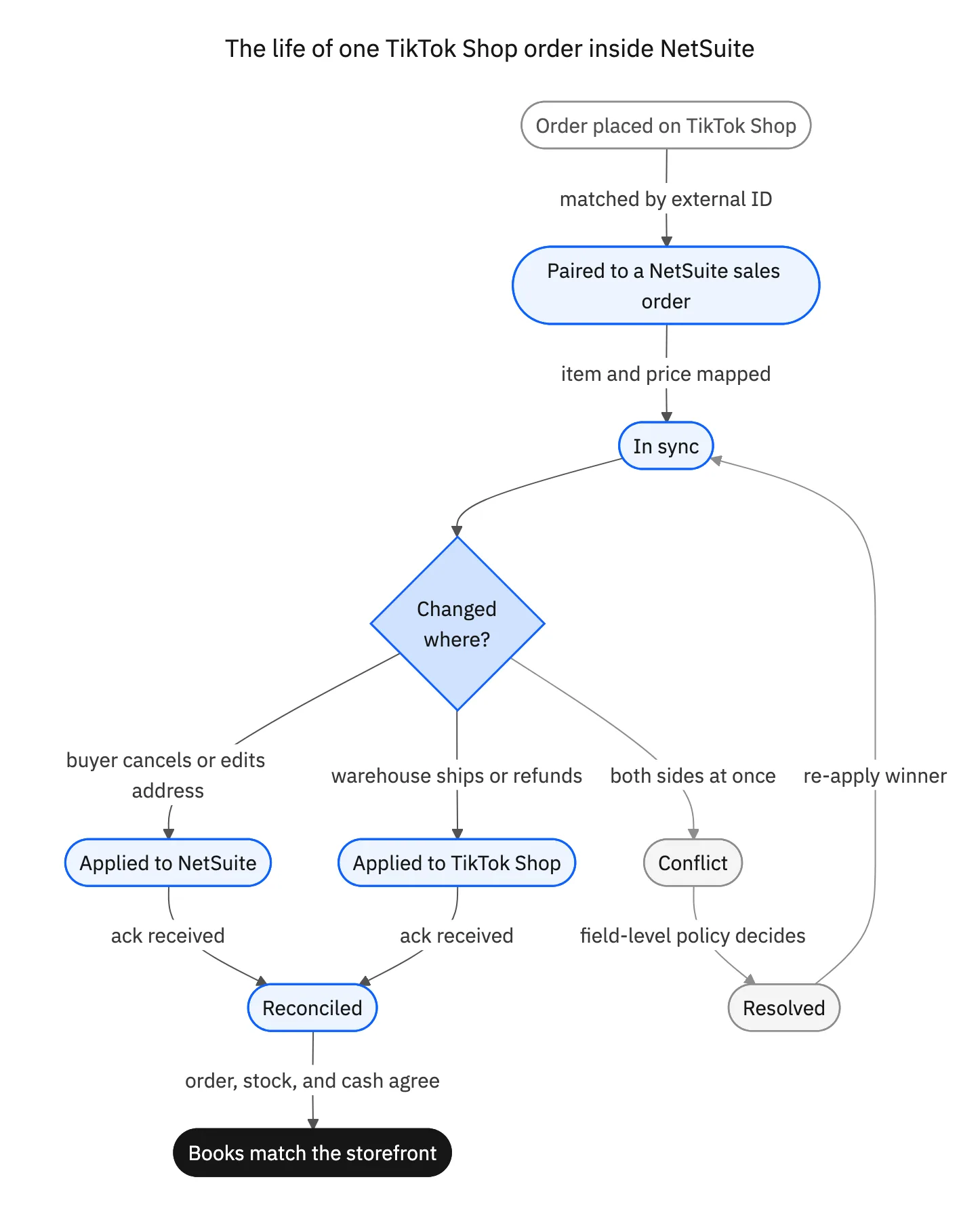
The first question is answered by a policy you set per field. Shipping address follows the buyer, so TikTok Shop wins. Item cost and tax treatment follow the books, so NetSuite wins. Quantity available follows the shelf, so the warehouse count wins. Anything genuinely ambiguous is better held for review than resolved by a rule nobody agreed to.
The second is answered by origin tracking, which is what keeps the return trip from becoming a new outbound trip. It is also what makes the audit trail usable: when a number is wrong, you can see which system caused the write that made it wrong.
One order, both systems current
The goal is not that NetSuite holds a copy of your TikTok Shop orders. It is that the warehouse team picking a box and the finance team closing the month are looking at the same order, with the same quantity, the same address, and the same refund, without either of them opening the other system to check.
If your stock is also sold on your own site, pair this with TikTok Shop and Shopify. The connector details live on the NetSuite and TikTok Shop integration page, or book a demo to see a cancellation resolved on a real sales order.

FAQ
Frequently asked questions










Related articles