Reconcile Contractor Quotes, Approved Work, and Maintenance Invoices
Reconcile a maintenance invoice by comparing its lines with the contractor quote and purchase order that facilities and purchasing approved, then checking completion and facility acceptance evidence.
- Author
- Ignacio Malpartida · GTM Engineer
- Published
- Read time
- 6 min read

Trace the invoice back to the approved version of the work
Reconcile a maintenance invoice by comparing its lines with the contractor quote and purchase order that facilities and purchasing approved, then checking completion and facility acceptance evidence. The latest quote in a ticket is not necessarily the approved one. Preserve version references so finance can see which scope and cost were authorized.
A contractor may discover additional work during the visit. That change needs the applicable facilities and purchasing decision before it is treated as part of the approved commitment. Do not retrofit an approval by updating the original quote after the invoice arrives.
Evidence needed to resolve the exception
Use this exception guide when reviewing a proposed Genie workflow or investigating a case that cannot proceed confidently. The tables describe operational decisions to configure in your environment. They are not claims that a connected application automatically supplies your organization’s policies, identity mappings, or approval process.
| System or owner | Evidence and responsibility |
|---|---|
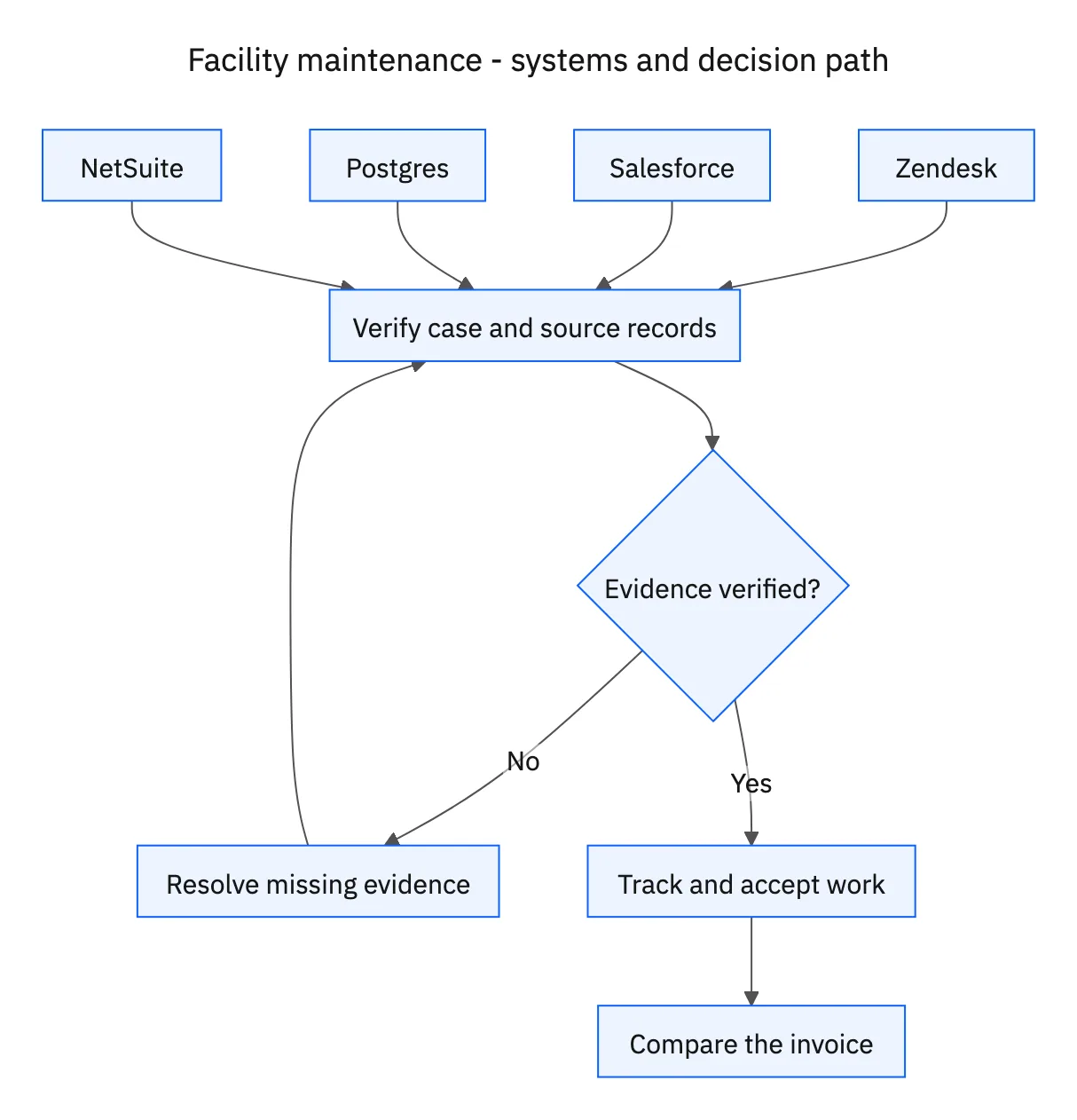
| Zendesk | Facility report, contractor coordination, progress updates, and facility acceptance. |
| Salesforce | Facility asset identity. |
| Postgres | Existing work requests, approved contractor records, progress, and completion evidence. |
| NetSuite | Approved purchase order and related invoice evidence. |
| Facilities and purchasing | Approval of the contractor quote and purchasing commitment. |
| Finance | Review of invoice discrepancies and all payment decisions. |
Required context for this workflow design.
Distinguish contractor completion from facility acceptance
The contractor’s completion note records their report of work performed. Facility acceptance confirms the required operational outcome from the facility’s side. This workflow requires acceptance before closing the maintenance request. Missing acceptance needs follow-up through Zendesk rather than an inferred sign-off based on elapsed time.
Compare invoiced quantities, hours, rates, and materials with the approved work and evidence. A matching total can still contain substituted or unsupported line items. Conversely, an apparent quantity difference may be explained by an approved change; include that reference rather than flattening the history into one final number.
Keep work closure and financial resolution linked
A facility can accept the repair while finance still needs to investigate the invoice. Track the financial exception separately but retain the maintenance request, asset, purchase-order, and acceptance references. Closing the work request must not imply that the invoice is approved for payment.
Send finance a concise packet with the approved amount, invoiced amount, line-level discrepancy, supporting evidence, and any requested clarification. If the contractor resubmits an invoice, check whether it replaces an earlier document to avoid duplicate review or payment risk. The agent can collect and compare evidence; it must never authorize payment or represent finance’s pending decision as complete.
Decision table for common exceptions
Use the condition in the first column to choose the next action. The final column describes the boundary that must remain true while the case is unresolved. Apply the organization’s actual policy and source records to the live case; do not treat an illustrative condition as proof that the condition exists.
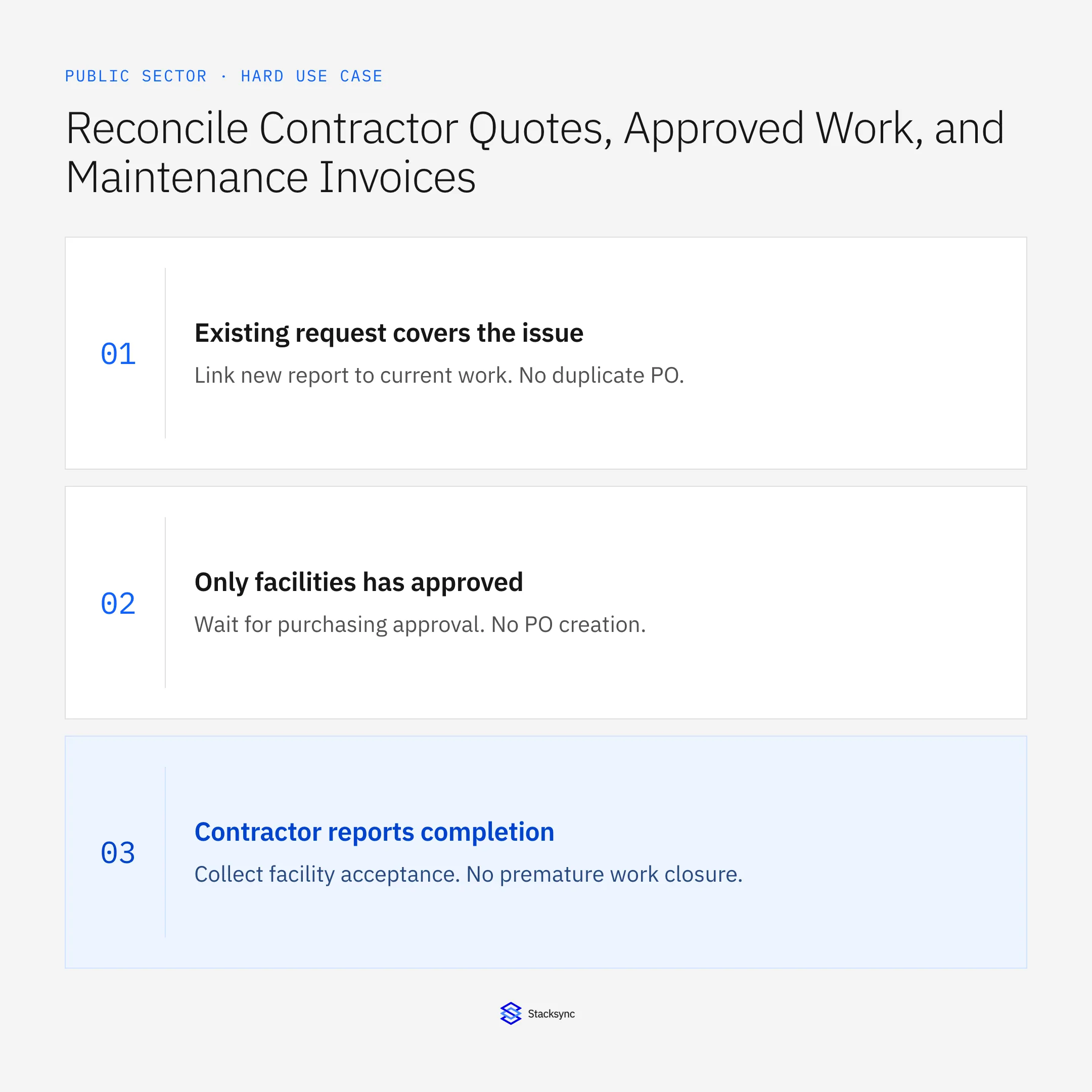
| Observed condition | Next action | Required boundary |
|---|---|---|
| Existing request covers the issue | Link new report to current work | No duplicate PO |
| Only facilities has approved | Wait for purchasing approval | No PO creation |
| Contractor reports completion | Collect facility acceptance | No premature work closure |
| Invoice includes unapproved work | Send discrepancy to finance | Never authorize payment |
Exception decisions for facility maintenance.
Illustrative exception and recovery
The facility accepts completed work, but the invoice adds two hours absent from the approved quote and change history. The maintenance acceptance remains recorded while the unsupported charge goes to finance; no payment is authorized.
This example uses fictional records to show the decision logic. It is not a customer case study or a claim of measured results. In a live case, retain the actual record IDs and evidence behind each statement, and replace all illustrative quantities or timing assumptions with the approved operational inputs.
What to record before resuming
A linked maintenance record from asset and contractor quote through dual approval, purchase order, completion, facility acceptance, and any finance-owned invoice exception.
Preserve the original finding and the evidence that resolves it. Record which person or system supplied the clarification, which proposal it applies to, and the action now permitted. Do not erase the uncertainty from the history: a later reviewer needs to understand why the case paused and why it resumed.
Boundaries that remain in force
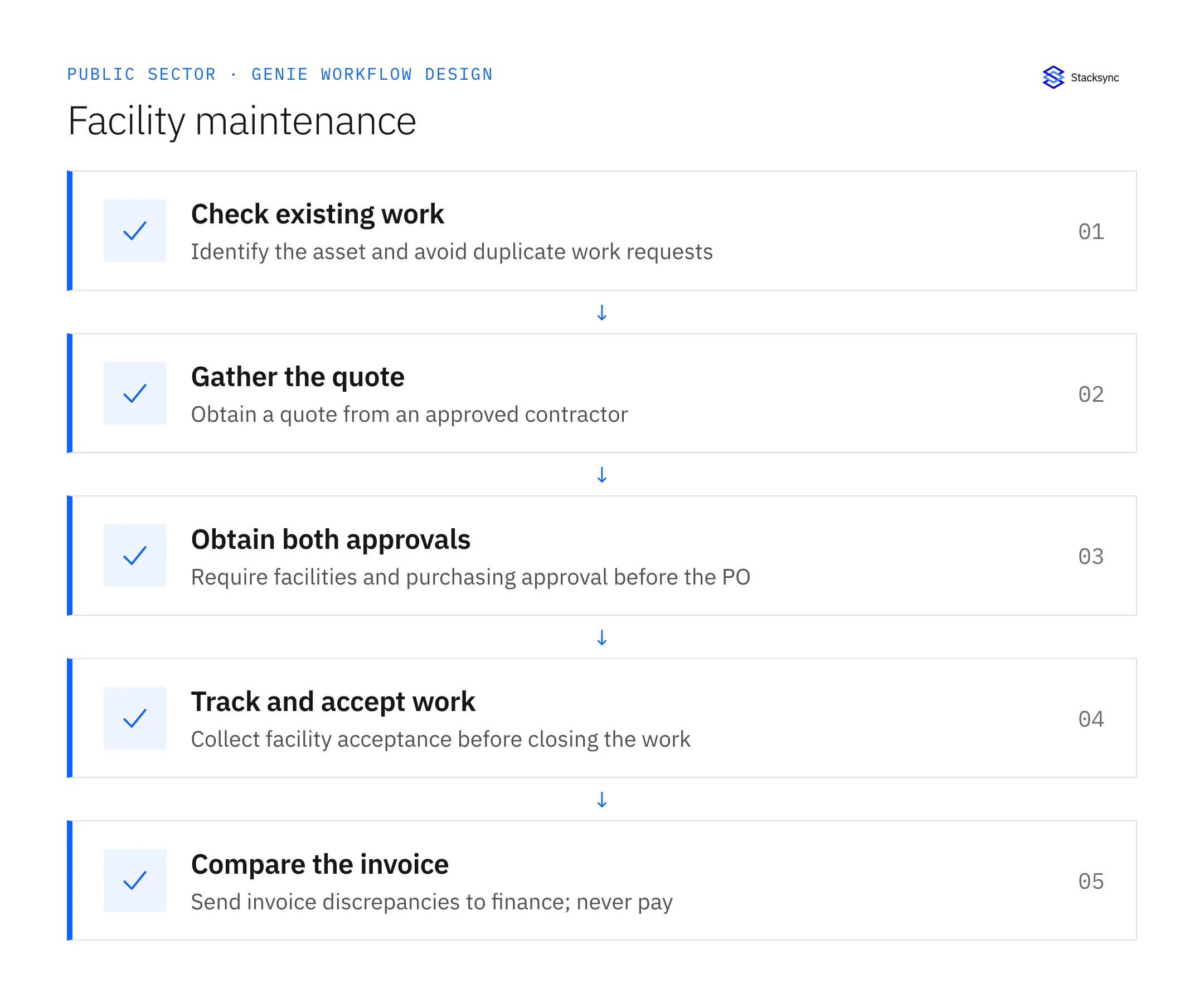
- Identify the Salesforce asset and check Postgres work requests before creating another.
- Use an approved contractor and require facilities plus purchasing approval before a NetSuite PO.
- Track work in Postgres and updates in Zendesk; obtain facility acceptance before closing.
- Compare invoice, approved work, and completion evidence; route discrepancies to finance and never authorize payment.

Review the case before restarting
First verify that the new evidence resolves the original blocker rather than a different issue. Then check whether the case, source records, or proposed action changed during the wait. A response attached to the right ticket can still be insufficient if it refers to an earlier proposal or leaves a required quantity, identity, or approval unresolved.
Run the relevant row from the decision table as a review scenario. Confirm that the job stops at the required boundary, asks for the specified information or decision, and resumes from the confirmed state. If a write or message may already have succeeded, inspect its destination before repeating it; if this job only prepares a draft or report, verify that it stays within that output scope.
- Duplicate work requests and purchase orders prevented
- Purchase orders backed by facilities and purchasing approval
- Accepted maintenance jobs with unresolved invoice discrepancies
Track unresolved cases by their actual blocker and owner. A case waiting for clarification needs a different next action from one waiting for a confirmed result. Review the evidence when the state changes, and keep any still-unresolved completion condition visible instead of treating a successful intermediate step as the end of the work.
Give your Genie a job description
Copy the job description below. It preserves the scope and decision boundaries of this use case. Configure the referenced systems, record relationships, policies, and approval owners in your workspace before enabling the job.
Paste this into “Give your Genie a job description.” Explore Stacksync Genies.
Implementation references
These first-party references document the underlying records and interfaces. The cross-system sequence, approvals, and completion rules in this article are a proposed operational configuration; validate them against your connected workspace before enabling it.

FAQ
Frequently asked questions










Explore these integrations and topics
Related articles