MEP Service Closeout Exceptions: Warranty Work, Callbacks, Missing Parts, and Customer Sign-Off
Handle the MEP closeout cases that require service judgment before an AI-prepared packet reaches billing.
- Author
- Ignacio Malpartida · GTM Engineer
- Published
- Read time
- 5 min read
The operating decision
MEP closeout exceptions should be organized around decisions that an agent cannot safely infer: warranty eligibility, callback classification, unclear parts usage and missing customer acceptance. A Genie can collect the relevant visit and agreement evidence, compare statements and draft an owned review task. Keep the original technician record visible. The agent should not classify every return visit as warranty, interpret a signature as unlimited approval, or make up an item code to finish a billing packet.
Explore the complete commercial HVAC, plumbing and electrical contractors integration and automation hub for the systems and processes around this guide.
What this looks like in commercial HVAC, plumbing and electrical contractors
An electrical contractor returns to a site after a repaired circuit fails again. The second technician notes a different fault, uses a part from truck stock and leaves before the facility manager can sign. The customer calls it a callback, but the service manager needs to determine whether the new work falls under the prior repair. Billing needs a decision, not a confident label. The exception packet should assemble both visits and identify the unresolved scope and part evidence.
Records, ownership, and update rules
| Record | Owner | Operating rule |
|---|---|---|
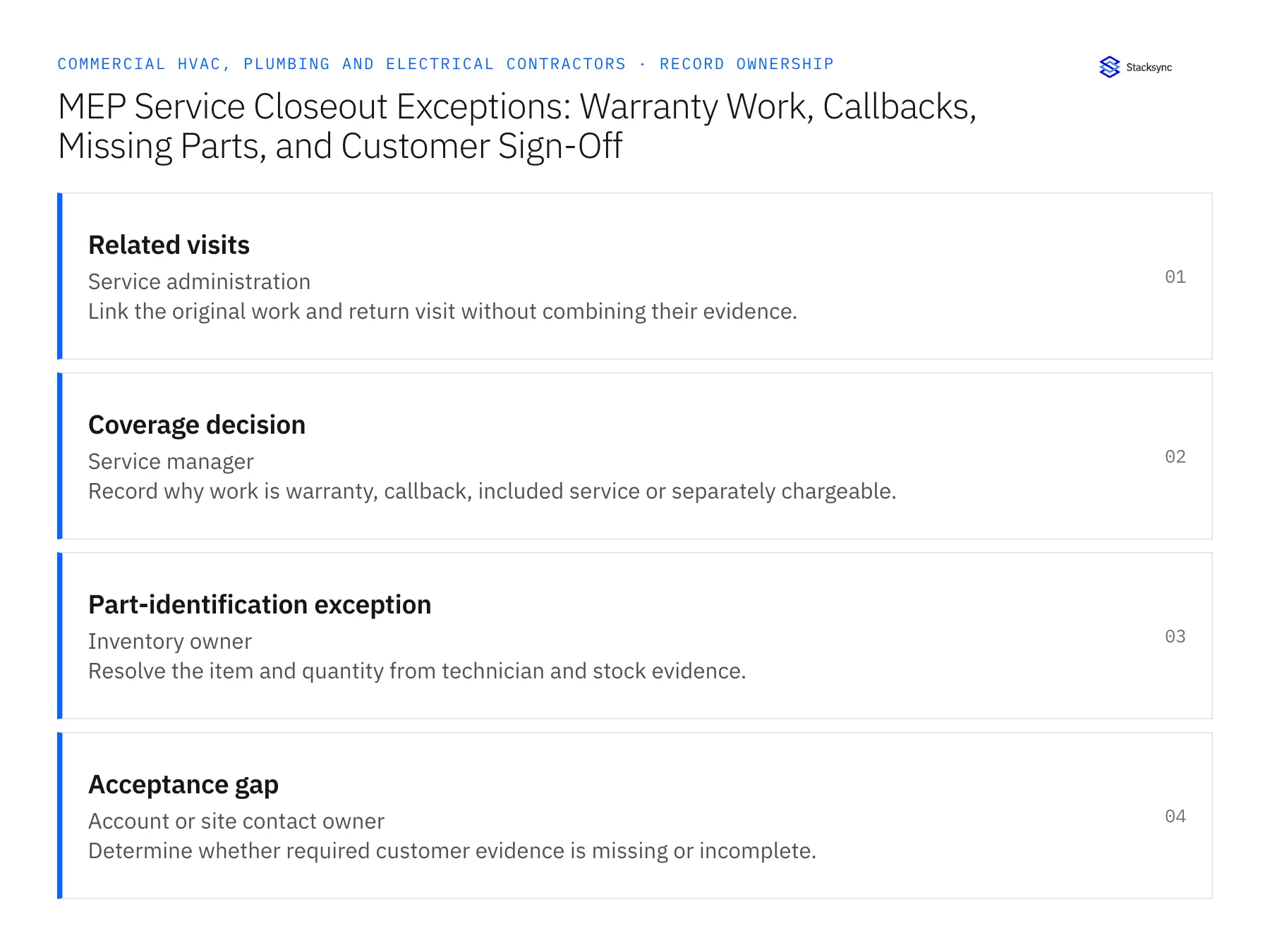
| Related visits | Service administration | Link the original work and return visit without combining their evidence. |
| Coverage decision | Service manager | Record why work is warranty, callback, included service or separately chargeable. |
| Part-identification exception | Inventory owner | Resolve the item and quantity from technician and stock evidence. |
| Acceptance gap | Account or site contact owner | Determine whether required customer evidence is missing or incomplete. |
Work through the process
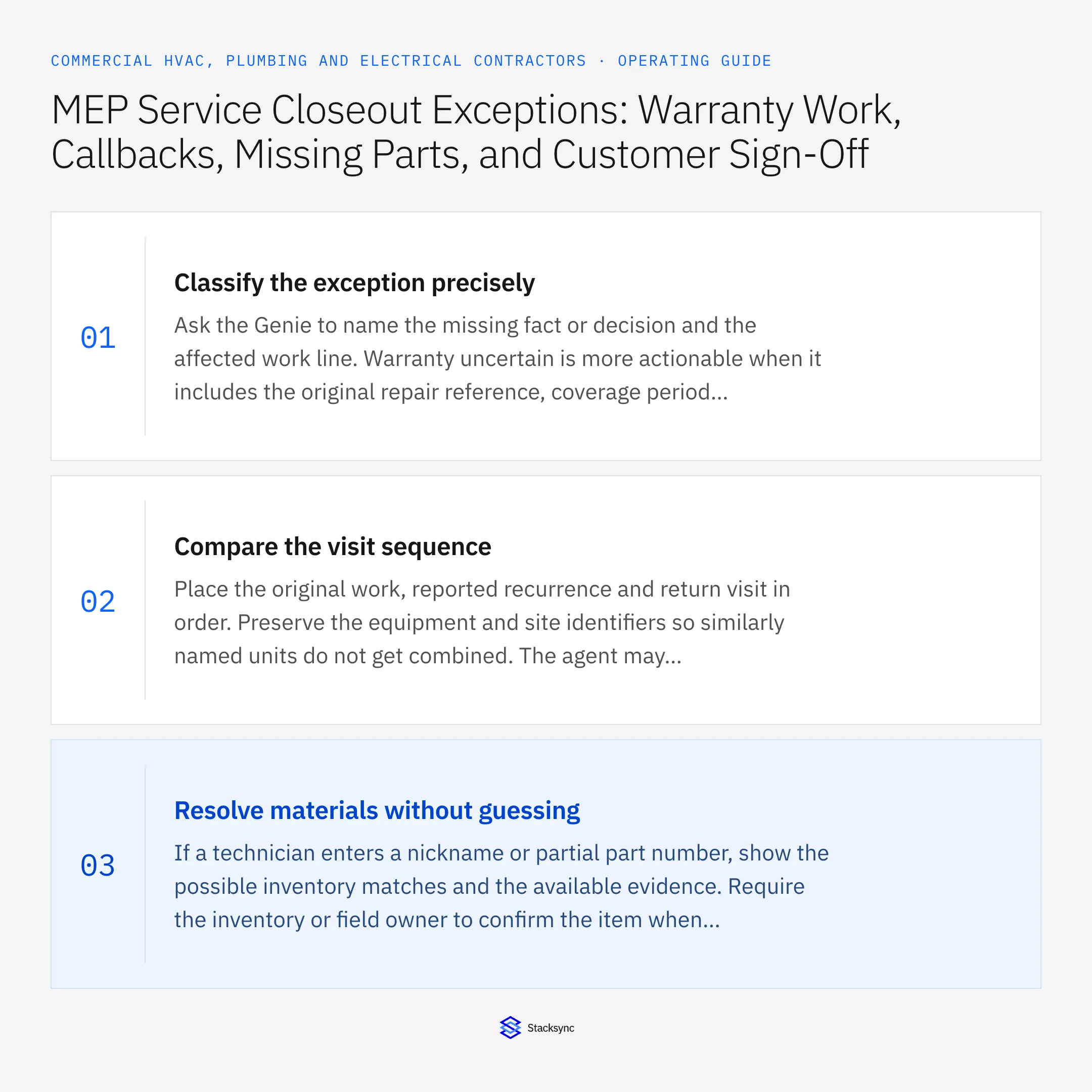
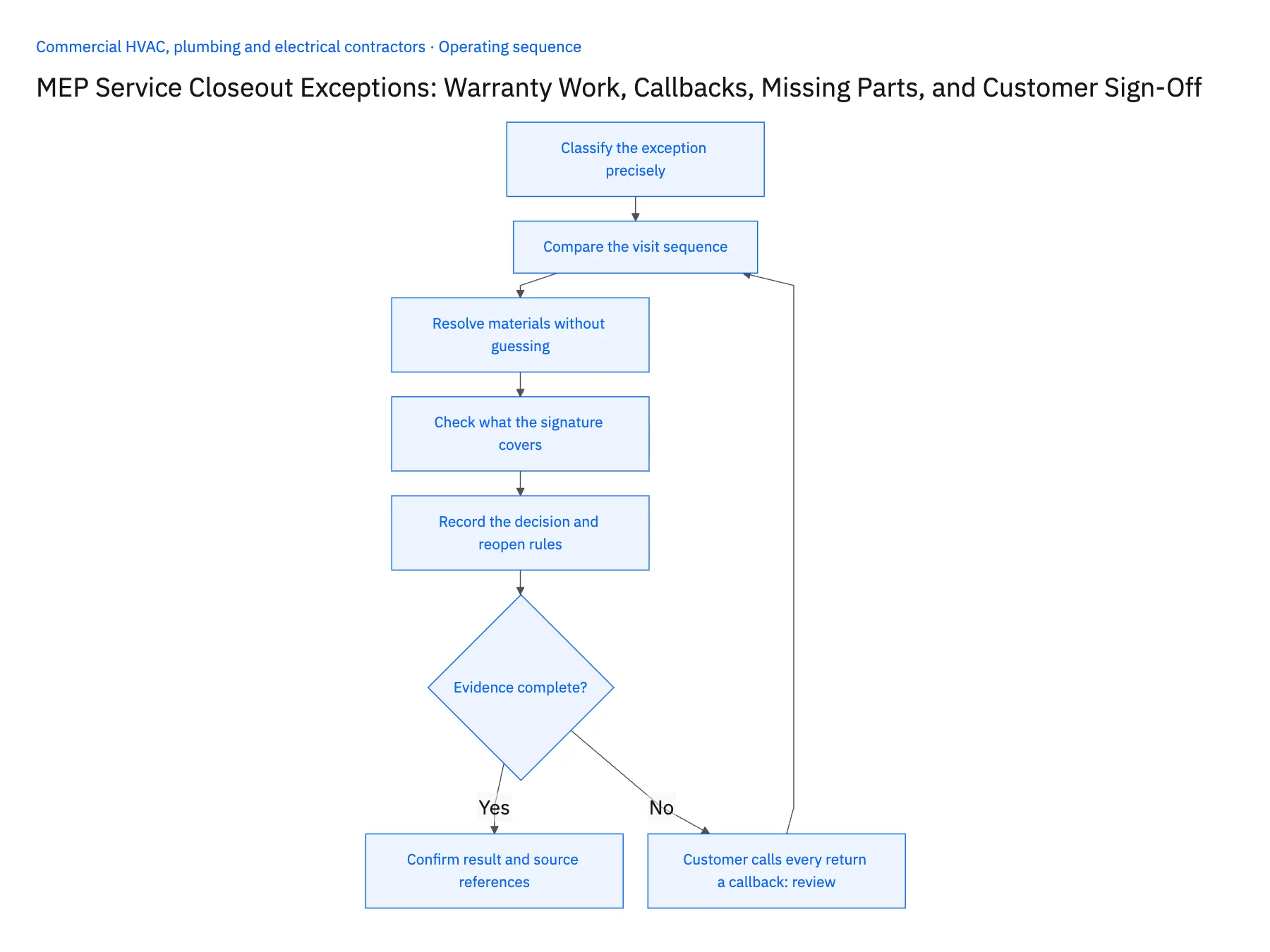
- 01Classify the exception preciselyAsk the Genie to name the missing fact or decision and the affected work line. Warranty uncertain is more actionable when it includes the original repair reference, coverage period evidence and the new technician's observation. Avoid treating a low model-confidence score as the whole explanation.
- 02Compare the visit sequencePlace the original work, reported recurrence and return visit in order. Preserve the equipment and site identifiers so similarly named units do not get combined. The agent may identify inconsistencies, but the service supervisor decides whether the second visit relates to the first repair or a new condition.
- 03Resolve materials without guessingIf a technician enters a nickname or partial part number, show the possible inventory matches and the available evidence. Require the inventory or field owner to confirm the item when several candidates remain. Do not use the most common part merely because its description resembles the note.
- 04Check what the signature coversRead the acceptance evidence in context: a sign-in record, acknowledgement of attendance and approval of completed scope can mean different things. Route missing or limited sign-off to the owner responsible for customer confirmation. Keep the contract's actual acceptance requirement attached to the case.
- 05Record the decision and reopen rulesAfter review, store the classification, supporting rationale and the work lines it covers. Resume only the permitted closeout or billing step. If new evidence changes the classification, retain the earlier decision and route the financial correction through finance instead of overwriting the history.
Handle the exceptions explicitly
Customer calls every return a callback
Collect the related visit evidence and ask the service manager to determine the actual classification.
Technician lists an unrecognized part nickname
Hold the coded material line until the item owner confirms its identity.
Signed form acknowledges arrival only
Do not treat it as completion approval; request the evidence required for the billing rule.
What to verify before expanding
- A return visit is linked without automatically becoming nonbillable.
- Every classification has a human decision and rationale.
- Unknown parts remain unresolved rather than receiving guessed codes.
- Acceptance evidence is evaluated for the scope it actually covers.

Connect this process to the rest of your operation
Explore Stacksync AI agents (Genies) and scope the records and actions against your actual systems. Book a demo with a real related visits example and the exception your team handles most often, for example customer calls every return a callback.
- AI Service Closeout for Commercial MEP Contractors
- Genies for Commercial MEP Service Closeout: Turn Technician Notes Into an Invoice-Ready Packet
- HVAC Distributor EDI for Mechanical Contractors: Track Equipment POs, Backorders, and Partial Receipts
- HVAC, Plumbing, and Electrical Customer Sites: Align Salesforce Accounts With NetSuite Billing Hierarchies
- Coordinate Equipment Repairs Across Service, Inventory, and Scheduling
- Verify Warranty Coverage and Customer Acceptance Before Closing Repairs
The shared architecture guide covers record matching, ownership, and recovery across systems.
Technical references
FAQ
Frequently asked questions










Related articles