







Assemble the right evidence
Connect the shortage to the affected run and collect the proposed material’s supporting information.
 Salesforce
  HubSpot
  NetSuite
  Zendesk
  Microsoft Dynamics 365 Sales
  Dynamics 365 F&O
  Attio
Attio  Pipedrive
  Zoho CRM
  Campfire
  Rillet
  Front
Front  Shopify
  Amazon Seller Central
  SendGrid
 Plastics and molding
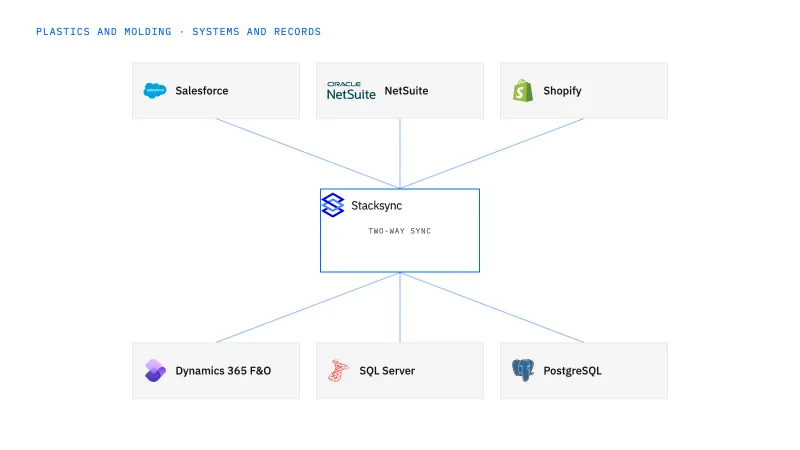
Bring resin shortages, candidate materials and affected molding orders into a controlled review handoff. Stacksync fits teams that spend time collecting supplier documents and chasing technical decisions before planning can recover a run. Engineering and quality retain suitability decisions, while purchasing and planning own the accepted supply action.
Purchasing can find another resin, but the team cannot quickly establish whether it is approved for the customer, part and planned run.
Explore your process in a demo, or get our shared two-way sync architecture guide.
When this fits
Plant operations, customer service and IT teams at US injection molders, extruders and plastics manufacturers with 100–1,000 employees.
Connect the shortage to the affected run and collect the proposed material’s supporting information.
Keep technical suitability, customer consent and commercial supply terms with their responsible owners.
A one-time accepted substitution remains scoped to its authorized use instead of silently becoming a global rule.
The process, end to end
a plant manager faces a material delay before a scheduled repeat run. The workflow should show existing eligible supply, the proposed substitute and the approval still needed, then preserve the exact scope of the accepted recovery plan.
Scope your implementation
Review current platform pricing alongside the records, volume, and actions in your process. Use your own operating baseline to evaluate the economics.
Explore your process in a demo, or get our shared two-way sync architecture guide.
From foundation to action
Keep shared customer, order, and operational records aligned, with clear field ownership.
Explore two-way sync 02Move approved work between systems, assign exceptions, and confirm the result.
Explore workflows 03Investigate cross-system questions, assemble the evidence, and prepare the next action.
Explore ai agents (genies) 04Connect trading-partner documents to operational records and exception handling.
Explore ediGo deeper
When a late resin delivery threatens a scheduled run, the workflow gathers the shortage, candidate grade and approvals so planning changes the run only on an accepted decision.
A finished molding run can still be partly on hold for color review; this workflow finds the affected allocations and recovery options before anyone promises a new date.
Explore all plastics and molding integration and automation guides ↗
It can organize candidate evidence and prior approvals. The manufacturer’s technical process determines suitability.
The shortage case stays open and the molding order keeps its original material requirement in NetSuite. Planning sees the proposed material, the review owners and which decision is outstanding, whether that is technical suitability, customer consent or supply terms. Nothing changes on the run until the accepted production change is recorded with its approval reference. If the supply window closes during review, purchasing updates the time-stamped availability so planning can choose to defer or split the run.
Measure time to a complete decision packet, clarification cycles and changes reopened for missing scope or approval.
Not strictly, but it is the right first layer. Two-way sync between NetSuite and PostgreSQL gives the workflow a current copy of molding orders, the approved material requirement, released stock and incoming supply to build a shortage case from. Workflows then route the substitute proposal and technical review to their owners. Once the change is accepted, planning applies it in NetSuite through its normal process with the approval reference attached, and the sync carries the updated order back to the database. Genies come after that, collecting supplier documents and prior approvals into the review packet. EDI applies only where the demand behind the run arrives as customer releases that need normalizing first.


