








Stacksync and Stile: Identity Verification for Connected Workflows
Stacksync and Stile partner to connect identity verification with enterprise operations. Explore privacy, signed webhooks, and potential workflow patterns.
- Author
- Ruben Burdin · Founder & CEO
- Published
- Read time
- 3 min read
Partnership


Identity verification. Connected operations.
Every important business action depends on two things: knowing who is making the request and making sure the right systems have the information they need to act. That is why we're excited to highlight our partnership with Stile, a developer-friendly identity verification platform built for high-risk transactions.
At Stacksync, we help companies keep operational data aligned across CRMs, databases, and enterprise applications through real-time, two-way synchronization. Stile tackles a different but complementary challenge: confirming that the person behind a sensitive action is who they claim to be.
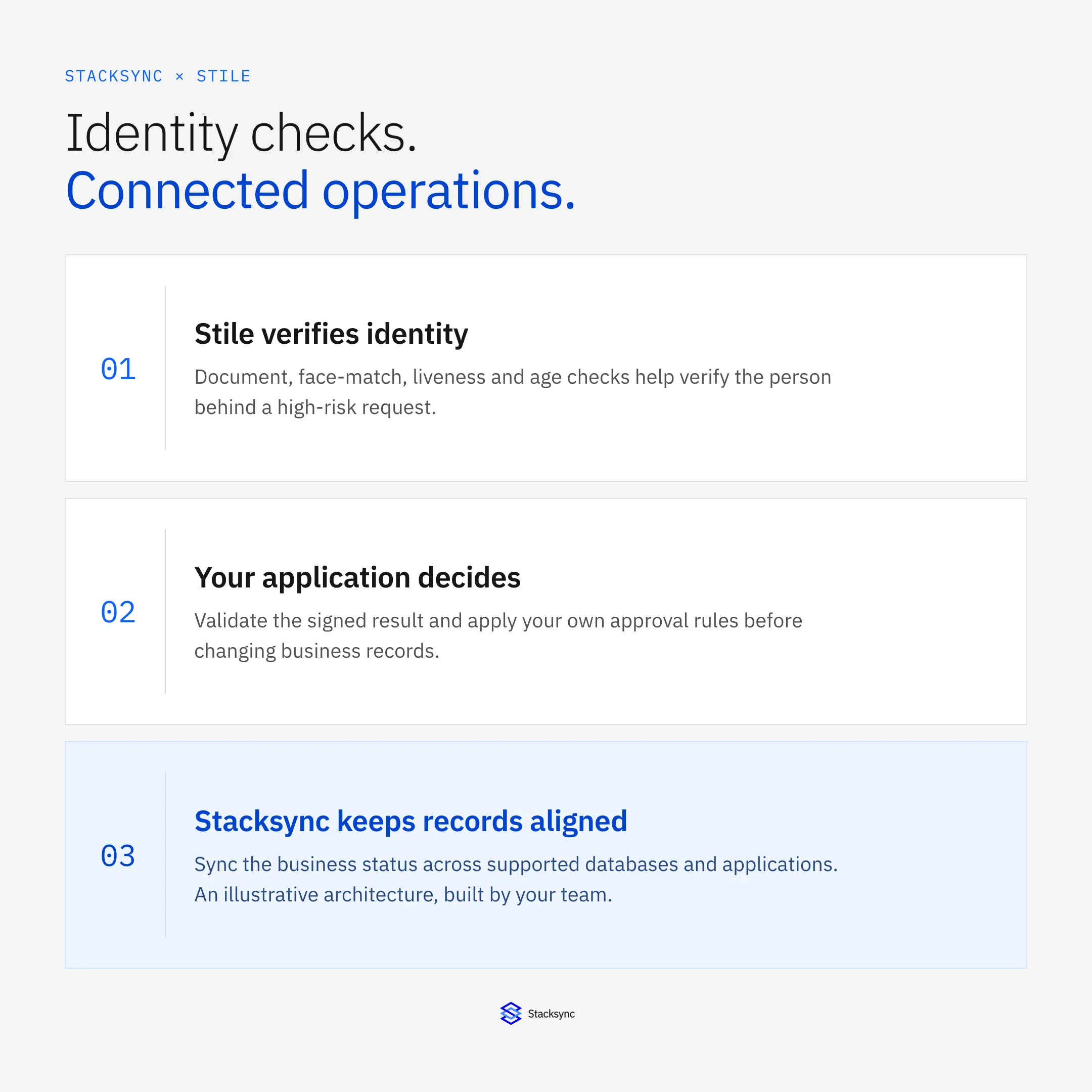
Together, these capabilities point toward a simpler way to design trustworthy business workflows: verify identity when it matters, then keep the relevant business records current across the systems teams already use.
Meet Stile: identity verification for high-risk moments
Stile helps businesses verify the person behind actions such as changing payment details, recovering an account, or collecting a high-value shipment. Its verification options include document checks, face matching, liveness detection, and age verification.
Developers can integrate Stile through an API or hosted verification flow; teams can also send a secure verification link or use a QR code. Once the verification is complete, Stile can deliver a signed result through a webhook. The person being verified does not need to download an app.
A particularly compelling aspect of Stile is its Proof with Privacy approach. According to Stile's retention documentation, captured document images and extracted document data are purged after the final verification or review decision. Evidence remains available during an active review; biometric templates follow the configured retention policy. Verification outcomes can persist after the underlying evidence is deleted.
Why Stacksync and Stile are complementary
Identity verification does not happen in isolation. The request may originate in a customer portal, an internal tool, a CRM, or a logistics application. The result may need to inform customer support, operations, or finance.
Stacksync helps companies synchronize business records between their databases and applications without maintaining a collection of fragile custom integrations. Stile provides a way to check identity at the point of risk.
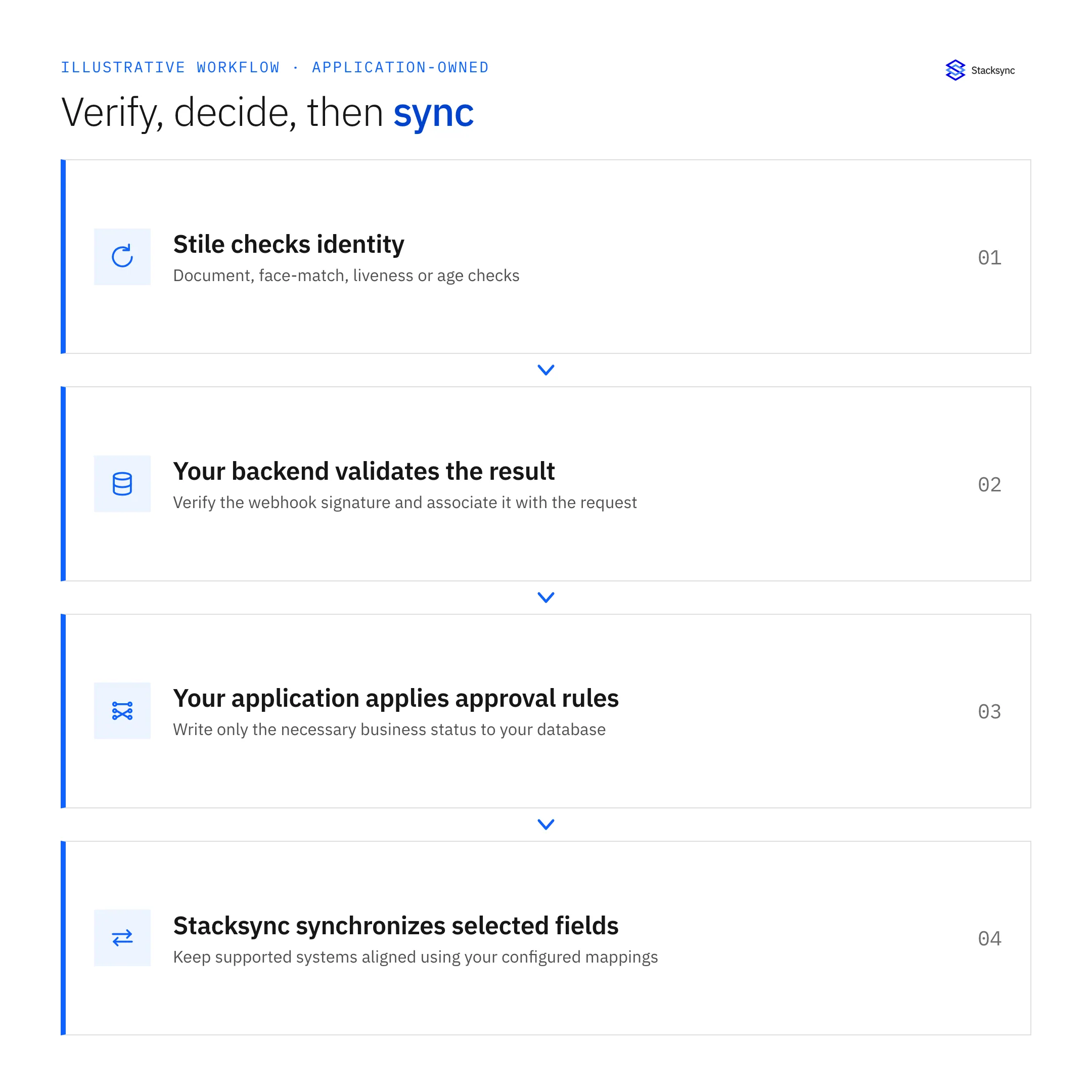
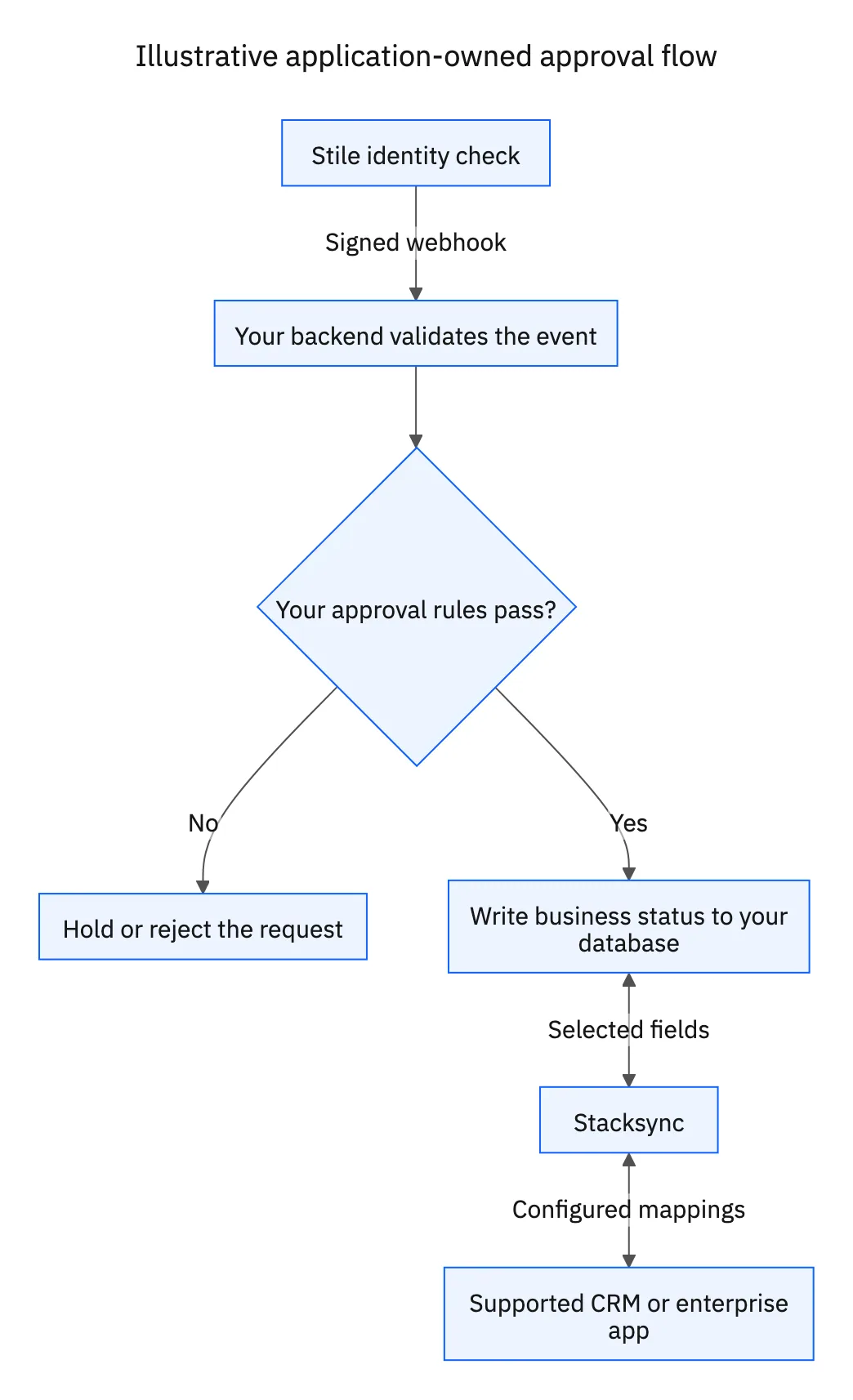
In an illustrative implementation, your backend validates Stile's webhook and associates the result with the original request. Your application then applies its approval rules and writes the necessary business status to a supported database. Stacksync synchronizes selected fields with the systems that need them. Identity verification informs the approval decision; it does not grant permission by itself.
Consider three potential workflow patterns:
- Account recovery: A customer completes a Stile identity check before an authorized support team restores access. The resulting business status can then be reflected across relevant customer systems.
- Payment-detail changes: A business requests identity verification before approving a sensitive vendor or customer update, with the approved status kept consistent across operational tools.
- High-value logistics: A pickup is verified before shipment release, while operational records remain aligned between logistics software and customer-facing systems.
These are illustrative architectures, not claims of a currently available native Stile–Stacksync connector or prebuilt joint workflow. Implementation depends on each company's application, data model, and approval process.
Built for developers, useful across the business
Stile's API, hosted flow, and signed webhooks give development teams flexible ways to add identity checks. Stacksync's real-time synchronization helps teams make business data accessible where it is needed, without rebuilding CRM and database integrations from scratch.
The combination reflects a broader shift in enterprise software: specialized services should be easy to adopt without creating new silos. Security and identity checks are most useful when they fit naturally into the operational processes they protect.

Learn more
Explore Stile's identity verification platform to see how document, face-match, liveness, and age checks can fit into high-risk workflows. See Stile in our partner directory, or explore Stacksync two-way sync to learn how real-time, two-way data synchronization connects CRMs, databases, and enterprise systems.




Related articles