







Keep the exact variant
Connect the stable Shopify variant to its approved ERP item rather than matching by flavor or shortened product title.
 Salesforce
  HubSpot
  NetSuite
  Zendesk
  Microsoft Dynamics 365 Sales
  Dynamics 365 F&O
  Attio
Attio  Pipedrive
  Zoho CRM
  Campfire
  Rillet
  Front
Front  Shopify
  Amazon Seller Central
  SendGrid
 Nutrition and supplements
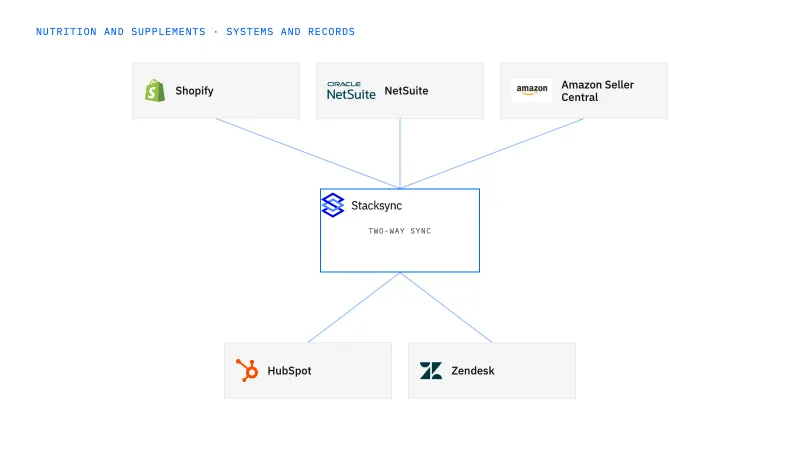
Connect nutrition ecommerce orders to the exact ERP product, package, and bundle definition. This fits brands selling across DTC and wholesale when flavor, serving-size, and kit variations create recurring reconciliation work. Two-way sync should connect stable records while preserving finance and product ownership.
Similar flavor names hide different tub sizes, serving counts, and bundle contents across commerce and ERP records.
Explore your process in a demo, or get our shared two-way sync architecture guide.
When this fits
Nutrition and supplement brands combining manufacturing, DTC, marketplaces, practitioner sales, and retail distribution.
Connect the stable Shopify variant to its approved ERP item rather than matching by flavor or shortened product title.
Retain the purchased bundle revision so fulfillment and returns can interpret the original product configuration.
Shopify product variants, orders, and customers are the listed sync objects for this pair. NetSuite writes are object-scoped, and the approved ERP item and bundle recipe stay owned by product operations. Inventory levels and fulfillment instructions are separate actions with their own permissions, so a synced order line confirms what was sold, not what the warehouse should pick.
The process, end to end
A nutrition brand sells several flavors in two package sizes and offers starter kits online. Operations needs the actual components while support needs the purchased variant and finance needs the accepted order trail. The fit is strongest when these teams repeatedly reconstruct the same relationships from exports or messages.
Scope your implementation
Review current platform pricing alongside the records, volume, and actions in your process. Use your own operating baseline to evaluate the economics.
Explore your process in a demo, or get our shared two-way sync architecture guide.
From foundation to action
Keep shared customer, order, and operational records aligned, with clear field ownership.
Explore two-way sync 02Move approved work between systems, assign exceptions, and confirm the result.
Explore workflows 03Investigate cross-system questions, assemble the evidence, and prepare the next action.
Explore ai agents (genies) 04Connect trading-partner documents to operational records and exception handling.
Explore ediGo deeper
Why a title match picks the wrong tub, and how an approved variant-to-item crosswalk keeps flavors, sizes, and kit revisions distinct in NetSuite.
A single bottle and a two-bottle promo share one product name on Amazon; keeping seller-scoped offers apart in NetSuite is what lets finance and returns agree on bottle counts.
A practitioner who works at two clinics is the test case: keep contacts, companies, and NetSuite payers as three levels so terms and order history stay with the right buyer.
Explore all nutrition and supplements integration and automation guides ↗
No. Package size and sellable configuration matter independently. The approved mapping must identify the exact item purchased.
The stable Shopify variant ID keeps its relationship to the approved NetSuite item, so a marketing rename on its own does not create a new ERP item or reassign old orders. When the kit contents or package size change, product operations versions the mapping and the bundle recipe, and orders placed before the change still resolve to the configuration that shipped. A changed serving-count description is held for the product owner to confirm whether the physical package changed.
Start with two-way sync between Shopify variants, orders, and customers and the approved NetSuite items so every order line carries the exact tub size and kit revision. Once that identity holds, workflows can route substitutions, sample requests, or return reviews to a named owner. Genies come next for evidence-heavy work such as batch-document requests. EDI applies only when a retailer needs item numbers and pack configurations exchanged as partner documents.


