







Use the actual agreement condition
Define the event and evidence that authorize recurring charges for the specific project.
 Salesforce
  HubSpot
  NetSuite
  Zendesk
  Microsoft Dynamics 365 Sales
  Dynamics 365 F&O
  Attio
Attio  Pipedrive
  Zoho CRM
  Campfire
  Rillet
  Front
Front  Shopify
  Amazon Seller Central
  SendGrid
 Fire, life-safety and security integrators
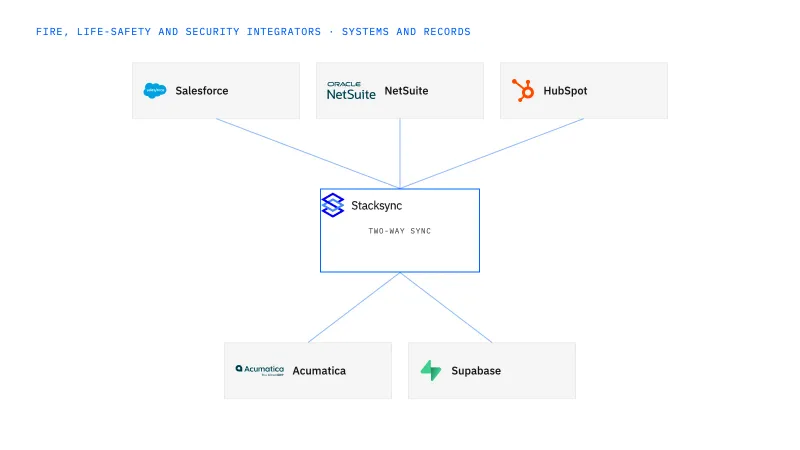
Connect installation completion, required handover evidence, customer acceptance and the approved recurring-billing start. The workflow makes each prerequisite visible and routes the activation decision to the authorized owner. A completed technician task does not establish every commercial condition.
Installation teams close the job while finance still needs to know which scope the customer accepted and when billing may start.
Explore your process in a demo, or get our shared two-way sync architecture guide.
When this fits
US fire, life-safety, alarm and access-control integrators with 100–1,000 employees that supply equipment and deliver installation or recurring service.
Define the event and evidence that authorize recurring charges for the specific project.
Keep site or scope boundaries visible when only part of a rollout has been accepted.
Record the destination reference so repeated acceptance updates cannot create another recurring handoff.
The process, end to end
an access-control rollout is technically complete at several locations, but one site still awaits handover review. The workflow shows the accepted portion and routes the remaining decision instead of marking the entire rollout billable.
Scope your implementation
Review current platform pricing alongside the records, volume, and actions in your process. Use your own operating baseline to evaluate the economics.
Explore your process in a demo, or get our shared two-way sync architecture guide.
From foundation to action
Keep shared customer, order, and operational records aligned, with clear field ownership.
Explore two-way sync 02Move approved work between systems, assign exceptions, and confirm the result.
Explore workflows 03Investigate cross-system questions, assemble the evidence, and prepare the next action.
Explore ai agents (genies) 04Connect trading-partner documents to operational records and exception handling.
Explore ediGo deeper
Connect installation acceptance to the correct recurring-billing start decision for security integrators.
Turn inspection findings into owned commercial follow-ups while preserving technical review and customer authorization.
Explore all fire, life-safety and security integrators integration and automation guides ↗
Commercial billing and operational activation are separate actions and must be scoped independently.
The designated finance or contract authority applies the agreement to the recorded evidence.
Yes. The workflow can prepare an owned activation packet without releasing financial changes automatically.
It helps. Two-way sync keeps the Salesforce installation record and the NetSuite recurring agreement pointed at the same customer, site and accepted scope. Then add this workflow to collect handover evidence and route the billing activation decision to the finance or contract authority. Genies come next if coordinators want the acceptance evidence, remaining handover items and agreement condition gathered into one packet for that approver. EDI enters only when supplier shipment documents for the installed equipment need to reach NetSuite, a transport separate from the billing handoff.


