


















Reverse ETL Pricing vs Two-Way Sync: What Warehouse Activation Really Costs
A cost-focused look at moving data from the warehouse into business tools. Reverse ETL tools often look cheaper on the invoice, but they meter per row, push one way, and leave the pipeline maintenance to you. This guide separates the license price from the total cost, compares the pricing models honestly, and explains where a two-way sync trades a different price for a lower total. Pairs with the capability argument in the reverse-ETL-falls-short post.
- Author
- Ignacio Malpartida · GTM Engineer
- Published
- Read time
- 9 min read

Someone always does the math and pushes back: a reverse ETL tool does warehouse-to-CRM sync for less than this. On the invoice line, that is often true. Reverse ETL products can look cheaper, and if all you need is a scheduled one-way push, they may well be the right call. The pushback is fair, and it deserves a real answer rather than a dismissal.
The honest answer is that the sticker price and the total cost are two different numbers. Reverse ETL is metered by volume, pushes one way, and leaves the pipelines for you to run. This guide separates the license from the true cost, compares the pricing models plainly, and shows where a two-way sync trades a different price for a lower total.
This is the cost companion to a capability argument we make elsewhere. For why reverse ETL falls short on function, not just price, see where reverse ETL falls short. And for the definitions, the ETL versus reverse ETL guide sets the terms. Here we stay on the money.
How reverse ETL is priced, and why it climbs
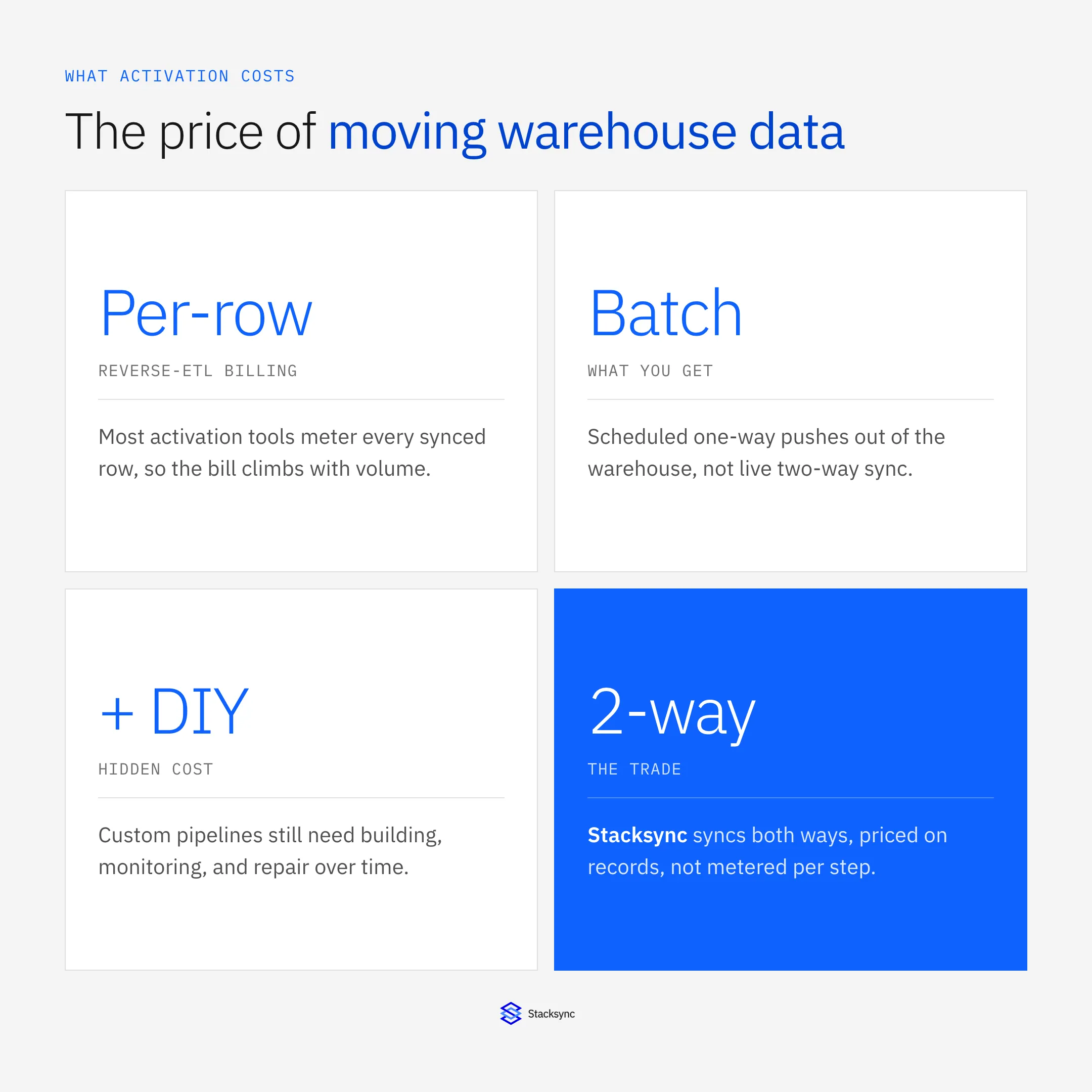
Most reverse ETL tools meter usage. The common unit is rows or records synced from the warehouse to your tools, sometimes with connector or seat fees layered on. At low volume this is genuinely cheap, which is why it demos so well. A sync touching a few thousand records costs very little, and the model feels efficient.
The problem is that the price is bolted to volume rather than to value. Activating a few thousand rows is cheap, activating millions across several destinations is not, and every tier you cross can add overage on top. The row that mattered and the row that did not are billed the same. So the effective cost of a useful sync rises as you scale, and the pricing that won the demo is not the pricing you renew on.
Two paths from the warehouse, and where the cost lands
It helps to trace both routes from the warehouse to the CRM and see where cost accrues. Reverse ETL runs a scheduled batch job, pushes one way, and leaves the data stale between runs with no path back unless you add tools. A two-way sync captures the change in real time, writes it, and carries edits back, so the return path is not a second project.
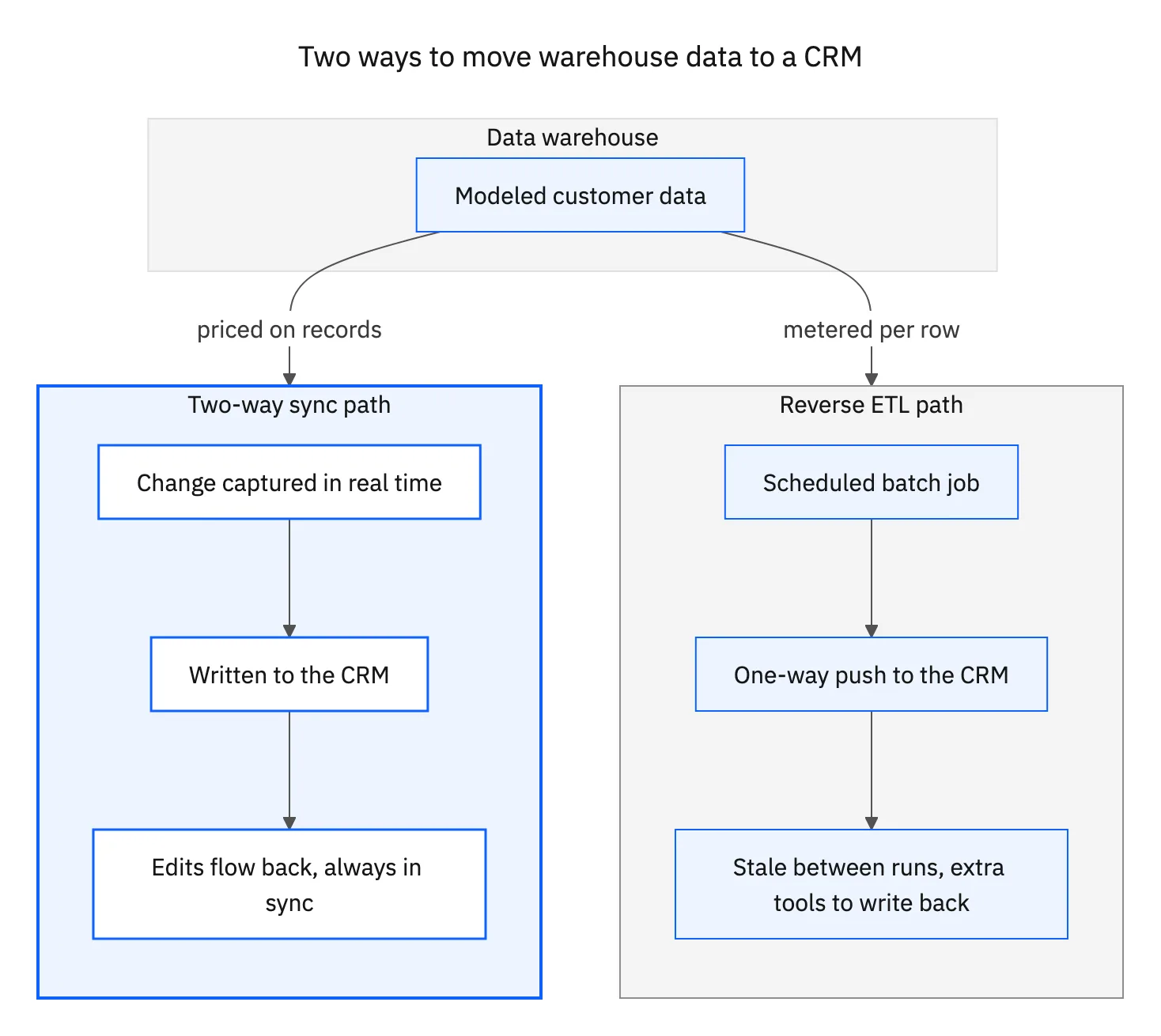
The two-way path costs something too, of course. The point is not that it is free, it is that its price already includes the return path, the conflict handling, the retries, and the monitoring that the reverse ETL path charges you for separately in engineering time. You are comparing a fuller outcome, not a cheaper line item.
Comparing total cost, not sticker price
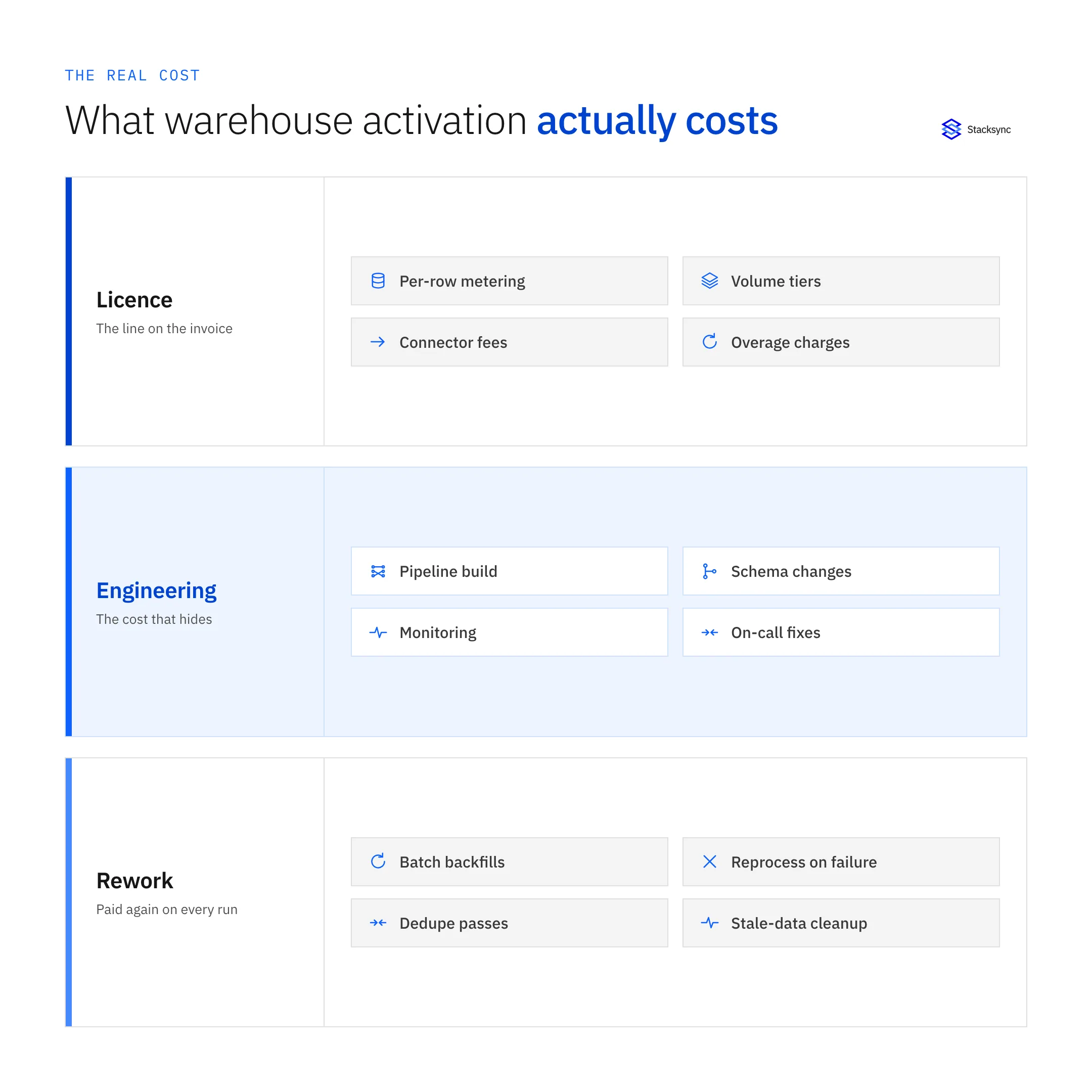
Put the pieces in one view and the comparison changes shape. The reverse ETL column often wins the license line and loses the total, because the costs it externalizes land on your team instead.
| Cost driver | Reverse ETL | Two-way sync |
|---|---|---|
| Pricing model | Metered per row or record | Priced on records, not per step |
| Behavior at scale | Climbs with volume, plus overage | Does not multiply per field change |
| Direction | One-way, write-back is a second build | Two-way, return path included |
| Pipeline upkeep | Yours to build and monitor | Handled by the platform |
| Rework | Batch backfills and reprocessing | Event-driven, no full re-runs |
Reverse ETL often wins the license line and loses on total cost once upkeep and the return path are counted.
This is not a claim that reverse ETL is overpriced. It is a claim that the right comparison is total cost of a working outcome. If the outcome you need is one-way and small, reverse ETL may be cheaper on both. If it is two-way, or large, or destined to grow, the metered one-way price is the beginning of the cost, not the end.

When reverse ETL is the cheaper, right answer
To keep this fair: there are cases where reverse ETL wins outright. If you push a computed score or a segment from the warehouse to a tool on a schedule, never need the edit to come back, and your volume is modest, a one-way metered tool does exactly that job for less. Do not buy a two-way sync to do a one-way task.
The cost problem shows up when the requirement quietly turns two-way, or the volume grows past the tier that looked cheap. That is the moment the sticker price and the total cost diverge, and it is worth naming before you commit rather than after. For the source-of-truth decision that usually sits behind this, see warehouse versus CRM as your source of truth.
Price the outcome, not the line item
Reverse ETL pricing is real and sometimes it is the better deal. But comparing a one-way metered push to a two-way sync on license price alone is comparing two different outcomes. Count the pipeline upkeep, the rework on every run, and the second build for the return path, and the cheaper line often becomes the more expensive project.
The number that matters is the total cost of data that stays in agreement across your tools. To see that math on your own volumes and destinations, book a demo.

FAQ
Frequently asked questions










Explore these integrations and topics
Related articles