


















eClinicalWorks vs Epic vs athenahealth: EHR Compared
How eClinicalWorks, Epic, and athenahealth compare on target customer, deployment, pricing, revenue cycle, and interoperability, plus how to keep EHR data in sync across your stack.
- Author
- Ignacio Malpartida · GTM Engineer
- Published
- Read time
- 8 min read

Here is the quick verdict. Epic fits large hospitals and integrated health systems that need deep inpatient coverage and can support a large budget. eClinicalWorks fits independent and mid-sized ambulatory practices that want a full cloud EHR at a lower monthly cost. athenahealth fits ambulatory groups that want billing and revenue cycle handled on a network model. The rest of this guide explains how the three compare on deployment, cost, billing, and data.
All three are certified EHRs, and all three support modern interoperability standards, so the choice rarely comes down to a single missing feature. It comes down to your care setting, patient volume, budget, and how much of the revenue cycle you want the vendor to run. Below we walk through eClinicalWorks vs Epic and eClinicalWorks vs athenahealth on the terms that actually change the buying decision.
Who each EHR is built for
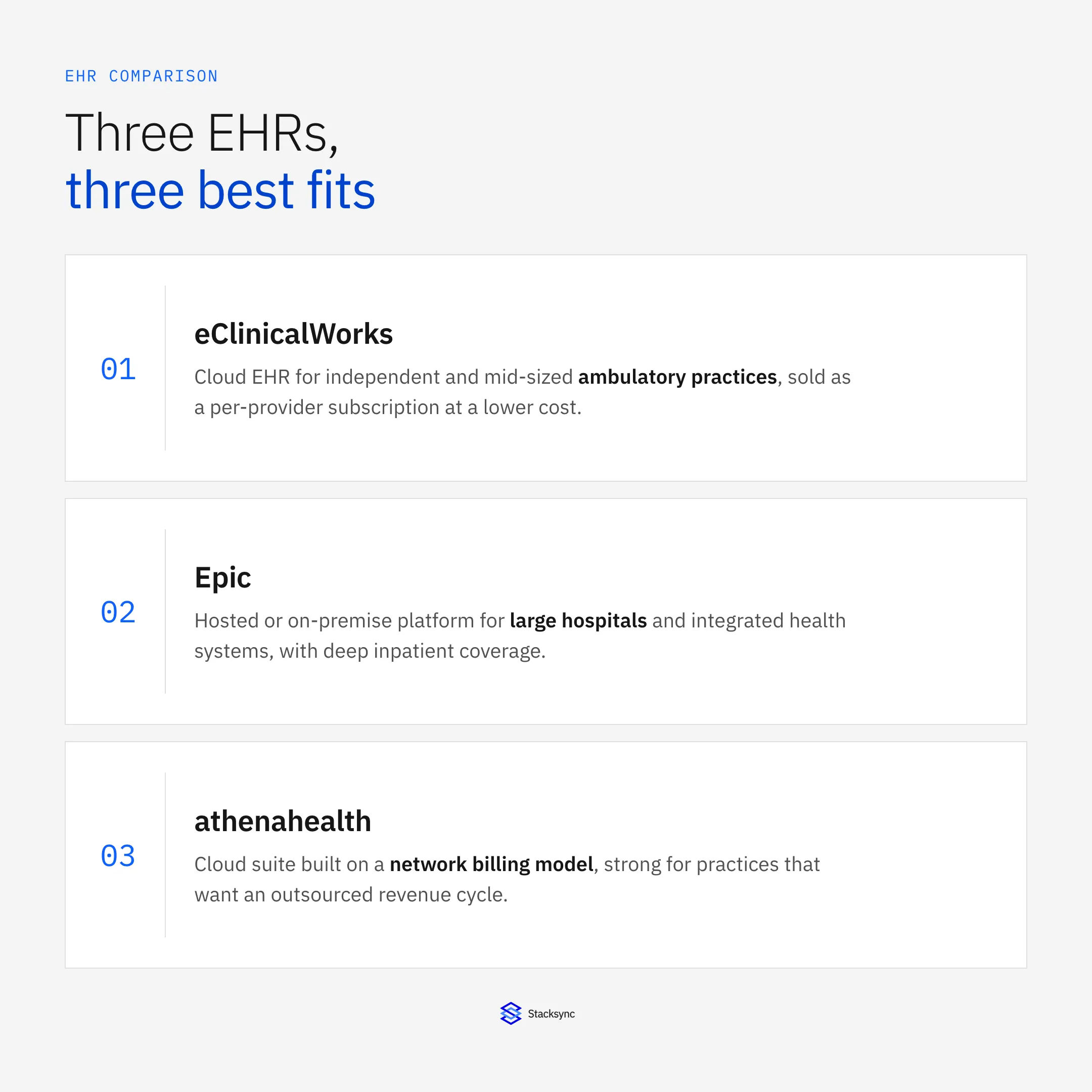
The clearest way to compare these three is by the type of organization each was designed to serve. Epic and eClinicalWorks and athenahealth all record clinical encounters, but they optimize for different sizes, settings, and operating models. Reading the vendor's core customer profile tells you more than a feature checklist does.
eClinicalWorks
eClinicalWorks is a cloud-based EHR and practice management system aimed at ambulatory care: independent physicians, mid-sized groups, community health centers, and specialty clinics. It bundles charting, e-prescribing, scheduling, and patient engagement through the healow app, and it is usually sold as a per-provider monthly subscription. Practices pick eClinicalWorks when they want a broad outpatient feature set without a large capital project, and many also buy its revenue cycle services to help with billing.
Epic
Epic is the platform most large hospitals and integrated health systems run. It covers inpatient and outpatient care in one record, includes the widely used MyChart patient portal, and is known for depth across specialties and departments. Epic is typically deployed as a hosted or on-premise system with a significant upfront license and a structured implementation. Its strength is scale: connecting a full health system, its clinics, and its billing under one platform. That is why epic vs eclinicalworks usually splits along the hospital versus independent-practice line.
athenahealth
athenahealth delivers athenaOne, a cloud suite that combines the athenaClinicals EHR, athenaCollector for billing, and patient engagement tools. Its defining trait is the network model: rules and payer data shared across athenahealth customers help keep claims clean before submission. athenahealth leans toward ambulatory practices and groups that want the vendor to take on much of the revenue cycle. When teams weigh athenahealth vs eclinicalworks, the question is often how much billing work they want to outsource versus keep in-house.
eClinicalWorks vs Epic vs athenahealth at a glance
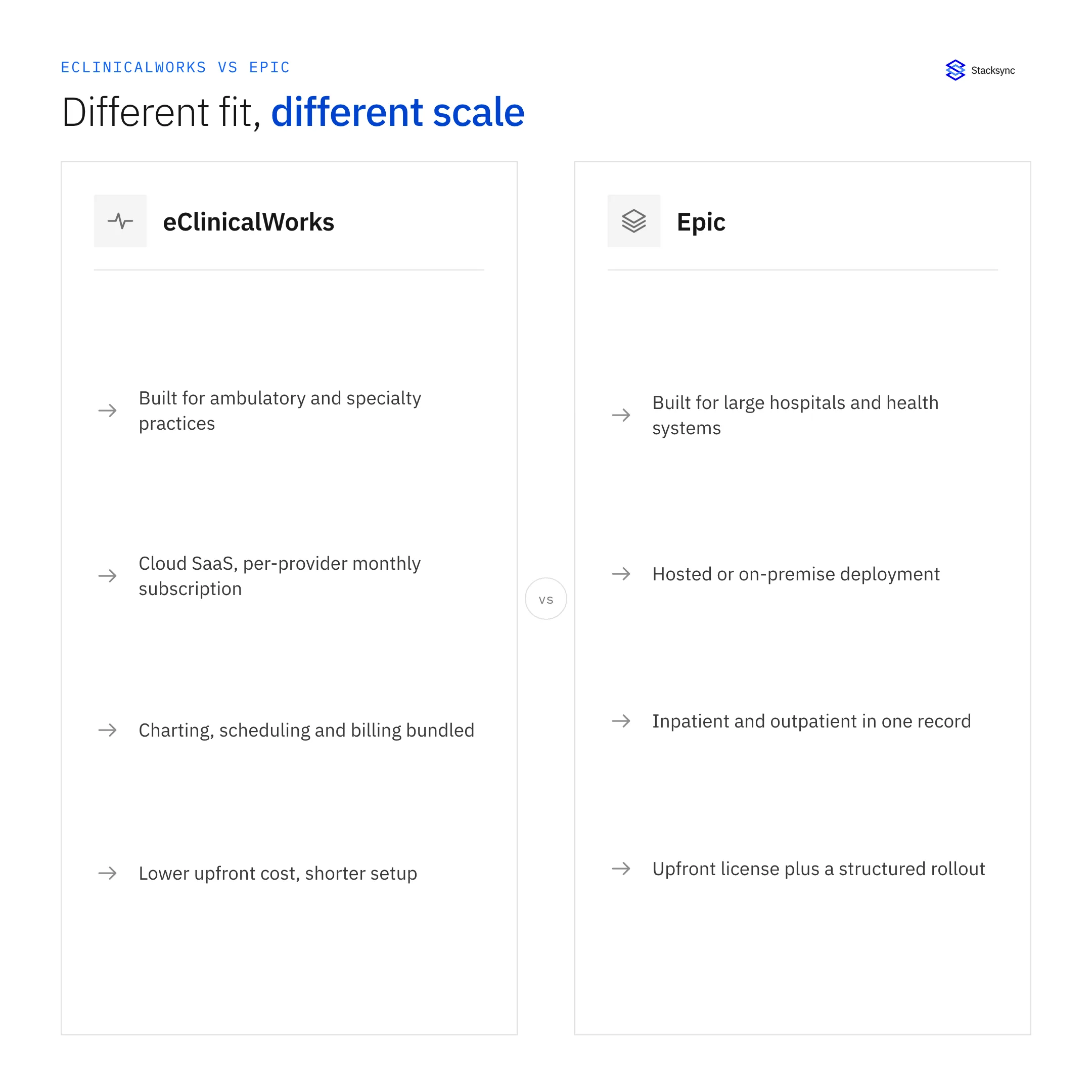
The table below sums up eclinicalworks vs epic vs athenahealth across the dimensions that matter most during selection.
| Dimension | eClinicalWorks | Epic | athenahealth |
|---|---|---|---|
| Target customer | Independent and mid-sized ambulatory practices | Large hospitals and integrated health systems | Ambulatory groups wanting network-based billing |
| Deployment | Cloud (SaaS) | Hosted or on-premise | Cloud (SaaS) |
| Pricing model | Per-provider monthly subscription | Large upfront license plus implementation | Subscription plus percentage-of-collections for RCM |
| RCM / billing | Built-in practice management, optional RCM services | Resolute billing within the platform | Core strength via the athenaCollector network |
| Interoperability / FHIR | HL7 and FHIR APIs, Cures Act certified | HL7 and FHIR APIs, Cures Act certified | HL7 and FHIR APIs, Cures Act certified |
| Best fit | Cloud EHR at a predictable cost | System-wide inpatient plus outpatient care | Outsourced revenue cycle at scale |
A neutral side-by-side of the three EHRs on the factors that drive most buying decisions.
Cost and pricing models
Cost is usually the first place eclinicalworks vs epic separates. Epic is built for organizations that can absorb a large upfront investment, with software licensing plus a multi-month implementation, data migration, and staff training. That model makes sense for a health system spreading the cost across hundreds or thousands of users. eClinicalWorks takes the opposite approach with a per-provider monthly subscription, which lowers the barrier for a small or mid-sized practice and keeps costs roughly proportional to headcount. athenahealth blends the two: a subscription for the software, plus a percentage-of-collections fee when you use its revenue cycle service, so the vendor is paid as your practice gets paid.
So is eClinicalWorks cheaper than Epic? For most independent and ambulatory practices, yes, both on day one and across the first few years, because there is no large capital outlay. But total cost depends on the modules you add, the services you buy, and your size, so it is worth getting written quotes from each vendor for your specific footprint rather than relying on list-price estimates.
It also helps to separate software cost from the cost of change. Migrating charts, retraining staff, and re-mapping workflows carry real expense no matter which vendor you pick. A cloud subscription like eClinicalWorks or athenahealth spreads that over time, while a large Epic project front-loads it. Budget for the transition, not just the license, and factor in the integrations you will need once the EHR is live.
Billing and revenue cycle management
Revenue cycle management (RCM) is where the three products feel most different. athenahealth built its reputation here: athenaCollector uses a shared rules engine and payer knowledge from across its network to catch claim errors before submission, and many practices hand the whole billing workflow to athenahealth. eClinicalWorks ships practice management with the EHR and also sells RCM services for practices that want help, while keeping the option to bill in-house. Epic handles billing through Resolute, which is capable and well-suited to consolidated hospital and professional billing, but it is generally adopted as part of a larger Epic deployment rather than on its own.
- Want the vendor to run billing: athenahealth's network model and percentage-of-collections pricing align the vendor's revenue with yours.
- Want flexibility: eClinicalWorks lets you bill in-house or buy RCM services as needed.
- Running a full health system: Epic's Resolute consolidates inpatient and professional billing under one record.
How to choose between them
If you strip the marketing away, most EHR decisions come down to a handful of questions about your organization. Answer these honestly and the shortlist tends to narrow itself.
- 01Define your care settingInpatient plus outpatient across a health system points toward Epic. Purely ambulatory or specialty care fits eClinicalWorks or athenahealth well.
- 02Set the budget modelDecide whether you can fund a large upfront project or prefer a predictable per-provider subscription. That single choice often separates Epic from the two cloud options.
- 03Choose your billing approachIf you want the vendor to run revenue cycle, athenahealth's network model is built for it. If you want to bill in-house with the option of help, eClinicalWorks gives you both.
- 04Map your integrations earlyList the CRM, warehouse, and finance tools the EHR must feed. Confirm each vendor's API and FHIR support, and plan how records will stay in sync once you go live.

eClinicalWorks vs NextGen and Allscripts
Epic and athenahealth are not the only comparisons practices run. eclinicalworks vs nextgen comes up because NextGen Healthcare targets a similar ambulatory and specialty market; the choice often turns on specialty-specific content, day-to-day usability, and support experience rather than a fundamental difference in scope. eclinicalworks vs allscripts is a common question too, since Allscripts (now Veradigm) has a long history in ambulatory care with products such as Professional EHR and TouchWorks. Practices weighing these options tend to prioritize how well the vendor supports their specialties, how modern the interface feels, and how the roadmap and support have held up over time. Whichever of these ambulatory systems you shortlist, the integration questions in the next section apply the same way.
Interoperability is the real operational need
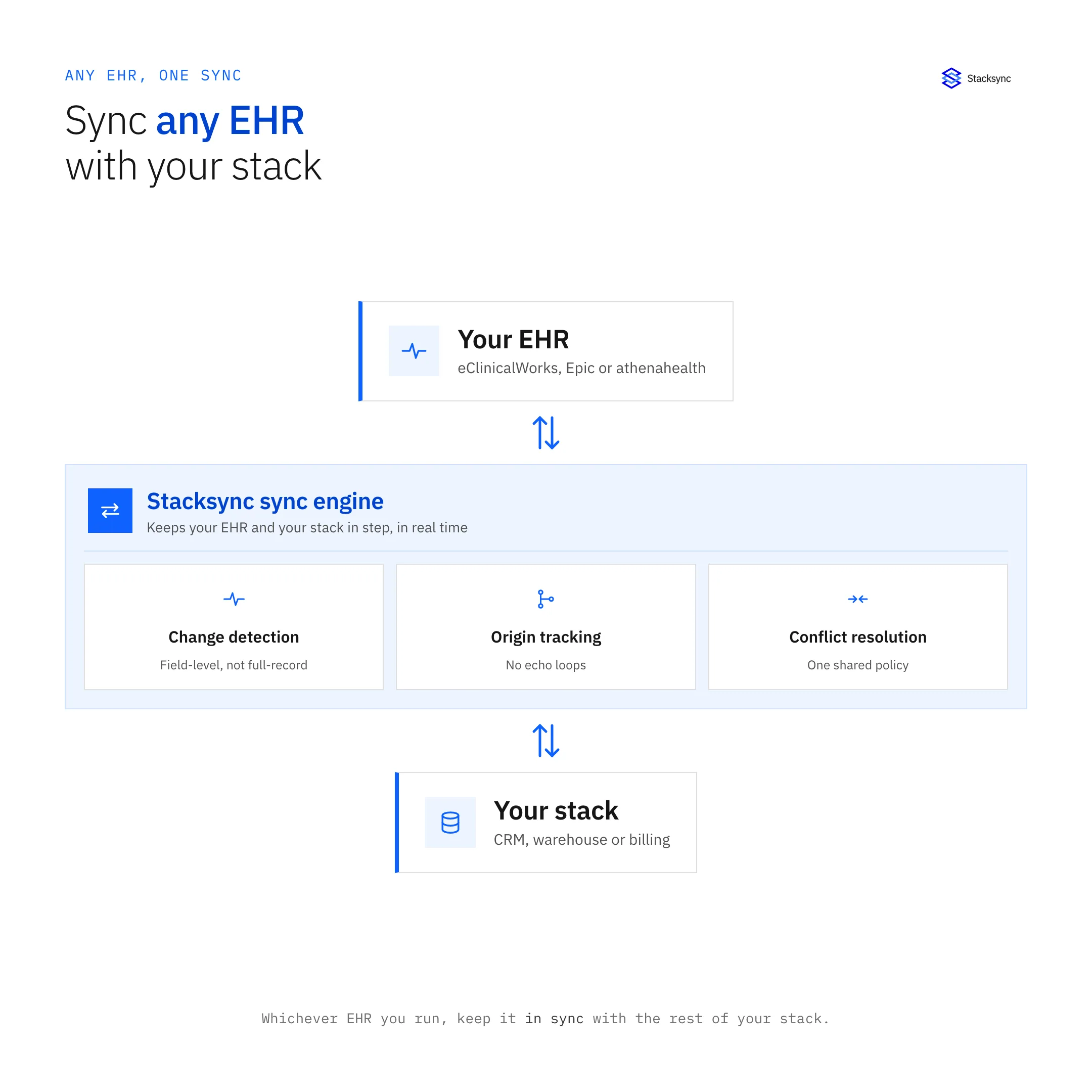
Here is the part that outlasts the EHR decision itself. Whichever platform you run, your patient, appointment, and billing data rarely lives in one place. It needs to reach a CRM for patient outreach, front-office tools like med spa AI agents that book and confirm visits, a data warehouse for analytics, and billing or finance tools for reporting. All three vendors support HL7 and FHIR and expose APIs under the Cures Act, but standards alone do not keep two systems continuously in agreement.
That is the gap two-way sync closes. Instead of nightly exports or one-directional feeds, real-time two-way sync keeps a record consistent in both systems: update a patient in the EHR and it updates in your CRM, and the reverse. Stacksync connects eClinicalWorks and other healthcare systems to the tools your operations team already uses, with SOC 2, HIPAA, and GDPR controls in place. A common pattern is an eClinicalWorks and Salesforce sync so front-office and clinical records stay aligned. You can see every supported system on the connectors page.
Whichever EHR wins your evaluation, the data still has to move. Book a demo to see how Stacksync keeps eClinicalWorks, Epic, or athenahealth in sync with the rest of your stack in real time.

FAQ
Frequently asked questions










Related articles