


















Boomi vs Celigo: Which iPaaS Wins in 2026?
Boomi vs Celigo: compare architecture, pricing, and real-time sync limits side by side, then see why Stacksync beats both for live data.
- Author
- Alexis Favre · Co-Founder & CTO
- Published
- Updated
- Read time
- 8 min read

Most businesses now run on a dozen or more specialized SaaS applications: CRMs, ERPs, marketing automation tools, and more. Data ends up fragmented across all of them, which creates operational friction, broken workflows, and business intelligence that nobody fully trusts.
An Integration Platform as a Service (iPaaS) can solve this by unifying data across systems. That much is true in principle, but the choice of platform is critical, and not every iPaaS solves the same problem.
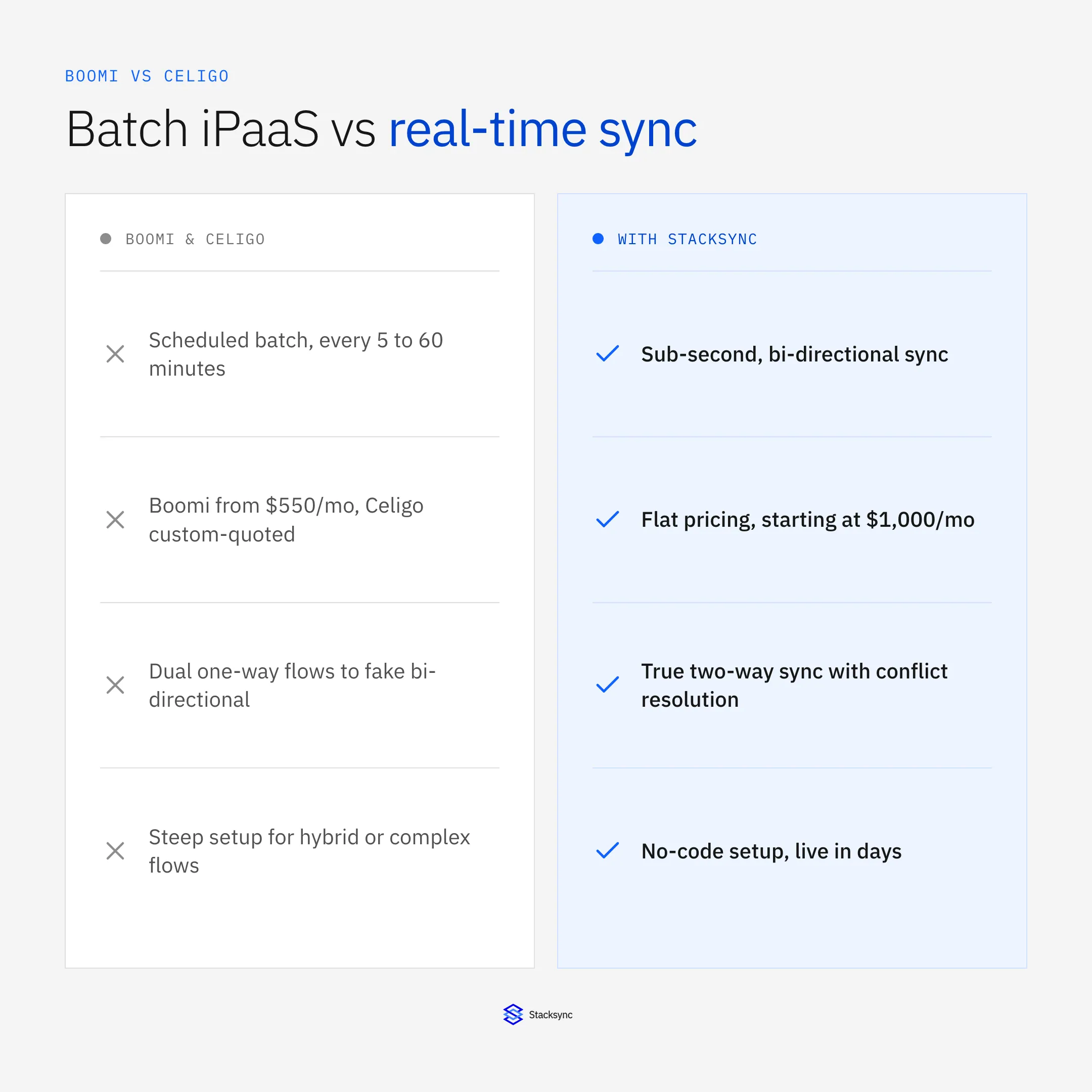
Two prominent players in the iPaaS market are Boomi and Celigo. Each offers a solid solution for connecting applications, but they are built on different architectural approaches that come with real trade-offs.
This guide breaks down a Boomi vs Celigo comparison, where MuleSoft fits into that decision, and introduces Stacksync, a modern alternative built specifically to fix the batch-sync limitations both platforms share. A comprehensive data integration platform as a service comparison for operational efficiency is a useful next read for any team optimizing its tech stack.
Understanding Boomi: The Enterprise-Grade iPaaS
Core Features and Architecture
Boomi, established in 2000, is a mature, cloud-native iPaaS designed to handle complex, enterprise-grade integration challenges [3]. Its low-code "AtomSphere" platform utilizes a patented distributed runtime engine, the "Atom," which can be deployed in the cloud or on-premise.
This architectural flexibility makes it a powerful tool for large enterprises managing hybrid environments that mix legacy systems with modern cloud applications. Boomi's strength lies in its comprehensive toolset, which includes application integration, API management, and master data management.
Use Cases and Limitations
Boomi is frequently deployed for B2B/EDI management, complex API lifecycle management, and large-scale data integration projects that span multiple departments and systems.
However, its power comes with complexity. The platform often requires specialized knowledge, entailing a steep learning curve for new teams.
Furthermore, its pricing model can be a significant investment, with a monthly subscription starting at $550 for on-premise use and no free versions available [4]. A critical limitation is its architectural foundation in scheduled batch processing. While effective for many tasks, this approach introduces data latency, making it suboptimal for operational use cases that demand real-time information.
Understanding Celigo: The SaaS Integration Specialist
Core Features and Architecture
Celigo represents a more modern approach to iPaaS, focusing on simplifying integration for mid-market companies that are heavily invested in SaaS. Its core value proposition is ease of use, driven by a user-friendly interface and a vast library of pre-built "Integration Apps" and templates.
These ready-made solutions accelerate the automation of common business processes, such as Order-to-Cash or Lead-to-Cash, between popular platforms like NetSuite, Salesforce, and Shopify [5]. Celigo also incorporates AI-assisted features to help with data mapping and error resolution, further lowering the technical barrier to entry.
Use Cases and Limitations
Celigo excels at automating business processes between SaaS applications. It is the go-to choice for businesses looking to quickly connect their cloud tools without a dedicated integration team.
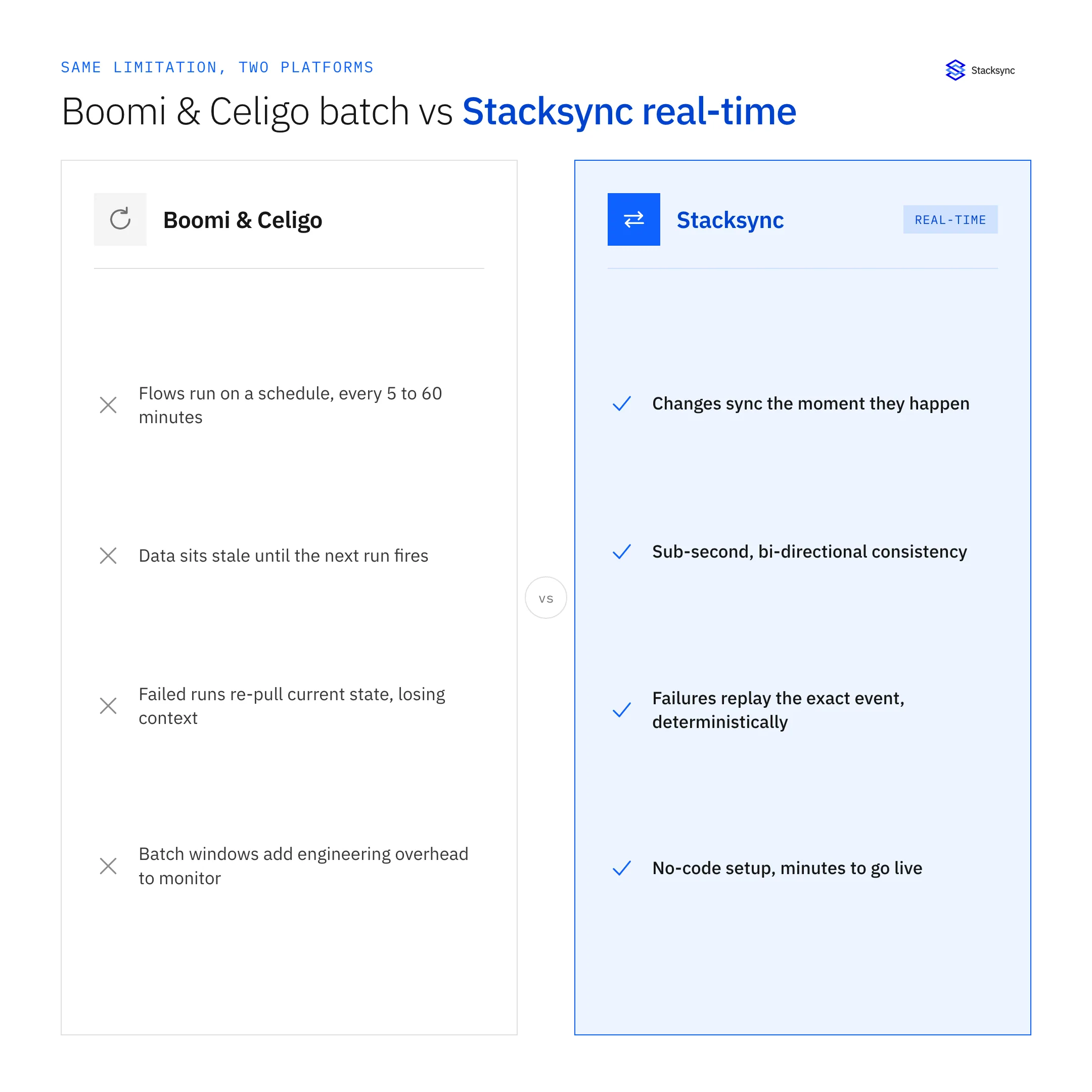
However, this focus on workflow automation reveals its primary limitation: Celigo is not architected for true, real-time operational synchronization. Like Boomi, it largely relies on scheduled syncs (e.g., every 5 or 15 minutes), which is inadequate for scenarios where instant data consistency is mission-critical.
Celigo does not publish list pricing; it quotes based on endpoints and flows rather than per-record volume. Third-party benchmarks put typical spend in the $600 to $1,500 per month range for smaller deployments, rising past $5,000 per month for larger, multi-flow enterprise use.
See our full Stacksync vs Celigo comparison for a deeper breakdown of architecture, pricing, and compliance.
Boomi vs Celigo Comparison: Key Differences
Let's compare them directly. Boomi is built around a single, all-encompassing platform that can be stretched to handle almost any integration type, including hybrid and on-premise systems. Celigo is built around the opposite bet: that pre-built "Integration Apps" can solve most SaaS-to-SaaS integration needs for the mid-market without custom development.
Direct Comparison Table
html
| Feature | Boomi | Celigo |
|---|---|---|
| Target Market | Large Enterprise | Mid-Market |
| Core Strength | Hybrid & Complex Integration | SaaS Process Automation |
| Usability | Low-code, requires expertise | No-code, pre-built templates |
| Architecture | Distributed (Cloud & On-prem) | Fully Cloud-centric |
Key Takeaways
Boomi is built for hybrid, large-scale enterprise environments that demand flexibility across cloud and on-prem systems.
Celigo focuses on mid-market organizations seeking faster, SaaS-first process automation through no-code templates and simplified setup.
Analysis of Differences
The choice between Boomi and Celigo depends entirely on your organization's needs and existing environment.
- Boomi is the logical choice for large enterprises with heterogeneous environments, including significant on-premise infrastructure and legacy systems. Its power and flexibility are necessary for managing such complexity.
- Celigo is better suited for agile, cloud-native, mid-market companies that need to automate standard business processes between their SaaS tools quickly and efficiently.
However, both platforms share a fundamental architectural constraint that limits their operational effectiveness. For a deeper enterprise integration platform technical analysis of Boomi vs. Celigo, it's clear that their core designs were not optimized for the real-time demands of modern business.
Where Does MuleSoft Fit Into the Decision?
Most shortlists for enterprise integration also include MuleSoft's Anypoint Platform alongside Boomi and Celigo. It belongs on the list, but for a different reason: MuleSoft is built around API-led connectivity and governance, not simple app-to-app automation.
- Choose Boomi if you need a broad, hybrid iPaaS that mixes on-premise and cloud systems without going as deep as MuleSoft on API management.
- Choose Celigo if you want the fastest time to value, a business-friendly interface, and strong pre-built templates for SaaS/ERP workflows like NetSuite or Salesforce.
- Choose MuleSoft if you run a large enterprise with a dedicated technical team that needs strict API governance, reusable API layers, and complex, custom integration architecture.
Pricing follows the same pattern: MuleSoft is typically the most expensive of the three, quoted on enterprise contracts around API call volume and vCore usage rather than a flat per-connection fee, and it generally requires developer resources to implement and maintain.
The one thing all three share: none of them are architected for sub-second, bi-directional data sync out of the box. MuleSoft can move data in near real time with custom-built flows and dedicated engineering effort, but that is a project, not a default. For a data replication or operational sync use case specifically, rather than API management, Stacksync solves the actual problem instead of adding another layer on top of a batch-based platform.
Boomi vs Celigo vs MuleSoft, at a Glance
| Feature | Boomi | Celigo | MuleSoft |
|---|---|---|---|
| Best For | Hybrid, on-prem + cloud integration | Fast SaaS/ERP process automation | API-led architecture & governance |
| Pricing Model | Subscription, on-premise from $550/mo | Custom quote, based on endpoints/flows | Enterprise contract, per API call/vCore |
| Technical Lift | Low-code, moderate learning curve | No-code, minimal technical lift | Developer-heavy, steep learning curve |
| Real-Time Sync Out of the Box | No, scheduled batch | No, scheduled batch (5-15 min) | No, requires custom-built flows |

Stacksync: The Modern Alternative for Real-Time, Bi-Directional Sync
Introducing Stacksync
The limitations of batch-based iPaaS platforms point to a clear requirement: for operational integrity, a solution needs to be architected from the ground up for real-time, bi-directional data flow, not bolted on top of a scheduler.
Stacksync is a next-generation integration platform built around that requirement. Its core differentiator is true, real-time, bi-directional synchronization that ensures data consistency across systems with sub-second latency.
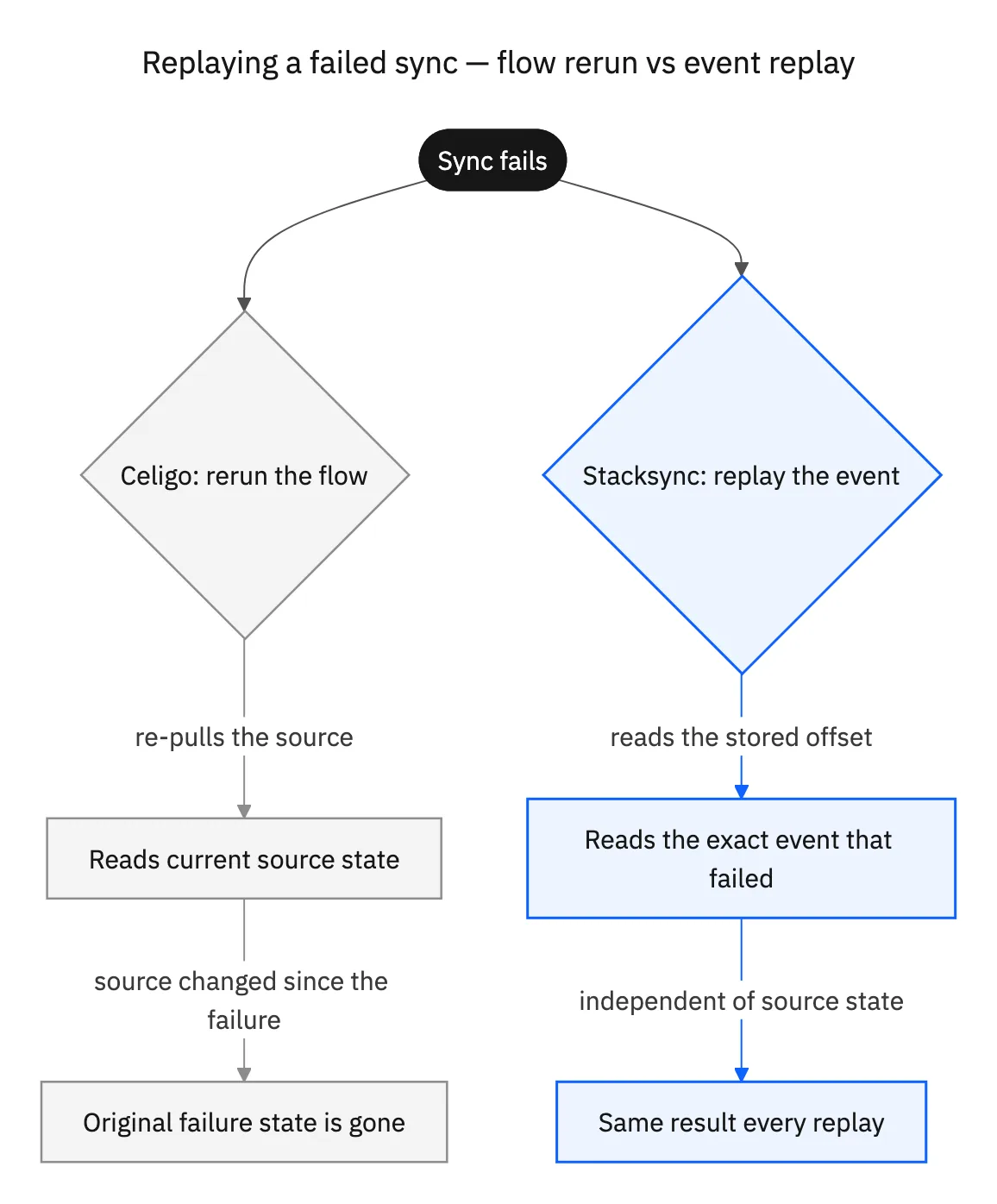
The difference shows up clearly when a sync fails. Celigo reruns the flow and re-pulls whatever the source looks like right now, which means the original failure state can already be gone if the source changed in the meantime. Stacksync instead replays the exact event that failed from its stored offset, producing the same result every time regardless of what the source looks like today.
Key Advantages over Boomi and Celigo
- Sub-Second Latency: Stacksync processes changes as they happen, eliminating stale data and enabling true real-time operations.
- True Bi-Directional Sync: Unlike the dual one-way syncs common in other platforms, Stacksync offers a single, cohesive bi-directional flow. It includes built-in conflict resolution to maintain a single source of truth, even when data is updated in multiple systems simultaneously.
- Developer-First & Scalable: Built for reliability, Stacksync handles millions of records without the performance degradation common in traditional iPaaS. It is one of the top Workato alternatives for scale and reliability.
- Simplicity and Lower TCO: With a no-code setup that can be completed in minutes, Stacksync cuts implementation time and ongoing maintenance costs by a wide margin. For example, you can sync HubSpot and Supabase in real time with two-way sync without writing a single line of code [1].
A Quick Comparison: Stacksync vs. Boomi vs. Celigo
This table summarizes where each platform fits for operational use cases. A visual data integration platform comparison chart can help clarify these distinctions further.
Feature and Use Case Table
html
| Feature | Stacksync | Boomi | Celigo |
|---|---|---|---|
| Best Use Case | Operational Sync & Data Replication | Enterprise Hybrid Integration | Business Process Automation |
| Sync Type | Bi-Directional Real-Time | Batch / Scheduled | Batch / Scheduled |
| Latency | Sub-second | Minutes / Hours | Minutes |
| Primary User | Engineers & Data Teams | Central IT Teams | Business Analysts & RevOps |
Key Takeaways
Stacksync delivers real-time, bi-directional sync built for operational data, giving engineering and data teams instant consistency across systems.
Boomi supports large enterprises with hybrid integrations but typically relies on batch schedules with higher latency.
Celigo simplifies SaaS automation for mid-market users but prioritizes usability over real-time performance.
Conclusion: Move Beyond Batch and Choose Real-Time
Our analysis concludes that while Boomi and Celigo are capable platforms, their value is constrained by their underlying batch-based architecture.
Boomi serves the complex needs of hybrid enterprises, and Celigo excels at automating SaaS workflows for the mid-market. However, both fall short of delivering the real-time data integrity required for modern operational excellence.
For businesses that depend on accurate, up-to-the-second data to drive decisions, manage customer relationships, and power workflows, real-time synchronization is a necessity.
Stacksyncis the definitive choice for teams that require fast, scalable, and reliable bi-directional data sync without the complexity and latency of traditional iPaaS.
If your team is struggling with stale data and the limitations of your current integration solution, it's time to move beyond batch. Contact Stacksync today to request a demo and see what true real-time integration can do for your business [2].

FAQ
Frequently asked questions










Related articles