


















eClinicalWorks Pricing and Cost: What to Budget
A plain-English look at how eClinicalWorks is priced: the per-provider, per-month subscription, the optional revenue cycle management percentage, add-ons, and the data costs behind total ownership.
- Author
- Ruben Burdin · Founder & CEO
- Published
- Updated
- Read time
- 8 min read

If you are budgeting for eClinicalWorks, the short answer is that it is sold mostly as a per-provider, per-month subscription. That base fee usually bundles the electronic health record (EHR) with Practice Management (PM) billing tools. On top of that, eClinicalWorks offers a revenue cycle management (RCM) service billed as a percentage of what your practice collects each month, plus optional add-ons like patient engagement, telehealth, and analytics. Exact pricing depends on your specialty, provider count, and contract, so treat any figure you read online as a starting point and confirm a current quote before you commit.
eClinicalWorks is one of the more affordable ambulatory EHRs, which is a big part of why independent practices and multi-site groups shortlist it. The published entry price is low compared with hospital-grade systems, but the number on the quote is only part of the story. This guide breaks down how eClinicalWorks is priced, the factors that move your total, and the total cost of ownership (TCO) items that rarely appear on the first quote. Wherever we cite a figure, treat it as a benchmark to check against a real quote for your specialty and size, not a fixed rate.
How eClinicalWorks is priced
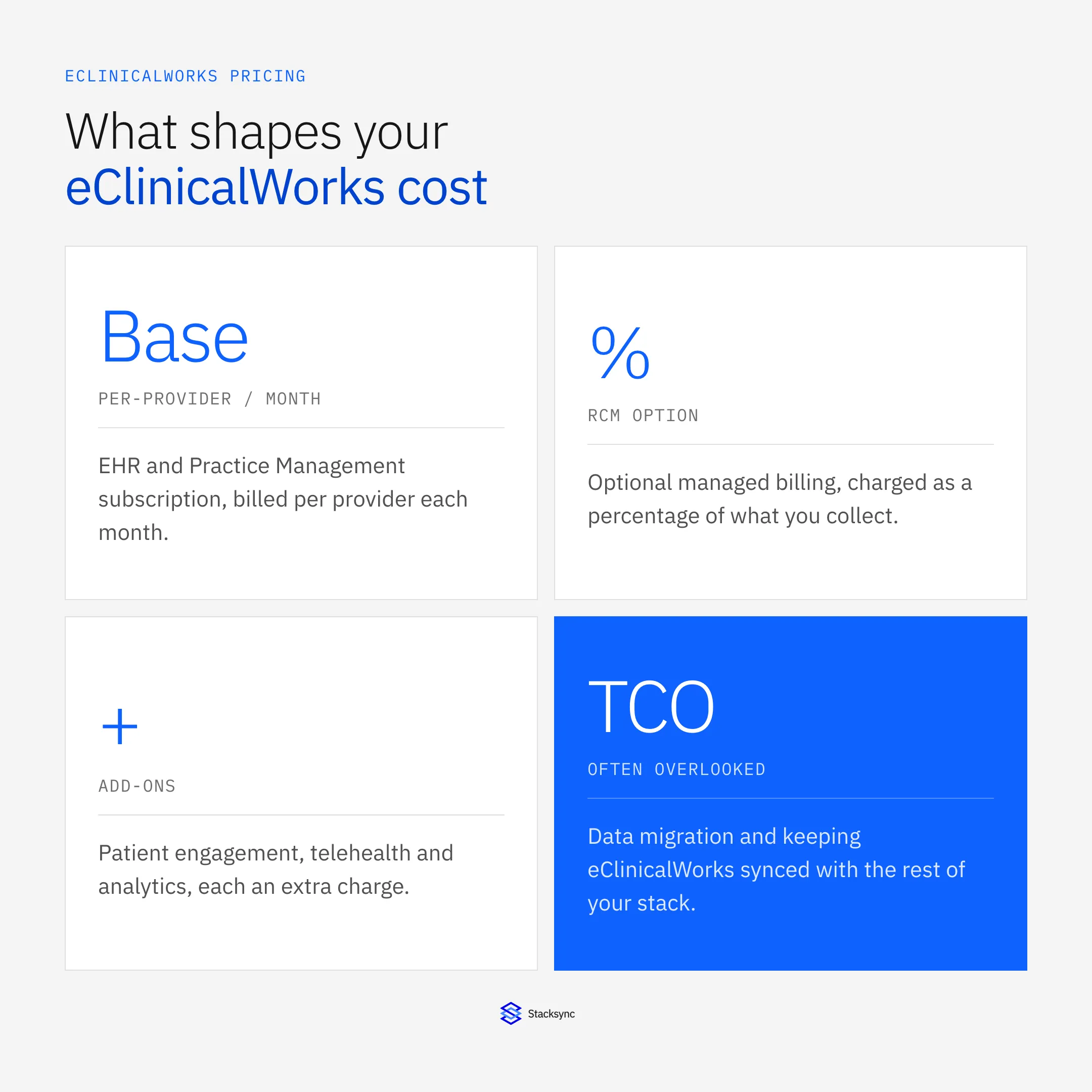
eClinicalWorks pricing rests on two independent levers, and it helps to keep them separate when you build a budget.
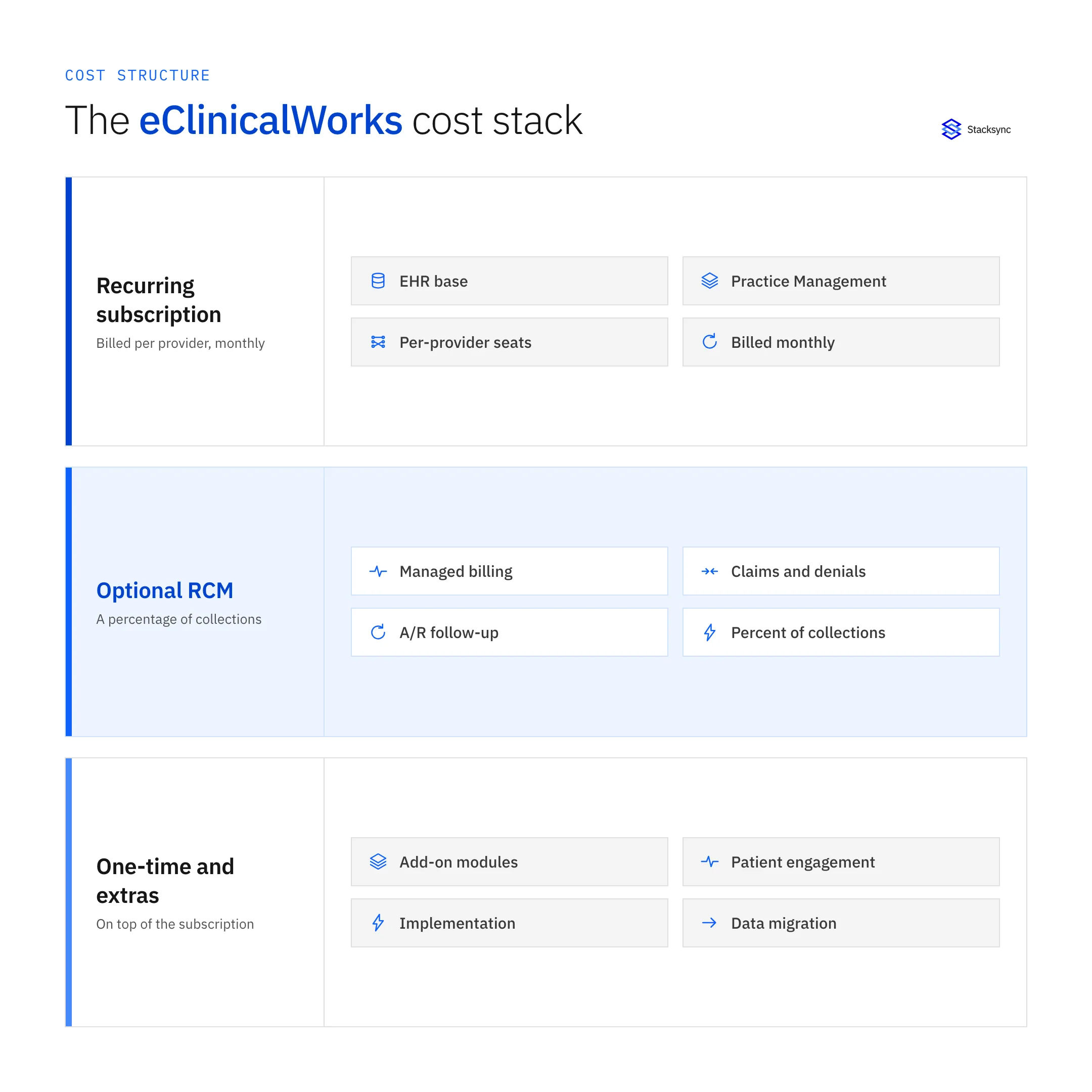
- Software subscription: a recurring per-provider, per-month fee for the EHR and Practice Management platform. This is the number most practices compare first.
- Revenue cycle management (RCM): an optional managed billing service where eClinicalWorks handles claims, denials, and collections for a percentage of your monthly collections instead of a flat software fee.
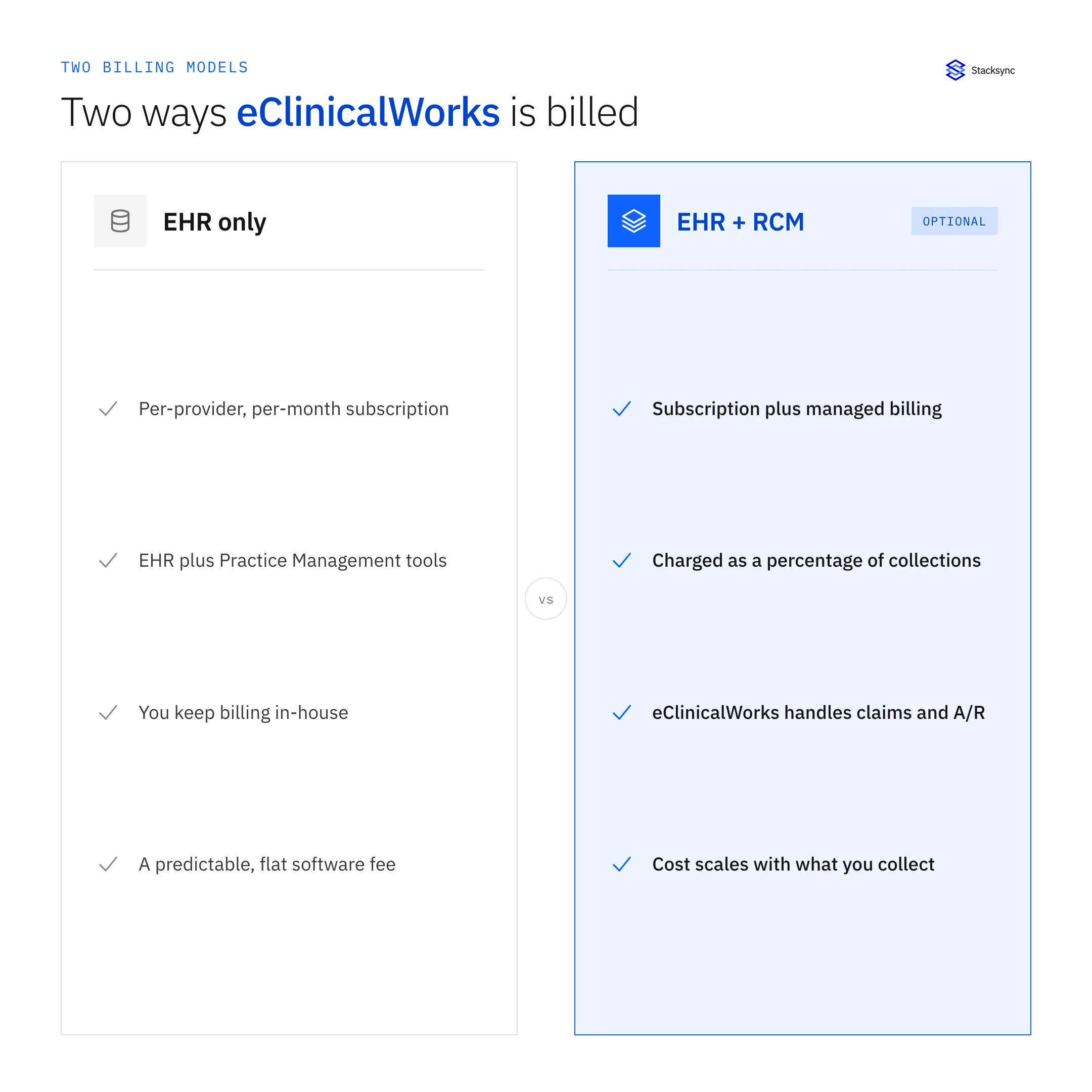
You can buy the software subscription on its own and keep billing in-house, or hand billing to eClinicalWorks under the RCM model. The two paths produce very different monthly bills, so the first budgeting decision is which one fits your practice. A small office with a strong biller may prefer the flat subscription; a growing group that wants to shed back-office work may lean toward RCM.
What eClinicalWorks commonly costs
eClinicalWorks has long marketed a low entry point. A commonly cited starting figure is a few hundred dollars per provider per month for the EHR plus Practice Management bundle, with EHR-only tiers coming in lower. These numbers circulate widely across review sites and forums, but eClinicalWorks does not publish a fixed public price list, and real quotes shift with provider count, specialty, contract length, and the add-ons you select.
The cost factors that move your total
The headline per-provider price is only the first line of a budget. The factors below decide what you actually pay each month and in year one.
| Factor | What it is | Effect on cost |
|---|---|---|
| EHR vs. EHR + PM tier | Whether you license the EHR on its own or the EHR bundled with Practice Management billing tools. | EHR-only sits at the lower end; adding Practice Management raises the per-provider monthly fee. |
| Number of providers | The count of clinicians licensed on the platform, since the subscription is charged per provider. | Cost scales roughly linearly with providers; more clinicians means a higher monthly bill. |
| RCM vs. self-billing | Choosing eClinicalWorks managed billing (a percentage of collections) versus keeping billing in-house on the flat subscription. | RCM cost rises with collections; self-billing keeps the software fee predictable but needs billing staff. |
| Add-on modules | Extras such as patient engagement, telehealth, analytics, and controlled-substance e-prescribing. | Each module adds a per-provider or per-practice charge on top of the base subscription. |
| Implementation and training | One-time setup, configuration, and staff onboarding to get the practice live. | Adds a year-one cost that is separate from the recurring subscription. |
| Data migration and integration | Moving records from a prior EHR and keeping eClinicalWorks in sync with your other systems. | One-time migration fees plus ongoing engineering time if integrations are built and maintained by hand. |
Two practices with the same per-provider rate can end up with very different bills once these factors are applied. That is why the per-provider number alone is a poor way to compare vendors. Build a line-item model with every factor above before you sign anything.
RCM as a percentage of collections vs. self-billing
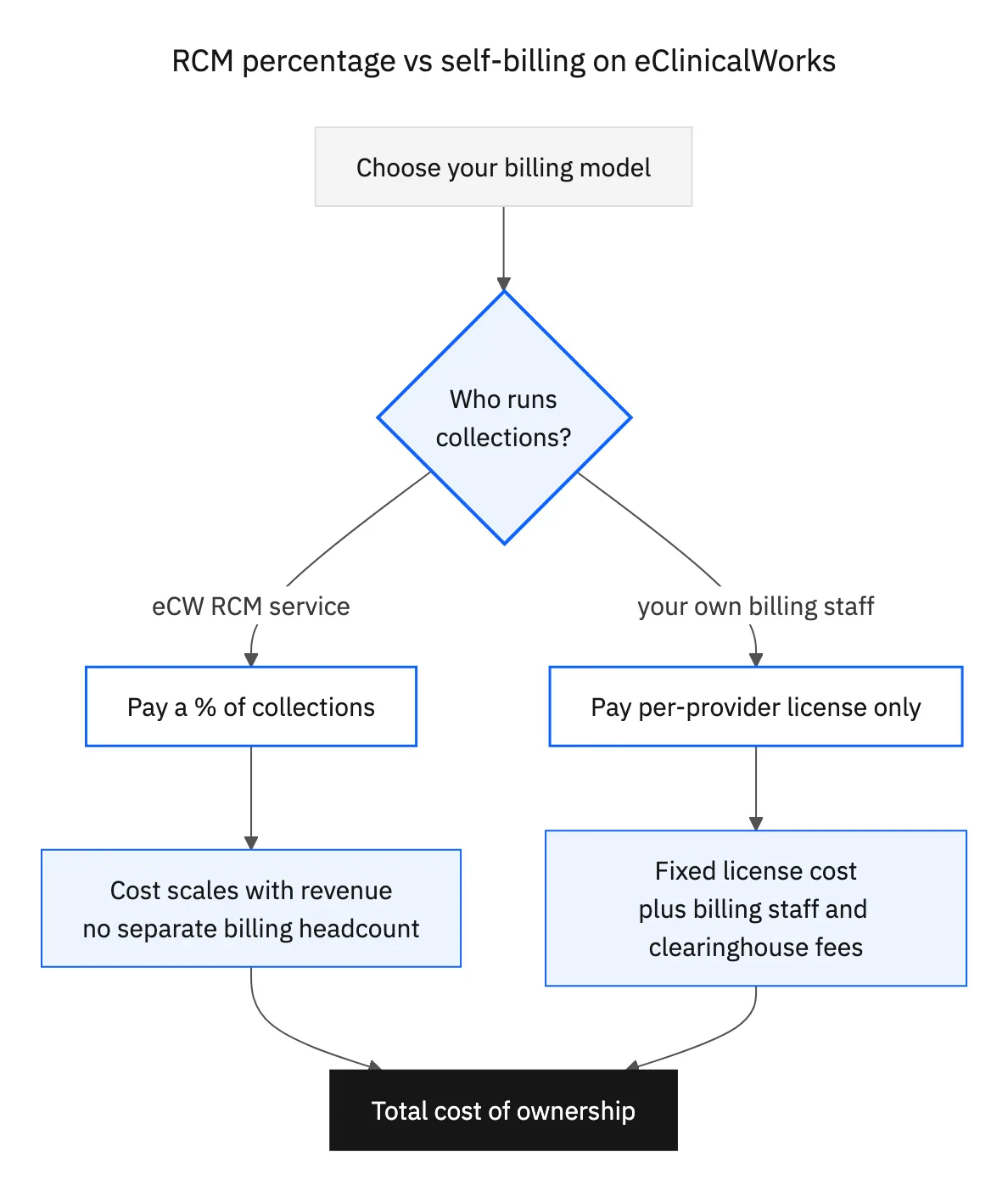
If you choose eClinicalWorks RCM, you are not paying a flat software fee for billing. You are paying a percentage of everything the practice collects. As collections grow, the fee grows with them, so a busy practice can end up paying more through RCM over a year than it would for the software subscription alone. In exchange, you offload claim submission, denial management, and accounts-receivable follow-up to eClinicalWorks staff.
Self-billing keeps costs predictable. You pay the per-provider subscription and staff the billing function yourself. The right choice depends on your collections volume, how strong your billing team is, and how much denial and A/R work you want to outsource. Model both options over 12 to 24 months at your expected volume before you commit, because the crossover point where RCM becomes more expensive than in-house billing depends entirely on how much you collect.
How eClinicalWorks compares on price
It helps to place eClinicalWorks on the wider map of EHR pricing. Ambulatory systems built for independent and mid-size practices, including eClinicalWorks, athenahealth, and Kareo, tend to charge per provider per month and market a low entry point. Enterprise systems such as Epic and Oracle Health are sold to hospitals and large health systems, with license and implementation costs that run into six or seven figures. eClinicalWorks and Epic rarely compete for the same buyer, so asking whether it is cheaper than Epic is usually the wrong question. The sharper question is what eClinicalWorks costs against other ambulatory EHRs once add-ons and billing are included.
On that comparison, eClinicalWorks holds up well on the sticker price, and its RCM option lets smaller practices avoid staffing a full billing team. The trade-off is that the low headline number assumes you stay close to the base configuration. Add several modules, choose RCM at higher collections, and layer in integration work, and the effective cost per provider climbs. Price the configuration you will actually run, not the entry tier a review site quotes.

Add-ons, implementation, training, and data migration
Beyond the core subscription, most practices add modules and pay one-time fees to get live. Budget for these early so the first invoice does not surprise you.
- Add-on modules: patient engagement (healow), telehealth, analytics and reporting, and controlled-substance e-prescribing each carry their own charge. Confirm which are included in your tier and which are extra.
- Implementation and training: one-time fees to configure the system, build templates, and onboard staff. These land in year one and are separate from the monthly subscription.
- Data migration: moving patient charts, schedules, and billing history from a prior EHR is usually a one-time project fee that varies with data volume and how clean the source data is.
None of these are optional in practice. A realistic budget includes the recurring subscription, the modules you actually need, and the one-time fees to go live, then leaves room for the item most teams underestimate: keeping data flowing between eClinicalWorks and the rest of your stack.
Total cost of ownership: budget for data and integration
The line item most practices forget is keeping eClinicalWorks in step with the rest of the systems they run. Patient, appointment, and billing data rarely stays in one place. It needs to reach a CRM, a data warehouse, an analytics database, or a custom application. When those connections are built and maintained by hand, engineering time becomes a recurring cost that can quietly dwarf a per-provider fee, and every eClinicalWorks upgrade risks breaking a fragile script.
This is where a dedicated sync layer changes the TCO math. Stacksync provides a managed eClinicalWorks connector and keeps records aligned across systems with real-time two-way sync, so a change in the EHR and a change in your database or CRM stay consistent without a nightly batch job or brittle custom code. A common pattern is an eClinicalWorks and PostgreSQL sync that gives analysts a queryable copy of operational data while writing approved changes back to the record of truth. Because the platform is SOC 2, HIPAA, and GDPR ready, protected health information stays governed as it moves.
When you compare eClinicalWorks quotes, add the integration and data lines to your model, not just the per-provider price. A cheaper EHR that costs a developer a week a month to keep connected is not actually cheaper. If you want to see what a managed, HIPAA-ready sync between eClinicalWorks and your other systems looks like, book a demo and we will walk through your specific stack and where the real total cost of ownership sits.

FAQ
Frequently asked questions










Related articles