







Keep destination at the right level
Route each purchase line to factory or site receiving with its project allocation intact.
 Salesforce
  HubSpot
  NetSuite
  Zendesk
  Microsoft Dynamics 365 Sales
  Dynamics 365 F&O
  Attio
Attio  Pipedrive
  Zoho CRM
  Campfire
  Rillet
  Front
Front  Shopify
  Amazon Seller Central
  SendGrid
 Modular and prefab building supply and installation
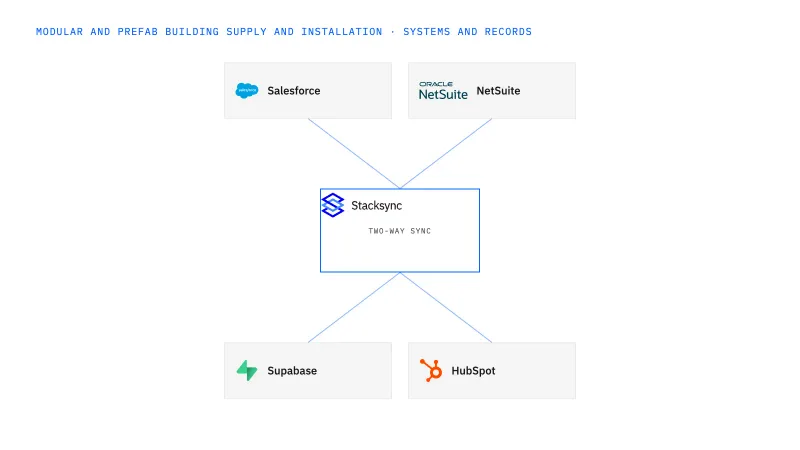
Map prefab supplier EDI to the correct project purchase lines and receiving destinations. Preserve component identity, units, supplier changes and split shipments while keeping factory stock separate from direct-site material. Procurement reviews substitutions; the actual receiver confirms quantity and condition.
One supplier order serves factory production and site installation, but shipment and invoice imports lose the destination detail.
Explore your process in a demo, or get our shared two-way sync architecture guide.
When this fits
US modular and prefab building companies with 100–1,000 employees that combine manufacturing or supply with onsite delivery and installation.
Route each purchase line to factory or site receiving with its project allocation intact.
Supplier acknowledgments and shipment notices inform planning; they do not establish accepted material.
Connect invoices to the relevant factory or site receipt and recognize retransmissions before another action is created.
The process, end to end
a modular manufacturer buys factory components and finishing materials on one order. Some goods arrive at the plant and others at the project. The mapping keeps both receiving paths connected to purchasing without inflating factory inventory.
Scope your implementation
Review current platform pricing alongside the records, volume, and actions in your process. Use your own operating baseline to evaluate the economics.
Explore your process in a demo, or get our shared two-way sync architecture guide.
From foundation to action
Keep shared customer, order, and operational records aligned, with clear field ownership.
Explore two-way sync 02Move approved work between systems, assign exceptions, and confirm the result.
Explore workflows 03Investigate cross-system questions, assemble the evidence, and prepare the next action.
Explore ai agents (genies) 04Connect trading-partner documents to operational records and exception handling.
Explore ediGo deeper
Map prefab supplier EDI to the correct factory or site destination and preserve component allocation by project.
Explore all modular and prefab building supply and installation integration and automation guides ↗
Yes. The designated site receiver provides the evidence instead of the factory warehouse.
It requires the applicable qualified and commercial reviews before changing released requirements.
Choose one with factory and direct-site lines, a split shipment and a changed component.
Only when supplier documents are the immediate gap. Two-way sync comes first when purchase lines, project allocations and receipts in NetSuite must stay current with the systems procurement and site teams use. Workflows follow to route supplier substitutions, changed dates and a misdirected direct delivery to the owner who resolves them. Genies then place direct-site receipt evidence alongside module factory and acceptance records in the progress-billing review that finance approves. EDI is the transport for acknowledgments, shipment notices and invoices; it moves documents into NetSuite and is not two-way sync.


