














Stacksync vs Celigo for CRM/ERP integration
A direct comparison on the four things that matter once you're running CRM/ERP integration in production: latency, recoverability, governance, and what it costs over three years.
- Author
- Ruben Burdin · Founder & CEO
- Published
- June 3, 2026
- Read time
- 6 min
Stacksync vs Celigo at a glance
Celigo and Stacksync solve different problems. Celigo is a general-purpose iPaaS with prebuilt "integration app" templates, Stacksync is purpose-built for one job: real-time, two-way sync between CRM, ERP, and database records. The table below is the short version, the sections after it go through the evidence for each row.
This page goes deep on production behavior. For pricing tiers, the full alternatives list, and a migration walkthrough, see the complete Celigo alternative guide.
| Dimension | Celigo | Stacksync |
|---|---|---|
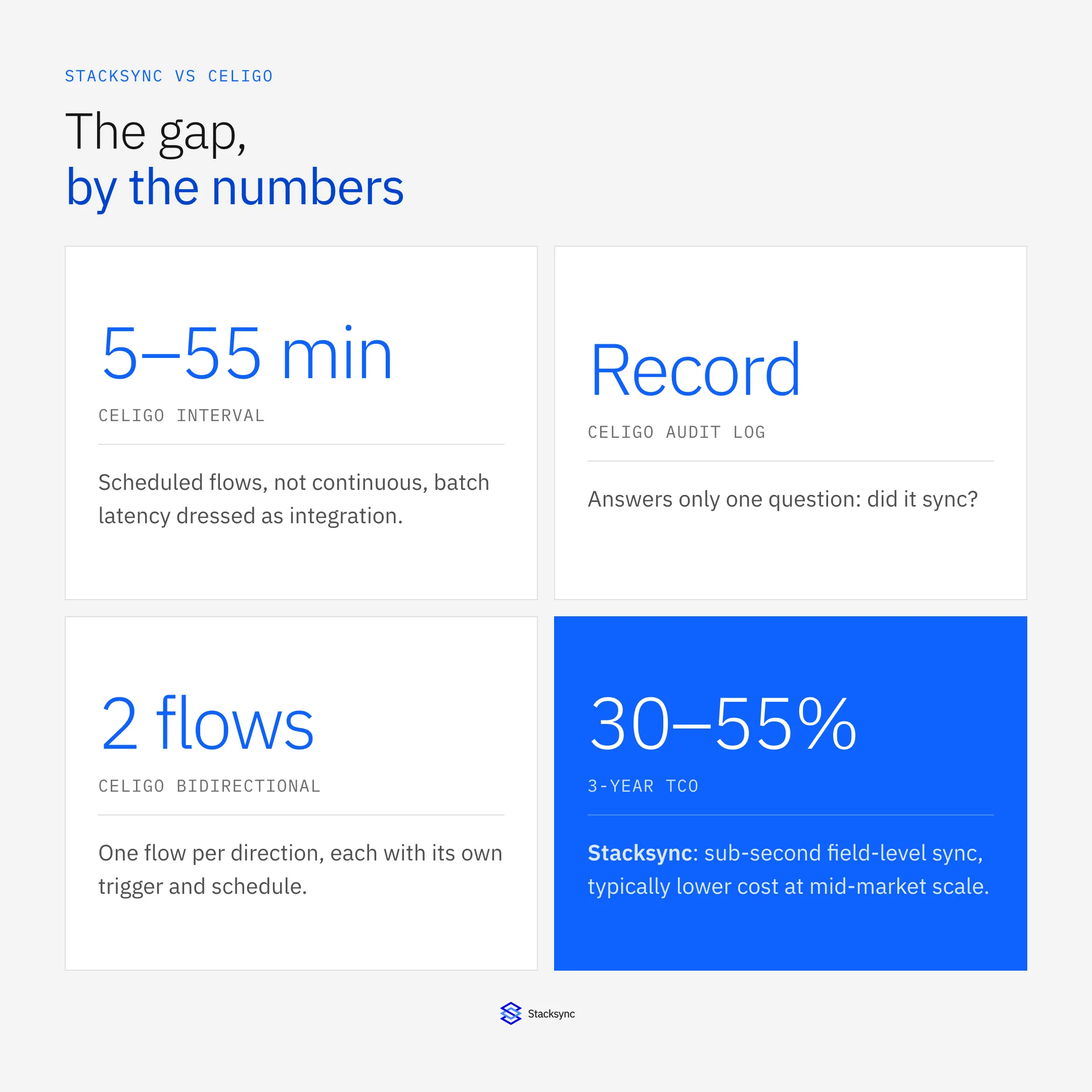
| Sync model | Scheduled flows, 5-55 minute interval or cron | Event-driven, sub-second propagation |
| Failure recovery | Rerun the flow, re-pulls current source state | Replay from the stored event ID, deterministic |
| Audit log | Record-level: did it sync? | Field-level: what changed, when, by whom |
| Bidirectional setup | Two flows, one per direction | Single two-way configuration |
| Pricing model | Endpoint/flow-based, quoted through sales | Published tiers, starting at $1,000/mo |
| Typical 3-year TCO (mid-market CRM/ERP) | Baseline | 30-55% lower |
Latency: scheduled vs event-driven
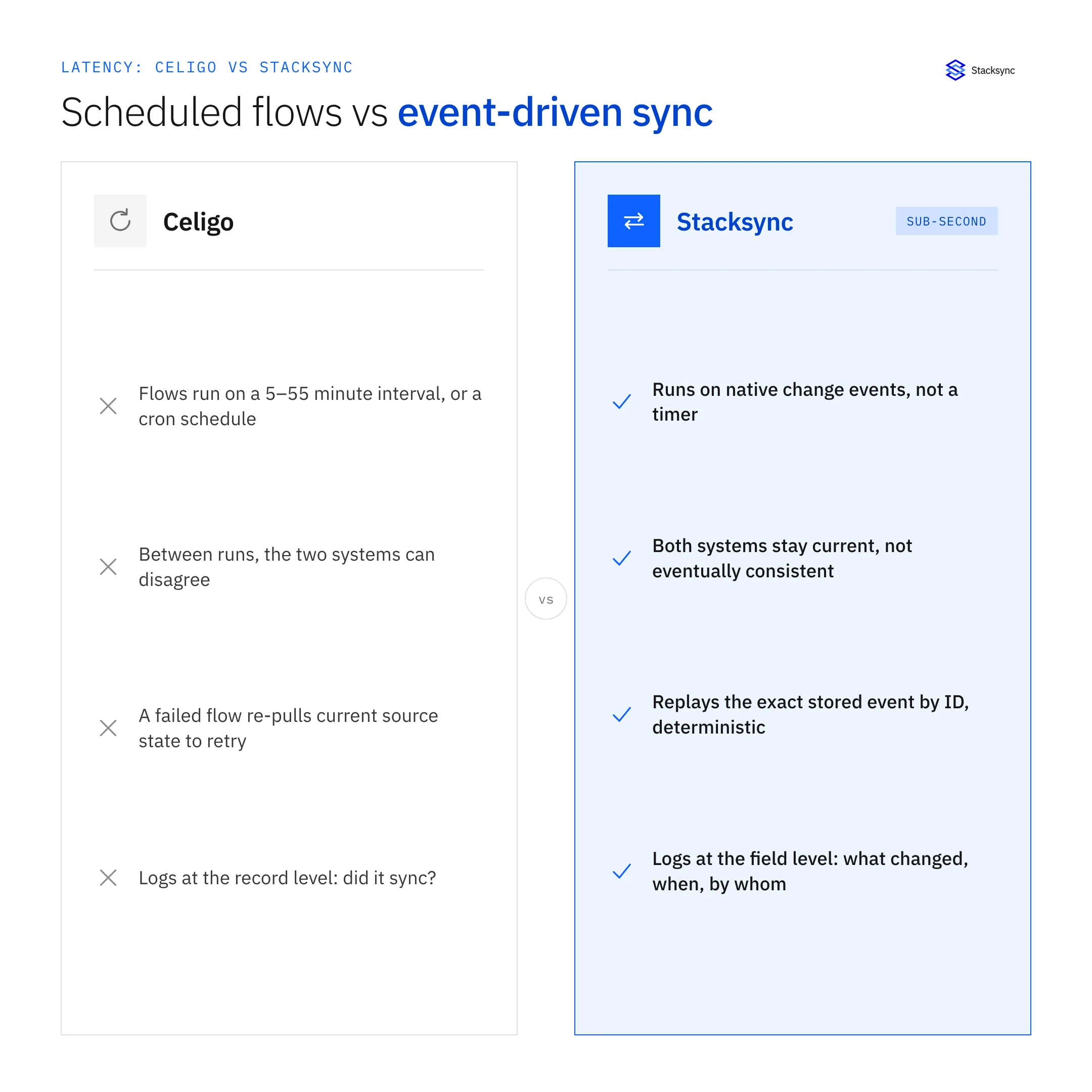
Celigo's CRM/ERP flows are scheduled. The minimum supported interval is 5 minutes and typical configurations run at 15, Celigo's own flow settings top out at 55 minutes for the longest interval option. That's batch latency dressed as integration. Stacksync runs on change events from each source's native event surface, Salesforce Platform Events, NetSuite SuiteAnalytics queue, HubSpot webhooks, and propagates in sub-second.
5-minute latency is fine for nightly reporting. It is not fine for an inside-sales motion that triggers off CRM changes, or for a finance close that depends on order data being current.
Error replay: per-record vs per-flow
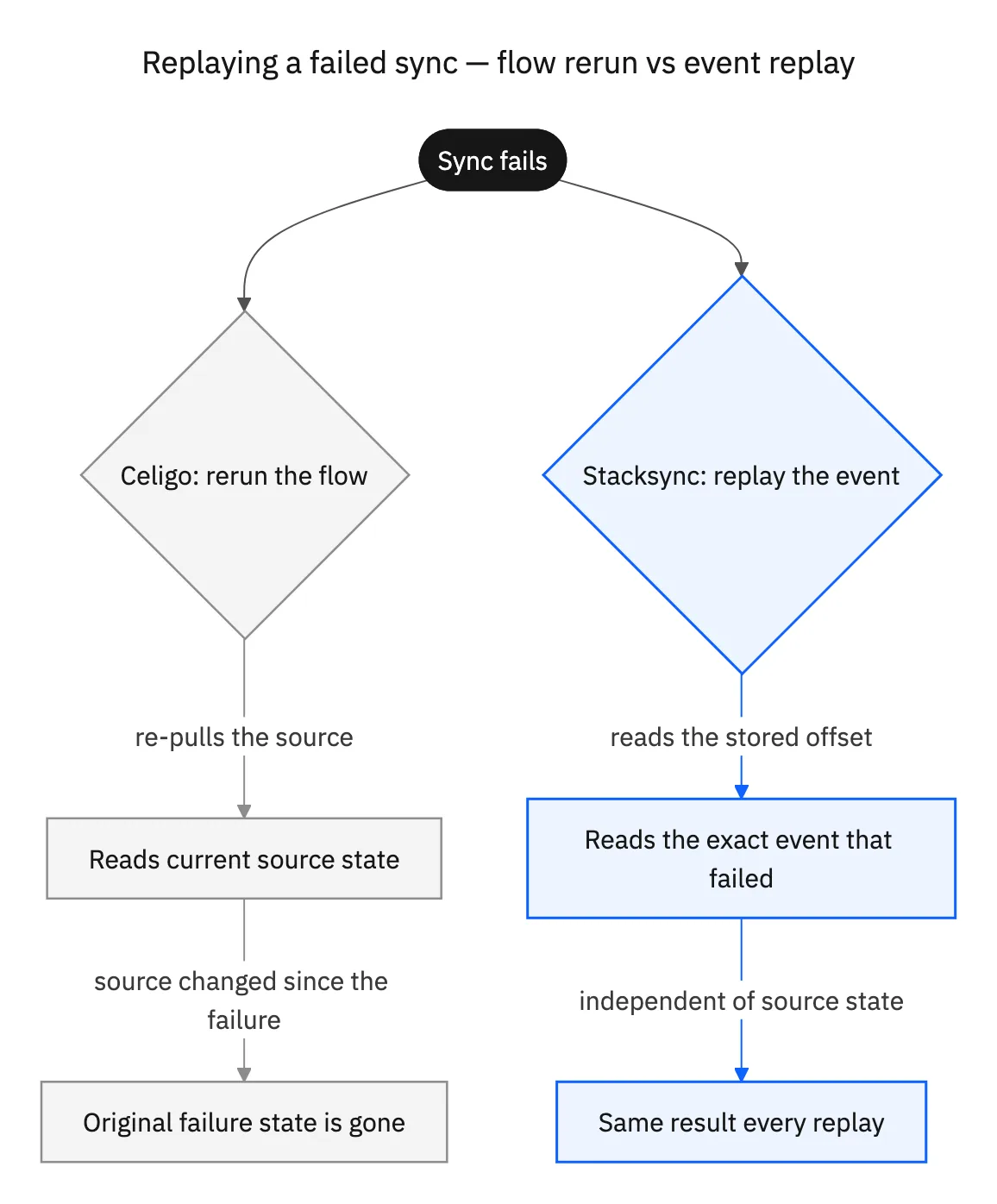
When a Celigo flow fails, you re-run the flow. The flow re-pulls the source and recomputes. If the source has changed, you may not get back the state you needed to replay. Stacksync persists every event in a queue and lets you replay individual records by their original event ID, the event is the source of truth, not the current state of the source system.
- Celigo: rerun the flow; depends on source state at rerun time.
- Stacksync: replay from a stored event offset; deterministic regardless of source state.
Governance and field-level audit
Celigo logs at the record level: "this record was synced". Stacksync logs at the field level: "account_owner on this record changed from X to Y, written from Salesforce at 14:02:11 by user Z, applied to NetSuite at 14:02:11.380". The first answers "did it sync?". The second answers every question your compliance team will ever ask.

Total cost of ownership over three years
Celigo doesn't publish list pricing. Its Standard, Professional, and Enterprise editions are flat-rate, based on endpoints and flows rather than per-task usage, but the actual number is quoted through sales. Third-party buyer data (Vendr, aggregated from real purchases) puts the median annual spend around $14,787, with a reported range of $6,514 to $35,988 depending on endpoint count and edition.
Stacksync's published tiers start at $1,000/mo, so the cost is knowable before a sales call. For a mid-market CRM/ERP setup we typically model 30-55% less in year-three total cost of ownership, and the gap is driven by three things: fewer paid integrations needed (one sync engine instead of a flow per object pair), less engineering time spent maintaining schedules and re-running failed flows, and no per-connection licensing as you add objects.
The break-even shifts with scale. A single NetSuite-Salesforce pairing under 100k records can be cheaper on Celigo's flat endpoint pricing. Once you're running several CRM/ERP object pairs with field-level conflict rules, the flow count on Celigo (and the engineering hours to keep each one healthy) tends to outgrow a single Stacksync configuration.
Evaluating other iPaaS platforms alongside Celigo? See how it stacks up against Boomi in our Celigo vs Boomi comparison, or the wider field in Stacksync vs competitors.

FAQ
Frequently asked questions










Related insights