

















Secure EDI Processing in Multi-Cloud Environments
Evaluate encryption, identity, validation, logging and recovery controls for EDI across cloud environments, independently of batch or event-driven processing.
- Author
- Ruben Burdin · Founder & CEO
- Published
- Updated
- Read time
- 9 min read

What Is Secure EDI Processing in Multi-Cloud Environments?
Secure EDI processing across cloud environments requires protecting business documents during transmission, transformation and storage. Select controls for the actual data, partner obligations and system boundaries. Either scheduled or event-driven processing can be secured; low latency alone is not a security property.
Key Takeaways
- Inventory every document copy, processing boundary and service identity.
- Verify encryption, access permissions, credential rotation, validation and audit evidence on each route.
- Choose processing frequency for operational needs and assess security controls separately.
Why Multi-Cloud Changes the EDI Security Model
Traditional EDI systems were designed for centralized, on-premise environments with predictable network perimeters. Multi-cloud architectures introduce new complexity:
- Data moving between cloud regions and providers
- Increased API exposure across public endpoints
- Distributed identity and access management models
- Expanded compliance requirements across jurisdictions
- Cross-platform encryption and key management standards
Without a unified integration strategy, EDI messages can become vulnerable during transmission, transformation, or storage.
Legacy systems that rely on brittle file transfers often struggle in distributed architectures. Many organizations are already reevaluating their approach after recognizing how traditional EDI systems become slow and brittle in cloud-native environments.
Core Security Requirements for Multi-Cloud EDI
To operate securely across multiple cloud platforms, EDI systems must implement layered security controls.
Encryption Across Each Boundary
Protect documents in transit and at rest with approved protocols and encryption settings appropriate to each endpoint. Verify TLS termination, storage encryption, key ownership and temporary copies. Encryption on one connection does not establish protection across every processing boundary.
Strong Identity and Access Controls
Role-based access control, token-based authentication, short-lived credentials, and centralized identity providers are critical to prevent unauthorized access.
Continuous Monitoring and Logging
Real-time monitoring, anomaly detection, and immutable audit logs reduce exposure to security incidents and simplify compliance reporting.
Regulatory Compliance Alignment
Determine the privacy, contractual and industry requirements that apply to the actual data and organizations involved. Review required attestations, agreements, retention and access controls; a multi-cloud deployment does not automatically make every framework applicable or prove compliance.
Validate document syntax and business mappings while also testing authentication, authorization and audit coverage. A data-quality error can affect operations, but it is not by itself evidence of an encryption or identity-control failure.
Compare Security Controls Across Processing Models
Evaluate the actual implementation rather than assigning security properties from the labels legacy, file-based, cloud-native, batch or real-time. A managed file-transfer process can have strong controls, and an event-driven API can be misconfigured.
| Control area | What to inspect | Evidence to request |
|---|---|---|
| Encryption | Every transport hop, storage location and temporary document copy | Approved protocol settings, encryption configuration and key ownership |
| Identity | Service identities, least-privilege permissions and credential lifecycle | Access policy, rotation procedure and revocation test |
| Monitoring | Coverage of failed access, rejected documents and stalled processing | Alert tests and correlated event records across boundaries |
| Validation timing | When unvalidated documents can reach downstream actions | Quarantine behavior and tests showing invalid inputs cannot proceed |
| Audit and retention | Document identity, reviewer decisions, access history and retention | Traceable records with access restrictions and tested retention rules |
Processing frequency affects freshness and detection delay. It does not determine whether credentials are static, storage is encrypted, logs are protected or a document is authorized to trigger a business action.
Architecture for Secure EDI in the Cloud
A secure multi-cloud EDI architecture typically includes:
- API gateways acting as controlled entry points
- Middleware for document transformation and validation
- Event-driven processing engines
- Centralized logging and monitoring layers
- Secure database storage environments with encryption keys managed separately
Documents can be mapped into structured records for ERP and operational use. Protect the original documents and derived records, and validate each downstream action regardless of whether ingestion is scheduled or event-driven.
Parsing EDI into relational storage can make mappings easier to inspect, but the parser and permissions still need validation. See this breakdown of converting EDI files into SQL-ready database records.
Retain source-document and transformation references alongside structured records so an auditor can trace the actual processing history.
Evaluate Timing and Security Separately
Scheduled processing can delay validation or operational response, while event-driven processing can reduce that delay. Both designs still need protected queues or storage, authenticated access and a gate that prevents unvalidated documents from triggering downstream actions.
Test the failure cases: a document waiting for validation, a replayed transmission, expired credentials and an unavailable destination. Verify who can read or alter queued data, how rejection is recorded, and how processing resumes. Faster synchronization does not itself prevent unauthorized manipulation.
Choose the cadence required by the business, then verify access, encryption, validation and audit controls on the chosen design.
Multi-Cloud Deployment Models for EDI
Different enterprises adopt varying deployment strategies depending on regulatory and operational constraints.
| Category | Description | Security Considerations |
|---|---|---|
| Single Public Cloud | All EDI and ERP systems hosted within one cloud provider | Simplified IAM management but higher provider lock-in risk |
| Multi-Public Cloud | EDI, ERP, and analytics distributed across multiple providers | Requires cross-cloud encryption and identity federation |
| Hybrid Cloud | Combination of on-premise infrastructure and cloud systems | Review private connectivity, authenticated endpoints, least-privilege access and segmentation for the actual route |
| SaaS + Cloud Database | EDI translation layer paired with managed cloud database backend | API rate limiting and token lifecycle management essential |
Key Takeaways
Deployment model directly impacts security complexity. Simpler architectures reduce IAM overhead but may introduce strategic risk like vendor lock-in.
Multi-cloud and hybrid setups add boundaries to inventory and test. Review encryption settings, identity relationships and segmentation at each boundary rather than assuming a deployment label determines the strength of its controls.
SaaS-based models shift responsibility. API governance, token management, and rate limiting become critical to maintain secure and reliable operations.
Selecting the right model requires evaluating data residency laws, trading partner requirements, and internal security policies.
Secure EDI Across Retail and Distribution Networks
Multi-cloud EDI must also support secure connections with major retailers and distribution partners. Enterprises frequently manage trading partner integrations such as Amazon EDI connectivity, Walmart supplier integration, and Costco EDI requirements.
Additional secure integrations may extend to The Home Depot vendor network, Walgreens supply chain connections, and healthcare logistics integrations such as CVS Health via MercuryGate.
Maintaining encrypted, authenticated, and monitored communication across these networks is central to compliance and operational resilience, especially when partner systems reside in different cloud environments.
For organizations operating across multiple trading partners, centralized management through a unified EDI integration platform simplifies governance and reduces operational complexity.
Simplifying Secure Multi-Cloud EDI with Modern Platforms
A shared integration platform can make ownership and monitoring easier to manage, but consolidation also concentrates permissions and operational dependency. Review which services can access or change each document and how a failure is isolated.
Mapping EDI into database records can support validation and reconciliation. Confirm the document types, partner mappings, transport arrangement and allowed application actions. Structured storage does not automatically enforce encryption, remove transformation errors or certify partner compliance.
Scope Stacksync’s two-way sync foundation, workflow handoffs, bounded Genies tasks and EDI exchange against the actual systems. Verify permissions, key handling and audit evidence for each connection instead of assuming that one platform guarantees security across every cloud.

Secure EDI Automation for Modern Commerce
As digital commerce expands, EDI must integrate seamlessly with ERP, ecommerce, and operational systems hosted across different clouds. Multi-cloud architectures are increasingly common among ecommerce brands managing complex partner ecosystems.
Integrated EDI strategies described in discussions about EDI integration for ecommerce brands demonstrate how automation reduces manual exposure and improves data integrity across distributed systems.
Automating core documents such as purchase orders and shipment confirmations through structured pipelines enhances both security and reliability. Advanced document workflows including EDI 850, 855, and 856 automation support encrypted, validated, and traceable transactions that remain synchronized across cloud platforms.
Why Explore Stacksync for Secure EDI Processing
Evaluate Stacksync with a representative partner document and the system records it should affect. Ask to see the identity mapping, validation failure path, permitted destination operation and evidence retained for review.
Review the configured transport, service identities, encryption boundaries and support responsibilities with the security owner. A supported connector or a successful exchange is not proof that the complete deployment meets every applicable requirement.
Use the same control checklist when comparing an existing file-based process with an event-driven design, and measure any operational improvement after implementation.
Apply this in modular and prefab building supply and installation: component purchase line and supplier response
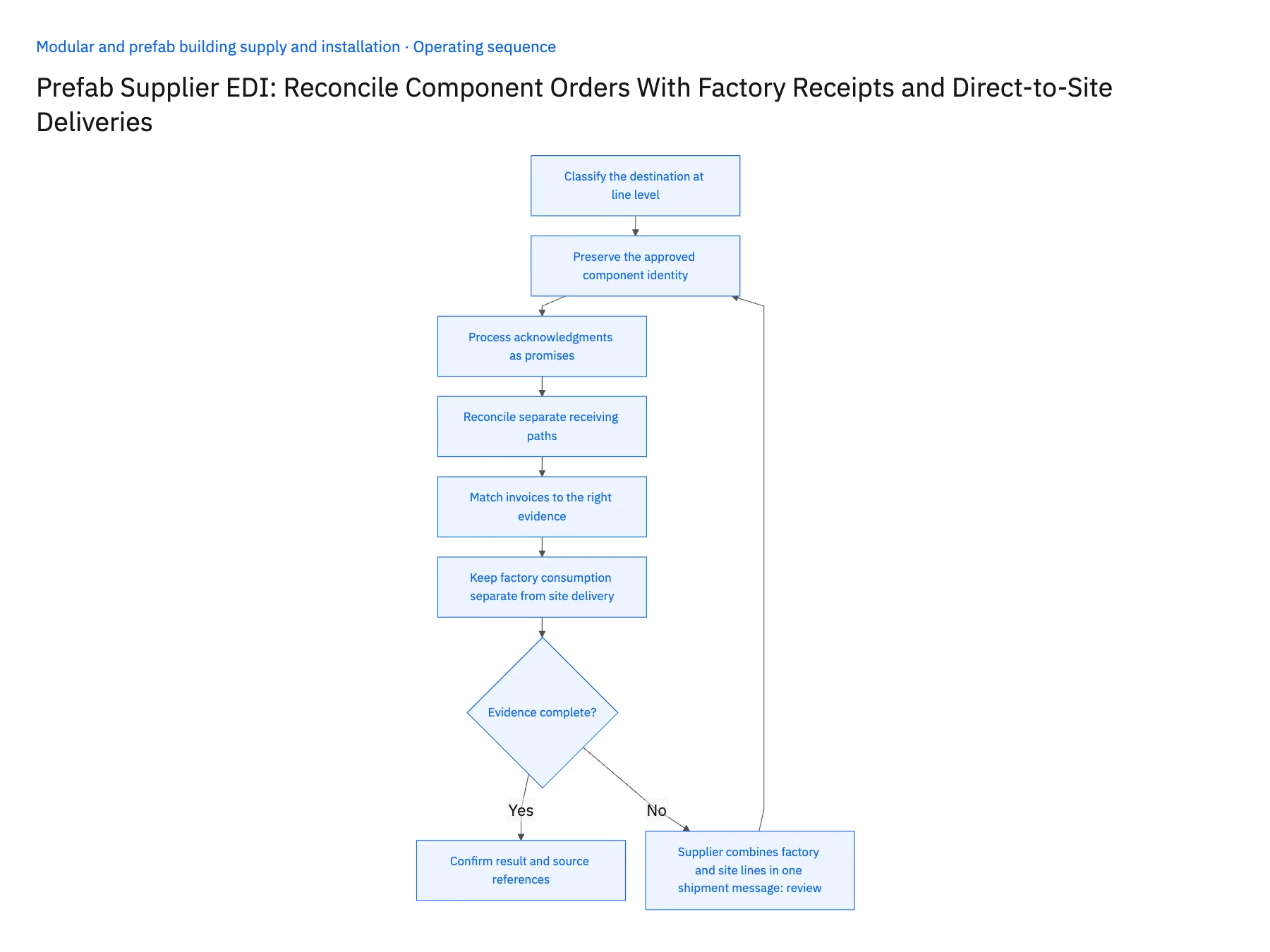
Prefab suppliers may send components to a factory or directly to an installation site. Apply the partner identity, environment, and access controls from this EDI guide to those distinct destinations while retaining the purchase-order and receiving evidence needed for reconciliation.
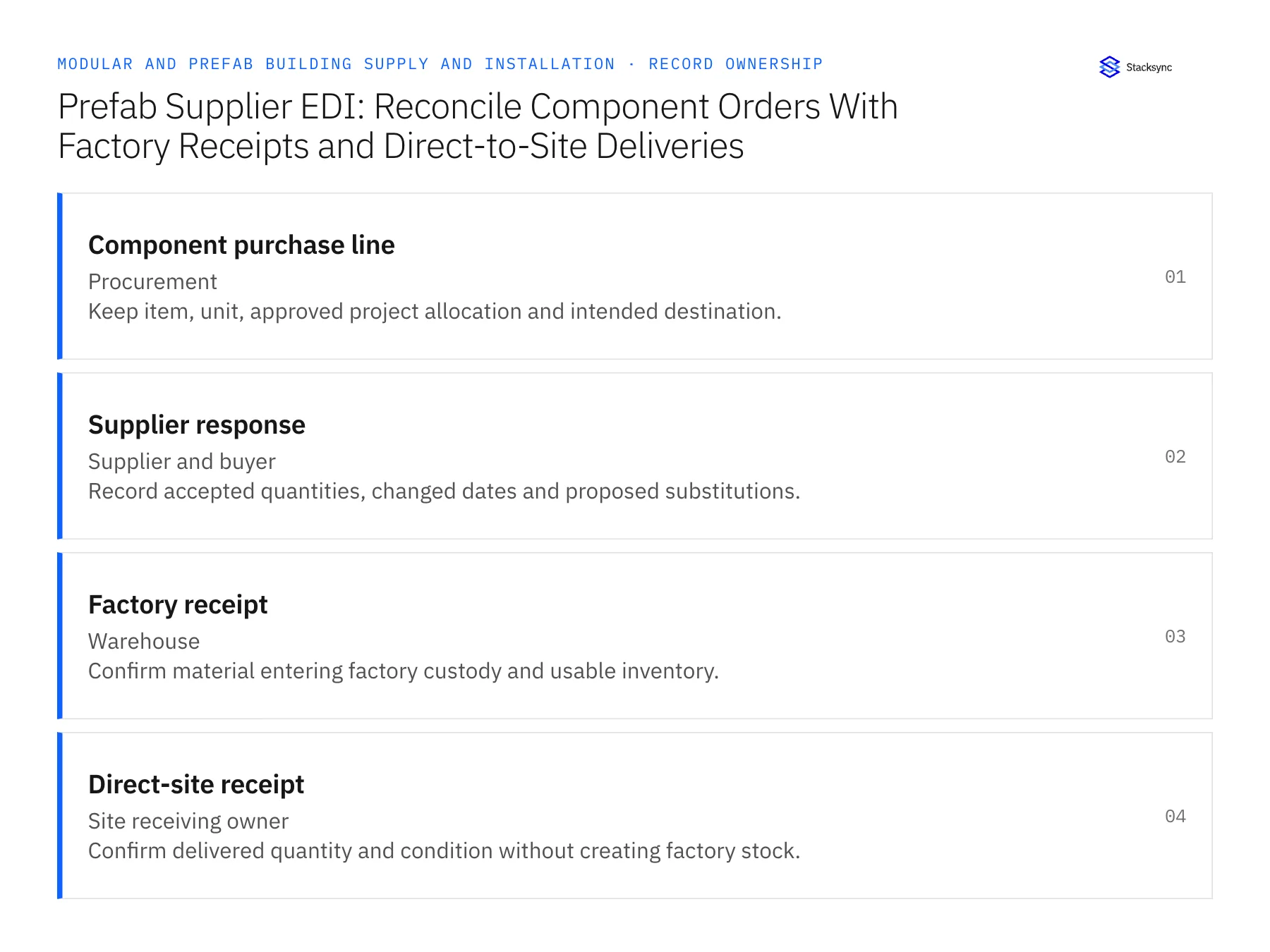
| Record to reconcile | Responsible owner | Rule to preserve |
|---|---|---|
| Component purchase line | Procurement | Keep item, unit, approved project allocation and intended destination. |
| Supplier response | Supplier and buyer | Record accepted quantities, changed dates and proposed substitutions. |
| Factory receipt | Warehouse | Confirm material entering factory custody and usable inventory. |
An exception to plan for: Supplier combines factory and site lines in one shipment message. Use line and destination references to route each quantity to the correct receiving process. Acceptance check for the pilot: factory and direct-site receipts remain separate.
The modular and prefab building supply and installation hub connects the broader operating context. These guides develop the specific record mappings and decisions for this application:
Strengthening Multi-Cloud Supply Chains Through Secure EDI
Cross-cloud EDI needs deliberate controls at each transmission, processing and storage boundary. Use stable document identities, partner-specific validation, least-privilege access and reviewable operational evidence. Verify these properties in the actual deployment rather than inferring them from processing speed or platform labels.
FAQ
Frequently asked questions










Related articles