

















EDI Integration for Ecommerce: Scale Without Chargebacks
Learn how growing ecommerce brands use EDI integration to automate orders, prevent chargebacks, and scale fulfillment across retailers, 3PLs, and marketplaces.
- Author
- Ruben Burdin · Founder & CEO
- Published
- Updated
- Read time
- 14 min read

Growing ecommerce brands reach a point where spreadsheets, email attachments, and manual order entry cannot keep up with the volume and compliance demands of retail trading partners. EDI integration for growing ecommerce brands replaces those manual processes with automated, standardized document exchange that connects purchase orders, shipment notifications, and invoices directly between your systems and the retailers, distributors, and 3PLs you sell through.
The challenge is not whether you need EDI. Once a brand begins selling through major retail channels, EDI compliance is a requirement, not an option. The challenge is choosing an integration approach that scales with your transaction volume without consuming engineering resources, generating chargebacks from stale data, or locking you into per-partner configurations that take weeks to set up.
Why Growing Brands Hit an EDI Wall
Order Volume Outgrows Manual Processes
A direct-to-consumer brand processing 200 orders per day can manage fulfillment with a small team and basic automation. When that brand expands into wholesale channels and marketplace selling, order volume can jump to thousands of transactions per day across multiple partners, each with their own document requirements, formatting rules, and compliance expectations.
Manual order entry at this scale is not just slow. It introduces errors that compound throughout the fulfillment chain. A mistyped SKU on a purchase order becomes a wrong item in the warehouse, which becomes a mismatch on the advance ship notice, which triggers a chargeback from the retailer. Every manual touchpoint is a potential failure point, and the failure rate increases linearly with transaction volume. Understanding the most common EDI errors in supply chain operations helps identify which failure points to prioritize when building automation.
Retailer Compliance Demands Increase With Scale
Each new retail partner adds a set of EDI compliance requirements. Retailers like Costco enforce strict EDI standards across 12 divisions, requiring suppliers to support specific document types from purchase orders through remittance advice. Lowe's mandates compliance across multiple divisions with document types including purchase orders (850), acknowledgements (855), ship notices (856), and invoices (810).
These are not suggestions. Failure to meet compliance requirements results in chargebacks, scorecard penalties, and in some cases, loss of the trading partnership entirely. A growing brand that adds five new retail partners in a year inherits five sets of compliance rules, testing requirements, and document formatting specifications.
Core EDI Documents for Ecommerce Operations
Purchase Orders and Acknowledgements
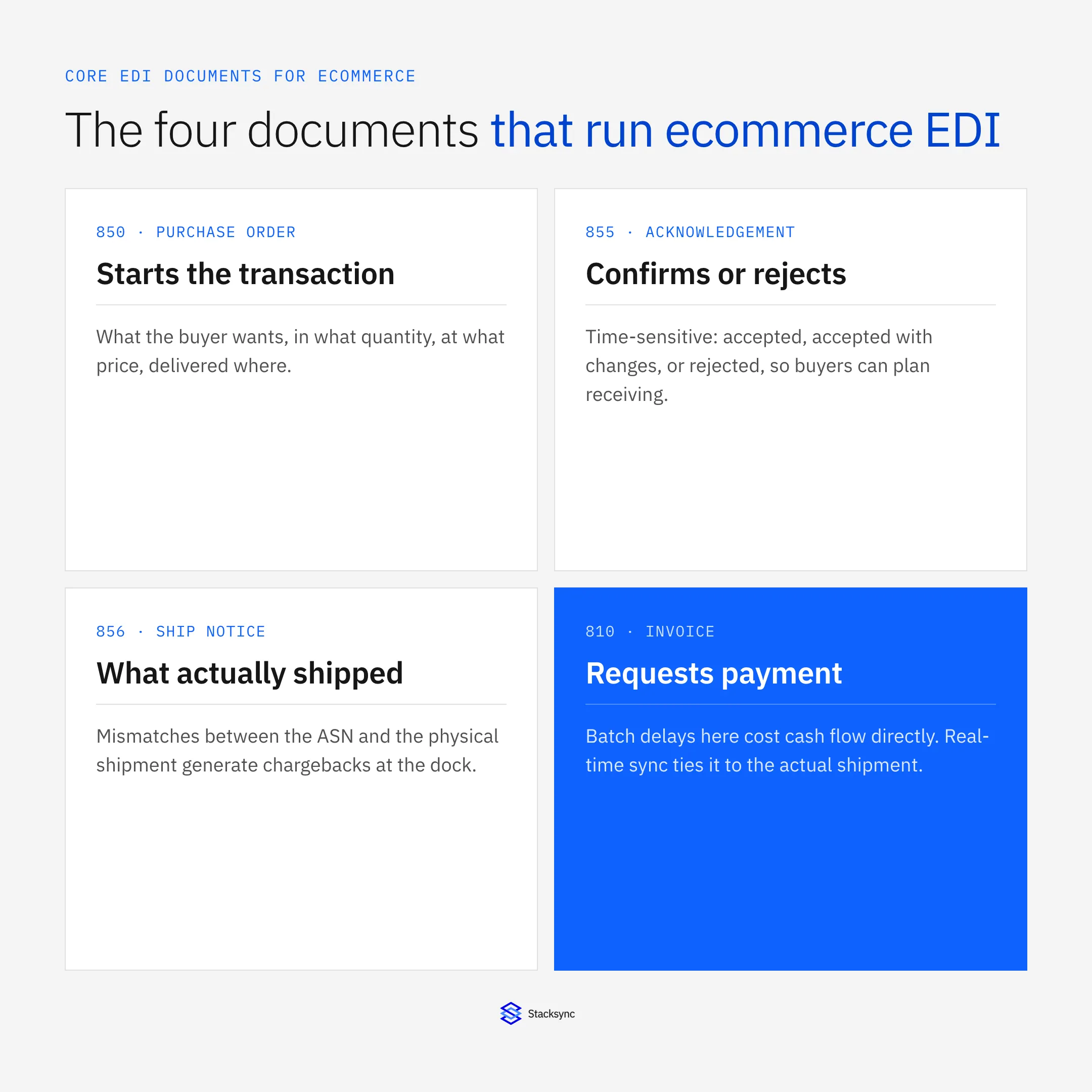
The EDI 850 purchase order is the document that starts every transaction. It specifies what the buyer wants, in what quantity, at what price, delivered to which location. The seller responds with an EDI 855 acknowledgement confirming whether the order is accepted, accepted with changes, or rejected. This confirmation step is time-sensitive because buyers need it to plan receiving and update their own inventory projections. Automating the 850, 855, and 856 document chain is the highest priority for growing brands because delays in any one document cascade through the entire fulfillment cycle.
Advance Ship Notices
The EDI 856 advance ship notice tells the trading partner what was actually shipped, how it was packed, and when it will arrive. The ASN uses a hierarchical structure (shipment, order, pack, and item levels) that receivers scan at the dock to validate incoming goods against the electronic notification. Mismatches between the ASN and the physical shipment generate chargebacks that erode supplier margins.
Invoices, Inventory, and Functional Acknowledgements
The EDI 810 invoice requests payment after goods ship and must align with the original purchase order and ship notice. The EDI 846 inventory inquiry shares stock levels with trading partners to prevent overselling. The EDI 997 functional acknowledgement confirms that a document was received and processed without structural errors. Together, these documents form the complete transaction lifecycle from order to payment.
Where EDI Fits in Your Ecommerce Tech Stack
Connecting ERP, WMS, and Ecommerce Platforms
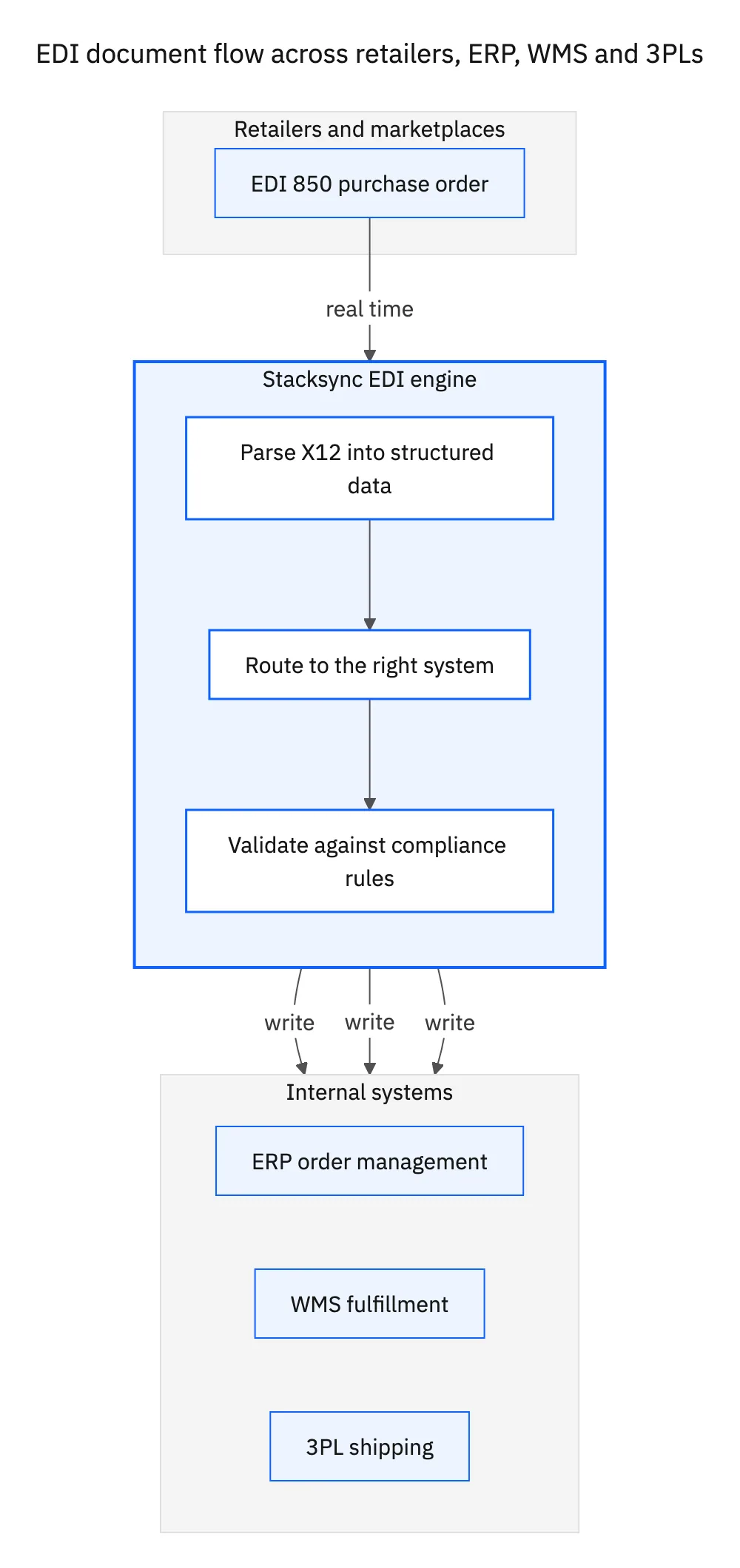
EDI integration sits between your trading partners and your internal systems. Inbound documents (purchase orders from retailers) need to reach your ERP for order management and your WMS for fulfillment. Outbound documents (ship notices, invoices) need to be generated from your warehouse and financial data and transmitted to the trading partner in the correct format.
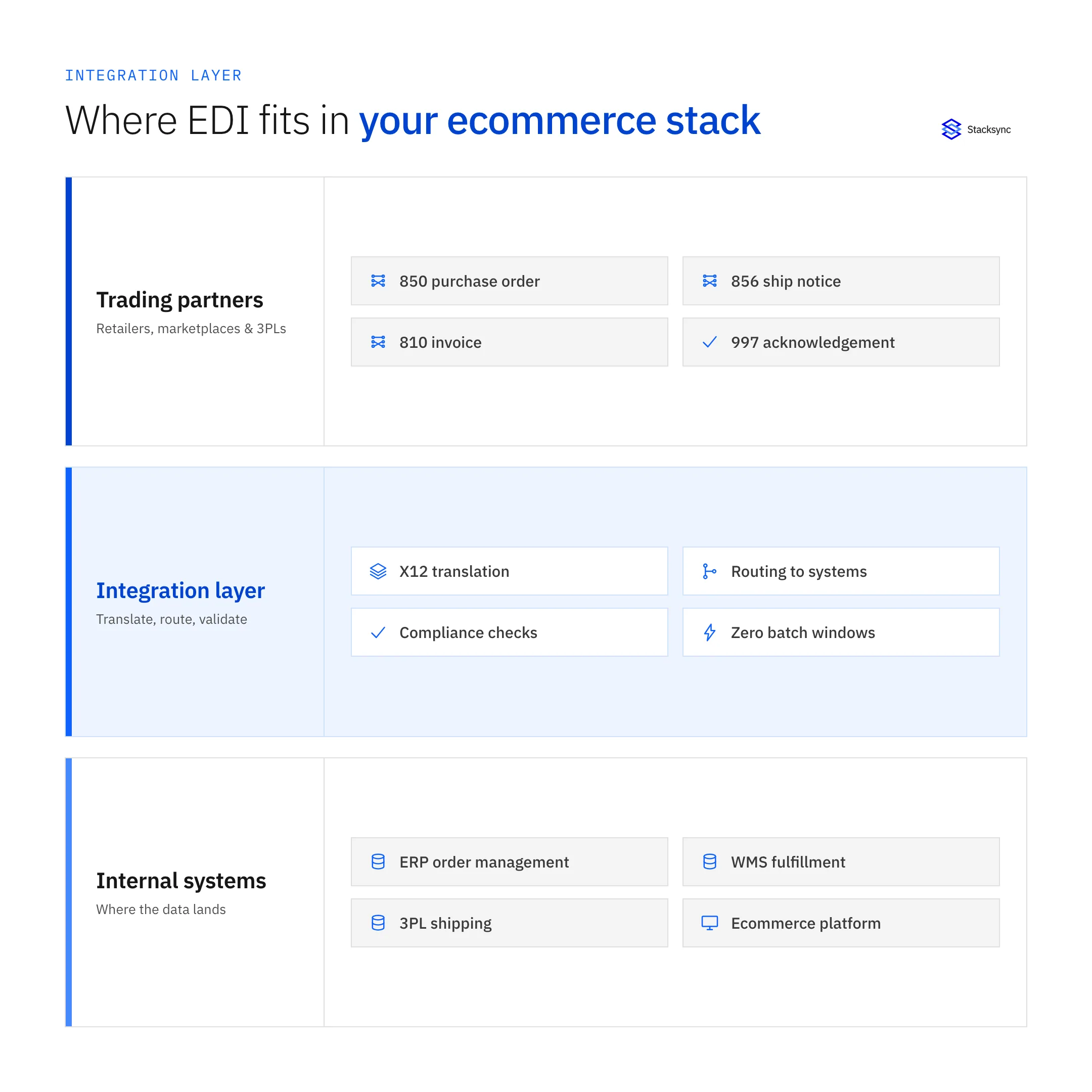
The integration layer handles translation (converting X12 EDI formats into data your systems understand), routing (sending documents to the right internal system), and validation (checking that documents meet compliance requirements before processing). The translation step is where parsing EDI files into structured SQL database tables converts opaque X12 segments into queryable rows that any team can work with.
API-First vs VAN-Based Integration
Traditional EDI relies on Value-Added Networks (VANs) that act as intermediaries, receiving documents from one party, storing them, and delivering them to the other. VAN-based integration works but adds per-document fees, introduces latency from the store-and-forward model, and limits how quickly you can onboard new partners.
API-first integration connects your systems directly to trading partners or through a platform that handles translation and routing without the VAN intermediary. This approach reduces per-document costs, enables real-time document exchange, and simplifies onboarding because new connections use the same API infrastructure rather than requiring partner-specific VAN configurations. Brands still running VAN-based or batch-dependent setups face the same challenges as organizations trying to modernize legacy EDI systems without replacing their core ERP infrastructure.
Rate Limits and Concurrency Bottlenecks
Growing brands using ERP systems like NetSuite hit concurrency limits as EDI volume increases. NetSuite standard tiers allow 15 concurrent API requests, and upgrading to SuiteCloud Plus for additional capacity costs around $12,000 per year for every 10 additional threads. A modern EDI integration platform manages these constraints by distributing API calls evenly rather than concentrating them into batch spikes.
EDI Integration Approaches for Ecommerce
The approach you choose for EDI integration determines how quickly you can onboard partners, how much ongoing maintenance your team absorbs, and whether your system scales with transaction volume or breaks down under it.
| Approach | How It Works | Trade-Offs |
|---|---|---|
| Value-Added Network | VAN stores and forwards documents between you and partners via mailbox retrieval | Reliable delivery but per-document fees, batch latency, and slow onboarding |
| Legacy EDI Translator | Standalone software maps EDI to flat files for scheduled ERP import | Proven but expensive licensing, batch-only, rigid per-partner configuration |
| ERP Native Module | Built-in EDI within NetSuite, SAP, or Dynamics handles translation inside the ERP | Tight ERP coupling but limited partner flexibility and concurrency constraints |
| Custom Middleware | In-house scripts parse, validate, and route EDI between endpoints and your systems | Full control but high build time and fragile when partner requirements change |
| API-First Platform | Cloud platform parses EDI into database tables with real-time sync to ERP and WMS | Fastest onboarding and scaling, subscription cost but minimal maintenance |
| Managed EDI Service | Third-party provider handles all EDI operations, mapping, compliance, and transmission | Zero internal effort but limited visibility and dependency on provider timelines |
Key Takeaways
VAN and legacy translator setups scale poorly because per-document fees and batch schedules compound as transaction volume grows.
Custom middleware gives control but becomes a maintenance burden each time a trading partner updates their compliance rules.
Choose based on how many new partners per quarter you expect to onboard, not just current transaction volume.
The Real Cost of Batch EDI for Growing Brands
Inventory Sync Delays That Cause Overselling
Batch-based EDI processes inventory updates on a schedule, typically every 15, 30, or 60 minutes. During that interval, your trading partners see inventory levels that may no longer reflect reality. When 200 units sell during a flash sale but the EDI batch does not fire for another 15 minutes, partners place orders against inventory that no longer exists.
The financial impact is measurable. Research on ecommerce latency shows that every 100 milliseconds of delay can reduce conversions by 1 percent. Inventory distortion, the gap between what systems report and what actually exists, costs the retail industry an estimated $1.2 trillion globally. For a growing brand shipping $10 million annually, even a small percentage of overselling-driven cancellations and chargebacks represents a significant margin hit.
Late ASNs That Generate Chargebacks
Advance ship notices that arrive after the physical shipment reach the dock create immediate problems. The receiving team cannot plan labor, validate incoming goods by scanning barcodes, or reconcile the shipment against the purchase order. Retailers like Best Buy and The Home Depot enforce strict ASN compliance across their divisions, and late or inaccurate ASNs trigger chargebacks that typically range from $75 to several hundred dollars per incident.
Suppliers operating in retail supply chains face 1 to 3 percent of annual revenue in EDI-related chargebacks. For a brand doing $20 million through retail channels, that is $200,000 to $600,000 in annual penalties, with a significant portion attributable to timing issues that batch processing creates.
The Cash Flow Impact of Delayed Invoices
When invoices (810) are generated from batch exports rather than real-time shipment data, they often lag behind the actual fulfillment event by hours or days. Every day of invoice delay is a day of delayed payment. Across hundreds of transactions per week, this adds up to meaningful working capital impact for a growing brand that needs cash flow to fund inventory purchases and marketing spend.
Stacksync transforms this by parsing incoming EDI documents directly into your database tables and converting outgoing data back into compliant EDI formats with zero batch windows. Supply chain teams manage their EDI data with the ease of SQL rather than legacy file parsers, and documents are generated from live system data rather than scheduled exports.
What to Look for in an EDI Solution as You Scale
Onboarding Speed and Pre-Built Connectors
The time it takes to go live with a new trading partner is one of the most important factors for a growing brand. Traditional EDI setups require weeks of testing and certification per partner. If you plan to add 10 new retail relationships this year, that testing overhead consumes months of engineering and operations time.
Pre-built connectors that already include the mapping, formatting rules, and compliance requirements for specific retailers reduce onboarding from weeks to days. The connector handles the partner-specific configuration so your team focuses on the business relationship rather than the technical plumbing.
Real-Time Processing vs Scheduled Batch Windows
Batch processing made sense when supply chains moved slowly and trading partners exchanged documents once or twice a day. Growing ecommerce brands operate at a velocity where 15-minute inventory gaps, delayed acknowledgements, and stale ASN data directly cost revenue. The shift from batch to real-time EDI processing handles each document the moment it arrives or the moment the underlying data changes, eliminating the timing failures that batch windows create.
Pricing Predictability at Higher Volumes
Per-document pricing from VANs and legacy providers scales linearly with transaction volume. A brand processing 1,000 documents per month may find VAN fees manageable, but at 10,000 documents per month, those fees become a significant line item. Evaluate whether the pricing model charges per document, per partner, per usage tier, or per record, and project costs at two to three times your current volume.
Trading Partner Coverage Across Retail and Healthcare
EDI requirements vary significantly across industries. Retail supply chains use standard 850, 855, 856, and 810 documents. Healthcare and pharmacy supply chains add compliance programs with different validation rules. Brands selling through retailers like CVS and Walgreens need an EDI solution that supports healthcare-specific document flows and compliance standards across multiple programs.
Organizations that also exchange transportation documents through third-party logistics networks need connectors that handle specialized carrier flows from partners like CVS Health via Mercury Gate and Walgreens via Mercury Gate, which include motor carrier load tenders, freight invoices, and shipment status messages alongside standard supply chain documents.
EDI Provider Evaluation Criteria for Ecommerce Brands
Choosing an EDI solution is a decision that affects operations, engineering, and finance. The following framework covers the criteria that matter most for growing ecommerce brands evaluating providers.
| Criteria | What to Evaluate | Why It Matters for Growing Brands |
|---|---|---|
| Onboarding Speed | Days to go live with a new trading partner using pre-built connectors | Every week of setup delay is a week of lost transactions and revenue |
| Real-Time Capability | Whether documents process on arrival or queue for scheduled batch runs | Batch delays cause overselling, late ASNs, and compliance penalties |
| Partner Coverage | Number of pre-built retail, healthcare, and logistics partner connectors | Broad coverage reduces per-partner engineering work as you expand channels |
| Pricing Model | Per-document fees vs per-record vs flat subscription tiers as volume grows | Per-document pricing compounds as volume grows, creating unpredictable costs |
| Compliance Support | Automated validation against partner-specific formatting and segment rules | Manual compliance checking does not scale past a handful of trading partners |
| Stack Compatibility | Native integration with your ERP, WMS, ecommerce platform, and 3PL systems | Poor compatibility adds middleware layers that increase latency and complexity |
Key Takeaways
Prioritize onboarding speed and partner coverage if you plan to add multiple retail channels within the next year.
Per-document pricing models create cost unpredictability that compounds with the transaction volume growth you are planning for.
Test real-time processing and ERP compatibility during evaluation since both are difficult to retrofit after deployment.

Connecting EDI to Marketplaces and Fulfillment Partners
Shopify, Amazon, and Walmart Integration Paths
Each major ecommerce platform handles EDI differently. Amazon Vendor Central provides EDI capabilities for wholesale sellers through middleware or certified providers. Walmart Marketplace requires EDI compliance for certain vendors and supports connections through approved gateways. Shopify does not support native EDI but connects through API-based apps and integration platforms.
The integration challenge for growing brands is that each platform has its own API structure, rate limits, and data format requirements. A brand selling through all three channels needs an EDI layer that normalizes these differences so documents flow consistently regardless of which platform originated the transaction.
3PL and WMS Connectivity
Brands using third-party logistics providers need EDI integration that extends beyond the retailer relationship. Warehouse shipping orders (940), warehouse shipping advices (945), and warehouse inventory adjustments (947) flow between your systems and your 3PL. These documents must stay synchronized with the retailer-facing documents (850, 856, 810) so that what the retailer expects matches what the 3PL actually ships.
Stacksync provides six products on one platform with zero batch windows, covering real-time sync, workflow automation, event queues, databases, EDI, and monitoring. With pre-built EDI connectors for retailers, distributors, and suppliers, teams connect their ERP, WMS, ecommerce platform, and 3PL systems through a single integration layer rather than stitching together separate tools for translation, synchronization, and document routing.
Apply this in building products manufacturing: retailer item reference and partner PO line
Building-product brands selling through ecommerce and retail face partner item and packaging rules alongside their storefront model. The linked EDI guide validates the retailer’s product and order revision before acceptance, preserving the actual unit and shipment evidence across channels.
| Record to reconcile | Responsible owner | Rule to preserve |
|---|---|---|
| Retailer item reference | Product operations | Map the partner item to the approved manufacturer variant and packaging definition. |
| Partner PO line | Customer operations | Preserve customer, PO, line and revision references through the ERP cross-reference. |
| Delivery requirement | Logistics | Retain the requested destination and agreed date meaning separately from accepted shipment plans. |
An exception to plan for: The retailer changes its pack reference. Require the reviewed cross-reference and effective definition before accepting affected quantities. Acceptance check for the pilot: retailer cartons convert to the intended product quantity under the approved definition.
The building products manufacturing hub connects the broader operating context. These guides develop the specific record mappings and decisions for this application:
Scale Your EDI Operations Without Scaling Your EDI Team
Growing ecommerce brands do not have the luxury of dedicating an entire engineering team to EDI integration. Every hour spent configuring partner-specific document maps, debugging batch failures, and manually reconciling orders is an hour not spent on the product, marketing, and customer experience work that drives growth.
The brands that scale EDI successfully treat it as an infrastructure problem, not a document problem. They invest in a shared data layer that all documents read from and write to, real-time processing that eliminates the timing failures batch windows create, and pre-built connectors that reduce partner onboarding from weeks to days.
Ready to simplify your EDI integration? Explore how Stacksync handles EDI by parsing documents directly into your database tables with real-time sync, pre-built trading partner connectors for retailers and 3PLs, and zero batch windows between your ecommerce platform, ERP, and warehouse systems.

FAQ
Frequently asked questions










Related articles